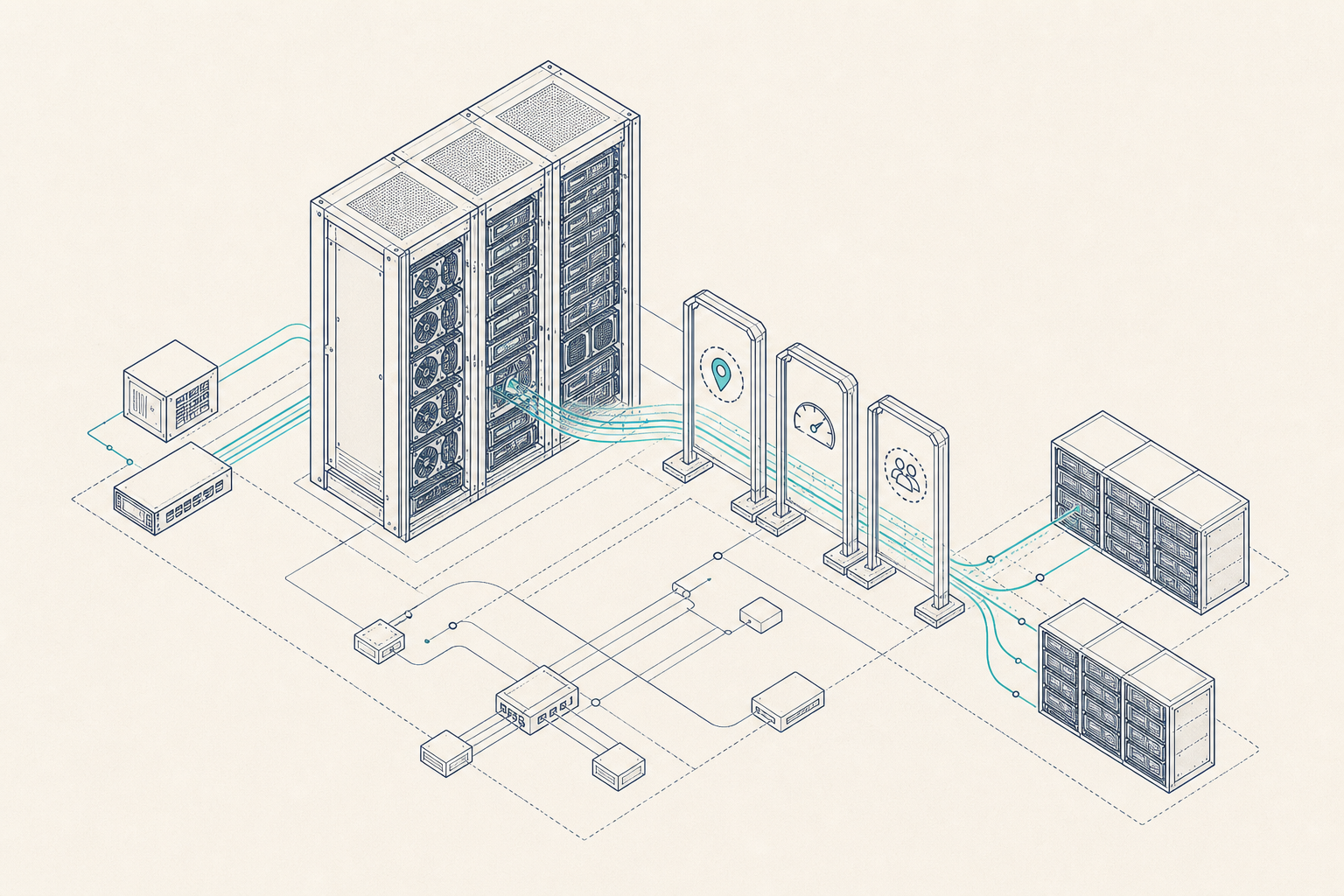
The news is about data, not only valuation
On 1 September 2026, TechCrunch reported that AfterQuery, an AI training-data startup, had raised a round valuing the company at $3.2 billion, making it Y Combinator’s fastest-ever unicorn according to the report. One week later, TechCrunch reported that Mistral had raised €3 billion as sovereign AI became a larger commercial category.
Those two reports are not the same story, but they point to the same operational constraint. Model work is no longer limited by who can buy accelerators. It is limited by whether the operator can bring governed data to those accelerators, prepare it, meter it, and keep it inside the required jurisdiction.
For a hyperscaler, this is hidden behind managed object storage, internal backbone capacity, large data engineering teams, and mature tenant accounting. For a GCC operator running a quarter rack to a few racks, it is a design problem that shows up quickly: a GPU cluster is installed, the first tenants arrive, and the training jobs spend too much time waiting for data.
The result is visible in several places. GPU utilization drops even when the scheduler says the cluster is booked. Training runs are delayed by preprocessing queues. Tenants copy the same dataset into their own directories because there is no governed shared data layer. Finance cannot recover cost because GPU-hours, storage consumption, and data-prep CPU time are not mapped to a tenant. Compliance teams ask where the health, finance, or government data was staged, and the answer is spread across notebooks, NFS mounts, and ad hoc object buckets.
The AfterQuery valuation is a market signal that curated and governed training data has economic value. For GCC infrastructure teams, the practical reading is narrower: if the storage and ingestion layer is not engineered with the same seriousness as the GPU layer, owned accelerators will underperform.
The bottleneck a small GPU estate actually hits
A small-to-mid GPU estate is usually constrained by three paths before it is constrained by model code.
First, there is the ingress path. Data arrives from hospital systems, banks, government repositories, enterprise data lakes, camera fleets, call-centre archives, document stores, or Arabic and bilingual corpora. In the GCC, those sources may be subject to data residency requirements, sector rules, customer contracts, or internal sovereign-cloud policy. Moving raw data to an external service for labeling, filtering, or embedding may not be acceptable. Even when allowed, it may be slow or expensive.
Second, there is the preparation path. Training data is rarely ready for a GPU job. It needs extraction, deduplication, format conversion, OCR, speech segmentation, tokenization, embedding, moderation, PII handling, and dataset versioning. Much of that work runs on CPU, sometimes with smaller GPU slices for inference-based filtering. If the estate only treats GPUs as first-class resources, the preparation layer becomes a queue that nobody owns.
Third, there is the read path. During training or fine-tuning, GPUs need a steady stream of batches. If the data loader is reading many small files from a saturated NFS server, or fetching objects through a congested link, accelerator time is wasted. The scheduler may show a job as running, but the device is waiting on storage, CPU transforms, or network I/O.
This is why a few racks can behave like a much smaller cluster. It is possible to have enough GPUs on paper and still deliver poor GPU-hours because datasets are fragmented, storage is underspecified, and tenant boundaries are enforced manually.
A worked example: the cost of starving 16 GPUs
Consider a GCC operator running a quarter-rack deployment with 16 mixed GPU accelerators across several servers. The estate supports internal AI teams and paid external tenants. The monthly fixed cost assigned to this GPU service is:
- Hardware amortisation and maintenance allocation: $46,000
- Facility, power, cooling, and rack allocation: $6,000
- Network, storage, and operations allocation: $10,000
Total monthly cost: $62,000.
There are 16 GPUs and 720 hours in a 30-day month:
16 × 720 = 11,520 available GPU-hours.
If scheduling reports 75% allocation but real GPU busy time is only 45% because jobs wait on ingestion and storage, delivered GPU-hours are:
11,520 × 0.45 = 5,184 delivered GPU-hours.
The cost per delivered GPU-hour is:
$62,000 ÷ 5,184 = $11.96 per GPU-hour.
Now assume the operator fixes the data path: shared governed datasets, Ceph-backed storage tiers, local NVMe cache where needed, CPU pools for preprocessing, quotas, and metering. Real GPU busy time rises to 68% without buying another accelerator:
11,520 × 0.68 = 7,834 delivered GPU-hours.
The cost per delivered GPU-hour becomes:
$62,000 ÷ 7,834 = $7.91 per GPU-hour.
That is a 34% reduction in cost per delivered GPU-hour from orchestration and data-path work, not from a hardware refresh.
If the operator charges tenants or internal business units $9.50 per delivered GPU-hour, monthly recovery changes from:
5,184 × $9.50 = $49,248
to:
7,834 × $9.50 = $74,423.
The same 16-GPU footprint moves from under-recovering its fixed cost by $12,752 per month to recovering $12,423 above the assigned monthly cost. Annualised revenue at the improved utilization is $893,076. If the cluster’s measured IT load at improved utilization is 18 kW, revenue per MW of IT load is:
$893,076 ÷ 0.018 = $49.6 million per MW-year.
That figure is not a universal market price. It is an operator metric. It tells the facilities and finance teams whether scarce power and rack capacity are being turned into billable or accountable compute.
Where the data pipeline fails
The failure usually does not come from one dramatic outage. It comes from small mismatches that compound.
| Layer | Common symptom | Operator control that matters |
|---|---|---|
| Ingestion | Data lands in many unmanaged locations | Standard landing zones, tenant ownership, retention rules |
| Preprocessing | CPU queues delay GPU jobs | Dedicated CPU pools, batch scheduling, metered prep jobs |
| Storage | GPUs wait on reads or small-file metadata | Ceph design, NVMe cache, dataset packaging, object layout |
| Tenancy | Teams duplicate datasets to avoid permissions | Shared governed datasets, quotas, access policy |
| Accounting | Finance sees servers, not services | GPU-hour, CPU-hour, storage, and egress metering |
| Sovereignty | Data path crosses unclear boundaries | On-prem control plane, audit trails, air-gap support |
A common pattern is that the GPU purchase is treated as the main capital event, while the storage and tenancy model is treated as implementation detail. That order is backwards for regulated AI services. In health, finance, public sector, and national data programs, the location and lifecycle of the dataset can be more sensitive than the model weights.
Another pattern is that every tenant brings its own toolchain. One team wants Kubernetes. Another wants VMs. A third wants bare metal because it needs direct device access or a licensed appliance. If the operator has separate islands for each model, the estate fragments. GPUs sit idle in one island while another tenant is queued. Storage fills unevenly. Policies are enforced with tickets instead of controls.
What a Clastiq-style operating model changes
A system like Clastiq addresses the bottleneck by treating the estate as one governed pool rather than a collection of servers. The point is not to force every workload into one runtime. The point is to put bare metal, Kubernetes, and VM tenancy under a common operating model with policy, metering, and storage.
At the foundation, bare-metal provisioning through MAAS and Juju gives the operator a repeatable way to install, rebuild, and repurpose nodes. That matters when a few racks must serve training, inference, preprocessing, and tenant environments. Manual builds do not scale operationally, even at small rack counts, because each exception becomes a future outage or audit gap.
Above that, Kubernetes and VM tenancy on the same fleet allow different users to consume the right abstraction. A data science team may need notebooks, batch jobs, and inference services on Kubernetes. A government tenant may need a VM boundary and a fixed image. A vendor appliance may need bare metal. The operator should not have to strand GPUs by committing whole nodes permanently to each mode.
GPU partitioning is part of the same control plane. Some jobs need full devices. Some can run on MIG slices where supported. Some need time-sliced access for notebooks, evaluation, labeling assistance, embeddings, or lightweight inference. Hardware support differs across NVIDIA, AMD, and CPU/GPU combinations, so the scheduler and policy model must stay hardware-agnostic. The operational goal is simple: avoid allocating a full accelerator to a task that only needs a fraction, while preserving full-device access for jobs that require it.
Storage is the second pillar. Ceph gives the operator a way to provide block, file, and object storage from owned hardware, with data remaining inside the facility or sovereign environment. It does not remove the need for design. Operators still need to plan OSD media, replication or erasure coding, metadata load, network capacity, and failure domains. But it gives a common storage substrate that can be attached to Kubernetes, VMs, and data landing zones instead of creating separate storage stacks for every tenant.
The third pillar is metering and chargeback. In a small cluster, informal sharing works for a pilot. It fails once multiple tenants arrive. The platform has to attribute GPU-hours, CPU-hours, memory, storage, and sometimes power allocation to tenants. Without that, the operator cannot answer basic questions: which tenant is consuming scarce GPU slices, who is holding 80 TB of hot storage, which dataset pipeline is causing network congestion, and which internal business unit should fund the next rack.
Test the data path before blaming the model
Operators should measure the read path with the same discipline used for GPU health checks. A simple storage test will not represent every training job, but it can reveal whether the cluster has a basic throughput problem.
For example, run a controlled read test from a representative dataset mount, during a maintenance window or against a test namespace:
fio --name=dataset-read \
  --directory=/mnt/datasets/test \
  --rw=read \
  --bs=1m \
  --iodepth=32 \
  --numjobs=8 \
  --size=200g \
  --runtime=300 \
  --time_based \
  --group_reporting
Then compare the result to the demand profile. If 16 GPUs need a combined 4 GB/s for a specific training workload after shuffling and transforms, a 1.2 GB/s storage path guarantees wait time. If small-file metadata is the problem, sequential throughput will look acceptable while training still stalls. In that case, dataset packaging, local cache, metadata server sizing, or object-layout changes may matter more than raw bandwidth.
For Kubernetes tenants, quotas should be explicit rather than implied. A simplified namespace policy might look like this:
apiVersion: v1
kind: ResourceQuota
metadata:
  name: tenant-a-quota
  namespace: tenant-a
spec:
  hard:
    requests.cpu: '160'
    requests.memory: 640Gi
    limits.cpu: '220'
    limits.memory: 900Gi
    requests.storage: 40Ti
    pods: '80'
GPU quota syntax depends on device plugins and partitioning mode, so it should be implemented according to the estate’s hardware mix. The principle is the same: a tenant should know its entitlement, and the operator should know what is being consumed.
GCC and MENA implications
The GCC context changes the design target. Many operators are building AI capacity not only for internal productivity but also for national programs, Arabic language capability, regulated-sector services, and local cloud alternatives. Data residency is not an afterthought in these environments. It is often the reason the cluster exists.
That means the ingestion layer must support local collection, local preprocessing, and local audit. A healthcare dataset may need de-identification before model work. A bank may require controls around customer data and transaction logs. A ministry may require that raw documents and derived datasets remain inside a sovereign facility or an air-gapped network. The platform must support those constraints without reducing the cluster to a set of manually administered silos.
Power is also a board-level constraint. In the GCC, operators may have access to strong facilities and energy planning, but rack power is still finite. Revenue per megawatt and useful GPU-hours per megawatt are practical metrics. If data stalls keep GPUs at low busy time, the operator is consuming power and cooling allocation without producing the expected service output. Improving ingestion and scheduling can be equivalent to adding capacity, because it increases useful work from the same electrical footprint.
Air-gap support matters for the same reason. Some sovereign and government environments cannot depend on external package repositories, cloud control planes, or remote managed services. Installation, updates, image management, observability, and support processes have to work locally. A turnkey deployment with human-led local support is not a convenience feature in that setting; it is part of the operating model.
Design the estate around the data lifecycle
A practical design starts by mapping datasets, not only accelerators.
The operator should define landing zones for raw data, staging zones for preprocessing, curated dataset stores, and training-ready mounts or buckets. Each zone needs ownership, retention policy, access rules, and cost attribution. Sensitive raw data should not be copied into every tenant namespace. Curated datasets should be versioned so that a model run can be reproduced. Temporary preprocessing output should expire unless promoted.
Compute pools should match the lifecycle. CPU-heavy extraction and deduplication should not compete blindly with latency-sensitive inference. Small GPU partitions may be suitable for labeling assistance, OCR, embeddings, or evaluation. Full accelerators should be protected for training and high-throughput inference. VM tenants should receive storage and GPU access through governed allocation rather than static side agreements.
Networking should be sized for east-west movement inside the rack, not just north-south access to users. Data preparation often causes large internal transfers between storage, CPU workers, and GPU nodes. If the storage network, tenant network, and management network are not separated or capacity-planned, troubleshooting becomes difficult and noisy-neighbour effects increase.
Metering should be visible to tenants. If a tenant sees GPU-hours but not storage or preprocessing cost, behavior will be distorted. Teams will retain too much hot data, run repeated transforms, and duplicate corpora. Chargeback does not have to be punitive. It has to make scarce resources legible.
How Clastiq fits the operator requirement
Clastiq is aimed at operators who own real hardware but do not operate at hyperscaler scale: from a quarter rack to a few racks. In this context, the useful control plane is one that can provision bare metal, run Kubernetes and VMs on the same fleet, partition GPU capacity where the hardware supports it, provide Ceph-backed storage, meter tenant usage, enforce quotas, and operate in sovereign or air-gapped settings.
That combination is relevant to the AfterQuery signal because training-data work creates mixed demand. Data curation and governance need CPU, storage, policy, audit, and sometimes fractional GPU. Training needs full GPU capacity and predictable reads. Tenants need boundaries. Finance needs chargeback. Facilities teams need power and utilization numbers. Compliance needs to know where data moved.
No orchestration layer removes the need for good operational practice. Operators still need to classify data, size storage, test throughput, define quotas, and run capacity reviews. The value of a platform is that those practices become repeatable controls rather than tickets and spreadsheets.
Hardware agnosticism is also important. GCC estates may include NVIDIA systems, AMD systems, CPU-heavy preprocessing nodes, and different generations of accelerator servers. A platform for this market should not assume a single vendor, a single runtime, or a single tenancy model. It should let the operator turn a mixed estate into a governed service.
What to do this week
- Measure real GPU busy time, not only scheduler allocation. Compare booked GPU-hours with device-level utilization and identify jobs waiting on data.
- Benchmark the dataset read path from representative tenant environments. Test both sequential throughput and small-file behavior.
- Map the data lifecycle for one regulated workload: raw landing, preprocessing, curated dataset, training mount, retention, and deletion.
- Define tenant quotas for GPU, CPU, memory, storage, and preprocessing queues. Make the quota visible to the tenant and finance team.
- Calculate cost per delivered GPU-hour and revenue per MW for the current month. Use those numbers to prioritize storage, cache, and scheduling work.
- Identify which workloads need Kubernetes, VMs, bare metal, MIG-style partitioning, or time slicing, then remove static islands where possible.
Clastiq runs this operating model on the operator’s own hardware; request a demo.