Dealroom’s agent map changes what has to be scheduled
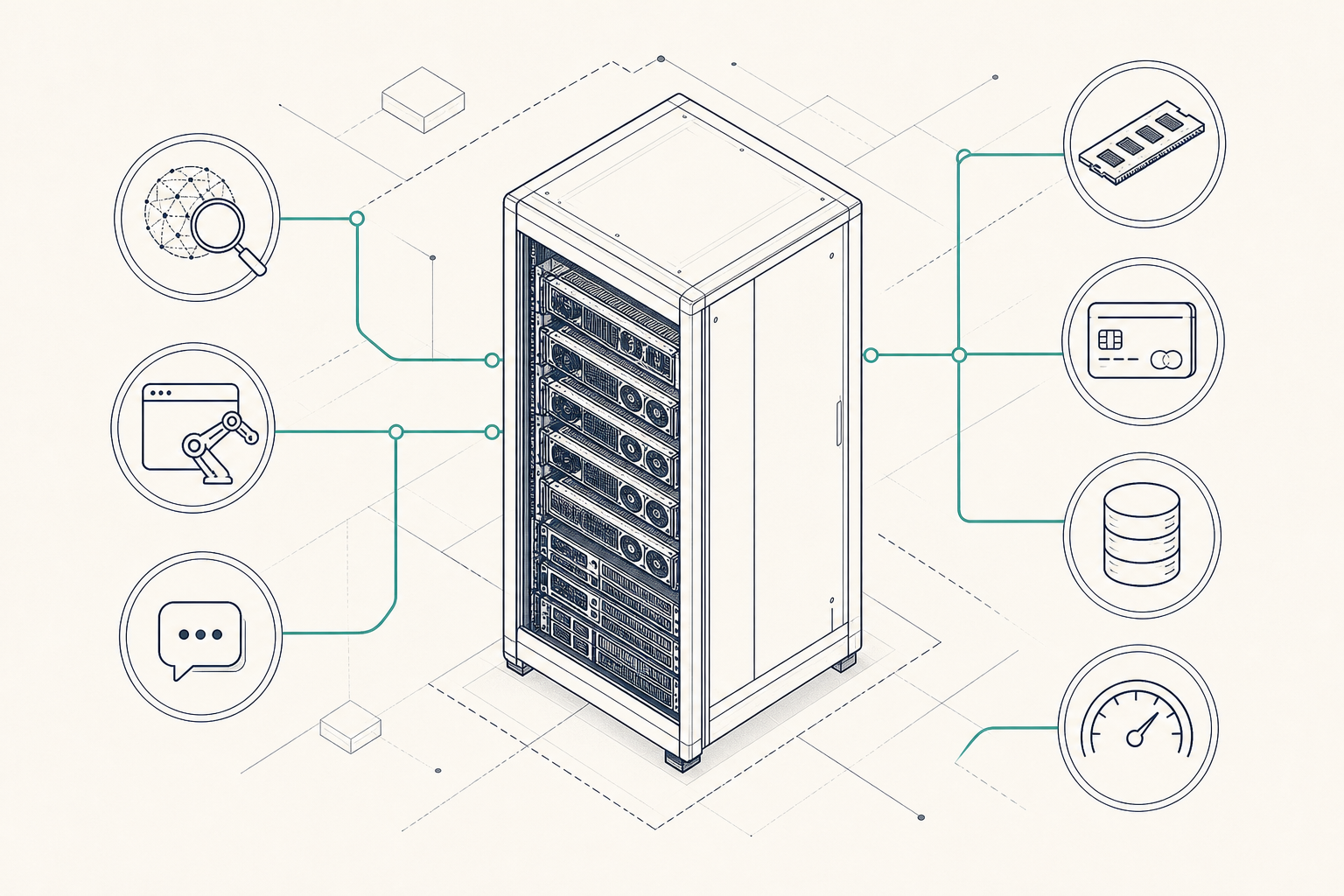
On November 17, 2026, Dealroom published an agent infrastructure market map for the a16z agent economy series. The map groups the infrastructure around agents across search, browsers, memory, communications, payments, and related execution services. The exact company count is less important than the shift in category boundaries. Agent infrastructure is no longer just a model endpoint plus an API key. It is a workflow substrate.
For operators of physical GPU estates, that matters. A chatbot request can be mostly inference. An agent request often becomes a chain of retrieval, browser execution, code execution, tool calls, document parsing, vector reads, queueing, policy checks, payment or entitlement checks, and then one or more model calls. Some steps want GPU acceleration. Many do not. Some want persistent storage and low latency metadata. Some want disposable browser sandboxes. Some want egress control because data leaves the facility. Some have to be metered to a tenant because they are part of a billable job.
A GPU-only scheduler sees the wrong shape. It sees a request for accelerators, allocates them, and then waits while the workflow is blocked on CPU, storage, a browser pool, or a network policy decision. In a hyperscaler region, idle gaps are hidden by huge pools, mature internal schedulers, and diversified demand. In a quarter rack to a few racks, those gaps become the difference between a profitable AI service and an expensive room heater.
The practical lesson from the Dealroom map is that agent workloads turn small GPU estates into multi-resource platforms. The operator needs one control plane that can provision bare metal, run Kubernetes and VM tenancy on the same fleet, partition GPUs, meter tenants, enforce quotas, attach storage, and report cost. That is the infrastructure problem ClastIQ is built to address for operators that own real hardware but are not hyperscalers.
The bottleneck is not model serving alone
A small or mid-size operator can usually solve the first model-serving problem. Install drivers, expose GPUs to Kubernetes, deploy an inference server, add ingress, and place tenants behind namespaces or projects. That is necessary, but it does not solve the agent workload.
Agent infrastructure adds at least six schedulable dimensions.
| Resource class | Agent use case | Operator failure mode |
|---|---|---|
| GPU slices or full GPUs | Inference, embeddings, reranking, vision, fine tuning | GPUs reserved while blocked on non-GPU work |
| CPU and memory | Browser pools, parsers, orchestration, tool runners | CPU saturation causes GPU idle time |
| Storage | Vector indexes, session memory, artifacts, logs | Tenants pay for GPU but consume unpriced storage |
| Network and egress | Search, APIs, payments, external tools | No per-tenant cost or policy boundary |
| VM isolation | Untrusted code, legacy apps, tenant appliances | Kubernetes-only tenancy is too weak or too rigid |
| Metering and quotas | Chargeback, prepaid plans, internal budgets | Utilization looks high but margin is unknown |
The painful case is not a single failed job. It is the quiet inefficiency that repeats every hour. A tenant reserves 4 GPUs for an agent service. The service calls a browser pool, reads a vector index, waits for a remote API, then runs inference for 8 seconds. If the scheduler only accounts for the GPU reservation, the tenant appears to be consuming GPU capacity. In reality, the GPUs are idle during much of the wall-clock time, while CPU and storage are doing the work.
This is why utilization has to be measured at two levels. First, accelerator utilization, including full GPUs, MIG slices, time-sliced GPUs, and vendor-equivalent partitioning. Second, workflow utilization, which includes vCPU-hours, memory, storage, network, and tenant-level job completion. An operator that measures only GPU allocation can report 80 percent allocation while delivering 35 percent useful GPU busy time.
A worked example for a 64 GPU estate
Consider an operator with 8 servers, each with 8 GPUs, for 64 GPUs total. Assume the servers draw 25.6 kW of IT load at the measured average, or 3.2 kW per server. With a PUE of 1.3, facility draw is 33.28 kW. Over a 30 day month, that is 23,962 kWh.
Monthly cost assumptions:
| Cost item | Monthly cost |
|---|---|
| Hardware amortization and maintenance | $72,000 |
| Power at $0.10 per kWh | $2,396 |
| Platform, support, operations | $18,000 |
| Storage and network allocation | $5,000 |
| Total | $97,396 |
The theoretical monthly capacity is:
64 GPUs x 720 hours = 46,080 GPU-hours.
If the estate achieves 85 percent billable utilization, billable capacity is:
46,080 x 0.85 = 39,168 GPU-hours.
The cost per billable GPU-hour is:
$97,396 / 39,168 = $2.49 per GPU-hour.
If agent workflows create blocking and the estate only reaches 45 percent billable utilization, billable capacity is:
46,080 x 0.45 = 20,736 GPU-hours.
The cost per billable GPU-hour becomes:
$97,396 / 20,736 = $4.70 per GPU-hour.
At a selling price of $4.00 per GPU-hour, the same hardware is profitable in the first case and loss-making in the second. The revenue per MW-month also changes sharply. At 85 percent utilization, revenue is:
39,168 x $4.00 = $156,672 per month.
On a 33.28 kW facility draw, that is:
$156,672 / 0.03328 MW = $4.71 million per MW-month.
At 45 percent utilization, revenue is:
20,736 x $4.00 = $82,944 per month, or $2.49 million per MW-month.
The physical estate did not change. The power did not change. The difference is orchestration, tenancy, and the ability to backfill gaps with other work instead of letting reserved GPUs wait on browsers, storage, or external services.
Chargeback has to follow the workflow
A second numeric example shows why GPU-only billing is not enough. Suppose a tenant runs 1,000 agent tasks in a month. The metered consumption is:
| Meter | Usage | Unit price | Charge |
|---|---|---|---|
| GPU inference | 420 GPU-hours | $3.00 | $1,260 |
| Browser and tool CPU | 6,000 vCPU-hours | $0.04 | $240 |
| Ceph-backed storage | 2,400 GB-month | $0.03 | $72 |
| External egress | 1.2 TB | $50 per TB | $60 |
| Browser session minutes | 8,000 minutes | $0.002 | $16 |
| Total | $1,648 |
If the operator bills only GPU-hours, the invoice is $1,260 and $388 of real resource consumption is either lost or smeared across all tenants. If the operator tries to recover that cost by raising the GPU price, light storage users subsidize heavy storage users, and agent tenants become hard to price.
The better model is not necessarily complicated. Meter each resource class, expose the tariff, apply quotas, and report tenant cost daily. The operator should be able to say: this tenant used 420 GPU-hours, 6,000 vCPU-hours, 2.4 TB-month of storage, and 1.2 TB of egress. That is the basis for chargeback, prepaid bundles, internal showback, or resale.
How a ClastIQ-style control plane resolves the issue
For a small estate, the solution is not to copy hyperscaler complexity. It is to integrate the minimum set of controls that make heterogeneous workloads governable.
Bare-metal provisioning is the first layer. Nodes should be installed, reinstalled, tagged, and returned to service without manual rebuilds. MAAS and Juju patterns are useful because they bring repeatability to physical hardware. When a node changes role from Kubernetes worker to VM host, the operator should not be editing spreadsheets or hand rebuilding images.
The second layer is mixed tenancy. Some agent components fit Kubernetes well: inference services, queues, vector databases, control APIs, and stateless workers. Other components may need VMs: tenant appliances, regulated workloads, Windows tooling, untrusted code runners, or stronger blast-radius separation. A small estate cannot afford separate hardware islands for every tenancy type. Kubernetes and VM tenancy need to share the same fleet under quota and policy.
The third layer is GPU partitioning. On NVIDIA estates, MIG can carve compatible GPUs into smaller instances. Time slicing can improve utilization for bursty inference or development. AMD and mixed fleets require equivalent policy thinking, even where the implementation differs. The scheduler should understand full GPUs, GPU slices, and CPU-only pools. It should also know when not to fragment capacity, because a future training or large inference job may need whole devices.
The fourth layer is storage. Ceph is a practical fit for many small to mid-size estates because it can provide block, object, and file services from operator-owned hardware. Agent workflows create artifacts: prompts, logs, documents, vector indexes, browser traces, embeddings, and model outputs. If storage is not quota-controlled and metered, it becomes the hidden subsidy in the platform.
The fifth layer is metering and policy. Tenant accounting needs to join data from Kubernetes, VM hosts, storage, and network boundaries. Policies need to express monthly GPU-hour caps, maximum concurrent slices, namespace limits, VM limits, storage quotas, egress rules, and placement constraints. Without that, the operator cannot offer clean internal chargeback or external resale.
A simple quota object should cover more than accelerators. Vendor resource names will vary, but the idea is the same:
apiVersion: v1
kind: ResourceQuota
metadata:
  name: agent-tenant-monthly
  namespace: tenant-research
spec:
  hard:
    requests.cpu: "400"
    requests.memory: 2Ti
    requests.storage: 20Ti
    limits.nvidia.com/mig-1g.10gb: "16"
    services.loadbalancers: "4"
    pods: "250"
That is not a full billing system. It is a guardrail. The billing system then needs to read actual usage over time, not just quota. A tenant with a quota of 16 slices may use 3 slices continuously, or 16 slices for 2 hours. Those are different commercial events.
Why this matters in GCC and MENA
Although the Dealroom map is global, the operational consequences are especially relevant in GCC and MENA markets. Many organizations in the region want AI capacity close to users, regulators, and data owners. They may not want sensitive workflows to traverse a foreign hyperscaler region. They may also face power allocation, data residency, procurement, and Arabic language requirements that make local capacity strategic.
Local GPU operators can serve this demand, but only if they can make smaller estates behave economically. Sovereignty without utilization becomes expensive. Air-gap without metering becomes ungovernable. Local support without repeatable provisioning becomes labor-intensive. A few racks can be a serious AI platform, but only when the operator can answer four questions every day:
- Who is using which accelerators, CPUs, storage, and network paths?
- Which resources are idle because another resource is blocked?
- What is the cost and margin per tenant or project?
- Which policies prove that data, workloads, and tenants stayed inside the required boundary?
Those questions connect directly to revenue per megawatt. In power-constrained markets, the operator is not only selling GPU time. The operator is converting allocated power, cooling, floor space, hardware depreciation, and support labor into useful compute. Agent workloads increase the value of local infrastructure, but only if the platform can schedule the whole workflow.
Practical scheduling patterns
A small estate should avoid one large undifferentiated pool. It should create resource pools that match workload behavior.
One pool can be optimized for latency-sensitive inference, using GPU slices or time slicing where appropriate. Another can be reserved for full-GPU jobs that need device locality. A CPU-heavy pool can run browsers, parsers, tool execution, and orchestration. A VM pool can serve tenants that need stronger isolation or custom images. Storage classes can separate hot block storage, object storage, and lower-cost archival tiers.
The goal is not to maximize fragmentation. It is to give the scheduler enough information to place work without wasting expensive accelerators. If browser workers are starved, add CPU nodes or cap browser sessions per tenant. If GPU slices are full but full GPUs are idle, revisit partitioning. If storage latency causes inference gaps, move hot indexes closer to the workers. If egress costs rise, expose them in tenant reports rather than hiding them in a blended GPU rate.
This is where human-led local support matters. The first version of a quota model is rarely perfect. Operators need weekly review of utilization, queue time, failed placements, power draw, and tenant invoices. The control plane should provide the data, but people still have to tune policy to local commercial reality.
What to do this week
-
Measure GPU busy time against reservation time. For each tenant, compare allocated GPU-hours with actual accelerator utilization. A wide gap usually means CPU, storage, browser, or network blocking.
-
Inventory non-GPU agent resources. Count browser workers, vCPU pools, VM hosts, Ceph capacity, object storage, load balancers, public IPs, and egress paths. Treat them as billable or quota-controlled resources.
-
Create a tenant cost model. Start with GPU-hours, vCPU-hours, GB-month, TB egress, and support tier. Use showback internally before exposing external invoices.
-
Define placement pools. Separate latency inference, full-GPU jobs, CPU-heavy agent workers, VM tenants, and storage-heavy services. Keep labels and quotas simple enough to operate.
-
Set monthly quotas before onboarding agent workloads. Quotas should cover GPU slices, full GPUs, vCPU, memory, storage, egress, and maximum concurrent browser sessions.
-
Review power as a revenue metric. Track revenue per kW or MW-month, not just rack occupancy. A full rack with low billable utilization is not a successful AI estate.
Bottom line
Dealroom’s November 2026 agent infrastructure map is a useful signal for physical GPU operators. The market is moving from single model endpoints toward multi-service agent workflows. That change pushes the bottleneck from raw GPU availability to heterogeneous scheduling, tenancy, and metering.
For quarter-rack to few-rack operators, the winning pattern is not a GPU cluster bolted to ad hoc scripts. It is a governed compute estate: bare-metal provisioning, Kubernetes and VM tenancy, GPU partitioning, Ceph-backed storage, per-tenant metering, quotas, policy, and support that understands the local operating environment.
That is the economic issue beneath the agent infrastructure map. Agents may create more demand for local compute, but they also expose every weak boundary in a small platform. If the operator can schedule the whole workflow, price the whole workflow, and keep the whole workflow inside the required jurisdiction, the estate can compete on utilization, sovereignty, and revenue per megawatt.
Sources
Dealroom, a16z agent economy infrastructure market map 2026
Related product: Canonical MAAS