TechCrunch Disrupt put the AI bottleneck below the software layer
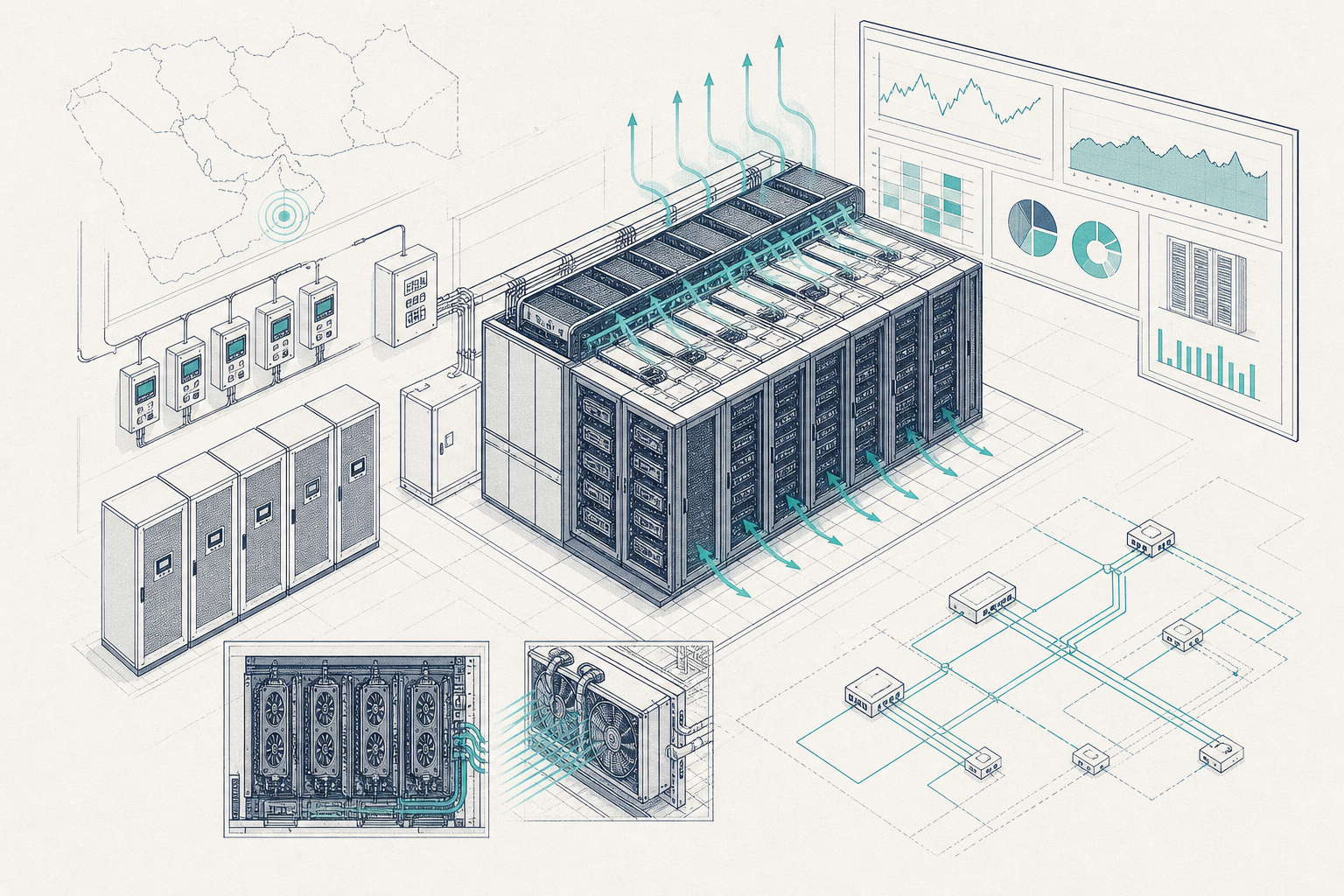
On October 8, 2026, TechCrunch Disrupt put a practical frame around the next phase of AI infrastructure. The discussion, featuring executives from Ambrosia Energy and Bloom Energy, focused on where the AI infrastructure boom is creating opportunity. The list was not only models, chips, or developer tools. It included power generation, grid connections, data centers, cooling, electrical equipment, and infrastructure software.
That shift matters for operators of small and mid-size GPU estates. If you run a quarter rack, one rack, or 2 to 3 racks, you may still think of scaling as a procurement question. Can you get the next GPUs, servers, switches, and storage nodes? Increasingly, the harder question is whether the room can support them continuously. The constraint may be the breaker panel, the UPS, the generator, the chilled water loop, the condenser, the in-row cooler, or the facility approval process.
For GCC and MENA operators, this is not an abstract hyperscaler problem. AI demand is growing across government, energy, finance, education, and media. Sovereignty requirements often keep workloads inside national or organizational boundaries. At the same time, high ambient temperatures make cooling design less forgiving, especially for facilities that were not originally built for dense GPU racks. A GPU cluster that looks economical on paper can become uneconomical if it sits idle because the rack cannot be powered, cooled, governed, or safely shared.
The practical lesson from the Disrupt framing is simple: the AI cluster is now an electrical and thermal asset as much as a compute asset. Operators need to manage GPU allocation, tenancy, storage, quotas, and chargeback with awareness of power density and thermal headroom. That is where orchestration becomes part of the power plan.
The bottleneck a small GPU estate will actually hit
A quarter rack can hide the problem for a while. Four GPU servers, a pair of switches, storage, and management nodes may fit within a modest footprint. But the electrical load can rise faster than the rack count. A modern GPU server can draw several kilowatts under sustained training or inference. Dense servers, dual CPUs, high memory capacity, NVMe, and high-speed NICs add more load. The rack may be physically half empty while already close to its safe power envelope.
This creates several operator-level failure modes.
First, the facility may have a nameplate rack limit that is lower than the IT team assumes. A 42U rack might be allowed only 8 kW, 12 kW, or 20 kW in a given room because of branch circuits, cooling distribution, floor layout, or fire and safety design. If the planned equipment can draw 30 kW at peak, the rack cannot be treated as a normal rack.
Second, average power and peak power are different. A cluster that averages 55 percent GPU utilization can still create synchronized peaks when multiple jobs start, checkpoint, run evaluation, or load data from shared storage. UPS and generator sizing must account for those peaks, not only monthly energy use.
Third, cooling is local. The building PUE may look acceptable, but the hot aisle behind a dense GPU rack may still exceed the desired inlet temperature if airflow is poorly balanced. Thermal headroom is consumed rack by rack and tile by tile.
Fourth, power allocation and tenant allocation can conflict. If every tenant receives a fixed GPU quota without regard to rack location, a scheduler may pack jobs into the electrically weakest part of the room. The result is not a software outage at first. It is throttling, nuisance trips, emergency moves, and maintenance windows.
For a small estate, these problems are magnified because there is less spare capacity to absorb mistakes. A hyperscaler can spread workloads across halls, substations, and sites. A regional operator with one room and one generator cannot assume that flexibility.
Translate power into GPU economics
Power constraints are often discussed in facility language, while GPU clusters are budgeted in utilization language. Operators need both in the same operating model.
Consider a small estate with 16 high-end GPUs across 2 dense servers. Assume each server draws 6.5 kW during sustained GPU work and 1.0 kW for shared network, storage, and management overhead allocated to this cluster. The IT load under full use is:
2 servers x 6.5 kW + 1.0 kW = 14.0 kW
Assume the site PUE is 1.45. Facility power attributable to the cluster is:
14.0 kW x 1.45 = 20.3 kW
Over a 30 day month, full operation consumes:
20.3 kW x 24 hours x 30 days = 14,616 kWh
If blended electricity and facility energy cost is $0.11 per kWh, monthly energy cost is:
14,616 kWh x $0.11 = $1,607.76
The cluster has a theoretical monthly supply of:
16 GPUs x 24 hours x 30 days = 11,520 GPU-hours
At 35 percent billable utilization, it delivers:
11,520 x 0.35 = 4,032 billable GPU-hours
Energy cost per billable GPU-hour is:
$1,607.76 / 4,032 = $0.40
At 70 percent billable utilization, it delivers 8,064 billable GPU-hours, and energy cost per billable GPU-hour falls to $0.20. The facility energy bill did not disappear, but the useful denominator doubled.
Now add chargeback. If the operator charges internal or external tenants $2.50 per GPU-hour and reaches 70 percent billable utilization, monthly gross GPU-hour revenue is:
8,064 x $2.50 = $20,160
On a power-normalized basis, the 20.3 kW facility draw equals 0.0203 MW. Revenue per MW at that utilization is:
$20,160 / 0.0203 = $993,103 per MW-month
The exact numbers will vary by GPU class, power tariff, cooling design, lease model, and pricing. The principle does not vary. Once power is the constraint, idle GPUs are not only a capital problem. They are lost revenue per megawatt, and they make every UPS, generator, breaker, and cooling investment look worse.
The operating question is not only how many GPUs
A small estate needs a capacity model that includes compute, power, thermal, storage, and tenancy. The operator should be able to answer these questions from one operating view:
| Operator question | Why it matters | Control required |
|---|---|---|
| Which racks are near power limit? | Prevent breaker trips and thermal events | Rack-aware placement and admission control |
| Which tenants consume GPU-hours? | Recover cost and justify expansion | Metering, showback, and chargeback |
| Which jobs need full GPUs? | Avoid wasting scarce accelerators | MIG, time-slicing, and quota policy |
| Which workloads can move? | Relieve hot spots and maintenance risk | Kubernetes and VM tenancy on one fleet |
| Which data must stay local? | Meet sovereignty and policy requirements | Local storage, identity, and audit controls |
This is the layer where a platform like ClastIQ fits. ClastIQ is not a replacement for electrical engineering, cooling design, or site commissioning. It is the infrastructure control plane that helps the operator turn a constrained physical estate into a governable compute service.
The core pattern is to provision the metal, segment the tenants, expose the right compute abstractions, meter consumption, and enforce policy. Bare-metal provisioning through MAAS and Juju gives operators repeatable server lifecycle management. Kubernetes and VM tenancy on the same fleet allows different workload types to share hardware without forcing every tenant into one runtime. GPU partitioning through MIG where supported, and time-slicing where appropriate, lets the operator fit inference, notebooks, batch jobs, and training into the same estate. Ceph provides local storage that can be aligned with sovereignty and performance requirements. Metering and chargeback connect utilization to money. Quotas prevent the loudest tenant from consuming the whole electrical envelope.
Rack-level power needs scheduling input
Schedulers cannot make safe decisions from GPU count alone. A job that asks for 4 GPUs may be acceptable in one rack and risky in another. If both servers in a weak rack start high-load training at the same time, the issue is not Kubernetes. The issue is that software placement ignored the electrical layout.
Operators should represent the facility reality in the platform. That can include labels for room, rack, power zone, UPS segment, cooling zone, and maximum planned IT load. For example, Kubernetes node labels and resource quotas can express part of the policy:
kubectl label node gpu-node-01 facility/rack=rack-a03
kubectl label node gpu-node-01 facility/power-zone=ups-a
kubectl label node gpu-node-01 facility/cooling-zone=hot-aisle-1
kubectl label node gpu-node-01 accelerator/vendor=mixed

kubectl create namespace tenant-energy-lab
kubectl -n tenant-energy-lab create quota gpu-quota \
  --hard=requests.nvidia.com/gpu=4,limits.cpu=128,limits.memory=512Gi
The labels alone do not solve the power problem, but they give the scheduler, admission policy, and operator runbooks something concrete to act on. In a mixed NVIDIA, AMD, and CPU estate, the same idea applies with hardware-specific resource names and policy abstractions. Hardware agnosticism does not mean ignoring hardware. It means exposing the differences cleanly enough that tenants get a catalog and operators keep control.
ClastIQ can use this kind of structure to separate tenant intent from placement rules. A tenant requests GPU capacity, storage, and runtime type. The operator defines which racks, GPU partitions, VM pools, namespaces, and quotas are eligible. If a rack is thermally constrained during summer conditions, it can be removed from a class of high-power jobs without taking the whole estate offline.
Partitioning is also a power and utilization tool
GPU partitioning is usually discussed as a way to improve sharing. It is also a power management tool because it increases the probability that available power is converted into useful work.
A full GPU assigned to a light inference service may hold capacity that another tenant needs. If the GPU is partitioned using MIG on supported devices, or shared through controlled time-slicing for suitable workloads, multiple tenants can run without each receiving an entire accelerator. This does not reduce the physics of the server at full load, but it reduces idle allocation. More of the powered equipment becomes billable or attributable to internal demand.
For example, assume an 8 GPU node is powered on for a mix of internal AI services. Without partitioning, 3 tenants each reserve 1 full GPU for small inference endpoints. Average GPU utilization on those devices is 18 percent. The other 5 GPUs run batch jobs at 65 percent utilization. Estate-wide utilization is:
(3 x 18 + 5 x 65) / 8 = 47.4 percent
With partitioning, the 3 small inference services are consolidated onto 1 physical GPU using slices or time-sliced shares that meet latency requirements. The 2 released GPUs join the batch pool. If the inference GPU runs at 55 percent and 7 GPUs run batch at 65 percent, utilization becomes:
(1 x 55 + 7 x 65) / 8 = 63.8 percent
That is a 16.4 percentage point improvement without buying another server or asking the facility for more power. It also changes the business case for the existing electrical capacity. If the node draws roughly the same facility power during the operating window, the estate is extracting more work from the same rack allocation.
The policy detail matters. Some training jobs require full GPU isolation. Some inference services are latency-sensitive and should not be overpacked. Some tenants require VM isolation rather than containers. The platform has to express these differences without turning every request into a manual ticket.
GCC and MENA operators need sovereignty and facility discipline together
In the GCC and wider MENA region, AI infrastructure planning often includes national data residency, sector regulations, and procurement preferences. A university, ministry, bank, telco, energy company, or local service provider may need to keep models, datasets, logs, and identities under local control. That requirement pushes operators toward sovereign or air-gapped deployments rather than defaulting to public cloud regions.
Sovereignty does not remove the power problem. It localizes it. If the workload must run in Muscat, Riyadh, Doha, Abu Dhabi, Manama, Kuwait City, Cairo, or another regional location, then the relevant grid connection, cooling plant, UPS room, and generator are the ones at that site. The operator cannot assume that overflow will be moved to a remote hyperscale region.
This is why governance and facility capacity should be designed together. Per-tenant metering is not only for billing. It is evidence for expansion requests. Quotas are not only for fairness. They are a way to prevent one project from consuming a constrained power envelope during peak conditions. Local Ceph storage is not only about performance. It helps keep data under the operator's control while supporting Kubernetes and VM workloads from the same fleet.
Air-gapped and sovereign deployments also change maintenance practices. Package repositories, images, drivers, firmware workflows, and audit records need to be available locally. Human-led local support matters because electrical, cooling, and cluster operations meet in the same room. When a GPU node is throttling, the cause may be a driver, a fan profile, a blocked airflow path, a hot aisle issue, or a job mix that creates an unexpected power peak.
Behind-the-meter capacity can help, but only with controls
The Disrupt discussion pointed to power generation and grid connections as opportunity areas. For operators, this raises an immediate question: can stranded capacity, private generation, or behind-the-meter power unlock more GPU utilization?
Sometimes yes. A site may have unused generator capacity, solar plus storage, industrial power availability, or a campus microgrid. In parts of the GCC, large campuses and industrial zones may have electrical infrastructure that is stronger than a typical office building. But extra power is not automatically usable GPU capacity.
The operator still needs to validate step load behavior, UPS autonomy, generator start and transfer characteristics, harmonic distortion, cooling redundancy, fuel logistics, and maintenance windows. If the extra power is intermittent, the cluster policy must know which workloads can be paused, drained, or shifted. Batch training can often tolerate scheduling windows. Production inference may not.
This is where infrastructure software becomes the bridge between electrical capacity and service capacity. If behind-the-meter power is available from 10:00 to 16:00, the operator can create a policy window for lower-priority batch jobs. If a cooling loop is constrained during the hottest afternoon hours, the operator can reduce high-density placements and maintain lower-power tenant services. If a UPS segment is under maintenance, VM and Kubernetes workloads can be steered away from that power zone.
None of this requires pretending that the cluster is a hyperscaler. It requires accurate inventory, clear labels, quotas, metering, and repeatable provisioning. Small estates need fewer abstractions, not weaker discipline.
What ClastIQ resolves in this model
ClastIQ is designed for operators who own the hardware and need to turn it into a controlled multi-tenant GPU and CPU service. The platform does not assume a single vendor fleet. It can be applied to NVIDIA, AMD, and mixed CPU and GPU estates, with the exact partitioning and scheduling features depending on the hardware capabilities available.
The operating value is in connecting layers that are often managed separately:
- Bare-metal provisioning, so servers can be commissioned, rebuilt, and returned to service consistently.
- Kubernetes and VM tenancy, so different users can consume the same fleet through the right runtime.
- GPU partitioning and sharing, so small workloads do not strand whole accelerators.
- Ceph storage, so local data services align with sovereignty, performance, and cost needs.
- Metering and chargeback, so GPU-hours, storage, and tenant consumption are visible.
- Quotas and policy engineering, so utilization gains do not become operational risk.
- Air-gap and sovereign deployment support, so regional operators can run under local control.
For a quarter rack to a few racks, this is the difference between owning GPU hardware and operating a GPU service. The former can become a collection of special cases. The latter can be measured, shared, billed, constrained, and expanded with evidence.
The power topic makes this distinction sharper. When the next upgrade is blocked by facility capacity rather than GPU procurement, the cheapest GPU-hour may be the one recovered from idle allocation, poor scheduling, or missing chargeback. Better orchestration will not create new megawatts, but it can increase useful work per kilowatt and help justify the next electrical investment with data.
What to do this week
- Build a rack-level power inventory. Record circuit capacity, measured IT load, UPS segment, generator dependency, cooling zone, and safe operating limits for every GPU node.
- Compare theoretical GPU-hours with billable or attributable GPU-hours. If utilization is below 50 percent, identify whether the cause is scheduling, tenant behavior, storage bottlenecks, or allocation policy.
- Add facility labels to nodes. At minimum, capture rack, power zone, cooling zone, accelerator type, and maintenance domain in the orchestration layer.
- Review tenant quotas. Separate full-GPU training, partitioned inference, time-sliced development, CPU-only work, and storage-heavy workloads into different policy classes.
- Calculate energy cost per billable GPU-hour and revenue per MW-month. Use measured PUE or a conservative estimate, then update it as metering improves.
- Test a constrained-capacity runbook. Simulate taking one rack, UPS segment, or cooling zone out of service and verify where workloads move.
ClastIQ runs this operating model on the operator's own hardware. request a demo