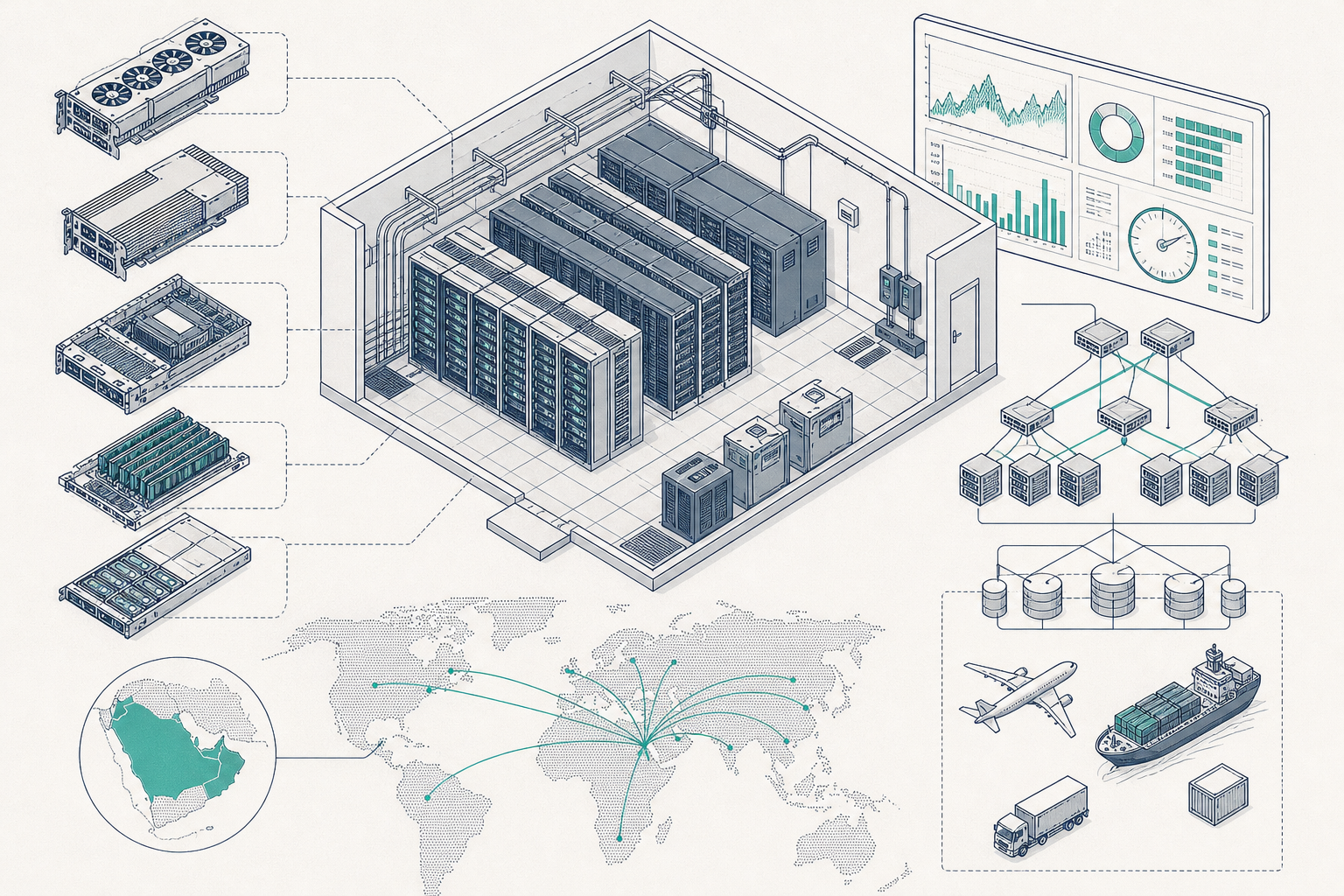
AI-designed chips are now a supply-chain question
On September 25, 2026, TechCrunch published a Disrupt 2026 discussion with Ricursive Intelligence co-founders Anna Goldie and Azalia Mirhoseini on when AI starts designing its own hardware. The important infrastructure signal was not that a new accelerator SKU had shipped that day. It was that AI-assisted chip design is moving from research narrative into the supply-chain conversation that operators will have to plan around.
For a small or mid-size GPU estate, that shift matters because hardware diversity is already hard to operate. If AI tools shorten design loops, increase specialization, or make more accelerator variants economically viable, procurement will not get simpler. A quarter rack to a few racks can quickly become a mix of GPU generations, CPU-heavy nodes, different memory sizes, different interconnect capabilities, different driver branches, and different levels of framework support.
The risk is not abstract. Operators buy hardware in batches. A site may start with 8 GPUs, add 16 more six months later, then accept a customer requirement that needs a different accelerator class or larger memory profile. The fleet still has to look like one commercial platform. Tenants expect placement, isolation, storage, metering, quota, and support. Finance expects chargeback. The facility team expects power discipline. In GCC and MENA markets, operators also have to account for sovereignty, air-gap requirements, import timing, local support, and power cost sensitivity.
The bottleneck is therefore not GPU count. It is whether the estate can present heterogeneous hardware as governed capacity without hiding the technical differences that affect jobs.
The near-term bottleneck is mixed-generation operations
AI-designed hardware could eventually produce more purpose-built accelerators for inference, training, retrieval, vision, edge deployment, and sovereign workloads. Even before that future arrives, small operators already face a version of the same problem. They rarely own one clean fleet with one accelerator model, one NIC, one storage profile, and one driver branch.
A mixed estate creates several practical constraints.
First, memory capacity and memory bandwidth become scheduling attributes. Two GPUs with the same headline memory size can behave differently under long-context inference, checkpoint loading, or fine-tuning. A tenant that asks for 4 GPUs may actually need 4 GPUs with high bandwidth memory, a specific interconnect topology, and enough host RAM to avoid input pipeline stalls.
Second, supported precision matters. BF16, FP8, INT8, INT4, and vendor-specific formats are not interchangeable from an operational point of view. A model that is economical on one class of accelerator can become unprofitable on another if kernels fall back to slower paths or require a different runtime.
Third, driver and framework maturity becomes a capacity planning item. Operators have to decide which nodes are on stable branches, which nodes support a newer stack, and which tenants are allowed to consume experimental profiles. The wrong driver upgrade can break a paying inference service. The wrong downgrade can strand a newer card.
Fourth, networking changes the economics. A 4 GPU training job on nodes with the right east-west fabric is a different product from 4 isolated GPUs behind weaker host connectivity. For inference, network placement affects token latency, storage fetch time, and multi-tenant noisy neighbor behavior.
Fifth, resale planning is no longer just depreciation by age. A three-year-old accelerator with mature kernels, stable drivers, and strong local demand may remain valuable. A newer accelerator without software maturity for the operator's workload mix may be harder to monetize.
Why this hits quarter rack to few rack estates first
Hyperscalers can absorb heterogeneity by building entire regions, zones, and product catalogs around it. A smaller operator does not have that buffer. If there are 24 to 96 GPUs on site, every stranded GPU is visible in monthly economics. A single incompatible node pool can reduce utilization enough to affect cash flow.
The typical pattern looks like this:
| Operator issue | What it looks like in a small estate | Operational control needed |
|---|---|---|
| Mixed accelerators | Different memory sizes, precision support, and driver needs | Hardware labels, node pools, tested images |
| Fragmented tenants | Kubernetes teams, VM users, bare-metal projects | Shared provisioning and tenancy model |
| GPU slicing demand | Small inference jobs do not need whole GPUs | MIG where supported, time-slicing where appropriate |
| Unclear economics | GPU count is known, billable GPU-hours are not | Metering, chargeback, utilization reporting |
| Sovereign workloads | Data and operations must stay local | Air-gap capable deployment and local control |
| Power ceiling | Rack capacity limits expansion before floor space does | Scheduling, quotas, and power-aware planning |
This is where an orchestration platform such as Clastiq is relevant. The operator does not need a promise that every accelerator is identical. The operator needs a way to model differences, publish them as capacity classes, and enforce who can use what.
Clastiq is designed for operators who own the hardware. It uses bare-metal provisioning through MAAS and Juju, supports Kubernetes and VM tenancy on the same fleet, manages GPU partitioning through MIG and time-slicing where the hardware and driver stack support it, integrates Ceph storage, and adds per-tenant metering, chargeback, quota, and policy engineering. The point is not to remove hardware diversity. The point is to make diversity schedulable, billable, and governable.
Capacity classes matter more than device names
A practical cluster catalog should not expose only vendor and GPU model. It should expose capacity classes that tenants and operators can understand.
For example, a fleet can be divided into profiles such as:
- inference-small, fractional GPU access, moderate memory, stable runtime
- inference-large, whole GPU access, larger memory, high bandwidth
- training-standard, multi-GPU nodes with tested collective communication
- training-premium, higher bandwidth, newer precision support, stronger networking
- cpu-memory, CPU and RAM heavy nodes for preprocessing, retrieval, or databases
- secure-airgap, restricted tenant pool with controlled images and offline updates
The profile names are less important than the discipline behind them. Each profile needs a tested image, supported driver branch, storage class, network expectations, quota rule, and price. This is where many small estates lose money. They buy GPUs, then sell them as generic GPU capacity. Generic capacity encourages generic placement. Generic placement causes job failures, lower throughput, support tickets, and disputed invoices.
A Clastiq-style operating model starts by registering the physical estate, provisioning nodes into known pools, then applying policy. Kubernetes can handle containerized tenants. VM tenancy can support users who need a full OS boundary, legacy licensing, or custom appliances. Bare-metal provisioning remains available for nodes that need direct hardware control. Ceph provides a common storage layer so tenant data, model artifacts, checkpoints, and images are not handled through ad hoc local disks.
The important operator move is to define what capacity means before selling it.
Worked example, utilization and chargeback
Consider a small estate with 32 accelerators across a few racks. Sixteen are an older class with 80 GB memory. Sixteen are a newer class with larger memory, better precision support, and stronger inference throughput for supported models. The site averages 42 kW of IT load for GPU nodes, CPU nodes, storage, and networking. There are 720 hours in the billing month.
Maximum theoretical GPU-hours:
32 GPUs x 720 hours = 23,040 GPU-hours per month
Before proper pooling and metering, the operator sells capacity manually. Some GPUs sit idle because jobs require the newer class. Some small inference workloads reserve whole GPUs because fractional access is not configured. Some tenants keep quota they are not using. Billable utilization averages 38 percent.
23,040 GPU-hours x 0.38 = 8,755 billable GPU-hours
If the blended realized rate is 8.50 dollars per GPU-hour, monthly revenue is:
8,755 x 8.50 = 74,418 dollars
If monthly operating cost, including depreciation, facility allocation, power, support labor, connectivity, and software operations, is 96,000 dollars, the estate is underwater on a cash basis for that month.
Now apply a governed capacity model. The older class is sold for stable inference and fine-tuning at 7 dollars per GPU-hour. The newer class is sold for higher memory and precision-sensitive workloads at 11 dollars per GPU-hour. MIG or time-slicing is used only where appropriate, with clear limits. Quotas reclaim idle reservations. VM users and Kubernetes users draw from the same metered fleet instead of separate stranded pools.
Assume utilization reaches 65 percent on the newer class and 59 percent on the older class.
Newer class: 16 x 720 x 0.65 = 7,488 GPU-hours
Older class: 16 x 720 x 0.59 = 6,797 GPU-hours
Revenue:
7,488 x 11 = 82,368 dollars
6,797 x 7 = 47,579 dollars
Total monthly revenue = 129,947 dollars
The same 96,000 dollars monthly cost now leaves 33,947 dollars before other overhead and taxes. This is an illustrative planning example, not a Clastiq benchmark. The arithmetic shows why utilization and capacity classification matter more than headline GPU count.
Revenue per MW is also useful for operators with power constraints. At 42 kW, or 0.042 MW, the annualized revenue per MW after orchestration is:
129,947 x 12 / 0.042 = 37.1 million dollars per MW-year
Before orchestration it was:
74,418 x 12 / 0.042 = 21.3 million dollars per MW-year
The improvement comes from fewer stranded GPUs, better matching of jobs to hardware, fractional access for smaller workloads, and pricing that reflects actual capacity classes.
Policy is the control plane for hardware diversity
When accelerator diversity increases, policy becomes a production system. Operators need to answer basic questions quickly.
Which tenants can use the newest hardware? Which workloads are allowed onto fractional GPU slices? Which images can run in a sovereign pool? Which driver branch is approved for a given accelerator class? Which tenant exceeded its quota? Which tenant created idle reservations? Which storage class is approved for regulated data?
These decisions cannot live in spreadsheets. They have to be encoded into provisioning, scheduling, and metering.
A simple Kubernetes example shows the pattern. The exact labels and resource names will vary by environment, but the operator intent should be explicit:
kubectl label node gpu-node-17 accelerator.class=inference-large
kubectl label node gpu-node-17 accelerator.precision=bf16-fp8
kubectl label node gpu-node-17 network.profile=high-east-west
kubectl label node gpu-node-17 sovereignty.pool=local-only

cat <<EOF | kubectl apply -f -
apiVersion: v1
kind: ResourceQuota
metadata:
  name: tenant-a-gpu-quota
  namespace: tenant-a
spec:
  hard:
    requests.nvidia.com/gpu: 8
    limits.cpu: 256
    limits.memory: 1024Gi
EOF
This is not enough by itself. Operators still need image management, bare-metal provisioning, VM tenancy, storage policy, chargeback, and lifecycle management. But it illustrates the principle: scheduling must reflect technical capability and commercial policy at the same time.
Clastiq's role is to tie those layers together on the operator's hardware. MAAS and Juju handle repeatable bare-metal deployment. Kubernetes and VM tenancy allow different customer operating models to coexist. GPU partitioning allows small workloads to consume fractions of a device when the hardware supports it. Ceph provides local storage under operator control. Metering and chargeback turn the technical allocation into invoices or internal cost reports. Quotas prevent a few tenants from occupying the entire estate. Policy engineering makes sovereignty and support boundaries enforceable.
GCC and MENA implications
The GCC and broader MENA region have a specific version of this problem. Demand for AI capacity is increasing across government, energy, banking, telecommunications, education, media, and Arabic language services. At the same time, many organizations cannot move sensitive data to an overseas public cloud region. Some workloads require local operation, local support, controlled update paths, and clear data residency.
Smaller GPU operators can serve that demand, but only if they run with hyperscaler-like discipline. A sovereign AI cluster that cannot show utilization, quota, tenant isolation, and chargeback will struggle to justify expansion. A cluster that cannot manage mixed accelerator generations will be forced into inefficient procurement, either buying only one expensive class of hardware or accepting operational fragmentation.
Power is also a regional planning issue. In hot climates, cooling efficiency, rack density, and megawatt allocation affect the commercial model. Revenue per MW is a better metric than GPU count because it links utilization to facility constraints. If a 42 kW estate can increase annualized revenue per MW from 21.3 million dollars to 37.1 million dollars through better allocation, that changes the business case for expansion, financing, and customer pricing.
Air-gap and sovereign deployments add another constraint. Operators must plan how driver updates, container images, model artifacts, security patches, and metering exports move through controlled environments. If AI-designed accelerators increase hardware variation, offline lifecycle management becomes harder. The answer is not to avoid new hardware forever. The answer is to require every new hardware class to enter through a controlled qualification path.
Procurement should include operations acceptance
As hardware cycles accelerate, procurement cannot stop at price, delivery date, and performance claims. Small operators should add an operations acceptance checklist for every accelerator class.
The checklist should include supported operating systems, driver branches, Kubernetes device plugin support, VM passthrough behavior, MIG or partitioning support where applicable, monitoring support, power telemetry, failure replacement process, storage interaction, and tested frameworks. It should also include resale assumptions. If a device depends on immature kernels or a narrow software stack, its residual value may be lower than expected.
A useful rule is to avoid buying a capacity class that cannot be described in one paragraph to a tenant and one line item to finance. If the product cannot be sold, metered, supported, and reclaimed, it is not yet operational capacity.
Clastiq's hardware-agnostic approach is important here. The platform is intended for NVIDIA, AMD, and mixed CPU and GPU estates. Hardware agnostic does not mean all devices are treated as the same. It means the operator can build a governance model across different hardware, then expose appropriate profiles to tenants.
What to do this week
-
Inventory the fleet by operational attributes, not just model name. Record memory size, memory bandwidth class, supported precisions, driver branch, NIC profile, host CPU, host RAM, storage path, and power draw.
-
Define 3 to 5 capacity classes that customers or internal tenants can actually buy. Include the tested image, quota rule, storage class, support boundary, and price for each class.
-
Measure billable utilization for the last 30 days. Separate allocated GPU-hours, active GPU-hours, idle reservations, failed jobs, and maintenance windows.
-
Pick one fractional GPU policy. Decide where MIG, time-slicing, or whole-GPU-only allocation is allowed. Do not apply fractional access uniformly across all workloads.
-
Add an operations acceptance gate to procurement. No new accelerator class should enter production without driver, kernel, monitoring, tenant isolation, metering, and rollback checks.
-
Review power economics using revenue per MW-year. If power is the limiting resource, optimize for governed utilization before adding more devices.
Clastiq runs this model on the operator's own hardware, from a quarter rack to a few racks, with local control over provisioning, tenancy, storage, metering, quotas, and support. request a demo
Sources
TechCrunch, Ricursive Intelligence on when AI starts designing its own hardware