What changed on September 25, 2026
TechCrunch reported on September 25, 2026 that Anthropic has committed to pay Akamai $11.6 billion over seven years for cloud infrastructure capacity. The report described a long-duration, capacity-heavy commitment by a frontier model company to a provider that is not one of the three largest hyperscale clouds. No second listed source was verified in the available results, so operators should treat the public detail as limited to the reported amount, term, counterparties, and date.
The infrastructure signal is still useful. Frontier AI buyers are not only renting spot capacity for experiments. They are signing multi-year commitments because access to dense compute, network, power, and operationally reliable capacity has become strategic. A seven-year term changes the risk profile. It is no longer only a question of which GPU is fastest this quarter. It is a question of whether the buyer can keep the estate busy enough, govern it tightly enough, and match the infrastructure contract to workloads that may change several times during the term.
For operators in the GCC and wider MENA region, the lesson is not that a quarter rack should behave like Anthropic. The lesson is that dedicated capacity has to earn its keep. A sovereign AI lab, university, government program, industrial group, bank, or local service provider may own real hardware because data residency, latency, procurement policy, or local support matters. But the economics of dedicated GPU capacity are unforgiving at small scale. Idle GPUs are not neutral. They consume rack space, power reservation, cooling capacity, support time, and depreciation while producing no tenant value.
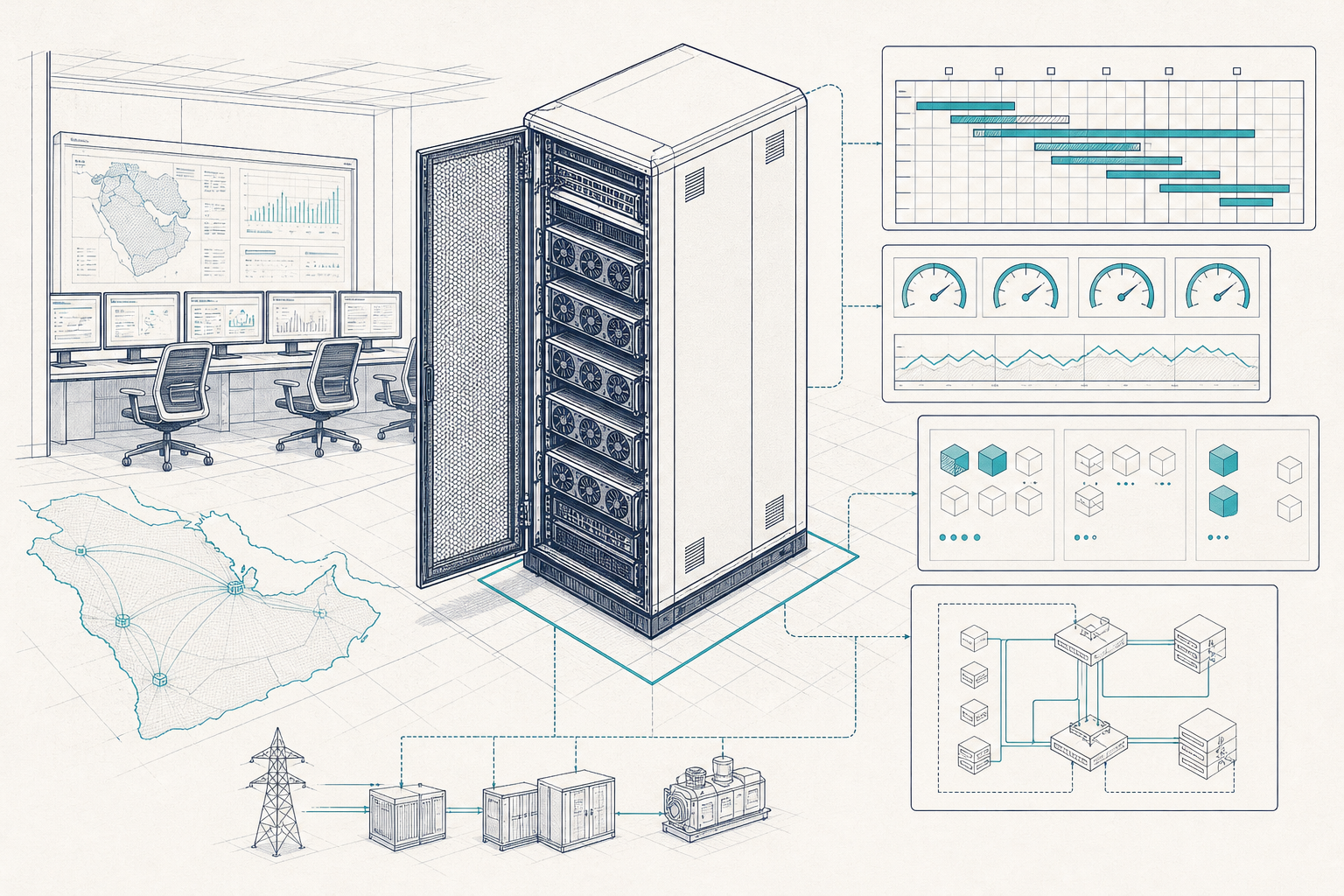
ClastIQ exists for this middle ground: operators with owned hardware, from a quarter rack to a few racks, who need hyperscaler-like discipline without becoming a hyperscaler. That means bare-metal provisioning, Kubernetes and VM tenancy on the same fleet, GPU partitioning, Ceph storage, metering, quotas, policy, air-gap options, and local human support. The objective is simple: turn a small GPU estate into a governed capacity pool rather than a set of individually precious machines.
The bottleneck small estates hit first
A large cloud commitment is about securing capacity. A small or mid-size GPU estate has a different first bottleneck: matching uneven demand to fixed inventory.
One team wants long-running fine-tuning jobs. Another wants interactive notebooks. A third wants inference endpoints during business hours. A fourth needs a VM with direct GPU access for a licensed application. Some tenants need data to stay in-country. Some workloads can burst to public cloud. Some cannot. If all of these requests are handled manually, the estate becomes fragmented quickly.
The bottleneck usually appears in one of five forms:
- Full GPUs are reserved for jobs that use only a fraction of memory or compute.
- Kubernetes users and VM users compete through tickets instead of policy.
- Storage is attached per project, making datasets hard to reuse and charge.
- Power and cooling are planned as peak allocation, while revenue follows actual usage.
- The finance team sees capex and power bills, but not tenant-level GPU-hours.
This is where a small estate differs from a large cloud region. A hyperscaler can absorb some inefficiency through scale, fleet diversity, and huge demand. A quarter rack cannot. If eight GPUs are stranded by poor scheduling, the operator may have lost a meaningful share of the entire business case.
Capacity contracts start with utilization math
The Anthropic and Akamai story points to long-term capacity planning. For a smaller operator, the same planning starts with a more modest question: should this workload live on dedicated local GPUs, burst to cloud, or wait in a queue?
A useful starting model is GPU-hours. The formula is simple:
# monthly theoretical GPU-hours
GPUS=32
HOURS_PER_DAY=24
DAYS=30
echo $((GPUS * HOURS_PER_DAY * DAYS))
# 23040
A 32 GPU estate has 23,040 theoretical GPU-hours in a 30 day month. That does not mean 23,040 billable hours. Maintenance, driver upgrades, failed jobs, queue gaps, reserved capacity, and tenant behavior reduce usable output.
Assume the estate has an all-in monthly cost of $75,000. This includes amortized hardware, data center space, power, cooling, support, software operations, and finance overhead. These numbers are illustrative, not a ClastIQ benchmark.
At 35 percent utilization, the estate produces:
23,040 GPU-hours x 0.35 = 8,064 used GPU-hours
The cost per used GPU-hour is:
$75,000 / 8,064 = $9.30
At 70 percent utilization, the estate produces:
23,040 GPU-hours x 0.70 = 16,128 used GPU-hours
The cost per used GPU-hour becomes:
$75,000 / 16,128 = $4.65
If the operator charges internal or external tenants $6.25 per GPU-hour, the difference is material.
| Monthly state | Used GPU-hours | Cost per used GPU-hour | Revenue at $6.25 per GPU-hour | Gross position |
|---|---|---|---|---|
| Poor scheduling, 35 percent | 8,064 | $9.30 | $50,400 | minus $24,600 |
| Governed pool, 70 percent | 16,128 | $4.65 | $100,800 | plus $25,800 |
Now add power density. Suppose the same estate draws 45 kW at the facility meter during typical operation, including servers, storage, networking, and cooling allocation. That is 0.045 MW. At $100,800 monthly revenue, annualized revenue is $1,209,600. Revenue per MW-year is:
$1,209,600 / 0.045 = $26,880,000 per MW-year
At the 35 percent case, annualized revenue is $604,800, or $13,440,000 per MW-year. The hardware did not change. The racks did not change. The commercial outcome changed because utilization and governance changed.
This is the core operator lesson from large capacity deals. Long-duration infrastructure only works when scheduling, tenancy, and chargeback are engineered together.
Why small GPU estates strand capacity
The most common reason small GPU clusters underperform is not that the operator bought the wrong accelerator. It is that the estate has no single control plane for competing modes of consumption.
Bare metal is needed for some workloads. Kubernetes is needed for platform teams and MLOps pipelines. VMs are needed for legacy applications, Windows or Linux desktop workflows, licensed engineering tools, or tenants who need stronger administrative isolation. Storage has to serve all of them. GPU access has to be partitioned fairly. Power and quotas have to be visible before someone consumes the last available resource.
Without orchestration, teams solve locally. One tenant gets a dedicated node because their first project was urgent. Another team gets a separate Kubernetes cluster. A third gets access to a VM host. The result is political allocation rather than measured allocation.
That is manageable when the estate is experimental. It fails when leadership asks for cost recovery, when a sovereign program needs auditability, or when a provider wants to sell GPU capacity to multiple tenants.
For GCC and MENA operators, this issue is particularly important because local infrastructure is often justified by sovereignty, latency, and national capability. Those are legitimate reasons to own hardware. But they do not remove the requirement for utilization. In some cases, they make it stricter. If workloads cannot leave the country, the local estate must be better governed, not less governed, because there is no easy public cloud escape valve for every queue spike.
What ClastIQ adds to the operating model
ClastIQ is designed for operators who own the hardware and need to run it as a governed service. It is hardware-agnostic, including NVIDIA, AMD, and mixed CPU and GPU estates. The point is not to hide the hardware. The point is to make the hardware schedulable, measurable, and governable across tenants.
At the bottom of the stack, bare-metal provisioning based on MAAS and Juju gives the operator a repeatable way to install, reimage, and lifecycle nodes. This matters in small estates because manual rebuilds consume the same senior engineering time that should be spent on utilization, policy, and tenant onboarding.
Above that, Kubernetes and VM tenancy allow different workload patterns to share one fleet. A model serving team may need Kubernetes namespaces, node pools, GPU device plugins, and storage classes. A research team may need notebooks. A government tenant may require a VM with controlled access and defined data boundaries. A software vendor may need a bare-metal test window. The estate should not become four separate islands.
GPU partitioning is the next lever. On compatible NVIDIA hardware, MIG can divide a physical GPU into isolated GPU instances. Time-slicing can help with lighter or bursty workloads where strict hardware partitioning is not required. On AMD or mixed estates, the exact mechanism differs, so policy must be hardware-aware without becoming vendor-locked. The operator goal is the same: stop assigning a whole accelerator when the tenant needs only part of it, and stop mixing tenants in ways that violate isolation requirements.
Storage is equally important. Ceph provides a shared storage layer for block, object, and file patterns depending on how it is deployed. In a small estate, storage policy affects GPU utilization directly. If datasets are copied slowly between silos, accelerators wait. If tenants cannot see their storage consumption, chargeback is incomplete. If snapshots and replication are not planned, recovery becomes a manual emergency.
Metering and chargeback close the loop. GPU-hours, CPU-hours, memory, storage, network egress, reserved capacity, and power allocation need to become tenant records. A finance or program office should be able to see who used what, when, and under which quota. That is how an operator defends local infrastructure investment without inventing utilization numbers at the end of the quarter.
Scheduling policy is a financial control
The biggest mistake in small GPU operations is treating scheduling as an engineering convenience. It is a financial control.
Consider three workload classes:
- Interactive development, low duty cycle, high user sensitivity.
- Batch training or fine-tuning, high duty cycle, queue tolerant.
- Inference, variable duty cycle, service-level sensitive.
If interactive notebooks occupy full GPUs all day, batch jobs wait and utilization looks deceptively high but produces low value. If batch jobs consume all GPUs overnight and continue into office hours, inference teams miss service targets. If every tenant asks for peak allocation, the operator buys too much hardware and still cannot explain why it is idle.
A governed scheduler needs quotas, priorities, preemption rules, partition sizes, maintenance windows, and burst policy. Some tenants should receive guaranteed reserved capacity because their application is critical. Others should receive a fair-share pool. Some jobs should be allowed to queue locally. Some should be pushed to cloud when data classification permits and when the economics are better than delaying local work.
This is where the Anthropic scale signal becomes practical for a quarter rack. The question is not whether the operator can sign an $11.6 billion commitment. It is whether the operator can make any capacity commitment, even a small one, with enough confidence that the GPUs will be used.
A simple tenant policy might look like this:
tenant: research-lab-a
monthly_gpu_hour_quota: 2200
reserved_gpu_slices: 4
max_full_gpus: 8
preemptible_allowed: true
cloud_burst_allowed: false
data_residency: oman-only
chargeback_rate_usd_per_gpu_hour: 6.25
storage_quota_tb: 40
The exact syntax will vary by implementation, but the operating idea is consistent. Policy has to express commercial, technical, and sovereignty constraints in one place.
Partitioning must match the workload
GPU partitioning is not a magic utilization button. It has to match workload behavior.
MIG-style partitioning is useful where the hardware supports it and where workloads fit into defined GPU instance profiles. It can improve isolation and allow multiple smaller jobs to run predictably on one physical accelerator. That is valuable for inference, notebooks, and smaller model experiments.
Time-slicing is useful for workloads that do not need sustained full-GPU performance. It can improve access for development environments, short tests, and low duty cycle users. It may not be appropriate for latency-sensitive production inference or jobs that assume consistent full-GPU access.
Full-GPU allocation remains correct for many training, fine-tuning, simulation, and high throughput inference workloads. The operator mistake is not using full GPUs. The mistake is using full GPUs by default.
A ClastIQ-style operating model makes these modes part of the service catalog. Tenants request a class of service, not a personal machine. The platform maps that request to available hardware, partitioning capability, isolation policy, and chargeback.
Sovereignty changes the burst decision
In the GCC, local GPU estates are often tied to sovereignty. Data may need to remain in Oman, Saudi Arabia, the UAE, Qatar, Bahrain, Kuwait, or another jurisdiction. Even when regulation allows cross-border processing, procurement and risk teams may prefer local execution for sensitive government, health, financial, energy, or defense-adjacent workloads.
That does not mean every workload must stay local. Public data experiments, synthetic test runs, open-source model evaluation, and overflow batch jobs may be eligible for external cloud capacity. The important point is to make burst policy explicit.
A practical burst policy answers:
- Which tenants can burst outside the local estate?
- Which datasets can leave the country or facility?
- Which job types are eligible for cloud execution?
- At what local queue time or cost threshold does bursting become preferable?
- How are cloud costs brought back into the same chargeback ledger?
Without those answers, the operator faces two bad outcomes. Either local GPUs are overbuilt for peaks that occur only occasionally, or users bypass governance with ad hoc cloud accounts. Both weaken the business case for sovereign infrastructure.
ClastIQ's relevance here is not only scheduling. It is the combination of tenancy, metering, quotas, policy engineering, and air-gap or sovereign deployment patterns. An air-gapped estate will not burst to public cloud, so utilization discipline must be even stronger. A connected sovereign estate may burst selectively, but only under policy.
Storage and data movement decide GPU output
GPU operators often model compute first and storage second. In practice, storage throughput, namespace design, and dataset lifecycle can decide whether the compute estate is productive.
Ceph helps because it can provide shared, resilient storage for multi-tenant environments. But Ceph still needs planning. Training datasets, model checkpoints, container images, VM volumes, logs, and tenant object stores have different access patterns. A checkpoint-heavy workflow can stress write performance. A shared model catalog can reduce duplication. A poorly designed image registry can slow every job start.
Chargeback should include storage because storage behavior affects GPU availability. A tenant that keeps 200 TB of inactive checkpoints is consuming more than disk. It is consuming backup windows, recovery time, capacity planning attention, and possibly replication bandwidth. If storage is free while GPU-hours are charged, tenants will optimize around the wrong signal.
The operator should meter at least the following:
- Allocated and used storage by tenant.
- GPU-hours by partition type and full-GPU allocation.
- CPU-hours and memory for non-GPU workloads.
- Failed job time, separated from productive time.
- Reserved but unused capacity.
- Power allocation where metering allows it.
This data turns an argument about fairness into a ledger.
Procurement should follow the operating model
The Akamai commitment reported by TechCrunch is large enough to be strategic on its own. Smaller estates usually buy in increments: a few nodes, a storage shelf, a network upgrade, another rack, or a power expansion. The procurement risk is buying the next increment before the current one is governed.
Before adding GPUs, ask whether the current estate has:
- Accurate utilization by tenant and workload class.
- A queue report showing denied, delayed, and abandoned demand.
- A chargeback model accepted by finance or program leadership.
- A policy for reserved capacity versus shared capacity.
- A data classification model that determines local-only versus burstable workloads.
- A power and cooling model tied to revenue or mission output.
If those items are missing, new hardware may temporarily reduce pain while preserving the same operating defect.
For GCC and MENA operators, this is also a revenue per megawatt issue. Power capacity is strategic. Data center power, cooling, and grid access are not infinite, especially when AI demand competes with cloud, enterprise, and national digital infrastructure. A GPU estate that produces more tenant value per megawatt is easier to defend, expand, and fund.
What to do this week
- Build a 30 day GPU-hour ledger. Separate full-GPU, partitioned, time-sliced, idle, failed, and reserved-but-unused hours.
- Classify workloads into local-only, local-preferred, and burst-eligible. Include data residency and tenant policy, not only technical preference.
- Define three service classes: interactive, batch, and inference. Assign quotas, priority, preemption, and chargeback rules to each.
- Audit storage consumption by tenant. Identify duplicated datasets, stale checkpoints, and storage that should be billed or archived.
- Run a utilization sensitivity model. Show leadership the cost per used GPU-hour at 35 percent, 50 percent, and 70 percent utilization.
- Freeze new GPU procurement until the current estate has tenant-level metering, or explicitly document why mission demand overrides the utilization gap.
ClastIQ runs this operating model on the operator's own hardware, from a quarter rack to a few racks. request a demo