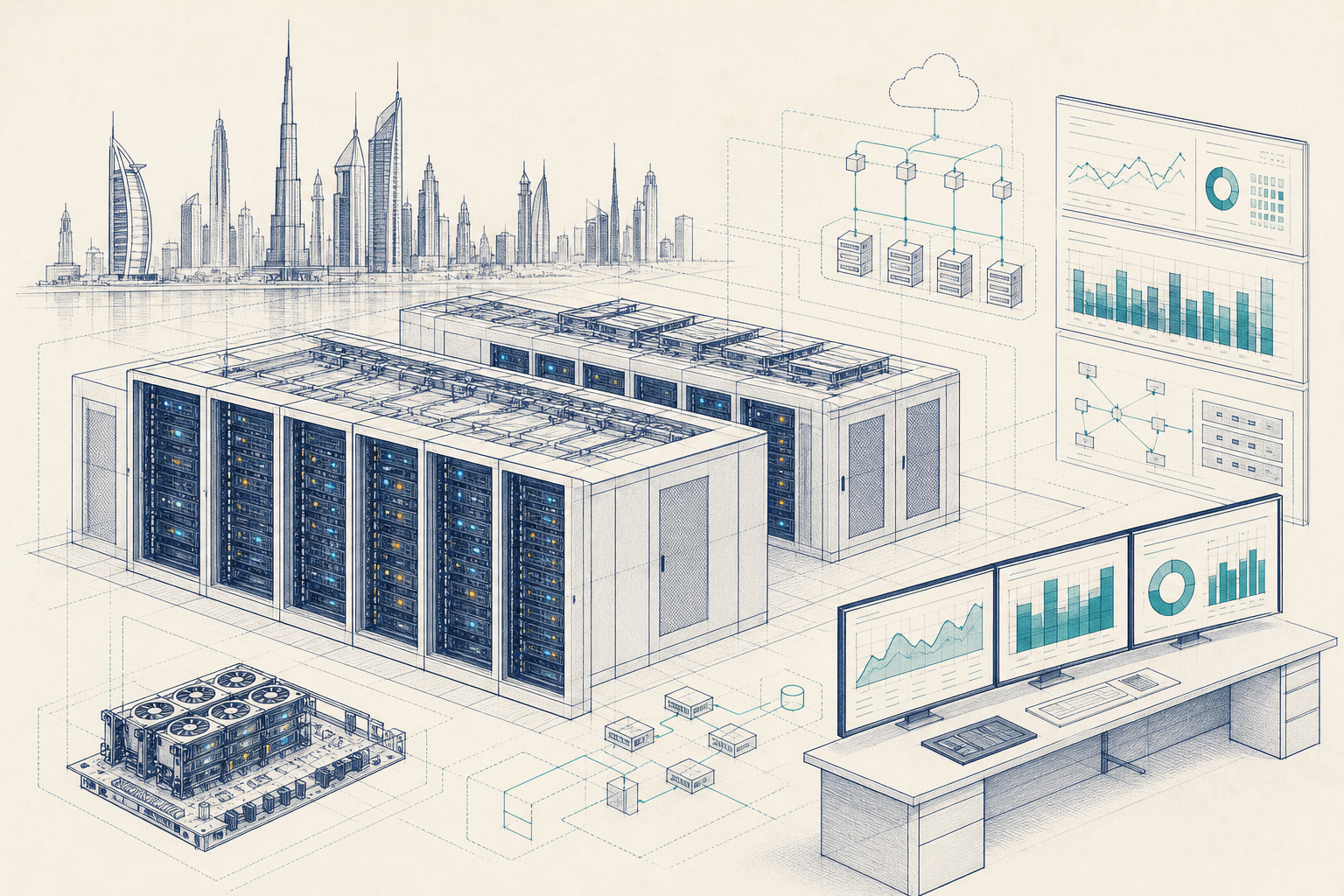
Anthropic's filing turns demand into a capacity signal
Anthropic filed for an IPO on October 26, 2026, according to TechCrunch and Dealroom reporting. The numbers disclosed around the filing are the important part for infrastructure operators. Anthropic reported 11,900 customers spending at least $100,000 annually, and Dealroom highlighted up to $807 billion in ten-year commitments across data-center capacity, chips, and compute. TechCrunch framed the public debut as a formal move into the public markets after a period of extraordinary enterprise AI demand.
For operators of small and mid-size GPU estates, from a quarter rack to a few racks, the signal is not that they should copy Anthropic's training footprint. They cannot. The signal is that enterprise AI demand is becoming contractual, metered, and governance-heavy. Once AI spend moves from experiment to annual commitment, the buyer asks different questions: where is the data processed, who can see usage, what quota applies, what happens during a capacity incident, and how is the bill allocated back to the consuming department or customer.
That is the practical overlap between the TechCrunch and Dealroom stories. One source shows enterprise adoption at unusual scale. The other shows the capital structure needed to feed frontier model development. Together they make the same point for the GCC, MENA, and other regional markets: the economic center of gravity for a smaller physical estate is unlikely to be frontier training. It is more likely to be governed inference, fine-tuning, evaluation, data preparation, and regulated workloads that need local control.
A regional operator with 16, 32, or 64 accelerators should not ask whether it can outbid hyperscalers for global training economics. It should ask whether it can offer low-latency, auditable, sovereign GPU capacity with clear utilization, quota, and chargeback. That is a more operator-grade question, and it is where orchestration matters.
The bottleneck is not only GPUs, it is governable utilization
A small GPU estate usually hits a familiar sequence of bottlenecks. First, the GPUs arrive before the tenancy model is settled. Then one or two teams consume entire nodes because scheduling is coarse. Next, finance asks for chargeback, but metering exists only in spreadsheets. Then a sovereign or air-gapped customer appears, and the original cluster design assumes internet access for images, licenses, packages, or telemetry. Finally, storage becomes the hidden constraint because inference logs, embeddings, checkpoints, and tenant datasets land on shared disks without clear quotas.
At hyperscaler scale, inefficiency can be hidden inside very large fleets, spot markets, and global capacity balancing. In a quarter rack, inefficiency is visible. One idle 8 GPU server can be a double-digit percentage of the entire estate. One unmetered tenant can turn a profitable cluster into an internal cost center. One policy exception can make a sovereign deployment hard to defend.
Anthropic's filing highlights the difference between demand and deliverable capacity. A commitment to compute is not the same as useful GPU-hours. Useful GPU-hours require scheduling, isolation, storage, networking, quotas, image control, power awareness, and a billing trail. Smaller operators need those controls earlier, not later, because they do not have enough slack capacity to absorb poor placement or unclear ownership.
This is also why the GCC and wider MENA context matters. Regional operators are often serving government, financial services, energy, health, education, Arabic language workloads, and regulated enterprise customers. Some workloads need data residency. Some need local latency. Some need an air-gapped build. Some need mixed CPU and GPU tenancy because the AI pipeline is not just inference. It includes preprocessing, vector indexing, model evaluation, postprocessing, and application hosting. If the GPU layer is treated as a standalone pool, the rest of the workload becomes unmanaged shadow infrastructure.
Why smaller estates should bias toward sovereign inference
Training frontier models is a capital concentration game. It rewards massive procurement, power access, chip allocation, long-term data-center contracts, and software teams that can keep huge clusters busy. The reported $807 billion commitment figure is a reminder that the economics of frontier training are not linear. They are dominated by scale, supply agreements, and the cost of downtime across very large parallel jobs.
Inference has different constraints. It rewards locality, predictable service classes, tenant isolation, observability, and high average utilization across many smaller jobs. A regional hospital group, bank, ministry, university, or industrial operator may not need a frontier training cluster. It may need a local endpoint for retrieval augmented generation, speech, document processing, code assistance, vision inspection, or private model evaluation. It may need evidence that data did not leave the country. It may need a monthly statement showing that one business unit consumed 9,400 GPU-hours and another consumed 1,100.
That does not make inference simple. Inference capacity fragments quickly. Some workloads need a full accelerator for latency. Others fit well into MIG partitions or time-sliced shares. Some need VMs because the tenant brings its own OS image or license model. Others fit Kubernetes because the workload is container-native. Some need object, block, and file storage in the same environment. Some need to run through maintenance windows without access to a public registry.
A platform such as ClastIQ is designed for that operating model on the operator's own hardware. It combines bare-metal provisioning through MAAS and Juju, Kubernetes and VM tenancy on the same fleet, GPU partitioning through MIG and time-slicing where supported, Ceph storage, per-tenant metering, quota and policy engineering, and support for air-gapped or sovereign deployments. The point is not to make a small estate look like a hyperscaler in size. The point is to make it behave like a governed region in miniature.
A numeric example for a 16 GPU estate
Consider a compact estate with 4 servers, each with 4 accelerators, for 16 GPUs total. Assume the full environment draws 14 kW at the rack after servers, storage, switching, and normal overhead inside the operator boundary. The month has 30 days.
Available GPU-hours:
16 GPUs x 24 hours x 30 days = 11,520 GPU-hours per month.
Assume the monthly all-in operating cost allocated to this estate is $54,000. This includes facility allocation, power, support labor, software operations, spares reserve, network, and finance allocation. The cost per available GPU-hour is:
$54,000 / 11,520 = $4.69 per available GPU-hour.
Now compare two utilization states.
| Metric | Coarse allocation | Governed inference pool |
|---|---|---|
| Available GPU-hours per month | 11,520 | 11,520 |
| Billable utilization | 42 percent | 72 percent |
| Billable GPU-hours | 4,838 | 8,294 |
| Monthly allocated cost | $54,000 | $54,000 |
| Cost per billable GPU-hour | $11.16 | $6.51 |
| Chargeback rate | $9.00 per GPU-hour | $9.00 per GPU-hour |
| Monthly chargeback revenue | $43,542 | $74,646 |
The arithmetic is simple, but it changes the operating conversation. At 42 percent billable utilization, a $9.00 chargeback rate does not recover the allocated cost. At 72 percent, the same rate produces $20,646 above the monthly allocation. On the same physical hardware, the difference is not magic. It is usually better tenancy, finer GPU slicing, fewer orphaned reservations, automated quota enforcement, faster reprovisioning, and storage that does not block jobs.
There is also a power lens. At 14 kW, the estate is 0.014 MW. Annualized chargeback revenue at 72 percent is:
$74,646 x 12 = $895,752 per year.
Revenue per MW of IT load is:
$895,752 / 0.014 = $63.98 million per MW-year.
This is not a universal benchmark. It is an internal planning metric. The useful comparison is between operating modes on the same power envelope. If better orchestration raises billable utilization without increasing power materially, revenue per megawatt improves. For GCC operators facing constrained data-center power, this metric belongs beside PUE, rack density, and gross margin.
What ClastIQ changes in the operating path
The first operational change is bare-metal lifecycle control. A small estate cannot afford slow, manual rebuilds every time a tenant changes requirements. MAAS and Juju give the operator a repeatable way to commission machines, apply roles, rebuild nodes, and manage the dependency graph around Kubernetes, storage, and supporting services. That matters when the same fleet must support GPU inference today, a VM tenant tomorrow, and a maintenance window on the weekend.
The second change is mixed tenancy. Many AI platforms assume the whole estate is Kubernetes. Real operators know that some tenants require VMs for isolation, license reasons, specialized images, or procurement comfort. Others want Kubernetes namespaces, Helm releases, and CI pipelines. Running Kubernetes and VM tenancy on the same physical fleet lets the operator allocate capacity according to workload reality rather than forcing every tenant into one abstraction.
The third change is GPU partitioning. For supported NVIDIA hardware, MIG can split a physical GPU into isolated instances with defined memory and compute profiles. Time-slicing can increase concurrency where hard partitioning is not the right fit. AMD and CPU-heavy estates have their own scheduling and isolation patterns. The operator principle is hardware-agnostic: expose the smallest safe unit that meets the tenant's latency, memory, and isolation requirement. Do not give away a full accelerator when a partition or scheduled share is enough. Do not slice a workload that needs deterministic full-GPU latency.
The fourth change is metering and chargeback. A cluster without tenant-level metering is a shared lab, not a commercial or accountable service. Metering should capture GPU allocation, actual usage where available, CPU, memory, storage, network egress where relevant, and reservation time. Chargeback does not have to mean external resale. It can be internal showback for ministries, universities, hospitals, or business units. The key is that consumption becomes visible and defensible.
The fifth change is policy. Quotas prevent one tenant from consuming the estate because a job autoscaled incorrectly. Priority classes protect production inference from batch experiments. Admission controls can restrict images, enforce labels, require storage classes, and prevent unsafe privilege escalation. In sovereign environments, policy also covers where images come from, which registries are mirrored, who can access logs, and how secrets are handled.
The sixth change is storage. Ceph is useful in this pattern because AI estates need more than a fast scratch disk. Tenants need block volumes for VMs, object storage for datasets and artifacts, and shared storage patterns for pipelines. Without storage quotas and lifecycle policy, GPU scheduling looks healthy while jobs wait on data movement or fill shared volumes. A GPU platform that ignores storage will eventually be scheduled by storage failure.
A quota example that operators can actually use
The following is not a complete production policy. It shows the shape of a tenant quota that makes GPU consumption explicit. Resource names vary by device plugin, accelerator type, and MIG profile, so operators should adapt it to their fleet.
kubectl create namespace tenant-a
kubectl -n tenant-a apply -f - <<'YAML'
apiVersion: v1
kind: ResourceQuota
metadata:
  name: tenant-a-ai-quota
spec:
  hard:
    requests.cpu: 64
    requests.memory: 256Gi
    requests.storage: 20Ti
    nvidia.com/mig-1g.10gb: 8
    pods: 80
YAML

kubectl -n tenant-a get resourcequota tenant-a-ai-quota
The operational value is not the YAML itself. It is the workflow around it. A tenant receives an approved quota. Jobs are scheduled against that quota. Usage is metered against that tenant. Storage is capped. If the tenant needs more, the request becomes a capacity and commercial decision, not an emergency Slack thread. In an air-gapped deployment, the same pattern must work with local registries, local package mirrors, and no dependency on public control planes.
The GCC and MENA operator angle
GCC and MENA infrastructure operators have a specific opportunity because many AI buyers in the region have two requirements at once. They want access to modern AI capability, and they want control over data, jurisdiction, latency, and procurement. A local estate can meet those requirements if it is operated as a governed service rather than a collection of expensive servers.
The strongest workloads are often not the loudest ones. Arabic document processing for regulated entities, call center summarization with residency constraints, industrial vision near production sites, legal discovery, education platforms, private code assistance, and retrieval systems over sensitive archives can all justify local inference. These workloads may not need thousands of GPUs. They need predictable performance, clear isolation, and an operator who can explain the bill.
There is also a sovereignty gradient. Some tenants are comfortable with public cloud for experimentation but not for production data. Some need in-country processing. Some need a dedicated environment inside their own facility. Some need disconnected operation. A hardware-agnostic orchestration layer lets the operator reuse the same operating model across NVIDIA, AMD, and mixed CPU and GPU estates, instead of building a one-off stack for each customer requirement.
For a small estate, the commercial goal should be disciplined density of value. That means filling the GPU calendar with inference and adjacent AI work that can be metered, governed, and renewed. It also means refusing workloads that destroy utilization or require capital scale the operator does not have. Anthropic's IPO filing is a reminder that hyperscale AI economics are becoming larger, not smaller. Regional operators should choose the part of the stack where proximity and trust matter.
Power, maintenance, and failure domains still decide the outcome
No orchestration layer removes physical constraints. Power capacity, cooling headroom, network design, spare parts, and maintenance windows still define the service. What orchestration does is make those constraints visible and manageable.
For example, if a 16 GPU estate has one 4 GPU server down for maintenance, 25 percent of capacity is unavailable. Without quotas and scheduling policy, that outage becomes a tenant dispute. With quotas, reservations, and priority classes, the operator can decide which batch jobs pause, which inference endpoints remain protected, and which tenants receive credits or schedule changes. The same logic applies to storage degradation, failed NICs, firmware updates, and driver changes.
Operators should also connect power data to tenant economics. If a tenant reserves full GPUs for long periods but uses them lightly, the issue is not only scheduler waste. It is power tied to low value output. Metering should distinguish between reservation, allocation, and observed utilization where possible. Chargeback models can then price reserved capacity differently from opportunistic batch use.
This is where revenue per megawatt becomes more than a board metric. In constrained facilities, every kilowatt assigned to AI should have a utilization story and a tenant story. If it does not, the estate will drift toward impressive nameplate capacity and weak economic output.
Reading the Anthropic signal correctly
The wrong reading of Anthropic's filing is that every operator needs to chase frontier scale. The right reading is that enterprise AI demand is now large enough to support formal capacity commitments, public market scrutiny, and long-term infrastructure contracts. That creates room for regional operators, but only if they operate with the discipline buyers now expect.
A small GPU estate can be economically useful when it does four things well. It keeps accelerators busy with the right granularity. It supports both containers and VMs. It meters consumption in a way finance can use. It enforces sovereignty and policy without turning every deployment into a custom project.
ClastIQ's role in that model is orchestration and operational control on hardware the operator owns. It does not require the operator to become a hyperscaler. It gives the operator a way to run a compact GPU and CPU estate with bare-metal provisioning, Kubernetes, VMs, partitioning, Ceph storage, metering, quotas, and air-gap options as one governed environment.
What to do this week
- Calculate available GPU-hours, billable GPU-hours, and cost per billable GPU-hour for the last 30 days. If you cannot calculate them, treat metering as the first infrastructure gap.
- Classify current and expected workloads into full GPU, partitioned GPU, time-sliced GPU, VM, Kubernetes, and CPU-only categories. Use this to expose over-allocation.
- Define 3 tenant service classes: production inference, batch AI work, and experimental use. Attach quota, priority, storage, and support expectations to each class.
- Audit sovereignty dependencies, including registries, package mirrors, identity, logging, backups, license checks, and remote support paths. Identify what fails without internet access.
- Build a power and revenue view for the estate. Track revenue or chargeback per kW and per MW-year, not only GPU count.
- Run one controlled tenant onboarding through quota, storage allocation, image approval, metering, and chargeback before expanding the catalog.
ClastIQ runs this operating model on the operator's own hardware, request a demo.
Sources
TechCrunch, Anthropic officially files for its public debut
Dealroom, Anthropic files for IPO that could value it at $2T and raise over $100B