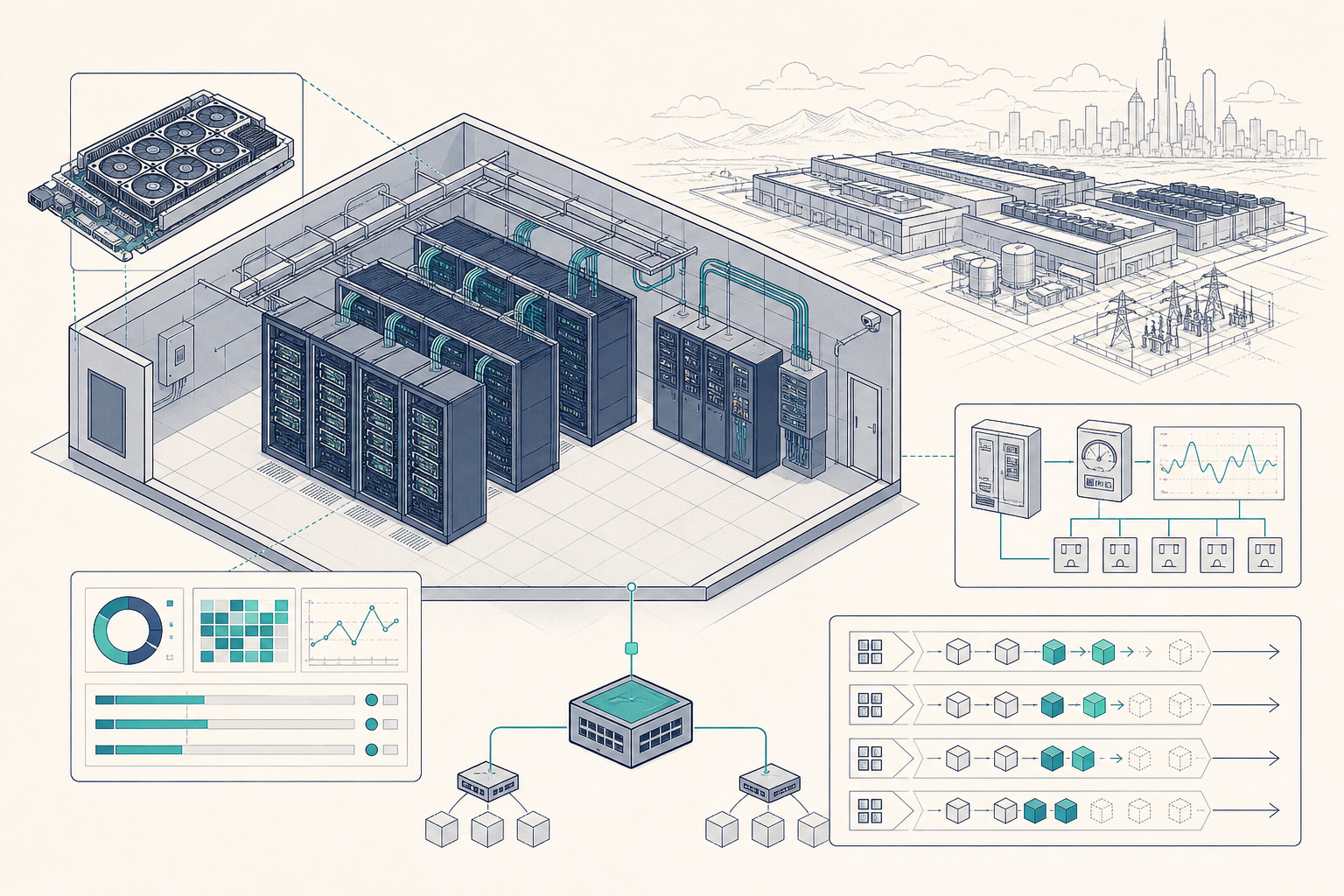
Anthropic changed the reservation signal
On November 19, 2026, TechCrunch reported that Anthropic’s IPO put a disclosed long-term infrastructure commitment of roughly $900 billion under scrutiny. The important operating signal is not the IPO itself. It is the size and structure of the compute obligation behind it. A leading AI lab is telling the market that future model training and inference demand will be supported by enormous reserved infrastructure footprints, supplier financing, and long horizon capacity commitments.
That matters to every operator outside the hyperscaler tier. If the largest labs reserve years of supply in advance, the market does not become more forgiving for smaller clusters. It becomes less forgiving. The scarce asset is no longer only GPUs. It is usable, schedulable, accountable GPU time that can be sold or allocated at high utilization without losing control of tenancy, data location, storage, quota, and power.
For an operator with a quarter rack, one rack, or a few racks, the response is not to imitate a hyperscaler capital plan. The response is to run the estate like a measured utility. Every GPU-hour must have a tenant, a priority, a queue position, a policy, a storage path, and a cost center. Raw availability is not enough. The business question becomes: how many paid or justified tokens, jobs, and notebooks can the site produce per kilowatt and per installed GPU?
The bottleneck is utilization, not the purchase order
Small and mid-size GPU estates often begin with a simple story. A university lab, enterprise AI team, government program, hospital group, telecom, bank, or model startup needs local compute. The operator procures GPU servers, attaches storage, installs Kubernetes or a VM stack, and gives teams access. Demand appears strong because every tenant says they need GPUs.
Then the operating pattern becomes uneven. Interactive users reserve full GPUs while debugging code. Training jobs sit idle because datasets are not staged. Inference services spike during office hours and fall at night. A tenant wants a VM because its license server and drivers are validated there, while another tenant wants Kubernetes because it needs autoscaling and CI. A government or regulated workload cannot leave the country. A commercial tenant wants an invoice by project, not a shared spreadsheet. The cluster is busy in conversations but underutilized in telemetry.
Hyperscaler scale hides some of this with geographic diversity, large internal demand, deep scheduling systems, and broad customer bases. Smaller estates cannot hide it. A few idle accelerators in a quarter rack can move the monthly economics from acceptable to loss making. A single tenant that reserves GPUs without a cost signal can block higher value work. A storage bottleneck can turn expensive accelerators into waiting rooms. A power ceiling can prevent expansion even when floor space remains.
The practical bottleneck is therefore orchestration discipline. The operator needs to make unlike workloads share the same physical fleet while preserving tenant boundaries. That means bare-metal provisioning when a tenant needs direct host control, Kubernetes when services and batch jobs need a scheduler, VM tenancy when isolation or legacy licensing requires it, and GPU partitioning when a full device is the wrong economic unit.
What a small estate must do differently
A cluster with 16, 32, or 64 accelerators cannot afford loose allocation. It needs a control plane that answers five questions continuously.
First, who owns the current GPU-hour? Ownership may mean a paying customer, an internal department, a national research program, or a sovereign AI initiative. If the answer is unclear, chargeback will fail.
Second, is a full GPU required? Many inference, notebook, and fine-tuning jobs do not need a whole accelerator all the time. Where the hardware supports it, MIG can carve one physical GPU into isolated slices. Where appropriate, time-slicing can improve access for bursty development tasks. The point is not to oversubscribe blindly. The point is to match the allocation unit to the workload.
Third, can the workload wait? Batch queues are not a nuisance. They are an economic instrument. Low priority fine-tuning can run overnight. Urgent production inference can preempt or reserve capacity. Research tenants can receive monthly GPU-hour budgets instead of permanent device assignments.
Fourth, where is the data? If datasets sit on slow storage, remote file shares, or unmanaged local disks, scheduler efficiency will not save the cluster. Operators need a storage layer, often Ceph in this segment, with clear performance classes, replication policies, and tenant-level accounting.
Fifth, what is the power envelope? Revenue per megawatt is not a hyperscaler-only metric. It is relevant to a one rack operator in Muscat, Riyadh, Doha, Dubai, Cairo, or Casablanca because power availability, cooling, and site approvals can be the real expansion constraint. The site should know how much billable compute it produces per kilowatt before buying the next server.
A worked example for a quarter rack
Consider a quarter rack deployment with 16 GPUs across several GPU servers, shared CPU nodes, Ceph storage, and top of rack networking. Assume the total loaded draw for the GPU estate, storage, networking, and management overhead is 18 kW. The site has 730 hours in a 30.4 day month.
The theoretical monthly GPU capacity is:
16 GPUs x 730 hours = 11,680 GPU-hours
Suppose the operator’s monthly all-in fixed cost for this slice of infrastructure is $32,704. This includes depreciation or finance cost, support labor allocation, licenses where applicable, power, cooling allocation, and facility cost. At 100 percent GPU utilization, the internal cost is:
$32,704 / 11,680 GPU-hours = $2.80 per GPU-hour
Without a disciplined scheduler, assume the site records 3,400 useful GPU-hours in the month. That is 29.1 percent utilization.
3,400 / 11,680 = 29.1 percent
The effective cost per useful GPU-hour becomes:
$32,704 / 3,400 = $9.62 per useful GPU-hour
Now add priority queues, tenant quotas, MIG or equivalent partitioning where supported, time-slicing for development notebooks, batch windows, and metering. Production inference receives protected capacity. Research and internal users receive quotas. Debug notebooks use fractional or time-sliced capacity. Low priority fine-tuning runs overnight. Dataset staging becomes a prerequisite for scheduling.
If useful utilization rises to 8,000 GPU-hours per month, utilization becomes:
8,000 / 11,680 = 68.5 percent
The effective cost per useful GPU-hour falls to:
$32,704 / 8,000 = $4.09 per useful GPU-hour
If the operator charges or internally allocates at $5.50 per useful GPU-hour, monthly recovered revenue is:
8,000 x $5.50 = $44,000
Monthly contribution after the fixed cost is:
$44,000 minus $32,704 = $11,296
At 18 kW average draw, annualized revenue per MW is:
$44,000 x 12 / 0.018 MW = $29,333,333 per MW-year
The exact numbers will vary by hardware generation, facility power cost, finance structure, support model, and local pricing. The lesson is stable. Utilization changes the economics more than a small discount on hardware. A cluster at 29 percent useful utilization is selling scarcity while wasting capacity. A cluster near 70 percent useful utilization can fund operations, support, storage, and reinvestment.
The operating controls that close the gap
A system like ClastIQ is designed around this kind of operating problem. The goal is not to make a small estate look like a hyperscaler region in size. The goal is to give it the same basic control surfaces: provisioning, tenancy, scheduling, metering, policy, and governance.
Bare-metal provisioning is the first layer. Tools such as MAAS and Juju allow an operator to rebuild physical servers consistently, assign them to roles, and recover from drift. This matters when the same fleet must support Kubernetes nodes this month, a VM tenant next month, and a bare-metal training appliance for a regulated workload after that.
Mixed tenancy is the second layer. Operators should not force every tenant into one consumption model. Some teams need Kubernetes namespaces, GPU operators, and batch controllers. Others need virtual machines with specific kernel, driver, or license dependencies. A few need bare metal for performance validation or appliance-style software. The fleet should be treated as a pool with policy boundaries, not as separate stranded islands.
GPU partitioning is the third layer. On supported NVIDIA hardware, MIG can provide hard partitions for compatible workloads. Other accelerators and CPU plus GPU combinations require different approaches, including device assignment, time-slicing, or scheduler-level isolation. A hardware-agnostic estate should express policy in terms of capacity classes, not only vendor features: full GPU, fractional GPU, high memory GPU, inference slice, development slice, and CPU-heavy preprocessing.
Metering is the fourth layer. Per-tenant metering must record more than allocation. It should capture requested GPU time, actual runtime, queue wait, memory class, storage consumed, egress where relevant, and project tags. Cost-per-token metering for inference is especially important because tenants understand tokens better than device hours. The operator still needs to map tokens back to GPU time, power, and margin.
Quota engineering is the fifth layer. Quotas should not be static ceilings only. They should express business intent: guaranteed monthly allocation, burst rights, maximum concurrent GPUs, off-peak discounts, preemption rules, and emergency priority. This is how a small cluster avoids becoming a first come, first served queue dominated by the loudest tenant.
Storage and data locality are the sixth layer. Ceph is useful because it can provide block, object, and file patterns in a common operational domain, but it must be designed deliberately. Training checkpoints, inference model weights, tenant datasets, logs, and billing records have different performance and retention needs. GPU scheduling should know whether data is ready, not just whether a device is free.
Sovereignty is the final layer, and it is not optional in many GCC/MENA contexts. Public sector, financial services, energy, health care, and defense adjacent workloads may require in-country operation, controlled administrative access, air-gap capability, local support, and clear audit trails. This is where a quarter rack can be strategically valuable. It may not compete with a global hyperscaler on raw inventory, but it can satisfy location, governance, and support constraints that matter more than scale.
A policy model operators can inspect
The following example is not a product syntax claim. It shows the type of policy object a small GPU operator should be able to express and audit.
tenant: applied-ai-lab
billing_code: oman-gov-research-042
monthly_gpu_hour_quota: 1800
max_concurrent_full_gpus: 4
allowed_capacity_classes:
  - full-gpu
  - mig-slice
  - cpu-preprocess
priority:
  production_inference: high
  batch_training: normal
  notebooks: low
preemption:
  notebooks: allowed
  batch_training: allowed_after_checkpoint
  production_inference: denied
storage:
  ceph_pool: tenant-applied-ai-lab
  checkpoint_retention_days: 21
  dataset_residency: in-country
metering:
  report_gpu_hours: true
  report_tokens: true
  report_storage_gb_month: true
The value of this model is operational clarity. A support engineer can explain why a notebook was preempted. A finance team can show how many GPU-hours were consumed by a department. A security officer can confirm that a dataset remained in country. A facilities manager can connect tenant demand to power planning.
Queue design beats informal sharing
A small GPU estate should separate at least four workload lanes.
| Lane | Typical workload | Allocation rule | Metering unit |
|---|---|---|---|
| Production inference | Chat, search, copilots, agents | Reserved plus burst | Tokens and GPU-hours |
| Batch training | Fine-tuning, evaluation, embedding jobs | Queue with checkpointing | GPU-hours |
| Development | Notebooks, testing, debugging | Fractional or time-sliced | Session hours and GPU-hours |
| Regulated tenancy | Sovereign or air-gap workloads | Dedicated policy pool | Contracted capacity |
This table is simple, but it changes behavior. Production users stop fighting with notebooks. Batch users learn to checkpoint. Development users get access without occupying full accelerators all day. Regulated tenants receive boundaries that can be audited.
The operator should also publish queue expectations. For example, a normal priority batch job may start within 6 hours if data is staged. A low priority notebook may be preempted after 30 idle minutes. A production inference endpoint may carry a reservation fee even if token volume is low. These rules reduce arguments because they convert allocation from favor-based operations into policy-based operations.
Why GCC and MENA operators should care
Although the Anthropic story is global, the implications are direct for GCC/MENA. The region has growing demand for Arabic language AI, government digitization, energy sector optimization, financial services automation, media workloads, and sovereign data platforms. It also has practical constraints: import lead times, specialized support availability, hot climate cooling considerations, national data policies, and site-by-site power approvals.
A local operator with a few racks can be valuable if it provides predictable, governed compute. That value does not come from claiming to match hyperscaler scale. It comes from matching local requirements: data residency, local hands, Arabic and English support workflows, air-gap installation, clear chargeback for ministries or business units, and the ability to place CPU-heavy preprocessing next to GPU-heavy inference.
The Anthropic scale of commitment also affects procurement psychology. Tenants will read about massive AI infrastructure spending and assume GPUs should always be available. Operators need to educate them that reserved capacity has a cost, idle reservations have a cost, and urgent priority has a cost. The right conversation is not whether a tenant can have GPUs. It is which service level, quota, data boundary, and cost model they are choosing.
What to do this week
-
Measure useful GPU utilization, not only device busy time. Separate allocated, running, idle allocated, failed, and queued GPU-hours for the last 30 days.
-
Create three capacity classes immediately: production, batch, and development. Even if the first implementation is manual, publish the rules and start metering by class.
-
Identify the top five idle reservation patterns. Look for notebooks left open, full GPU allocations for small inference, blocked jobs waiting on data, and tenants reserving capacity without chargeback.
-
Build a first chargeback model. Use fixed monthly estate cost divided by useful GPU-hours, then add storage and support allocation. Show each tenant both consumption and effective cost.
-
Review storage readiness. Confirm that datasets, model weights, and checkpoints are on managed storage with known performance, retention, and tenant ownership.
-
Map power to revenue or mission output. For each rack or quarter rack, record average kW, useful GPU-hours, recovered revenue or internal value, and expansion headroom.
The practical conclusion
Anthropic’s reported $900 billion infrastructure commitment is a reminder that the leading AI companies are reserving compute at a scale most operators will never touch. Smaller estates should not respond with vague ambition. They should respond with tighter operations.
For a quarter rack to a few racks, the winning metric is not installed GPUs. It is governed, metered, high utilization GPU service. That requires orchestration across bare metal, Kubernetes, and VMs. It requires GPU partitioning where suitable, batch queues, priority classes, Ceph-backed storage, per-tenant metering, quota engineering, sovereign deployment patterns, and power-aware economics.
ClastIQ’s role in this pattern is to make those controls operable for organizations that own real hardware but are not hyperscalers. The result should be a cluster where tenants know what they are consuming, operators know what each kilowatt produces, and leadership can decide whether the next investment should be more GPUs, more storage, more power, or better scheduling.
The hyperscaler lesson is not that everyone needs hyperscaler scale. It is that reserved compute only pays back when it is scheduled, measured, and governed.
Sources
TechCrunch, Anthropic’s IPO puts AI’s circular financing boom to the test
Related product: NVIDIA Multi-Instance GPU