Arena funding signals a change in inference operations
On October 8, 2026, TechCrunch reported that Arena raised $200 million at a $3.1 billion valuation. The report says the valuation nearly doubled in 10 months, driven by demand for its crowdsourced AI model leaderboard and comparison platform.
The funding number matters less to a GPU estate operator than the behavior behind it. Buyers and builders are no longer treating model choice as a one-time architecture decision. They are comparing models continuously, ranking quality by task, switching between open weights and hosted APIs, and expecting routing decisions to reflect cost, latency, data sensitivity, and output quality.
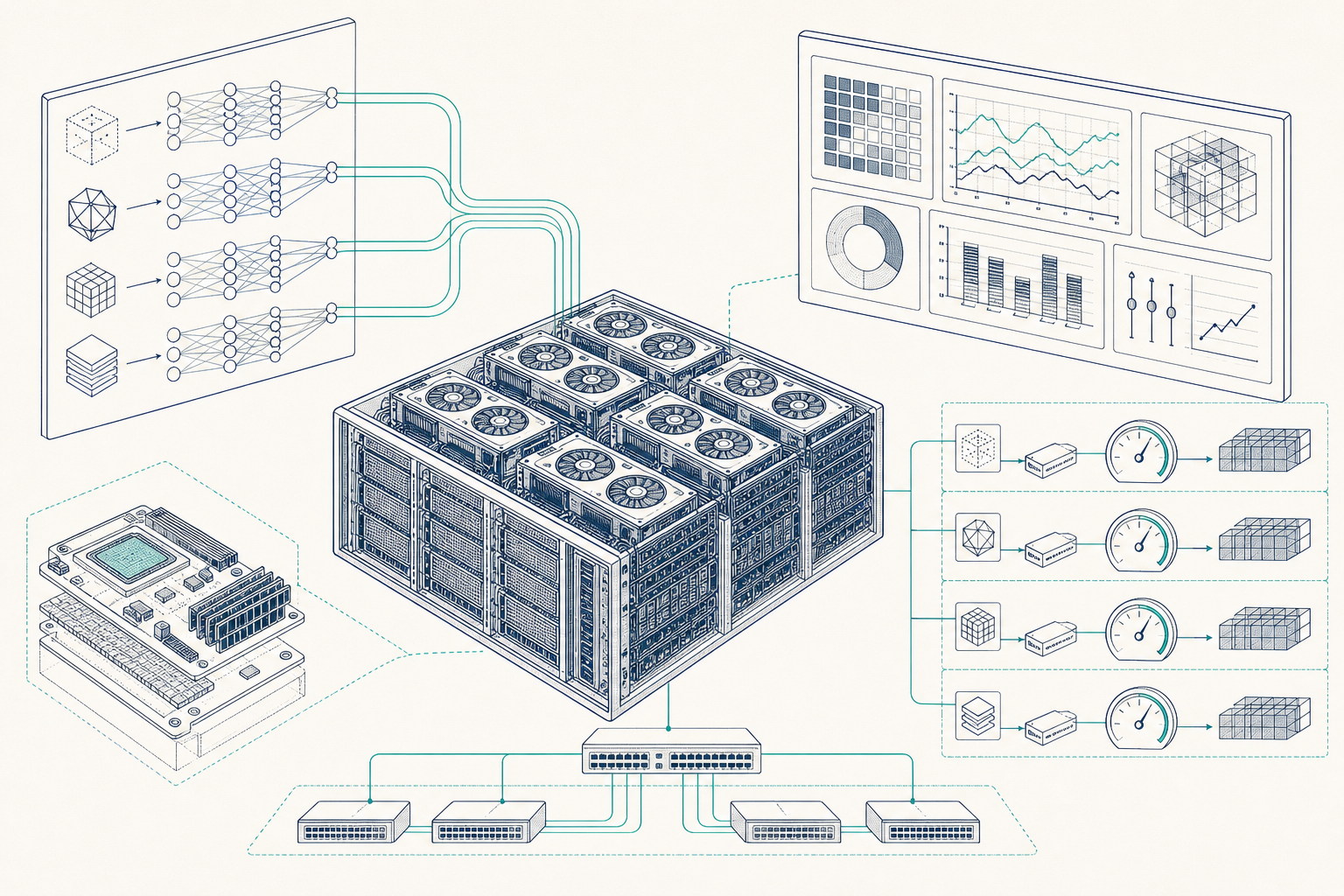
That is a different operating model from a single large model endpoint. It creates more moving parts in a small estate. A quarter rack or a few racks can run serious inference, fine-tuning, evaluation, and tenant workloads, but only if the platform is disciplined about placement, metering, warm capacity, storage, and quotas.
Arena is a useful signal because leaderboards turn model choice into an observable market. If users can compare models publicly, internal platform teams will be asked to compare them privately. The same pattern appears in banks, universities, media groups, government agencies, healthcare networks, and regional AI service providers. They need to know which model is good enough for Arabic summarization, code review, customer support, search augmentation, OCR cleanup, or legal drafting. They also need to know what each answer costs.
For operators, the bottleneck is not only GPU supply. It is the cost of keeping several models usable at once without letting evaluation traffic consume production capacity.
The operational bottleneck is model plurality
A single-model stack is relatively easy to reason about. The operator sizes the model, reserves GPUs, puts a gateway in front of the endpoint, tracks tokens, and tunes batch size. Multi-model operations are different.
A practical estate may need to serve:
- One or two large open models for sensitive data.
- Smaller models for routine chat, classification, or extraction.
- A code model for engineering teams.
- A vision-language model for document and image tasks.
- Hosted API routes for workloads where local serving is not economical.
- Evaluation jobs that replay prompts against several candidates.
- Fine-tuning or adapter training jobs that arrive in bursts.
Each model has a memory footprint, a weight location, a cold-start time, a preferred precision, and a throughput curve. Some benefit from MIG-style partitioning or other hardware partitioning. Some prefer whole accelerators. Some can tolerate time-slicing. Some should never share an accelerator because latency jitter becomes visible to the user.
This is where small and mid-size estates are exposed. Hyperscalers absorb fragmentation with scale. A regional operator with 16, 32, or 64 accelerators cannot waste 20 percent of the fleet keeping unpopular models warm. At the same time, it cannot evict every model aggressively, because cold starts produce bad service and failed internal evaluations.
The operator also has to answer commercial questions. Which tenant used the expensive model? Which department drove the evaluation run? Did a benchmark team consume production GPUs at 10 a.m.? Are hosted API calls being charged back at token cost plus margin, or hidden inside a shared budget? Is a model being kept warm for one tenant while the whole estate pays for it?
These are not AI research questions. They are infrastructure accounting questions.
What changes inside a quarter rack to a few racks
In a small GPU estate, the limiting factor is often the shape of demand rather than the absolute number of accelerators. Chat traffic is spiky. Batch evaluation is elastic. Fine-tuning is scheduled. Embedding jobs can be delayed. Production inference has latency targets. Hosted API traffic has token charges and data movement rules.
If all of this lands in a single Kubernetes cluster with loose priority classes and weak metering, the estate will look busy while commercial utilization remains poor. GPUs may show allocation, but not productive usage. Tenants may reserve full devices for workloads that could run in a partition. Evaluation may run during business hours because nobody created a policy boundary. Model weights may be copied repeatedly to local disks, delaying rollout and wasting storage.
A ClastIQ-style control plane approaches the problem from the physical fleet upward. It is designed for operators who own real hardware, not for teams abstracted away from the data center. The relevant controls are:
| Operator problem | Infrastructure control | Business result |
|---|---|---|
| Too many models kept warm | Model residency policy and eviction windows | Less idle GPU memory and fewer cold-start incidents |
| Evaluation traffic competes with production | Quotas, priority classes, and reserved pools | Production capacity remains protected |
| Tenants share GPUs without clear accounting | Per-tenant GPU-hour and token metering | Chargeback becomes auditable |
| Some workloads need VMs, others need Kubernetes | Mixed Kubernetes and VM tenancy on one fleet | Higher utilization without separate silos |
| Model weights are duplicated across nodes | Ceph-backed shared storage and caching policy | Faster rollout and lower storage waste |
| Sensitive prompts cannot leave jurisdiction | Air-gap and sovereign deployment patterns | Local governance remains enforceable |
The important point is that orchestration must understand both the infrastructure unit and the service unit. GPU-hours are not enough. Token counts are not enough. Operators need both, correlated by tenant, model, endpoint, time window, and policy class.
Routing is a capacity decision, not only an application feature
Multi-model routing is usually presented as an application layer feature. A gateway receives a prompt, scores the request, and chooses a model. That is necessary, but incomplete.
The router must know whether a local model has warm capacity. It must know whether the tenant is allowed to use a hosted API. It must know whether the workload contains data that must stay inside Oman, Saudi Arabia, the UAE, Qatar, Bahrain, Kuwait, or another jurisdiction. It must know whether the evaluation pool is full. It must know whether the tenant has exceeded a monthly token budget or a GPU-hour quota.
If the router ignores infrastructure state, it can make locally rational but operationally bad decisions. For example, it may route a low-value summarization request to a high-quality local model that is occupying full accelerators, while a smaller model could answer within policy. Or it may send a sensitive document to a hosted API because the local model is cold, even though sovereignty policy forbids it.
For GCC and MENA operators, this is not theoretical. Many organizations want local AI capability for Arabic, English, and mixed-language workloads, but they also need predictable governance. Public cloud regions may be limited, procurement may favor owned assets, and data residency can be a board-level requirement. A platform that runs on the operator's own hardware lets the routing policy reflect local law, institutional risk, and commercial pricing rather than only global API availability.
ClastIQ is hardware-agnostic, so the policy model should not assume one accelerator vendor or one partitioning method. NVIDIA MIG, AMD GPU partitioning approaches, CPU-only inference, and mixed CPU/GPU estates all need to be represented as schedulable capacity. The control plane should expose capability labels, not force every workload into one device vocabulary.
A worked example: 32 GPUs, evaluation capped, utilization improved
Consider a regional AI service provider operating 32 high-power accelerators across a few racks. The maximum theoretical monthly capacity is:
32 GPUs x 24 hours x 30 days = 23,040 GPU-hours per month.
Before introducing strict tenancy and model policy, the provider averages 42 percent billable utilization. Some GPUs are allocated but idle, evaluation jobs run during peak hours, and several models are kept warm for low-volume tenants.
23,040 GPU-hours x 42 percent = 9,677 billable GPU-hours.
Assume facility draw is 51 kW including servers, storage, networking, and cooling overhead. At $0.10 per kWh:
51 kW x 720 hours x $0.10 = $3,672 per month for facility power.
Assume depreciation, support, software operations, and data center allocation add $28,000 per month. Total monthly cost is:
$28,000 + $3,672 = $31,672.
Cost per billable GPU-hour is:
$31,672 / 9,677 = $3.27 per billable GPU-hour.
Now apply a more disciplined operating model. Production inference gets a protected pool. Evaluation is capped at 15 percent of capacity unless explicitly approved. Batch embedding and fine-tuning move to off-peak windows. Smaller models use partitions or time-slicing where latency permits. Cold models are evicted based on measured demand, not team preference. Hosted API routes are metered separately by token and tenant.
If billable utilization rises to 68 percent, monthly billable capacity becomes:
23,040 GPU-hours x 68 percent = 15,667 billable GPU-hours.
Assume the stronger control plane and operations process add $1,500 per month in operating overhead. Monthly cost becomes:
$31,672 + $1,500 = $33,172.
Cost per billable GPU-hour is now:
$33,172 / 15,667 = $2.12 per billable GPU-hour.
If the operator charges internal or external tenants $2.60 per GPU-hour for local inference capacity, monthly GPU-hour revenue is:
15,667 x $2.60 = $40,734.
At 51 kW, the estate represents 0.051 MW of facility draw. Revenue per MW-month is:
$40,734 / 0.051 = $798,706 per MW-month.
This example is not a benchmark and not a promise. It shows why utilization controls matter. The same physical estate can look constrained at 42 percent billable utilization and commercially viable at 68 percent. The difference is not only more demand. It is better separation of production, evaluation, hosted API routing, and tenant accountability.
Metering must join GPU-hours to tokens
A model-comparison workflow produces two different accounting streams. Local models consume accelerators, memory, storage bandwidth, and power. Hosted APIs consume tokens, request volume, and sometimes data transfer. If those streams are not joined, chargeback becomes political.
A useful record for each request should include:
- Tenant ID.
- User or service account.
- Model selected.
- Route type, local GPU, local CPU, or hosted API.
- Prompt tokens and completion tokens.
- GPU seconds, where applicable.
- Queue time and generation latency.
- Policy class, such as production, evaluation, development, or batch.
- Data residency class.
- Cost center and project.
This record lets finance ask the right questions. Did the research team spend $4,000 evaluating models that product never deployed? Did one tenant's evaluation create latency for another tenant's production endpoint? Are small models handling enough routine traffic to justify keeping a large model for only complex cases? Is the Arabic model route cost-effective compared with a hosted API after data residency constraints are applied?
For an operator, the answer should come from the platform, not from a spreadsheet assembled after the fact.
Quotas and policy need to be visible to tenants
Quotas should not be hidden until they block a job. Tenants need to know what they can consume, what is burstable, and what needs approval. This is especially important when evaluation teams compare several models at once.
A simple namespace policy might separate production inference from evaluation traffic:
apiVersion: v1
kind: ResourceQuota
metadata:
  name: arena-eval-quota
  namespace: tenant-arena-eval
spec:
  hard:
    requests.cpu: 64
    requests.memory: 512Gi
    requests.vendor.com/gpu-partition: 8
    limits.vendor.com/gpu-hours-monthly: 2400
---
apiVersion: scheduling.k8s.io/v1
kind: PriorityClass
metadata:
  name: eval-low-priority
value: 1000
globalDefault: false
description: Evaluation jobs yield to production inference
The resource names will vary by hardware and device plugin, which is why an operator should treat this as a pattern rather than a universal manifest. The principle is stable: evaluation has a budget, a priority, and an accounting boundary.
Operators should also expose current consumption in simple terms. A tenant should be able to see that it has used 1,700 of 2,400 monthly GPU-hours, 180 million hosted API input tokens, and 42 million output tokens. If a benchmark run will exceed quota, the team should request capacity before it starts, not after production latency rises.
Storage is part of the model-routing problem
Model plurality creates a storage problem that is easy to underestimate. A few 30 GB models are manageable. Several large weights, quantized variants, adapters, tokenizer files, evaluation datasets, logs, and cached embeddings quickly become operationally significant.
Ceph is useful in this context because it gives the operator a shared storage layer that can support model catalogs, tenant datasets, object storage, block volumes, and VM disks. The storage design still needs discipline. Hot model weights should be cached near inference nodes. Evaluation datasets should be versioned. Tenants should not be allowed to create uncontrolled replicas of the same base model. Logs that contain prompts or completions must follow retention policy.
For sovereign environments, storage policy also needs to map to data residency. A hosted API route may be allowed for public product descriptions but blocked for medical records, citizen data, legal work, or regulated financial documents. If the model router is aware of storage labels and tenant policy, it can reject the wrong route before data leaves the estate.
Why mixed VM and Kubernetes tenancy matters
Many small and mid-size GPU estates begin with one tenancy pattern, then outgrow it. AI platform teams prefer Kubernetes for autoscaling, service discovery, and endpoint deployment. Some enterprise tenants still need VMs because their software stack, license model, or security review is VM-centric. Research users may want interactive environments. Operations teams may need separate management nodes.
Splitting these use cases into separate hardware pools reduces utilization. A better pattern is to provision bare metal consistently, then offer Kubernetes and VM tenancy on the same physical fleet with clear scheduling and quota rules.
MAAS and Juju are useful primitives for this kind of estate because they support repeatable bare-metal provisioning and service lifecycle management. ClastIQ builds on that operating style: own the hardware, define the tenancy model, partition capacity where appropriate, meter usage, and keep policy close to the infrastructure.
The goal is not to make a small estate look like a hyperscaler in branding. The goal is to give it the controls that hyperscaler regions use to stay efficient: standard provisioning, isolated tenants, metered consumption, capacity reservations, policy enforcement, and operational support.
Power is a commercial metric, not only a facilities metric
GPU operators often discuss power as a constraint, but it should also be a pricing signal. If a few racks consume 51 kW and produce $40,734 per month in chargeback revenue, the estate has a measurable revenue per MW-month. If utilization drops, that metric deteriorates even if the power bill looks stable.
Power-aware scheduling can also improve service quality. Batch evaluation can run when facility conditions are favorable. Tenants with flexible jobs can receive lower rates for off-peak windows. Production inference can reserve power and cooling headroom during business hours. If the estate is in a market with variable energy pricing or constrained data center capacity, these controls become direct economic levers.
For GCC and MENA operators, revenue per megawatt is an important board-level metric. Data center power, cooling, and sovereign AI investment are tightly connected. A small GPU estate that cannot show utilization and chargeback discipline will struggle to justify expansion. A governed estate can show which tenants, models, and services turn electricity into revenue or institutional value.
What to do this week
- Inventory every model route. List local GPU models, local CPU models, hosted APIs, evaluation endpoints, and tenants. Include warm-state requirements and data residency rules.
- Separate production and evaluation capacity. Create quota and priority boundaries so comparison traffic cannot silently consume production inference headroom.
- Join token and GPU metering. Require each request to carry tenant, model, route type, policy class, token counts, and GPU seconds where applicable.
- Set a model residency policy. Decide which models stay warm, which are warmed on schedule, and which are evicted based on observed demand.
- Calculate cost per billable GPU-hour. Use facility power, depreciation, support, and operations cost. Compare current utilization with a target utilization after quotas and partitioning.
- Review sovereignty rules. Identify which prompts, documents, and datasets cannot leave the operator-controlled estate, then encode that rule into routing policy.
ClastIQ runs this on the operator's own hardware: request a demo.