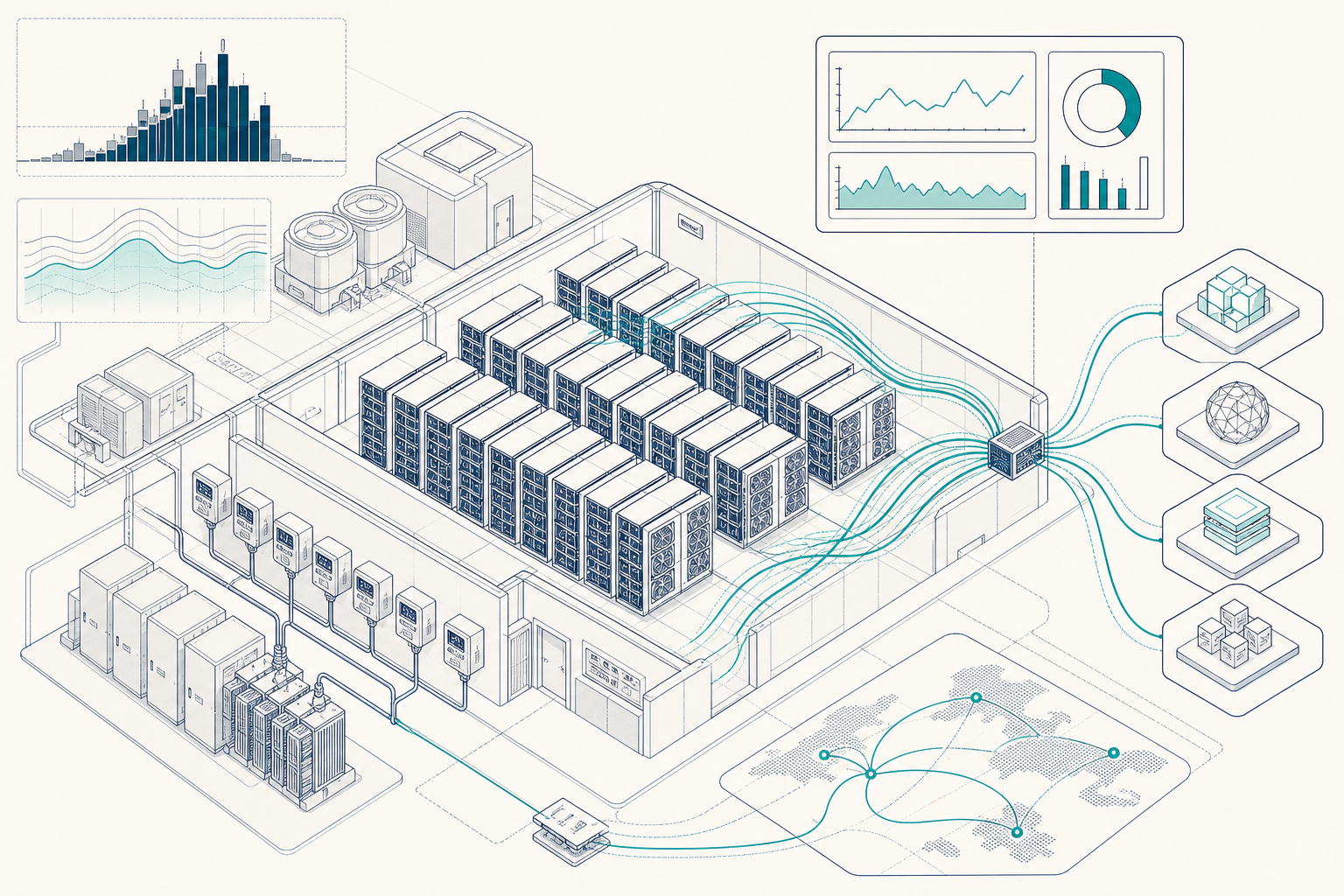
OpenAI’s Pro pause turns demand into an infrastructure question
TechCrunch reported in September 2026 that OpenAI put Pro subscriptions on hold because demand for Astra had consumed available capacity. The supplied report does not give a public GPU count, queue depth, regional breakdown, or number of affected subscribers. The important change is still concrete: a paid consumer product was constrained not by feature readiness, but by inference capacity. A subscription that normally looks like a commercial switch became a capacity-planning decision.
For GPU cluster operators, this is not only an OpenAI story. It is the pattern every operator eventually meets: demand does not rise in neat monthly steps. A model release, a government pilot, a university deadline, an enterprise demo, a gaming event, or a viral application can turn a comfortable fleet into a saturated service in hours. When that happens, the operator discovers whether the estate is a schedulable platform or just a room full of expensive accelerators.
The lesson for a quarter rack to a few racks is not to copy hyperscaler scale. It is to copy the disciplines that make scale survivable: admission control, reservations, queues, tenant isolation, chargeback, partitioning, storage locality, power awareness, and a clear policy for who gets capacity when everyone asks at once.
ClastIQ is built for that operator profile: real hardware, limited headroom, local support obligations, and no assumption that spare GPUs can be summoned from a global cloud region. The aim is to help small and mid-size GPU estates operate with the governability of a larger platform while retaining control of sovereignty, hardware choice and economics.
The bottleneck is not just GPUs
Inference shortages are often described as a GPU shortage. That is partly true, but too imprecise for operations. A demand surge stresses several layers at once.
First, it stresses scheduler placement. A fleet may have enough aggregate GPU memory, but not enough contiguous devices on the right nodes, with the right drivers, storage mounts and tenant permissions. A single large model replica may need full accelerators, while lighter workloads could run on MIG slices or time-sliced partitions. If the platform cannot express those differences, it over-allocates scarce hardware.
Second, it stresses concurrency. Inference is not only tokens per second. It is requests per second, batch windows, context length, latency objectives and failure domains. A chatbot with short prompts behaves differently from document analysis, video understanding or agent workflows that call multiple models. A burst can make the queue explode even while average daily utilization looks safe.
Third, it stresses tenancy. Small regional operators usually serve multiple internal or external tenants: an AI product team, a university lab, a government department, a bank proof of concept, and perhaps a reseller. During normal weeks, goodwill can allocate capacity informally. During a spike, informal allocation becomes a dispute. The cluster needs quotas, priorities, metering and chargeback that were agreed before the incident.
Fourth, it stresses storage and network paths. Model weights, vector indexes, checkpoints and customer data must land near compute. If every new inference pod pulls hundreds of gigabytes at the same time, Ceph, object storage, registry mirrors and east-west networking become part of the capacity problem.
Finally, it stresses power. A few racks can be constrained by cabinet density, UPS headroom, cooling limits or contractual megawatts. The business metric is not only revenue per GPU. It is revenue per constrained watt, with a policy for low-priority jobs when power or thermal headroom tightens.
What a small estate will hit first
Consider a regional operator with 32 modern accelerators across four GPU nodes, plus CPU-only nodes for control, preprocessing and storage services. This is not a hyperscaler, but it is a meaningful estate for sovereign AI pilots, enterprise inference and local research.
On a normal week, the operator may see 45% average GPU utilization. That feels healthy compared with idle labs, but it is not enough information. If utilization comes from a few long training jobs, the estate may still have no room for bursty inference. If utilization is averaged over 24 hours, peak hours may already be saturated. If utilization is measured only by device busy time, it may ignore tenants waiting in queues.
A sudden Astra-like demand pattern changes the question from “how many GPUs do we own?” to “how many GPU-hours can we admit without breaking promises?”
Assume the 32-GPU estate has 768 GPU-hours available per day. The operator reserves 20% for platform maintenance, driver rollouts, failed nodes, test deployments and emergency government workloads. That leaves 614.4 saleable GPU-hours per day. If normal contracted demand is 420 GPU-hours per day, the estate looks 68.4% committed against saleable capacity. There is headroom.
Now a consumer application spikes from 80 to 260 GPU-hours per day for three days after a launch. Total demand becomes 600 GPU-hours per day if everything else stays flat. On paper, it still fits inside 614.4 GPU-hours. In practice, it may fail because the demand arrives between 18:00 and 01:00, because the model needs full devices rather than partitions, or because the tenant has no quota that lets the scheduler pre-empt batch workloads. Without policy, the operator sees saturated nodes, angry tenants and manual intervention.
This is where capacity planning becomes a product feature.
Queueing is a business control, not only an SRE tool
A queue is often treated as a technical fallback: when the service is overloaded, requests wait. For a GPU operator, queues should be commercial controls. They express who paid for reserved service, who accepted best-effort latency, and what happens when a launch consumes more capacity than forecast.
At minimum, the platform should support three classes.
| Class | Operational policy | Commercial meaning |
|---|---|---|
| Reserved | Capacity blocked for named tenant or service window | Paid guarantee for critical workloads |
| Standard | Fair-share scheduling within quota | Normal subscription or internal allocation |
| Best effort | Runs only when spare capacity exists; interruptible | Discounted experiments, batch, non-urgent jobs |
The point is not to punish innovation. It is to prevent one successful launch from consuming the estate invisibly. If a tenant wants launch-day headroom, reserve it and meter it. If a tenant wants low cost, make the queue and pre-emption rules explicit.
In Kubernetes, this can be expressed with namespaces, ResourceQuota, priority classes and admission policy. For VM tenancy, the same principle applies through flavors, host aggregates and reservation pools. Bare metal requires even clearer policy, because a tenant can hold an entire node.
A ClastIQ-style deployment gives the operator a common control plane across bare metal provisioning, Kubernetes and VM tenancy. MAAS and Juju handle repeatable node lifecycle and service deployment. Kubernetes handles container placement and quota. VM tenancy serves workloads that need stronger isolation or legacy operating systems. The operator should not have three separate capacity stories for the same fleet.
A simple operational interface might look like this:
# reserve GPU partitions for a tenant launch window
clastiq quota set tenant-astra-demo \
  --gpu-hours-per-day 180 \
  --reserved-window 18:00-01:00 \
  --priority reserved \
  --max-full-gpu 8

# keep best-effort research jobs interruptible during the same window
clastiq policy set research-pool \
  --priority best-effort \
  --preemptible true \
  --checkpoint-storage ceph://checkpoints/research
The command is illustrative, but the operating principle is real: the launch window must be represented in the scheduler before the launch, not negotiated over chat while queues are backing up.
Partitioning decides whether scarcity is precise or wasteful
GPU partitioning is one of the strongest levers available to a small estate. Some inference services need a whole accelerator because the model is large or latency is strict. Others need only a slice. Some can tolerate time-slicing. Some should run on CPU while waiting for GPU post-processing. A hardware-agnostic platform needs to expose these options without assuming the entire estate is one vendor or one generation.
MIG, where supported, can divide a physical accelerator into isolated GPU instances. Time-slicing can improve utilization for workloads with intermittent device use, though it is not a substitute for hard isolation. CPU-only nodes can absorb tokenization, retrieval, filtering, transcoding, API gateways and control tasks so that GPU nodes do not waste cycles on work that does not require accelerators.
The operational mistake is to sell only “a GPU” as the unit. That creates waste. A tenant running small embedding jobs may consume an entire card because no smaller product exists. Another tenant with latency-critical inference may be blocked by batch jobs that could have run overnight.
A better catalog offers full GPU, partitioned GPU, time-sliced GPU and CPU tiers, each with separate metering. ClastIQ’s role is to make those tiers enforceable across the same physical estate: bare metal for tenants that need whole nodes, Kubernetes for elastic inference services, and VMs for isolated environments. Metering turns the technical partition into a chargeback line.
Worked example: chargeback and revenue per megawatt
Take the 32-GPU estate above. Assume each GPU node draws 8 kW at typical inference load, including accelerators, CPUs, memory and fans. Four GPU nodes draw 32 kW. Add 10 kW for CPU nodes, storage, networking and overhead inside the operator boundary. The estate therefore draws about 42 kW during busy hours, or 0.042 MW.
Daily electrical energy at steady busy load is:
42 kW × 24 hours = 1,008 kWh per day.
Now assume the operator has 614.4 saleable GPU-hours per day after keeping 20% operational reserve. The internal cost model allocates 0.09 OMR per kWh for energy and facility power, plus 0.70 OMR per saleable GPU-hour for hardware depreciation, support, maintenance and software operations. Daily power cost is:
1,008 kWh × 0.09 OMR = 90.72 OMR.
Allocated across 614.4 saleable GPU-hours, power contributes:
90.72 ÷ 614.4 = 0.148 OMR per GPU-hour.
Total internal cost is therefore:
0.148 + 0.70 = 0.848 OMR per GPU-hour.
If the operator charges an average of 1.25 OMR per standard GPU-hour, gross contribution before other overhead is:
1.25 - 0.848 = 0.402 OMR per GPU-hour.
At 420 GPU-hours per normal day, revenue is 525 OMR per day. At 600 GPU-hours during the surge, revenue is 750 OMR per day, if the capacity can be admitted and metered. Annualised revenue per MW at the surge-day run rate is:
750 OMR per day × 365 ÷ 0.042 MW = 6,517,857 OMR per MW-year.
That number is not a benchmark and not a promise. It is a planning lens. It shows why utilization, reservation and partitioning matter. If the same estate fails to admit the extra 180 GPU-hours because the scheduler cannot protect launch traffic from batch jobs, the operator leaves 225 OMR per day of revenue unserved while still paying for much of the power, staff and depreciation.
It also shows why chargeback must be precise. A tenant using reserved evening capacity should pay differently from a tenant using best-effort daytime fragments. Without that distinction, the operator subsidises the noisiest tenant and underprices scarcity.
Sovereignty changes the burst strategy
A global SaaS provider can sometimes route overflow to another region. A sovereign or air-gapped operator may not be able to do that. For GCC and MENA estates, this distinction is central. Public sector, regulated financial, energy, healthcare and national research workloads may have data residency requirements, procurement constraints, Arabic content governance, or explicit restrictions on cross-border processing.
That does not mean burst strategy disappears. It means the burst domains must be defined in advance.
A GCC operator might define three tiers. Tier one is local reserved capacity inside the country. Tier two is overflow to another approved in-country site operated under the same policy. Tier three is degraded service: smaller models, lower context limits, asynchronous completion, or best-effort queues. For some tenants, cross-border burst is not allowed. For others, it may be allowed only for non-sensitive workloads or synthetic test traffic.
The scheduler cannot decide this from GPU availability alone. It needs tenant metadata, data classification, workload labels and routing policy. A request containing regulated data should not be sent to an unapproved destination just because a GPU is idle there. Conversely, a public demo workload should not block sovereign production jobs if it can be routed to an approved burst pool.
ClastIQ’s relevance here is not that it replaces policy. Operators set the policy. The platform must make policy executable: namespace labels, VM projects, storage pools, quotas, audit trails and metering that reflect the operator’s legal and commercial commitments. Air-gap and sovereign deployments are not only installation patterns; they are scheduling constraints.
Storage and model distribution are part of capacity
During a demand spike, model loading can become the hidden bottleneck. If every node pulls the same model weights from a remote registry or a single storage endpoint, GPUs sit idle while the network and disks do the work. For a few-rack estate, this can look like a GPU shortage even when accelerators are free.
Operators should treat model artifacts as first-class infrastructure. Keep approved model weights in local storage. Use Ceph for resilient shared storage where appropriate, but design for read patterns. Cache hot models near GPU nodes. Separate tenant data from shared model artifacts. Keep a registry mirror inside the sovereign or air-gapped boundary. Pre-warm replicas before launch windows.
Checkpointing matters too. If best-effort jobs are pre-empted during a surge, they must be able to resume. Otherwise, pre-emption is politically difficult and economically wasteful. A research job that loses twelve hours of progress every time inference spikes will quickly become a support escalation. Ceph-backed checkpoint storage, combined with clear pre-emption classes, turns interruption into an expected service tier.
Storage metering should be linked to compute metering. A tenant that keeps 40 TB of checkpoints and vector indexes has a different cost footprint from a tenant that only consumes transient inference. Chargeback that ignores storage encourages hoarding, which eventually reduces operational flexibility.
Power is the hard ceiling
GPU estates in the quarter-rack to few-rack range often begin as IT projects and become power projects. Once the racks are installed, the operator may discover that the limiting factor is not floor space but breaker capacity, cooling, UPS autonomy or the data center’s contracted load.
This is why revenue per megawatt is a useful operating metric. It forces the operator to ask whether each watt is serving reserved, standard or best-effort demand. It also exposes the value of moving non-GPU work away from GPU nodes. Running API gateways, databases, storage daemons or preprocessing on accelerator servers may be convenient during installation, but it consumes power and thermal headroom that could support revenue-generating inference.
ClastIQ’s hardware-agnostic stance matters here. A mixed estate may include NVIDIA GPUs, AMD GPUs and CPU-heavy nodes. The orchestration layer should schedule according to capability, policy and efficiency, not brand assumption. If a CPU node can handle retrieval and filtering, use it. If a smaller GPU partition can meet latency, do not burn a full device. If a tenant requires a specific accelerator stack, meter that scarcity explicitly.
Power policy can also inform admission control. During peak tariff periods or thermal events, the platform can reduce best-effort concurrency, delay batch jobs, or route eligible workloads to another approved pool. This is not glamourous automation. It is how a small operator avoids turning every hot evening into a manual incident.
The operator-grade response to an Astra-like spike
The OpenAI Pro pause is a reminder that subscriptions are only as strong as the capacity model behind them. For regional operators, the temptation is to solve this by buying more GPUs. Sometimes that is necessary. But more hardware without orchestration usually creates a larger version of the same problem: unclear ownership, weak quotas, idle fragments, noisy tenants and no reliable chargeback.
A better response starts with the assumption that demand will surprise you. Build the platform so that surprise is absorbed by policy rather than heroics.
That means every tenant has a quota. Every quota has a unit: GPU-hours, partitions, storage, network egress, reserved windows or a combination. Every service class has an admission rule. Every burst path has a sovereignty decision. Every best-effort job can be interrupted without data loss. Every major launch has a pre-warm plan. Every invoice or internal showback report explains who used the scarce capacity.
It also means the operator can run different tenancy models on the same fleet. Some customers need bare metal. Some need Kubernetes. Some need VMs. The estate should not be split into permanent silos unless policy requires it. A few racks cannot afford stranded capacity. If Kubernetes inference is idle at night and VM research jobs can use the same accelerators within quota, the platform should allow that safely.
This is the economic center of ClastIQ: make a regional GPU estate more governable and more utilized without requiring the operator to become a hyperscaler. The hardware stays with the operator. The sovereignty boundary stays with the operator. The platform brings provisioning, orchestration, partitioning, storage, metering and support into one operating model.
What to do this week
-
Measure peak-hour utilization, not only daily average. Break usage down by tenant, workload type, accelerator type and hour. Add queue wait time as a first-class metric.
-
Create three service classes. Define reserved, standard and best-effort capacity in writing. Map each class to quotas, pre-emption rules and chargeback.
-
Run a launch-day simulation. Pick one tenant and triple its evening demand in a test plan. Check scheduler behavior, model loading, storage throughput, support workflow and customer communications.
-
Inventory partitioning options. Identify which workloads need full devices, which can use MIG or equivalent partitioning where available, which can tolerate time-slicing, and which should move to CPU nodes.
-
Define sovereign burst rules. For GCC/MENA operators, label which workloads must remain in-country or air-gapped, which can use approved in-country overflow, and which can degrade rather than burst.
-
Tie chargeback to scarcity. Price or show back reserved GPU-hours, best-effort fragments, storage consumption and launch-window capacity separately.
ClastIQ runs this operating model on the operator’s own hardware. Request a demo.