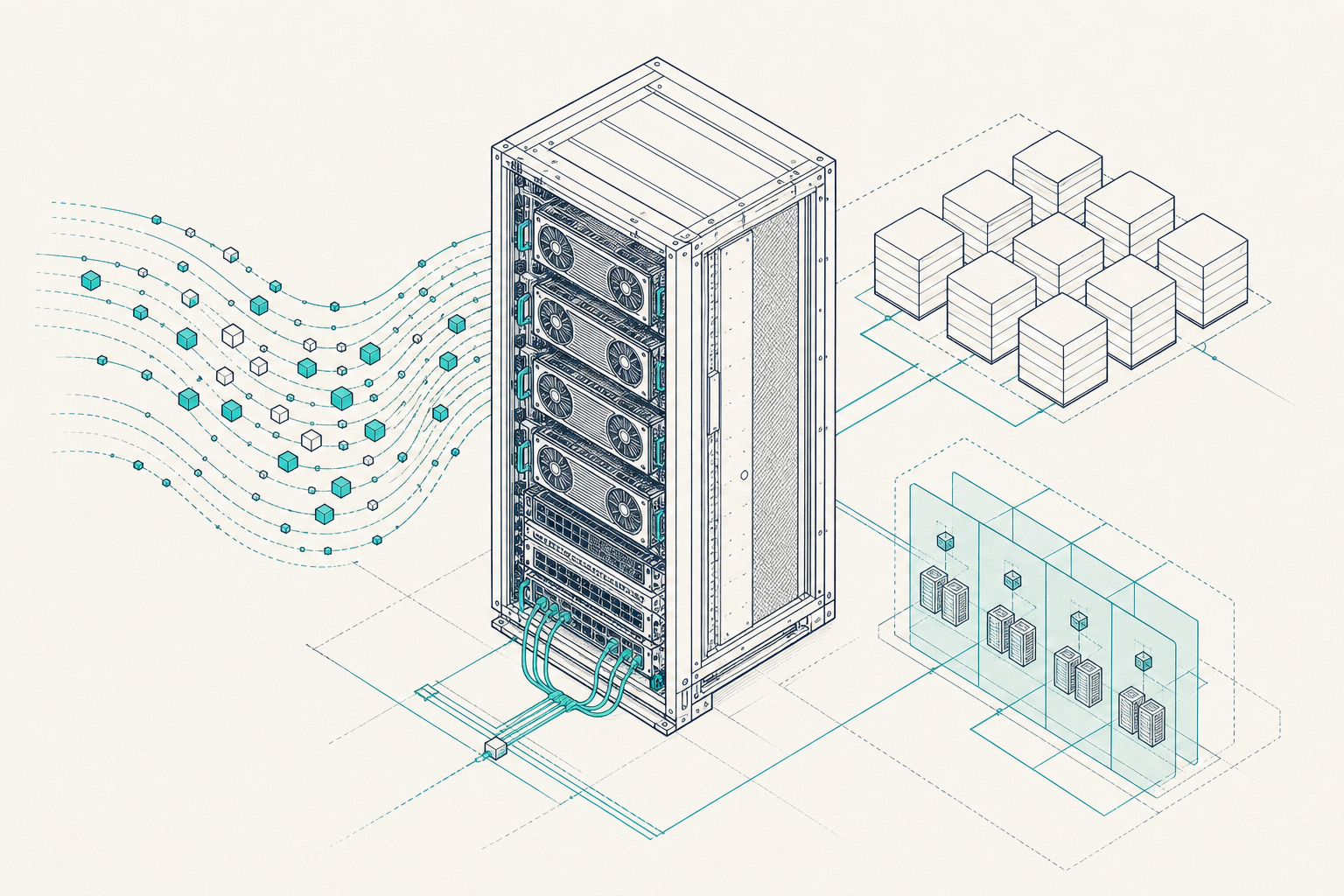
Beam moves open reasoning from model choice to cluster design
Reflection AI unveiled Beam on 5 October 2026, positioning it as an open-weight reasoning model intended to compete with Chinese open models at lower compute cost, according to TechCrunch. The date matters because the open model discussion has been moving quickly from research leaderboard selection to operations. If a model with stronger reasoning can be served, fine-tuned, or adapted on local hardware, then universities, banks, ministries, hospitals, energy firms, and national labs have a different buying question. They are no longer asking only which API to call. They are asking whether their own GPU estate can become an institutional AI factory without losing control of data, budget, and utilization.
For a small or mid-size operator, from a quarter rack to a few racks, Beam should not be read as a simple invitation to buy more GPUs. A reasoning model changes the operating profile. It can run longer generations. It can carry larger context. It can grow the KV cache per request. It can make prefill and decode phases behave differently under load. It can create bursts when users submit agentic tasks, code tasks, legal reviews, or Arabic and English document workflows that request multi-step answers. The bottleneck becomes tokens per second per watt, not only raw GPU count.
Open weights also change tenancy. A single organization may want one shared base model, several department-specific adapters, and separate serving classes for production, evaluation, and experimentation. One tenant may need low-latency inference. Another may need overnight fine-tuning. A third may need secure retrieval over local documents. Without hard quotas and metering, the loudest project consumes the cluster, and the operator is left with anecdotal utilization rather than chargeback.
This is where an orchestration layer such as ClastIQ is relevant. ClastIQ is designed for operators that own real hardware but are not hyperscalers. It joins bare-metal provisioning with MAAS and Juju, Kubernetes and VM tenancy on the same fleet, GPU partitioning through MIG or time-slicing where the hardware supports it, Ceph storage, per-tenant metering, chargeback, quotas, and policy engineering. The point is not to claim a Beam benchmark. The point is to make the cluster ready to measure Beam, serve it under policy, and decide whether local operation is economic.
The first bottleneck is not the GPU, it is the serving shape
A reasoning model usually stresses four dimensions at the same time.
First, prefill cost rises with prompt length. Enterprise prompts are rarely short. They include system instructions, retrieved documents, policy text, conversation history, and formatting rules. The prefill phase can saturate compute and memory bandwidth before decoding even begins.
Second, the KV cache grows with context and concurrency. The operator may have enough GPU memory for one or two users, then fail at twenty concurrent users because every live sequence reserves cache. Quantization can help, but it does not remove the need to profile memory per sequence at the intended context length.
Third, decode throughput drives the user experience. If a model is advertised as lower compute, the operator still needs tokens per second at the batch sizes and sampling settings that real users require. A model that is efficient at batch 1 may be less attractive if the cluster earns its keep at high concurrency.
Fourth, fine-tuning competes with inference. A local AI factory is not a static endpoint. Teams will want adapters, evaluation runs, synthetic data generation, red teaming, retrieval indexes, and regression tests. These jobs have different scheduling behavior from production inference. They consume GPU-hours, storage IOPS, and sometimes entire nodes.
The practical question for a quarter-rack operator is therefore: can production inference stay inside a latency budget while customization jobs run on the same fleet? If the answer depends on manual Slack messages and spreadsheet reservations, the operation will not scale.
What a small estate should measure before declaring success
A local Beam deployment should begin with a measurement catalog, not a launch announcement. At minimum, the operator should record model size and quantization, context length, prompt length distribution, output length distribution, request rate, concurrency, prefill throughput, decode throughput, time to first token, total latency, GPU memory consumed by weights, GPU memory consumed by KV cache, CPU utilization, network throughput, storage reads, and power draw.
The cluster view matters more than a single benchmark line. An operator needs to know whether two replicas on one host beat one larger replica, whether tensor parallelism is worth the interconnect cost, whether a smaller quantized variant improves revenue per watt, and whether a separate fine-tuning pool is required. It is common for the answer to change once real tenant behavior appears.
A short benchmark run can be useful if it is repeatable and tied to chargeback. For example:
MODEL=/models/reflection/beam
PORT=8000

vllm serve "$MODEL" \
  --host 0.0.0.0 \
  --port $PORT \
  --max-model-len 32768 \
  --gpu-memory-utilization 0.88

vllm bench serve \
  --backend vllm \
  --model "$MODEL" \
  --base-url http://127.0.0.1:$PORT \
  --dataset-name sharegpt \
  --num-prompts 512 \
  --request-rate 16 \
  --save-result
The command is not a production design. It is a controlled starting point. The important step is to put the output into the same metering system that records GPU-hours, power, storage, and tenant identity. A benchmark that cannot be compared to cost is only a lab note.
| Operator question | Measurement | Why it matters | Control plane response |
|---|---|---|---|
| Can Beam serve peak traffic? | Time to first token, output tokens per second, p95 latency | Users feel decode delay first | Add replicas, cap context, tune batching |
| Is KV cache the limiter? | GPU memory per live request at target context | Concurrency can fail before compute is full | Set max context by tier, reserve larger GPUs for long context |
| Can teams customize safely? | Fine-tuning GPU-hours, adapter storage, queue delay | Training jobs can starve inference | Separate quotas, scheduled windows, preemptible pools |
| Is local operation economic? | Cost per billable GPU-hour, tokens per kWh | Hardware value depends on utilization | Chargeback, quotas, power-aware scheduling |
| Is data staying in jurisdiction? | Tenant, dataset, model, and storage placement logs | Sovereignty requires evidence | Air-gap operation, local Ceph, policy audit |
Tenancy is the real product boundary
Open weights make institutional ownership possible, but ownership creates administrative duties. Who can download the weights? Who can run them? Which tenant can fine-tune? Which dataset can be used? Where are checkpoints stored? How long are prompts retained? Which workloads are production, research, or billable external services?
A small cluster becomes fragile when every workload is treated as a privileged exception. The control plane has to expose standard tenant shapes. One tenant may receive a Kubernetes namespace with a GPU quota and a Ceph-backed object bucket. Another may receive VMs for a data science environment. A production service may receive a node pool with reserved GPUs, a service-level policy, and a metering label that maps usage to a cost center. A research team may receive a lower-priority time-sliced pool that can be preempted if production inference needs capacity.
This is why ClastIQ supports Kubernetes and VM tenancy on the same fleet. Some teams are ready for containers and model servers. Others need a VM because their toolchain, security review, or license workflow is not container-native. For the operator, the important point is that both tenancy styles consume from the same physical estate and must be governed by the same quota, power, and chargeback policies.
GPU partitioning is also a tenancy control, not only a performance feature. On suitable NVIDIA hardware, MIG can carve a GPU into isolated slices for smaller inference or development tasks. On other hardware, or for workloads that do not fit MIG, time-slicing can increase access for bursty jobs. AMD and mixed CPU and GPU estates require their own scheduling and device plugin realities. The platform should not assume one vendor. It should treat accelerators as allocatable resources with policies, labels, and measured consumption.
A worked example for a 32 GPU estate
Consider a regional operator running 32 data center GPUs across a few racks. Assume the GPU servers, CPUs, memory, storage, switching, and cooling overhead inside the room average 35 kW of IT load. With a facility PUE of 1.25, the facility draw is 43.75 kW. Over a 30 day month, that is 43.75 kW times 720 hours, or 31,500 kWh. At $0.09 per kWh, the monthly power cost is $2,835.
The cluster has 32 GPUs times 720 hours, or 23,040 capacity GPU-hours per month. Suppose depreciation, support contracts, rack fees, software operations, and local staff allocation total $60,000 per month. The total monthly operating cost is therefore $62,835. If every GPU-hour were usable and billable, the cost floor would be $62,835 divided by 23,040, or $2.73 per capacity GPU-hour.
Now apply real utilization. Before disciplined tenancy, the estate averages 35 percent billable utilization because GPUs sit idle between projects, fine-tuning blocks production, and some teams reserve full nodes for small jobs. Billable usage is 23,040 times 0.35, or 8,064 GPU-hours. The effective cost per billable GPU-hour is $62,835 divided by 8,064, or $7.79.
After policy changes, assume the operator reaches 68 percent billable utilization. This is not a benchmark claim, only an arithmetic target. The same estate now produces 23,040 times 0.68, or 15,667 billable GPU-hours. The cost per billable GPU-hour falls to $62,835 divided by 15,667, or $4.01.
If the operator charges internal or external tenants $5.00 per GPU-hour, monthly GPU usage revenue is 15,667 times $5.00, or $78,335. Add a small storage charge, for example 20 TB of Ceph-backed tenant data at $12 per TB-month, and that tenant segment adds $240. The material change is not the storage line. It is the utilization shift.
Revenue per facility megawatt also becomes visible. At 43.75 kW, the estate draws 0.04375 MW. Monthly GPU usage revenue of $78,335 divided by 0.04375 MW equals about $1.79 million per MW-month. Annualized, that is about $21.5 million per MW-year. If utilization falls back to 35 percent at the same rate, monthly revenue is 8,064 times $5.00, or $40,320, which is about $0.92 million per MW-month. Same hardware, same power envelope, different operating discipline.
This example is deliberately simple. It excludes financing costs, taxes, bandwidth, spare parts, and model engineering labor. It also ignores token-based pricing. The lesson still holds. A lower-compute model only improves economics if the operator can convert the saved capacity into more served tenants, shorter queues, or lower power draw.
How ClastIQ maps the Beam problem to controls
For Beam or any comparable open-weight reasoning model, the operator needs a chain of controls from bare metal to invoice.
Bare-metal provisioning gives the estate a consistent base. MAAS can inventory and provision machines, while Juju can model services and lifecycle operations. This matters when the fleet is mixed. GPU nodes, CPU nodes, storage nodes, and management nodes should not be handmade one by one.
Kubernetes provides the serving plane for model servers, routers, metrics collectors, retrieval services, and batch jobs. VM tenancy provides compatibility for teams that need traditional environments. The same hardware pool can serve both when quotas and placement rules are enforced centrally.
GPU partitioning gives the scheduler more shapes to sell or allocate. A small adapter test does not always need a whole GPU. A production Beam endpoint may need full devices, while evaluation jobs may tolerate time-sliced access. The policy should express the difference.
Ceph gives local storage for model weights, adapters, datasets, retrieval indexes, logs, and checkpoints. In an air-gapped or sovereign environment, local object and block storage are not optional. They are part of the compliance boundary.
Metering and chargeback turn behavior into economics. A tenant that asks for 64k context, high concurrency, and priority scheduling should see the cost. A tenant that runs overnight on lower-priority capacity should receive a different rate. Without this feedback loop, every workload becomes urgent and oversized.
Quota and policy engineering protect production. The operator can set maximum context by tier, reserve GPUs for inference, limit fine-tuning hours per tenant, require approval for large checkpoint writes, and isolate sensitive datasets. These controls are administrative, technical, and financial at the same time.
Power visibility links AI to the data center. For GCC and MENA operators, this is especially relevant. Power availability, cooling design, sovereign data policy, and local support capacity often decide whether a GPU project survives beyond the pilot. A small estate in Muscat, Riyadh, Doha, Abu Dhabi, Manama, Kuwait City, or Cairo may not have hyperscaler elasticity, but it can still run a disciplined local AI factory if it treats power and utilization as first-class metrics.
Fine-tuning without starving production
The most common failure mode after an open-weight model arrives is enthusiasm-driven contention. A research group starts adapter training. A product team begins load testing. A compliance team runs document summarization. A director asks for a demo. Production inference slows down, but nobody can prove which workload caused the problem.
The fix is not to ban experimentation. The fix is to make experimentation schedulable. A cluster can define production inference as reserved capacity, development inference as burstable capacity, and fine-tuning as queued capacity. Jobs can be labeled by tenant, project, data classification, and billing code. Checkpoints can be written to tenant-specific Ceph buckets with retention rules. Evaluation runs can be scheduled after office hours if they are not urgent.
Adapters are particularly useful for small estates because they reduce the need to duplicate full model weights for every tenant. However, they introduce versioning and provenance questions. Which base model was used? Which dataset created the adapter? Which evaluation suite approved it? Which tenant can load it into production? The storage layer and the orchestration layer must carry that metadata.
A practical policy is to require every fine-tuning job to declare its maximum GPU count, wall time, storage target, and expected output artifact. If it cannot declare these, it runs in a sandbox quota first. Once measured, it can graduate to a larger pool. This keeps the cluster open to users while protecting production inference from unbounded experiments.
Sovereignty and air-gap are operating models, not labels
Open weights are attractive to sovereign operators because the model can be run inside local infrastructure. But sovereignty is not achieved by downloading a checkpoint. It requires placement control, identity control, update control, and audit evidence.
In an air-gapped deployment, model weights, packages, container images, benchmark datasets, and security updates must move through a controlled import process. The platform must know which versions are approved. It must be possible to rebuild nodes, redeploy services, and restore storage without reaching an external cloud. Local support matters because the failure domain is local.
For GCC and MENA institutions, this can align with national data residency, sector regulation, and procurement preferences. A ministry may require local Arabic document processing. A bank may require customer data to remain in country. An oil and gas operator may require edge or campus operation near sensitive engineering data. A university may want shared access across faculties without sending research data abroad. The common requirement is not a slogan. It is a controlled hardware estate with measurable usage and enforceable policy.
ClastIQ's role in that setting is to run the control plane on the operator's own hardware, not to move the workload into a hidden external region. The operator keeps the fleet, the data, and the policy boundary. The platform supplies the structure for provisioning, tenancy, metering, quota, storage, and support.
What to do this week
-
Build a Beam evaluation plan around workload shapes, not only accuracy. Include prompt length, output length, concurrency, p95 latency, KV-cache memory, and power draw.
-
Create three tenant classes before onboarding users: production inference, development inference, and fine-tuning. Give each class a quota, priority, storage policy, and chargeback rate.
-
Run a repeatable serving benchmark on your own hardware and store the result with GPU-hours, kWh, model version, quantization, and dataset notes.
-
Decide which jobs can use partitioned or time-sliced GPUs and which jobs require full devices. Encode that choice in scheduler policy rather than operator memory.
-
Price internal usage from real capacity math. Start with monthly cost, capacity GPU-hours, expected utilization, and a target reserve for support and spares.
-
Test the air-gap path. Import weights, containers, adapters, and updates through the same process you would use in production, then rebuild one node from scratch.
ClastIQ runs this on the operator's own hardware. request a demo