What changed
TechCrunch reported on 16 September 2026 that Anthropic is merging Claude chat and Cowork into one interface. The practical signal is not only a product-design change. It is a workload-shape change. A chat surface that used to serve short interactive turns is being joined with agentic workspaces that can hold context, execute longer plans, call tools, run code, inspect files, and continue work after the first prompt.
For GPU cluster operators, that matters because interactive inference and long-running agent work are not the same tenant behavior. They may arrive through the same user interface, authenticate through the same identity provider, and be paid for by the same department, but they stress the estate differently. Interactive chat is latency-sensitive and bursty. Agentic work is more likely to be sessionful, tool-heavy, storage-attached, and persistent. It can occupy GPU slices, CPU cores, RAM, scratch storage and network egress long after the human has stopped watching the screen.
The product trend is wider than one vendor. The market is collapsing separate modes (chat, code assistant, research assistant, workflow runner, data agent) into fewer user surfaces. That is convenient for users and dangerous for under-governed infrastructure. The interface becomes simpler while the scheduler’s job becomes harder.
A hyperscaler absorbs this by hiding queues, spreading jobs over many regions, enforcing account limits, and pricing every unit. A quarter rack or a few racks cannot rely on statistical smoothing at the same scale. If a small estate allows one team’s agents to reserve GPU capacity without admission control, another team’s interactive inference will see tail latency rise, queues deepen, and confidence in the platform fall.
The operator-grade conclusion is direct: once chat and agentic work converge, multi-tenancy stops being a nice-to-have. It becomes the control plane for economic survival.
The bottleneck is not only model speed
Small and mid-size GPU estates often begin with a simple allocation model: reserve whole nodes for teams, run Kubernetes for some workloads, keep a few bare-metal machines for experiments, and use manual coordination for priority conflicts. That can work while usage is human-paced. It breaks when the same users start launching agents that behave more like background workers than chat clients.
The first failure mode is starvation. An agent tasked with analyzing a repository, preparing a financial report, or iterating on synthetic-data generation may hold a GPU allocation for hours. It might not fully use the accelerator every minute, but the reservation still blocks others. Interactive inference then waits behind workloads that are not latency-critical.
The second failure mode is invisible utilization. Operators may see high allocated GPU time but low useful work. A GPU can be reserved by a notebook, a container, a VM, or an agent runtime while spending much of its time idle between tool calls. If billing or chargeback only counts node ownership, the estate looks busy while revenue per megawatt stays weak.
The third failure mode is weak isolation. Agentic systems read files, call tools, write artifacts, and may connect to internal services. Tenants need separation across compute, storage, network policy, secrets, logs and metering. GPU isolation alone is not enough.
The fourth failure mode is sovereignty drift. In GCC and MENA markets, many organizations operate under data-residency, sector-regulatory, or sovereign-cloud requirements. If internal teams cannot get reliable capacity on the owned estate, they will push work to external APIs or overseas clouds. The infrastructure problem then becomes a governance problem.
A few racks can deliver excellent value, but only if the control plane treats GPU time as a governed resource rather than a pile of expensive devices.
What changes inside the cluster
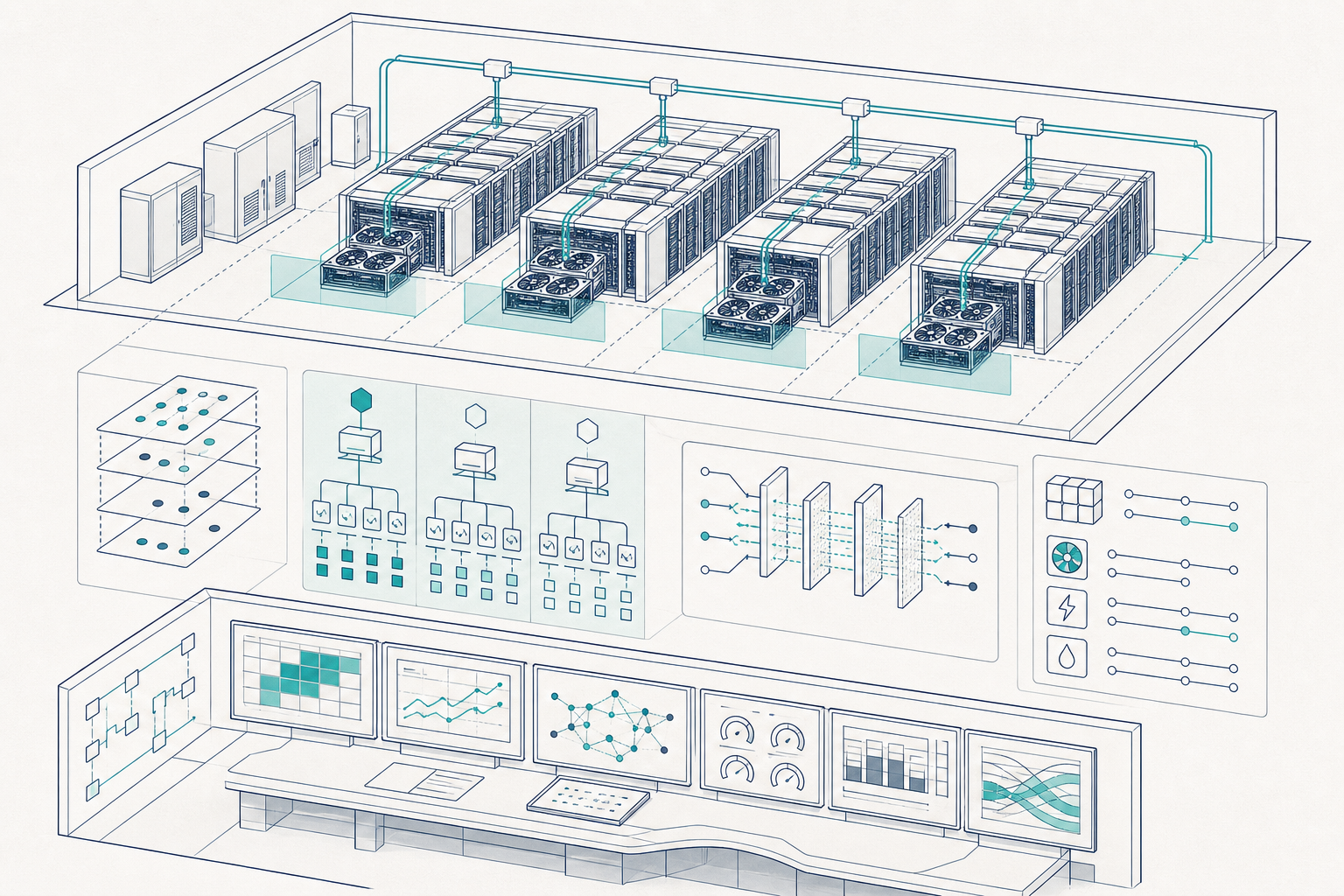
When chat and agents share one interface, the estate needs to classify work before it lands on GPUs. At minimum, operators should distinguish:
| Workload class | Operator objective | Common controls |
|---|---|---|
| Interactive inference | Low latency and predictable response | reserved pools, priority classes, admission limits |
| Agentic sessions | throughput with bounded runtime | quotas, preemption, time limits, checkpointing |
| Fine-tuning and batch | high utilization off peak | queues, scheduled windows, lower priority |
| Development notebooks | flexibility without hoarding | idle culling, namespace quotas, small slices |
| VM tenancy | strong separation for teams or customers | project quotas, storage limits, metered GPU passthrough |
The right answer is not to ban long-running agents. They are valuable. The answer is to stop letting them compete unmanaged with latency-sensitive inference.
This is where bare-metal provisioning, Kubernetes, VM tenancy, GPU partitioning, Ceph storage, quota engineering and metering need to act as one operating model rather than separate tools.
On a Clastiq-style deployment, the fleet begins with hardware inventory and provisioning. MAAS can discover and provision physical servers. Juju can model and operate the platform components. Kubernetes can run containerised inference, agent runtimes and platform services. VM tenancy can support teams that need stronger boundaries, custom kernels, licensed software stacks, or legacy environments. Ceph provides shared and block storage for artifacts, model weights, datasets and tenant volumes.
The important point is that all of these layers must be tied back to tenant identity, quota and chargeback. Otherwise the operator has automation, but not governance.
Admission control before acceleration
The critical control is admission. By the time a workload has already occupied a whole GPU, the platform is negotiating from a weak position. Admission control asks a few questions before placement:
- Which tenant owns this request?
- Is the workload interactive, agentic, batch, development, or VM-based?
- What GPU type or capability is required?
- Can it run on a partition, or does it need a full device?
- How long may it run before checkpoint, preemption or termination?
- What storage and network access does it require?
- What budget or quota will it consume?
The policy should be boring and explicit. For example, a research team may have 200 GPU-hours per week for agentic work, a maximum of four concurrent GPU partitions during office hours, and access to a larger queue overnight. A customer-support AI team may have a reserved interactive pool from 08:00 to 20:00. A batch fine-tuning team may have cheaper priority after 22:00.
A simplified Kubernetes example might look like this:
kubectl create namespace tenant-research
kubectl -n tenant-research create quota agent-quota \
  --hard=requests.cpu=160,requests.memory=640Gi,limits.nvidia.com/gpu=8,pods=80
kubectl -n tenant-research label namespace tenant-research \
  clastiq.io/tenant=research clastiq.io/class=agentic
kubectl -n tenant-research annotate namespace tenant-research \
  clastiq.io/monthly-gpu-hour-budget=2400 \
  clastiq.io/preemptible-after=180m
The exact syntax will vary by scheduler, GPU plugin and policy engine. The operating principle should not vary: a workload enters with a class, a tenant, a budget, and a runtime expectation.
Partitioning is an economic tool
GPU partitioning is often described as a technical feature. For operators, it is an economic tool.
Some interactive inference workloads need only a fraction of a modern accelerator. Some agent steps are CPU-heavy and touch the GPU only during model calls. Some development sessions need a small slice for testing. If every one of these receives a full device, the estate will show high allocation and poor return.
On NVIDIA estates, Multi-Instance GPU can divide supported GPUs into hardware-isolated instances. Time-slicing can share devices where hard partitioning is not available or not suitable. On AMD and mixed estates, the operator still needs equivalent scheduling policy around available partitioning, device plugins, node labels, and workload classes. Clastiq’s position is hardware-agnostic: the goal is to expose the right unit of acceleration to the right tenant, whether the fleet is NVIDIA, AMD, CPU-heavy, or mixed.
Partitioning policy should follow workload behavior:
- small interactive models can use small slices with strict latency monitoring;
- agentic work can use bounded partitions and checkpointable runtimes;
- large model serving can reserve full devices or groups of devices;
- notebooks should default to smaller allocations and expand only by request;
- VM tenants should receive metered passthrough or mediated access according to contract.
The operator should also avoid treating partitioning as a way to overcommit blindly. A cluster can be sliced into unusable fragments. The aim is to increase completed useful work per watt, not to make a dashboard look full.
A worked utilization and chargeback example
Consider a 32-GPU estate in one or two racks. Assume the full platform draws an average of 32 kW IT load under normal operation, and the facility power usage effectiveness is 1.3. The facility load is therefore 41.6 kW. Over a 30-day month, energy use is:
41.6 kW × 720 hours = 29,952 kWh.
At USD 0.10 per kWh, monthly electricity is USD 2,995. That is not the whole cost. Suppose hardware finance, support, space, networking and operations add USD 72,000 per month. Total monthly estate cost is then USD 74,995.
The raw capacity is:
32 GPUs × 720 hours = 23,040 GPU-hours per month.
Before workload controls, assume the estate bills or allocates only 11,520 useful GPU-hours per month, equal to 50 percent of raw capacity. The internal cost is:
USD 74,995 ÷ 11,520 = USD 6.51 per useful GPU-hour.
Now add admission control, GPU partitioning, idle culling for notebooks, reserved interactive pools, and overnight queues for agentic and batch work. If useful billable usage rises to 18,432 GPU-hours, equal to 80 percent of raw capacity, the cost becomes:
USD 74,995 ÷ 18,432 = USD 4.07 per useful GPU-hour.
If the operator uses an internal chargeback rate of USD 5.25 per GPU-hour, monthly recovered value is:
18,432 × USD 5.25 = USD 96,768.
That creates USD 21,773 above the assumed monthly cost, available for spares, expansion, support, or price reduction. The same estate at 41.6 kW facility load produces a chargeback run-rate of:
USD 96,768 ÷ 0.0416 MW × 12 = USD 27.9 million per MW-year.
The number is not a universal benchmark. It depends on hardware, power price, financing, support model, utilization and the local market. But the direction is the point. A small estate cannot change the purchase price of accelerators after deployment. It can change how many useful, metered, tenant-attributed GPU-hours it extracts from every kilowatt.
That is the difference between owning expensive equipment and operating a GPU cloud.
Storage and state become first-class
Agentic work is stateful. It creates plans, intermediate files, embeddings, logs, tool outputs, code changes and evaluation artifacts. If the platform only meters GPU time, it misses a growing part of the cost and risk.
Ceph or another operator-controlled storage layer should be integrated into tenancy from the beginning. Tenants need quotas for object, block and file use. Snapshots should have retention policy. Model weights should be cached without giving every team uncontrolled copies. High-churn scratch data should sit on the right tier. Sensitive datasets should have placement and access controls aligned with the organization’s rules.
This matters in sovereign deployments. A ministry, bank, telco, university or energy company in Oman, Saudi Arabia, the UAE, Qatar, Kuwait, Bahrain, or the wider MENA region may be comfortable operating its own estate but unable to send certain data to a foreign region. In that context, the local cluster must provide more than raw GPUs. It must provide auditable tenancy: who used which model, on what data, with which storage path, for how long, and under which policy.
Air-gap support also changes operations. Package repositories, model registries, container images, drivers, firmware, observability tools and security updates need a controlled import process. Agentic platforms increase this requirement because they often depend on toolchains and connectors. The operator should decide what is available inside the boundary, not discover it when a workflow fails.
Kubernetes and VMs on the same fleet
Many GPU estates split early: Kubernetes for platform teams, VMs for enterprise tenants, and bare metal for special projects. The split becomes political and inefficient if capacity cannot move between modes.
A better model is to provision the same physical fleet through a common inventory and policy layer, then expose capacity as bare metal, Kubernetes nodes, or VM hosts according to demand. Some tenants will need Kubernetes-native inference services. Others will need VMs because their software stack is not container-ready or because isolation requirements are stronger. Some hardware may need to be temporarily reprovisioned for firmware work, benchmarking, or private model training.
The operator’s job is to keep the accounting consistent across modes. A VM with GPU passthrough still consumes GPU-hours, CPU, RAM, storage, power and support. A Kubernetes pod with a MIG slice still consumes a tenant budget. A bare-metal reservation still needs start and stop dates. If each mode has its own spreadsheet, chargeback will be contested.
Clastiq’s architecture is aimed at this mixed reality: bare-metal provisioning, Kubernetes, VM tenancy, GPU partitioning, Ceph storage, policy and metering tied together on the operator’s own hardware. It is not a claim that every workload should run the same way. It is a claim that every workload should be governed under the same operational ledger.
Power is a scheduling constraint
Power is often treated as a facilities issue until the cluster hits a breaker, a cooling limit, or an expansion ceiling. For a few-rack GPU estate, power should be part of scheduling and business planning.
If agentic work can run overnight, schedule it when interactive demand is lower and cooling conditions may be better. If the site has a contracted power cap, reserve headroom for interactive inference and critical tenants. If certain nodes are less efficient, place lower-priority work accordingly or retire them from GPU-heavy service. If a tenant wants guaranteed capacity, include the power reservation in the commercial model.
Revenue per megawatt is a useful forcing function because it connects infrastructure to economics. A cluster with high benchmark performance and low tenant utilization is a poor business asset. A cluster with slightly older hardware but strong metering, high occupancy, predictable latency and enforceable quotas may be the better estate.
For GCC operators, this metric is especially relevant. Data centers compete for power allocations, cooling design, land, network proximity and regulatory trust. GPU estates that can prove utilization and chargeback discipline will have a stronger case for expansion than estates that can only show nameplate accelerator count.
What Clastiq resolves
The infrastructure response to merged chat and agent work is not a single feature. It is an operating pattern.
Clastiq brings the pieces together for operators who own the hardware: MAAS and Juju for bare-metal provisioning and model-driven operations; Kubernetes and VM tenancy on the same fleet; GPU partitioning through MIG, time-slicing or the appropriate hardware-specific mechanism; Ceph storage for tenant data and artifacts; quota and policy engineering; metering and chargeback; and deployment patterns for air-gapped or sovereign environments.
For a quarter rack, that may mean stopping the first wave of agent workloads from consuming the entire estate. For a few racks, it may mean turning departmental demand into a measurable internal GPU service. For an operator selling capacity, it may mean making tenant isolation and invoices credible before adding more hardware.
The key is to install governance before demand becomes chaotic. Once users experience a single interface that can chat, reason, call tools and run workflows, they will not naturally think in GPU-hours, storage classes, partition sizes or power envelopes. The platform must think that way for them.
What to do this week
- Classify current GPU workloads into interactive inference, agentic sessions, batch, notebooks and VM tenancy. Do not rely on team names alone.
- Set initial quotas for each tenant: concurrent GPUs or slices, monthly GPU-hours, storage, runtime limits and priority class.
- Create a reserved pool for latency-sensitive inference and keep long-running agents out of it unless explicitly approved.
- Turn on tenant-level metering for GPU-hours, CPU, memory, storage and power attribution where available.
- Review idle notebook and agent sessions, then implement culling, checkpointing or preemption rules.
- For sovereign or air-gapped sites, audit which models, images, package repositories and tools must be available inside the boundary.
Clastiq runs this operating model on the operator’s own hardware. Request a demo.