COFE Tech’s funding round turns commerce AI into an infrastructure question
COFE Tech, a Kuwait-founded company serving businesses across the Gulf, announced a pre-IPO funding round at a 178 million US dollar valuation at LEAP 2026 on September 2, 2026, according to Wamda. The company is positioning itself beyond consumer coffee ordering and into AI-powered procurement and commerce infrastructure for more than 1,000 businesses across the Gulf.
That is the relevant change for infrastructure operators. This is not only an application story. It is a signal that agentic procurement, supplier matching, order routing, catalogue intelligence, credit checks, fraud controls, document processing and conversational purchasing will move from experiments into production workflows used by real businesses. Those workflows do not look like a single training job. They look like many tenants, many short inference bursts, retrieval-heavy pipelines, occasional batch jobs, audit requirements and data boundaries that matter in GCC procurement.
For a quarter-rack to few-rack GPU estate in the GCC, the bottleneck is not simply whether there are enough GPUs. The bottleneck is whether an operator can run enterprise AI commerce workloads with clear segregation, predictable access, metered consumption and sovereign controls, while still keeping expensive accelerators busy enough to make the site pay for itself.
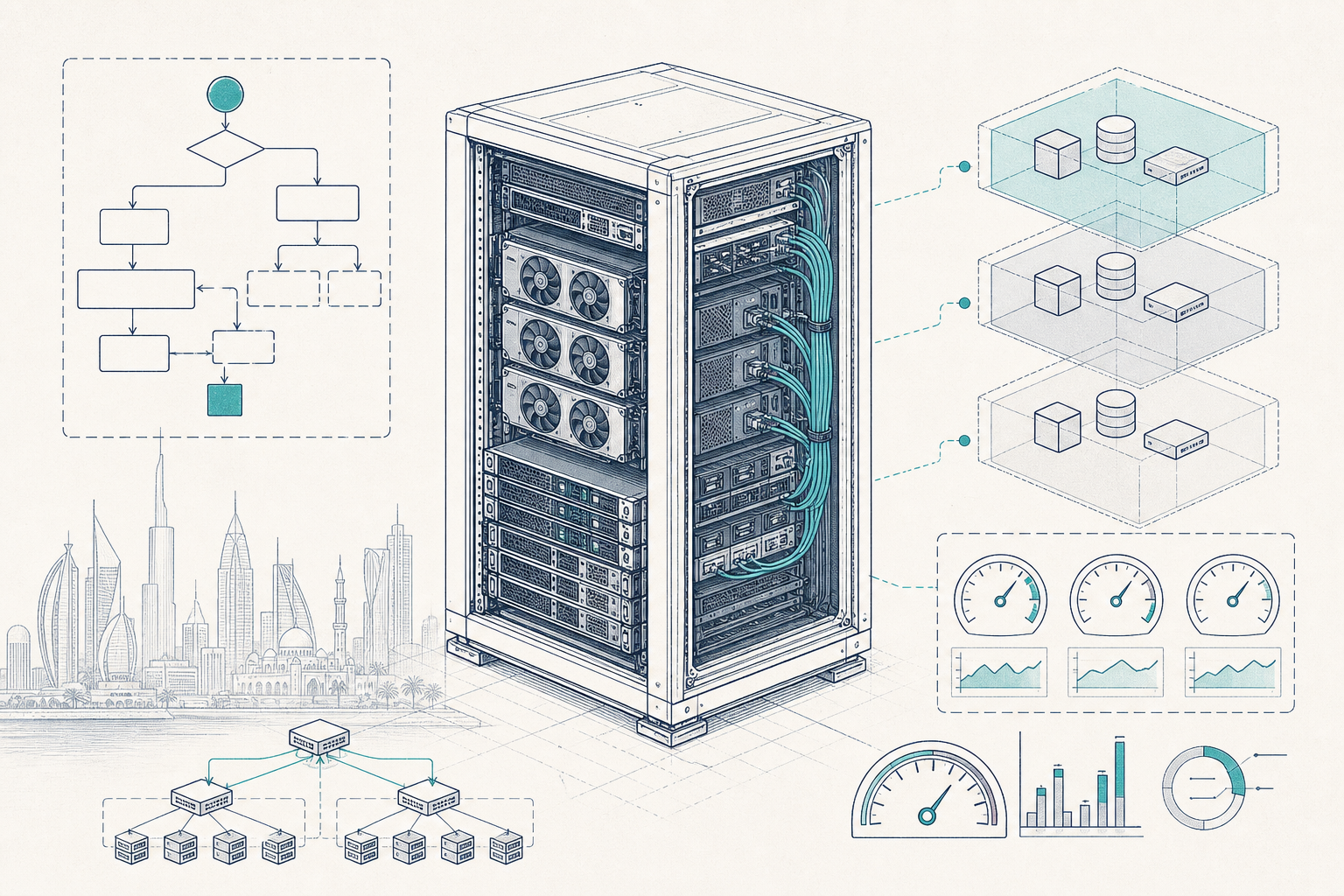
A platform such as ClastIQ is aimed at that operating layer: bare-metal provisioning, Kubernetes and VM tenancy on the same fleet, GPU partitioning, Ceph storage, quota and policy engineering, metering and chargeback, air-gap and sovereign deployment patterns, and local human support on the operator’s own hardware. The point is to turn a small or mid-size estate into something governable enough for enterprise workloads without pretending it is a hyperscaler region.
Why agentic procurement stresses small estates
Agentic procurement and commerce systems create a difficult shape of demand. A procurement agent may perform catalogue search, call a language model, extract fields from supplier documents, run policy checks, rank quotes, trigger approval workflows and generate emails or purchase-order drafts. Each step may use a different compute profile.
Some steps are CPU-heavy. Some need a small GPU slice for low-latency inference. Some need a full GPU for document vision models. Some need storage throughput for retrieval-augmented generation. Some need to run inside a customer-specific VM because the integration endpoint, audit tooling or data-handling policy requires it. A single enterprise tenant can therefore consume Kubernetes pods, VM capacity, object or block storage, network egress and GPU time in the same business process.
This is where many small estates hit the first operational wall. They can run one good demo namespace. They can run one team’s notebooks. They can run one VM with a GPU passed through. But when ten or twenty businesses need isolated inference endpoints, separate procurement data, different quotas and monthly usage reports, the estate needs tenancy discipline.
In the GCC, that discipline is not optional. Procurement flows carry supplier identities, pricing, trade terms, invoices, tax documents and approval chains. For government-linked entities, regulated sectors and large family groups, the questions will be practical: where is the data stored, who can administer the cluster, how are tenants separated, how is usage billed, and can the service keep running if disconnected from an external control plane.
The applied infrastructure requirement is therefore multi-tenant workload segregation and metering for agentic procurement flows. It sounds narrow. In practice it touches the entire stack.
The bottleneck is not only GPU supply
A few racks can contain meaningful compute. The problem is that unmanaged shared compute decays quickly. One tenant leaves a batch job running. Another pins an entire GPU for a small chatbot. A third wants a VM because its ERP connector is not containerised. A fourth needs a private object bucket for invoice PDFs. The operator then starts solving everything manually: spreadsheet allocations, hand-created namespaces, SSH access, manual invoices and late-night reboots.
That model does not survive enterprise AI commerce.
The better operating model is to treat the fleet as a governed resource pool. Bare metal is provisioned consistently. Kubernetes handles elastic services and batch jobs. VMs support tenants or appliances that need stronger isolation or legacy integration. GPU partitioning allocates the right amount of accelerator to each workload. Storage is tenant-aware. Policies stop noisy neighbours. Metering records consumption. Chargeback turns usage into a commercial signal.
For an operator serving GCC businesses, this is also a sovereignty model. The estate can sit in-country or in a controlled regional facility. Images, packages and control services can be prepared for air-gapped or restricted environments. Operational support can be delivered locally rather than through an offshore-only model. None of this removes the need for good application design, but it makes the infrastructure credible.
A reference pattern for a few-rack commerce AI estate
A small estate for agentic procurement does not need to imitate a hyperscaler. It needs clean boundaries and repeatable operations. One workable pattern is:
| Layer | Operator concern | Control to implement |
|---|---|---|
| Bare metal | Repeatable rebuilds and hardware inventory | MAAS-style provisioning and hardware profiles |
| Tenancy | Different businesses and internal teams | Kubernetes namespaces plus VM projects |
| GPU access | Bursty inference and occasional heavier jobs | MIG where available, time-slicing, passthrough or full-device allocation |
| Storage | Procurement documents and retrieval indexes | Ceph block, file or object pools with tenant quotas |
| Policy | Noisy neighbours and runaway agents | ResourceQuota, admission rules, priority classes and network policy |
| Metering | Billable consumption and internal chargeback | GPU-hours, CPU-hours, RAM-hours, storage GB-months and egress records |
| Sovereignty | GCC data and operational control | Local deployment, air-gap options and controlled admin access |
ClastIQ brings these controls together for operators who own the hardware. MAAS and Juju provide a repeatable base for bare-metal and service lifecycle operations. Kubernetes and VM tenancy can share the same fleet rather than forcing a hard choice between container-native workloads and VM-only enterprise integration. Ceph provides storage that can be carved into tenant-specific pools and quotas. GPU partitioning can use hardware features such as MIG where supported, time-slicing where appropriate, and full-device assignment where a workload needs it. The platform is hardware-agnostic across NVIDIA, AMD and mixed CPU/GPU estates, so the operating model is not tied to one accelerator supplier.
The important part is not any single component. It is the integration. Metering must understand that a tenant consumed a quarter-GPU slice for inference, a VM for ERP integration, and object storage for procurement documents. Quotas must prevent an agentic workflow from scaling itself into every available accelerator. Storage policy must ensure tenant data does not become a shared scratch directory. Rebuild workflows must make failed nodes boring rather than existential.
Worked example: why utilisation and chargeback matter
Consider a GCC operator with eight GPU servers in two racks. Each server has four accelerators, for 32 GPUs total. The estate is used for procurement agents, document extraction, RAG services and some batch analytics. Assume the monthly all-in cost allocated to the GPU platform is 82,000 US dollars. That includes hardware depreciation or lease allocation, facility power, cooling, support, networking, storage and operations labour. The exact number will vary, but the arithmetic is what matters.
There are 32 GPUs x 24 hours x 30 days = 23,040 available GPU-hours per month.
If the estate runs at 28 percent average billable GPU utilisation, it produces:
23,040 x 0.28 = 6,451 billable GPU-hours per month.
The effective cost per used GPU-hour is:
82,000 / 6,451 = 12.71 US dollars per used GPU-hour.
At that utilisation, a tenant paying 8 dollars per GPU-hour looks profitable on a rate card but is actually being subsidised by idle capacity. Now apply partitioning, queueing, quotas and tenancy discipline. Small inference endpoints move to GPU slices or time-shared devices. Batch document extraction is scheduled outside peak interactive windows. Idle notebooks are culled. Tenants receive quotas instead of open access. The average billable utilisation rises to 65 percent.
23,040 x 0.65 = 14,976 billable GPU-hours per month.
The effective cost per used GPU-hour becomes:
82,000 / 14,976 = 5.48 US dollars per used GPU-hour.
At the same 8 dollar internal or external chargeback rate, monthly chargeback becomes:
14,976 x 8 = 119,808 US dollars.
Now include power density. Suppose the two-rack platform draws 38 kW of IT load and the facility PUE is 1.4. Facility load is:
38 kW x 1.4 = 53.2 kW, or 0.0532 MW.
Annualised chargeback at 65 percent utilisation is:
119,808 x 12 = 1,437,696 US dollars.
Revenue or recovered cost per MW-year is:
1,437,696 / 0.0532 = 27.0 million US dollars per MW-year.
This is not a benchmark and it is not a promise. It is the operator’s arithmetic. A small estate can be economically weak at 28 percent utilisation and commercially credible at 65 percent, using the same hardware, if tenancy and scheduling improve. Agentic procurement workloads make this urgent because they generate many small and medium jobs that waste full GPUs unless they are partitioned and governed.
Segregation for procurement agents
The first practical design decision is tenant shape. For procurement AI, a tenant might be a customer, a business unit, a ministry programme, a portfolio company or an application provider serving many downstream customers. The estate should not rely on naming conventions alone. It needs enforced boundaries.
On Kubernetes, each tenant should receive namespaces, quotas, network policy and access controls. On the VM side, each tenant should receive projects or pools with defined GPU assignment rules, images and storage volumes. Storage should map to the same tenant identity so that a deleted namespace does not leave sensitive procurement files in an unmanaged bucket.
A simple Kubernetes quota is not enough for the whole platform, but it is a useful control at the edge. For example:
apiVersion: v1
kind: ResourceQuota
metadata:
  name: tenant-procurement-a
  namespace: procurement-a
spec:
  hard:
    requests.cpu: 64
    requests.memory: 256Gi
    limits.cpu: 96
    limits.memory: 384Gi
    requests.nvidia.com/gpu: 4
    persistentvolumeclaims: 20
    requests.storage: 20Ti
---
apiVersion: v1
kind: LimitRange
metadata:
  name: default-container-limits
  namespace: procurement-a
spec:
  limits:
  - type: Container
    default:
      cpu: 4
      memory: 16Gi
    defaultRequest:
      cpu: 1
      memory: 4Gi
In a ClastIQ design, this type of control is part of a wider policy model. The quota may correspond to a commercial plan, an internal cost centre or a sovereign workload class. The metering layer then records actual consumption against that identity. The operator can show that tenant A used 920 GPU-hours, 11,000 CPU-hours, 8 TB-months of Ceph object storage and 3 TB of egress in a billing period. That is the difference between shared infrastructure and chargeable infrastructure.
Partitioning is where money is lost or recovered
Agentic commerce systems usually do not need a full high-end accelerator for every step. A small language model endpoint, embedding service or classifier may need predictable latency but not a whole GPU. Document vision extraction may need more memory for short bursts. Fine-tuning or batch analytics may need full devices for scheduled windows.
The operator needs multiple allocation modes:
- Full GPU assignment for heavy jobs, sensitive tenants or VM passthrough.
- Hardware partitioning where the accelerator supports it, such as MIG on compatible NVIDIA devices.
- Time-slicing for smaller inference jobs where strict hardware isolation is not required.
- CPU-only pools for orchestration, ETL, API gateways and business logic.
- Dedicated storage pools or classes for high-throughput retrieval and archive workloads.
The wrong default is to give every tenant a full GPU because that is easiest to understand. That creates low utilisation and poor revenue per megawatt. The other wrong default is to overcommit every device without policy, which creates unpredictable latency and tenant disputes. The operator-grade answer is to publish allocation classes and meter them differently.
For example, a small procurement assistant may receive a fractional inference class with a latency SLO and a monthly quota. A document extraction tenant may receive burst capacity during off-peak hours. A regulated customer may pay for dedicated full-device allocation and a dedicated storage pool. These are product and policy decisions, but they require the infrastructure platform to enforce them.
Storage and audit are part of the GPU service
Procurement AI is document-heavy. Purchase orders, supplier catalogues, invoices, delivery notes, trade licences, tax records and approval attachments become part of the AI pipeline. The GPU estate therefore needs storage policy, not just accelerator scheduling.
Ceph is useful here because it can provide object, block and file patterns from the same storage foundation, with quotas and replication policies designed for the operator’s failure domains. A tenant might use object storage for PDFs and scanned invoices, block volumes for vector databases, and file storage for shared batch inputs. Metering should include GB-months and possibly IOPS or throughput classes where those are commercially relevant.
Audit also matters. Agentic procurement systems make recommendations and may trigger business actions. Operators should retain infrastructure-level records: which tenant ran which workload, when it consumed GPU resources, which storage pool it accessed, and which administrative identities changed policy. This is not the same as application audit, but it supports incident response and customer trust.
In GCC and MENA markets, this connects directly to sovereign deployment requirements. Some buyers will not accept sensitive procurement data leaving the country. Others may require local administration, restricted remote access or disconnected operation. A platform that can be installed on the operator’s own hardware, including air-gapped patterns, lets the operator answer those requirements without redesigning the whole estate for each customer.
Kubernetes and VMs on the same fleet
A common mistake is to make the estate either a Kubernetes platform or a virtualisation platform. Agentic procurement will need both. New inference services, retrieval pipelines and batch jobs fit Kubernetes well. ERP connectors, legacy middleware, Windows-based tools, vendor appliances or stricter isolation requests may require VMs.
Keeping these on separate hardware pools can strand capacity. One rack has idle GPUs but the VM cluster is full. Another has CPU headroom but the Kubernetes cluster cannot use it. ClastIQ’s model is to orchestrate Kubernetes and VM tenancy on the same physical fleet, with bare-metal provisioning underneath. That lets the operator rebalance hardware roles as demand changes.
For a quarter rack, this can be the difference between selling a service and saying no. A small operator may not have spare nodes for every new tenancy model. If nodes can be reprovisioned, assigned and metered consistently, the fleet becomes more liquid. Hardware failures are also easier to absorb because rebuilds follow a known path rather than a one-off installation memory held by one engineer.
GCC operator implications
COFE Tech’s move matters because it points to applied AI demand inside Gulf commerce, not only model development. If procurement agents become part of B2B transaction infrastructure, regional operators will be asked to host or integrate similar workloads close to customers, under local policy, with commercial accountability.
The questions to prepare for are concrete:
- Can each enterprise tenant prove where its procurement data resides?
- Can the operator provide monthly metering by tenant and workload class?
- Can GPU access be offered in smaller units than a whole device?
- Can VMs and Kubernetes services share the same capacity plan?
- Can quotas stop an autonomous workflow from consuming the fleet?
- Can the platform run without depending on an external cloud control plane?
These questions are not unique to coffee, retail or procurement. They apply to logistics, healthcare purchasing, public-sector tendering, industrial spare parts and hospitality supply chains across GCC and MENA. The common feature is a many-party business process with sensitive documents, variable demand and a need to translate AI usage into a bill or internal cost allocation.
For operators, the opportunity is not to claim hyperscaler scale. It is to offer credible regional capacity: governed, metered, sovereign and close to the businesses using it. That requires a platform view of the GPU estate, not a pile of servers.
What to do this week
- Map your current tenants and classify them as Kubernetes, VM, bare-metal or mixed. If the answer is unknown, you do not yet have a tenancy model.
- Calculate available GPU-hours per month and current billable utilisation. Use the 32 GPU example above as a template, but replace every number with your own.
- Define three GPU allocation classes: fractional or time-sliced inference, full-device jobs, and dedicated regulated capacity. Attach a draft chargeback rate to each.
- Review storage paths for procurement-style documents. Identify where tenant quotas, retention rules and audit logs are missing.
- Test one namespace-level quota and one VM-level quota for a real internal workload. Measure whether metering can follow the tenant across both.
- Check your sovereignty posture: image sources, package mirrors, remote access, admin roles, backup location and whether the platform can operate during restricted connectivity.
ClastIQ runs this orchestration, partitioning, tenancy and metering model on the operator’s own hardware: request a demo.