Two transactions, one operating pattern
Dealroom reported that Nebius bought Inferize, a 10 month old Israeli startup, for up to $130 million. Inferize was focused on making AI models start faster and run with lower latency. On October 23, 2026, TechCrunch reported that Daytona, an agent cloud startup, reached a $1 billion valuation with backing from FirstMark and a long list of angel investors.
Read separately, these are startup financing and acquisition stories. Read together, they describe a practical infrastructure shift. AI platforms are no longer only trying to keep a few large training jobs fed. They are trying to start models quickly, keep execution environments warm, run many small stateful tasks, and meter usage without losing control of expensive accelerators.
For operators of quarter rack to few rack GPU estates, this matters more than the headline valuations. A hyperscaler can absorb cold-start waste by spreading it over a large fleet. A regional operator, enterprise AI lab, university center, bank, energy company, or sovereign cloud in the GCC and MENA cannot. If 8, 32, or 128 GPUs are the estate, then every image pull, model load, sandbox boot, failed admission, and idle MIG slice shows up in utilization and chargeback.
The new bottleneck is not simply GPU supply. It is the coordination cost around GPUs: images, local storage, queueing, tenancy boundaries, admission control, quotas, and metering. A system such as ClastIQ is built for that layer on hardware the operator owns, across NVIDIA, AMD, and mixed CPU and GPU fleets.
What changed at the infrastructure level
Model startup used to be treated as an application detail. A notebook user pulled a container, loaded weights from shared storage, warmed a runtime, and waited. For low concurrency this was tolerable. For agentic workloads it breaks down.
An agent platform may launch thousands of short lived or medium lived jobs. Each job may need a sandbox, a browser, a code runner, a vector index, tool credentials, a model endpoint, and persistent state. Some tasks need a full GPU for seconds. Some can use a partition. Some are CPU heavy with occasional GPU bursts. Some require isolation because they execute untrusted code. Some must remain inside a national boundary because the prompt, file, or generated artifact is regulated.
The Nebius and Inferize story points at cold start as a first class platform problem. The Daytona story points at agent execution as a stateful, fragmented workload problem. Together, they create a direct requirement for small and mid-size GPU estates: keep models and execution environments close to compute, then admit jobs only when the right accelerator slice, storage path, and security boundary are available.
If an operator treats every job as a generic Kubernetes pod or a generic VM, the estate becomes noisy. GPUs sit allocated but underused. Tenants complain about latency. Storage fills with duplicate images. Queues favor whoever submits the most jobs. Finance cannot explain why a department consumed 40 percent of the power budget but paid for 15 percent of the service.
The bottleneck a small estate will hit first
A few rack estate typically hits one of five constraints before it runs out of theoretical GPU FLOPS.
| Constraint | Operator symptom | Control to add |
|---|---|---|
| Cold model start | Users wait minutes before first token or first inference | Hot image cache, local model cache, pre-warmed runtimes |
| Fragmented jobs | Many small agent tasks block larger inference work | Queue classes, backfill policy, GPU partitioning |
| Weak isolation | Untrusted code runs near shared credentials or data | Sandboxed tenancy, VM and Kubernetes separation |
| Poor chargeback | GPU allocation is billed, but real use is unknown | GPU-second, token, storage, and egress meters |
| Power contention | Racks hit power limits before revenue targets | Admission control tied to power and quota policy |
This is not solved by buying a bigger model server. The platform must decide where a job lands, whether it deserves a full accelerator, whether a partition is enough, whether local NVMe contains the right model, whether the tenant has quota, and whether the job can run in a shared cluster or must run in an isolated VM.
That is the orchestration problem beneath the acquisition and funding news.
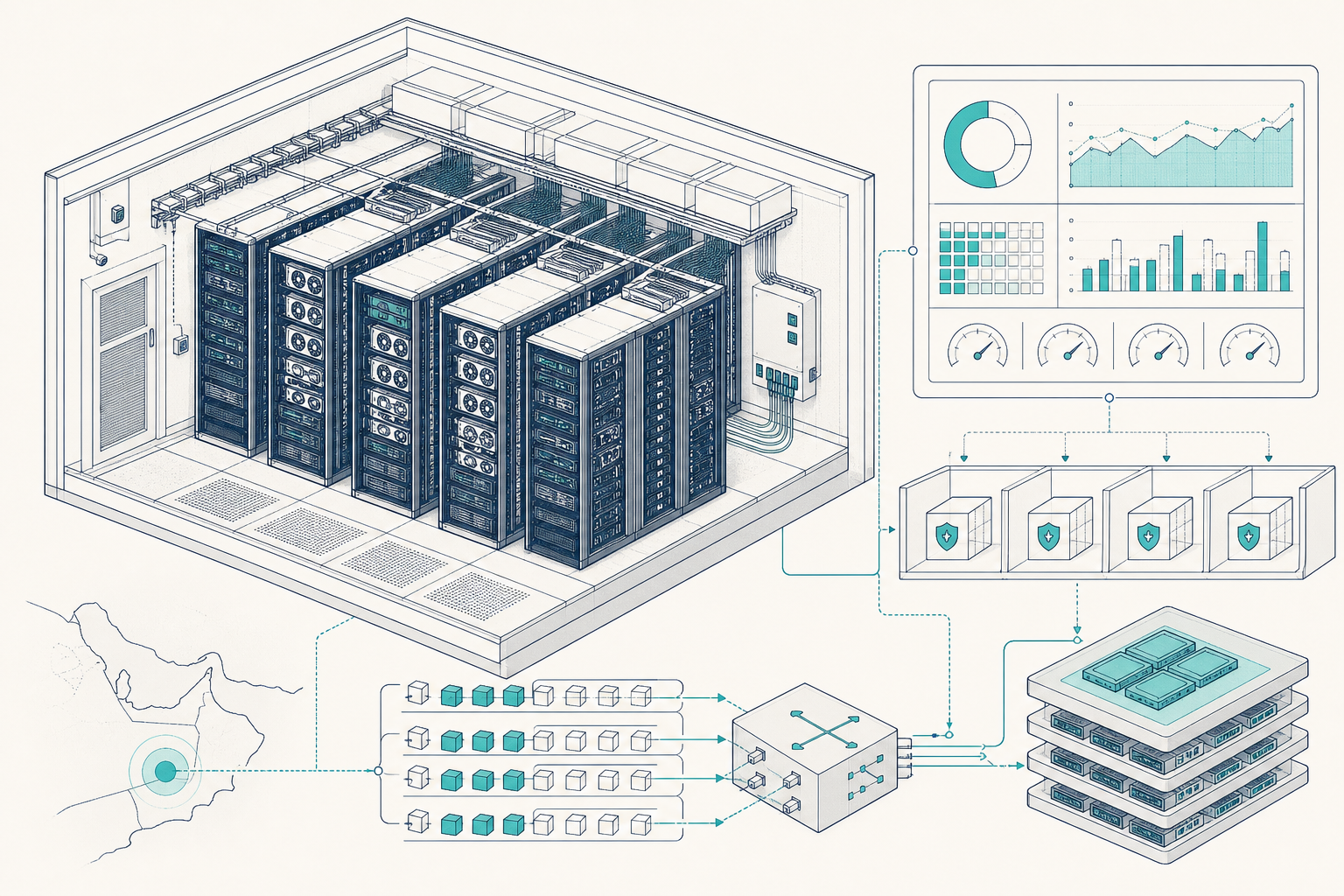
Reference architecture for a regional GPU estate
Consider a GCC or MENA operator with two racks of mixed GPU and CPU servers. Some accelerators are optimized for large inference. Others are older but still useful for embeddings, fine tuning, batch transcription, video analytics, or internal agents. The operator serves tenants from government, education, finance, media, and energy. Some tenants require data residency. Some need air-gap operation. Some want Kubernetes. Others want VMs because their security team understands VM boundaries and images.
A practical architecture has seven layers.
First, bare-metal provisioning. Hardware should be discoverable, reprovisionable, and recoverable without manual installs. MAAS provides bare-metal lifecycle control. Juju provides model driven deployment of platform services. The objective is repeatability: a node can be drained, reimaged, returned to a pool, or assigned to a dedicated tenant without an operator rebuilding it by hand.
Second, a shared fleet with multiple tenancy modes. Kubernetes should run elastic containers and microservices. VMs should run stricter tenant environments, legacy workloads, or agent sandboxes that require stronger isolation. The same physical estate should support both, with policy determining placement.
Third, accelerator partitioning. Large jobs may need full GPUs. Agent workers, embeddings, routing models, or small inference endpoints may fit in MIG style partitions, time-sliced devices, or vendor equivalent partitioning. The platform should remain hardware-agnostic. The policy question is not which logo is on the accelerator, it is whether the job requires exclusive memory, exclusive compute, predictable latency, or best effort throughput.
Fourth, storage locality. Ceph provides resilient shared storage for tenant volumes, images, artifacts, and datasets. Local NVMe provides the fast path for images, model weights, compiled kernels, and hot scratch. Cold-start control depends on deciding what belongs in Ceph and what must be staged onto local NVMe.
Fifth, queue classes. Not every job deserves the same scheduling treatment. Interactive inference, agent tool execution, batch evaluation, fine tuning, and data preparation should have different queues, limits, retry rules, and preemption behavior.
Sixth, admission control. A job should not start simply because a pod can be created. It should start when quota, GPU partition, memory, local cache state, storage class, power headroom, and tenant policy all agree.
Seventh, metering. GPU-second metering shows accelerator occupancy. Token metering shows inference volume. Storage metering shows persistent footprint. Queue delay shows service quality. Without all four, chargeback becomes political rather than operational.
Cache design for cold starts
Cold starts waste both user time and accelerator time. The usual sequence is inefficient: pull container image, attach volume, read model weights over the network, initialize runtime, compile kernels, then finally accept work. On a small estate, this can consume the same GPUs that should be serving users.
A better design separates the cache layers.
Container images should be mirrored inside the site. In a sovereign or air-gapped deployment, the image catalog should be curated, scanned, signed, and replicated through an approved path. The operator should avoid letting every tenant pull large images from the public internet during business hours.
Model weights should be stored in Ceph as the durable source of truth, then staged to local NVMe on selected nodes. Popular models should be pinned. Less common models should be fetched on demand and evicted by policy. The scheduler should be cache aware: if model A is already hot on node 7, an inference replica for model A should not be scheduled randomly onto node 12 unless there is a stronger reason.
Runtime artifacts also matter. Compiled kernels, tokenizer files, agent base environments, browser layers, and Python wheels can each add seconds or minutes. Operators often optimize the model file and ignore the rest of the startup path.
A simple node label pattern helps express this to scheduling and operations teams:
kubectl label node gpu-node-07 clastiq.io/local-nvme=true
kubectl label node gpu-node-07 clastiq.io/cache-class=hot
kubectl label node gpu-node-07 clastiq.io/tenant-zone=sovereign-a
kubectl -n tenant-a create quota agent-quota --hard=pods=600,requests.cpu=240,requests.memory=900Gi
The exact labels and quota keys will vary by implementation. The operating principle is stable: expose locality, tenancy, and limits as schedulable facts, not tribal knowledge.
Queue classes for fragmented agent work
Agent workloads are awkward because they are both small and stateful. One user request can fan out into code execution, retrieval, web automation, document conversion, model calls, and validation. Many of those steps do not need a whole accelerator. Some do not need a GPU at all. Others need a short GPU burst with low latency.
For a small estate, queue design is the difference between useful utilization and gridlock.
A workable policy might define four queue classes. Interactive inference receives the strictest latency target and a reserved accelerator pool. Agent sandbox tasks get high concurrency but limited GPU burst rights. Batch evaluation gets backfill access when the estate is quiet. Fine tuning gets scheduled windows because it can monopolize memory and storage bandwidth.
The mistake is to let agent tasks flood the same pool that serves customer facing inference. Thousands of agent jobs can occupy CPU, memory, volumes, and network ports while holding small GPU reservations. The GPUs may look allocated while real work is delayed.
ClastIQ resolves this through quota and policy engineering across Kubernetes and VM tenancy. A tenant can receive a maximum number of pods, VM instances, GPU partitions, full GPUs, persistent volumes, and concurrent jobs. Policies can distinguish between guaranteed and best effort capacity. A finance tenant can have a sovereign isolated pool. A university tenant can have best effort partitions for student experiments. An internal support agent can have strict CPU limits and no access to sensitive storage classes.
Isolation is part of utilization
It is tempting to treat isolation as a compliance cost that reduces utilization. In agent systems, isolation protects utilization.
If tenants run untrusted code in weakly separated containers, one incident can force an operator to pause a shared environment, rotate credentials, audit volumes, and rebuild nodes. That outage destroys more utilization than a properly isolated VM pool would have cost.
A mixed tenancy design gives the operator choices. Kubernetes handles high density trusted services. VMs handle stricter tenant boundaries, regulated applications, or untrusted agent execution. Bare-metal pools can be assigned to a tenant with special security or performance requirements. The key is to meter all of them consistently, so a VM tenant is not invisible to the same chargeback system that measures Kubernetes users.
For GCC and MENA operators, this is a central requirement. Public sector, defense adjacent, energy, telecom, health, and financial workloads may have national data residency, procurement, or audit constraints. Cross-border cloud regions may not be acceptable for prompts, documents, voice recordings, or derived embeddings. A local GPU estate must therefore deliver not only compute, but also evidence of where the work ran and which tenant boundary applied.
Air-gapped and sovereign deployments are not edge cases in this market. They are normal buying patterns. That changes patching, image import, model catalog approval, support workflows, and incident response. The platform must be operable by local teams, with human led support, on the operator's own hardware.
Worked example: utilization and chargeback
Take a 32 GPU estate in a regional data center. The average facility draw for the GPU racks, CPUs, storage, networking, and cooling allocation is 70 kW. The operator has three monthly cost lines:
Hardware amortization: $33,333 per month Power: 70 kW x 720 hours x $0.10 per kWh = $5,040 per month Operations allocation: $8,000 per month
Total monthly cost is $46,373.
The estate has 32 x 720 = 23,040 theoretical GPU-hours per month.
Before queue and cache control, assume average billable utilization is 32 percent. Billable usage is 23,040 x 0.32 = 7,373 GPU-hours. The break-even cost is $46,373 divided by 7,373 = $6.29 per billable GPU-hour. If the operator charges internal tenants $3.60 per GPU-hour, chargeback recovers only 7,373 x $3.60 = $26,543. The platform looks expensive, even if the hardware is modern.
After adding hot image caches, local model staging, GPU admission control, queue classes, and partitioning for agent jobs, assume billable utilization rises to 62 percent. Billable usage is 23,040 x 0.62 = 14,285 GPU-hours. The break-even cost is $46,373 divided by 14,285 = $3.25 per billable GPU-hour. At the same $3.60 chargeback rate, recovery becomes 14,285 x $3.60 = $51,426 per month.
That is not magic. It is the same hardware. The difference is that fewer GPU-hours are lost to cold starts, blocked queues, idle allocations, and oversized reservations.
The power metric also changes. At 70 kW, the first case produces $26,543 divided by 0.07 MW = $379,186 per MW-month of chargeback recovery. The second case produces $51,426 divided by 0.07 MW = $734,657 per MW-month. For an operator with constrained power allocation, this is the metric that matters. Revenue per megawatt, or internal recovery per megawatt, improves when utilization is governed, not just when more GPUs are purchased.
Token metering adds another dimension. Suppose tenant A consumes 2,000 GPU-hours for inference and generates 800 million output tokens in a month. The operator can charge $3.60 x 2,000 = $7,200 for GPU time plus a token service fee, for example $0.20 per million output tokens, which adds 800 x $0.20 = $160. The token line is small in this simplified case, but it explains application volume. GPU-second metering explains infrastructure cost. Both are needed to arbitrate disputes between teams.
How ClastIQ fits the operating model
ClastIQ is not positioned as another remote cloud region. It is an orchestration platform for operators who own real hardware, from a quarter rack to a few racks. The platform combines bare-metal provisioning through MAAS and Juju, Kubernetes and VM tenancy on the same fleet, GPU partitioning through MIG, time slicing, or vendor equivalent controls, Ceph storage, tenant metering, chargeback, quotas, policy engineering, air-gap and sovereign deployment patterns, turnkey installation, and human led local support.
The hardware-agnostic point is important. GCC and MENA estates are often mixed. Procurement cycles, availability, power envelopes, and support contracts may produce a blend of NVIDIA, AMD, and CPU heavy nodes. The platform should not require the operator to strand useful hardware because a workload does not fit a single accelerator profile.
In the reference architecture, ClastIQ provides the control plane that turns physical assets into governed services. MAAS and Juju manage the base lifecycle. Kubernetes runs shared services and elastic workloads. VMs provide isolation where needed. Ceph holds durable data and model catalogs. Local NVMe caches hot paths. GPU partitioning lets operators fit small jobs onto large devices without giving every tenant an entire card. Metering converts activity into a bill, budget, or showback report.
The operating goal is economic efficiency and governance: higher utilization, clearer chargeback, stronger sovereignty, and better recovery per megawatt.
Power and storage should be first class signals
Many GPU scheduling plans ignore power until a breaker, facility limit, or procurement review forces the issue. Small estates cannot do that. A few high density servers can consume the same power as a much larger traditional virtualization footprint.
Admission control should understand power policy. If the site has a 70 kW envelope, the platform should know which queues can expand during off peak hours, which tenants have guaranteed capacity, and which batch jobs should wait. Time windows may be as useful as quotas. For example, fine tuning can run overnight, while interactive inference keeps priority during business hours.
Storage has a similar effect. Agent platforms create many artifacts: logs, browser traces, downloaded files, intermediate code, embeddings, converted documents, and evaluation outputs. Without lifecycle rules, storage fills quietly and then fails loudly. Ceph gives the operator durable shared storage, but policy must decide retention, replication, tenant quotas, and which artifacts move to colder pools.
For sovereign environments, storage policy must also encode geography and import controls. A model copied into an air-gapped site should have a documented path. An image catalog should have approval state. A tenant volume should have a residency zone. These facts must be visible to operators and auditors.
What to do this week
-
Measure cold-start time by workload class. Separate image pull, model load, runtime initialization, and first token latency. Do not report only the total.
-
Build a cache map. Identify which models, images, tokenizers, kernels, and agent base environments should be pinned to local NVMe and which should remain in shared Ceph storage.
-
Define queue classes before adding more GPUs. At minimum, separate interactive inference, agent sandbox execution, batch evaluation, and fine tuning.
-
Add admission checks for quota, accelerator partition, storage class, tenant boundary, and power headroom. A pod that can start is not always a job that should start.
-
Implement chargeback with GPU-seconds, token volume, storage footprint, and queue delay. Use the numbers for budget conversations, not just dashboards.
-
Review sovereignty requirements tenant by tenant. Decide which workloads can run in shared Kubernetes, which need VMs, and which require dedicated or air-gapped pools.
ClastIQ runs this operating model on the operator's own hardware. request a demo