The news: GPU pricing is becoming a developer surface
Product Hunt’s weekly leaderboard for the week of 31 August 2026 listed the Computable GPU Index, or CGI, as the fourth-ranked product of the week. The project describes itself as an open-source price index for GPU compute. In the same leaderboard context, infrastructure-adjacent products such as Monid, positioned as an “OpenRouter for agent tools,” and IDE-integrated coding agents appeared alongside it. The signal is not that a weekly leaderboard defines infrastructure economics. The signal is that GPU price discovery, routing, and tool-level purchasing decisions are moving closer to developers.
That matters for operators who own physical GPU capacity. If developers can compare GPU-hour prices across cloud providers, model-routing platforms, and specialized compute marketplaces, an on-prem estate can no longer be managed as a static pool with monthly cost allocation by headcount or project name. It needs to expose credible units: GPU-hours, partition-hours, storage GB-months, power-aware rates, reserved versus burst capacity, and service-level constraints.
The same pattern is visible beyond Product Hunt. Dealroom has covered SwiftScale raising Tencent-linked angel funding for an AI model routing platform, while Trajectory’s reported $40 million Series A at a $300 million valuation points to continued investment in orchestration around AI software workflows. The common thread is not a single vendor category. It is the emergence of a market layer that asks, for each workload: where should this run, what does it cost, and what evidence supports that price?
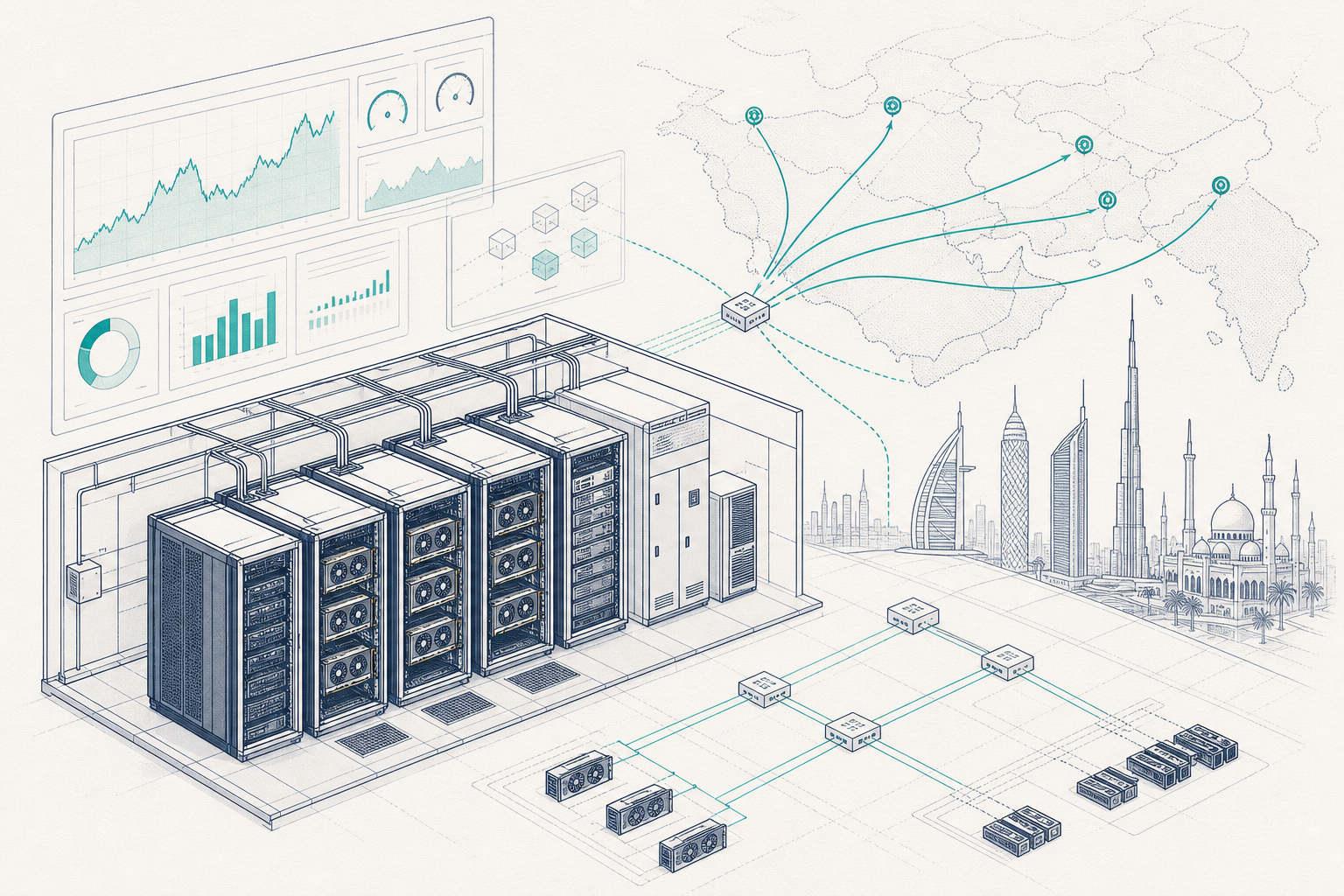
For small and mid-size GPU operators in GCC/MENA, this is not abstract. A university lab, sovereign AI program, systems integrator, media group, healthcare network, or regional service provider may own anything from a quarter rack to a few racks of mixed CPU/GPU hardware. The local constraint is often not whether the organization can buy accelerators. It is whether it can govern them tightly enough to raise utilisation, recover cost, and keep data and operations inside the jurisdiction.
A public price index does not manage a rack. But it changes expectations. Once buyers and developers have reference prices, the local operator must be able to answer harder questions: why is this internal GPU-hour priced at this level, what utilisation assumption sits behind it, how are MIG partitions billed, how are failed jobs treated, what happens when storage or egress dominates the job, and can the tenant prove that the workload never left the site?
The bottleneck: price discovery requires instrumentation
The first operational mistake is to treat a GPU price index as a procurement artifact. It is really a metering and scheduling challenge. A public or open-source price reference can show that a particular accelerator class is available elsewhere at a published hourly rate. It cannot tell whether a local rack is idle because users cannot get access, because jobs are too large for the scheduler, because storage is under-provisioned, because tenancy is manual, or because the finance model charges everyone equally regardless of consumption.
A quarter-rack estate can hit this bottleneck quickly. Suppose it has 16 to 32 GPUs, a mix of CPU-only nodes for preprocessing, local NVMe, and shared Ceph storage. The team may begin with a simple Kubernetes cluster and a spreadsheet of users. That works while one research group or one product team dominates demand. It breaks when the same hardware must support training jobs, inference endpoints, fine-tuning experiments, VMs for data science desktops, and short-lived benchmark runs for external tenants.
The operator then faces five practical problems.
First, allocation is not the same as usage. A tenant can reserve a full GPU for 24 hours and use it heavily for two. Without device-level and job-level metering, the rack appears “allocated” while the hardware is economically idle.
Second, partitioning changes the billing unit. NVIDIA MIG, AMD partitioning features where available, CPU pinning, memory limits, and time-sliced GPU access can all improve throughput, but only if the platform records what was allocated and for how long. A 1g MIG slice, a half-day time-slice, and a full accelerator training run cannot be treated as the same product.
Third, routing decisions need policy. If a developer tool asks for the cheapest available GPU class, the on-prem operator still has to enforce sovereignty, tenant isolation, quota, maintenance windows, data gravity, and model-risk policy. Cheapest compute is not always admissible compute.
Fourth, storage and data movement matter. Many AI jobs are not bounded only by GPU time. Dataset staging, Ceph performance, checkpoint retention, object storage policy, and backup windows can determine the true cost per run.
Fifth, power is now a commercial metric. In hot climates and constrained facilities, revenue per megawatt is more meaningful than headline utilisation. A rack that runs inefficient jobs at poor occupancy can consume the same power envelope as a rack that produces materially more billable work.
What an operator-grade stack must measure
For a small GPU estate to participate in a transparent pricing environment, it needs a local source of truth. ClastIQ is designed for operators that own their hardware and need to run bare metal, Kubernetes, and VM tenancy on the same fleet. The aim is not to imitate a hyperscaler control plane feature by feature. It is to give a smaller estate the minimum operational machinery required for utilisation, chargeback, sovereignty, and policy enforcement.
At the provisioning layer, bare-metal automation matters because GPU nodes are not interchangeable cattle in the same way as generic CPU instances. Firmware, driver versions, kernel modules, IOMMU settings, NIC configuration, out-of-band management, and storage topology all affect whether workloads run reliably. MAAS and Juju provide the basis for repeatable node deployment and service lifecycle management. That repeatability is what lets an operator rebuild a node, add a new accelerator generation, or split the estate into Kubernetes and VM pools without turning every change into a manual project.
At the tenancy layer, Kubernetes and VMs need to coexist. Some tenants want containerized training pipelines and inference services. Others need VM desktops, licensed tools, or isolated environments for regulated datasets. If the GPU estate can only offer one consumption mode, utilisation suffers because real demand is heterogeneous.
At the partitioning layer, the platform must expose GPU capacity in practical shapes. That can include full-device assignment, MIG-backed slices where the hardware supports it, time-sliced sharing for interactive and lower-duty workloads, and CPU/GPU combinations for preprocessing or inference. The key is that each shape must map to a metered unit and a quota policy.
At the storage layer, Ceph provides shared block, file, or object patterns that can be aligned with tenant needs. The chargeback question is not only “who used the GPU?” It is also “who kept 80 TB of checkpoints for three months?” Without storage accounting, GPU price comparisons become misleading.
At the governance layer, metering, quota, and policy engineering turn a rack into a service. They define who can request which accelerator class, how many concurrent partitions a tenant may hold, which workloads must remain on sovereign infrastructure, and what rate card applies to each consumption unit. Air-gap support and local human-led operations are relevant here because GCC/MENA operators often have data residency, national policy, or disconnected-environment requirements that public routing layers cannot satisfy.
A worked example: the cost of idle allocation
Consider a GCC operator running 32 GPUs across a few dense nodes, plus CPU nodes and Ceph storage. Assume a 30-day month.
Maximum monthly GPU capacity:
32 GPUs × 24 hours × 30 days = 23,040 GPU-hours
Assume the loaded monthly cost of the estate is:
- Hardware amortisation: $384,000 over 36 months = $10,667 per month
- Facility power and cooling: 50 kW facility draw × 720 hours × $0.11/kWh = $3,960 per month
- Network, storage media, spares, and operations allocation = $6,000 per month
Total loaded monthly cost = $20,627
If the estate achieves only 28% billable utilisation, it sells or charges back:
23,040 × 0.28 = 6,451 GPU-hours
Loaded cost per billable GPU-hour:
$20,627 ÷ 6,451 = $3.20 per GPU-hour
Now assume the operator introduces proper tenancy, partitioning, queue policy, and metering. Interactive users are moved to time-sliced or partitioned capacity. Long-running jobs go through quotas and scheduled reservations. Idle allocations are reclaimed. Billable utilisation rises to 62%:
23,040 × 0.62 = 14,285 GPU-hours
Loaded cost per billable GPU-hour:
$20,627 ÷ 14,285 = $1.44 per GPU-hour
If the internal chargeback rate is set at $2.40 per GPU-hour, monthly GPU chargeback revenue becomes:
14,285 × $2.40 = $34,284
Annualized against a 50 kW facility draw, revenue per megawatt is:
($34,284 × 12) ÷ 0.05 MW = $8.23 million per MW per year
This example is simplified. It excludes tax, financing cost, staff time by role, support contracts, and different rates for different accelerator classes. But it shows the main point: price competitiveness is often less about buying cheaper GPUs and more about converting stranded allocation into metered usage.
| Metric | Before policy and metering | After policy and metering |
|---|---|---|
| Monthly theoretical capacity | 23,040 GPU-hours | 23,040 GPU-hours |
| Billable utilisation | 28% | 62% |
| Billable GPU-hours | 6,451 | 14,285 |
| Loaded cost per billable GPU-hour | $3.20 | $1.44 |
| Chargeback at $2.40/GPU-hour | $15,482 | $34,284 |
The operator has not changed the silicon. It has changed the control plane and the commercial model.
From a price index to a local rate card
A public GPU index can help set external context, but an on-prem operator should not copy a public cloud price and call it a rate card. Local cost structure is different. Sovereign hosting, air-gapped operations, local support, dedicated storage, and predictable reservation may justify a different rate. Conversely, an internal platform with low network egress and high utilisation can beat external alternatives for data-heavy workloads.
A useful local rate card separates at least six dimensions:
- Accelerator class: full GPU, partitioned GPU, or time-sliced access.
- CPU and memory bundle: preprocessing-heavy jobs should not hide CPU cost inside GPU pricing.
- Storage: hot Ceph block, shared file, object storage, snapshots, and checkpoint retention.
- Reservation type: best-effort, scheduled, reserved, or preemptible.
- Sovereignty tier: standard on-prem, restricted tenant, or air-gapped enclave.
- Support model: self-service, assisted operations, or managed run.
This is where operators should be careful with open routing layers. A developer may see a cheap GPU somewhere else, but the complete job may require moving a regulated dataset out of country, changing audit posture, or accepting a different incident-response model. In GCC/MENA, where public-sector, energy, healthcare, and financial workloads may carry residency or sovereignty constraints, the routing decision must include policy before price.
Instrumentation that should exist before exposing prices
Before publishing internal prices or connecting to any routing layer, the estate should be able to answer basic questions from logs and meters, not from meetings.
A minimal daily operator view should include allocatable GPUs by class, allocated GPUs, actual device activity, queued demand, failed job time, tenant quota consumption, storage consumption, and power draw where available. The exact tooling depends on the hardware and software stack, but the operating model is consistent.
A simple operator check might look like this:
# Capacity and allocation by node
kubectl get nodes -L gpu.vendor,gpu.class,gpu.mig.capable
kubectl describe node gpu-node-07 | grep -A8 "Allocated resources"

# Tenant quota and current use
kubectl get resourcequota -A
kubectl top pods -A --containers

# GPU telemetry export target, example only
curl -s http://metrics.local:9090/api/v1/query \
  --data-urlencode 'query=sum by (tenant,gpu_class) (gpu_hours_metered_total)'
The command block is not a billing system. It illustrates the required posture: capacity, allocation, and metered consumption must be queryable. If those data points are not available, a price index will only create arguments. Tenants will challenge the bill, finance will distrust utilisation claims, and operators will lack the evidence needed to tune queues.
ClastIQ’s role is to assemble this into an operator workflow on the owner’s hardware. Bare-metal provisioning establishes repeatability. Kubernetes and VM tenancy provide consumption modes. GPU partitioning improves fit between workload and device. Ceph supplies shared storage primitives. Metering and chargeback connect technical usage to financial accountability. Quotas and policy prevent the loudest tenant from becoming the scheduler. Air-gap and sovereign deployment patterns keep the control plane aligned with local requirements.
Routing is useful only when the local pool is governable
The developer ecosystem is moving toward routing: route a model request to the cheapest endpoint, route an agent to the available tool, route a coding task to the preferred model, route a batch job to the lowest-priced GPU. For on-prem operators, the right response is not to block routing. It is to make the local pool eligible for rational routing.
That means publishing enough information for internal users to choose correctly. A tenant should know that a short notebook session belongs on a time-sliced GPU, a seven-day training job needs a reservation, a sensitive dataset must stay in the sovereign pool, and checkpoint-heavy work carries a storage cost. If all these choices appear as “request GPU,” the scheduler becomes a political system.
The same applies to mixed NVIDIA, AMD, and CPU/GPU estates. Hardware-agnostic does not mean pretending all accelerators are identical. It means normalizing operations across different device classes while still exposing the capabilities that matter: memory size, interconnect, partitioning support, driver stack, framework compatibility, and performance profile for the workload. Benchmarking should be local and repeatable, because an external index cannot represent the operator’s exact mix of storage, network, thermals, drivers, and tenant behavior.
Small estates have one advantage over hyperscale regions: proximity to the user and the facility. The operator can understand which workloads matter, which datasets are immovable, when the power envelope is tight, and which tenants can tolerate preemption. That advantage is only useful if encoded into policy and metering.
Benchmarking without turning it into theatre
Emerging GPU price indices will increase demand for benchmark evidence. Operators should resist the temptation to publish a single heroic number. For chargeback and routing, stable repeatability is more useful than peak performance.
A practical benchmark set should include one or two representative training jobs, one inference throughput test, one fine-tuning or LoRA-style job if relevant, and one storage-heavy checkpoint test. Run them after driver changes, firmware updates, Kubernetes upgrades, and storage topology changes. Record accelerator class, partition shape, CPU allocation, storage path, dataset location, framework version, power window, and wall-clock time.
The result should feed two decisions. First, scheduling: which node class should receive which job type? Second, pricing: does this workload consume a premium resource or a standard pool? For example, a tenant that needs high-memory full devices should pay differently from a tenant using small partitions for interactive development. A tenant that retains many terabytes of checkpoints should see that cost directly.
Benchmarking also helps defend sovereign economics. A GCC/MENA operator may not always match the lowest public GPU-hour headline. But if data stays local, storage is nearby, support is in-region, and utilisation is high, the end-to-end cost and risk profile can be better for the workload owner. The operator needs measured evidence to make that case.
The operational takeaway
The Computable GPU Index appearing near the top of a developer leaderboard is a small event, but it reflects a larger shift. GPU compute is becoming priced, compared, and routed at the workflow layer. That will put pressure on every operator with physical accelerators, including estates far smaller than hyperscale regions.
For a quarter rack to a few racks, the response is not to build a public cloud clone. The response is to run the local estate like a measured utility: provision nodes consistently, offer Kubernetes and VM tenancy, partition accelerators where appropriate, meter usage by tenant, enforce quota, account for storage and power, and publish a rate card that reflects real cost and policy.
Once that foundation exists, a price index becomes useful context instead of a threat. Without it, transparent external prices will expose the weaknesses of manual allocation.
What to do this week
- Calculate theoretical monthly GPU-hours by accelerator class, then compare them with billable or chargeback GPU-hours for the last 30 days.
- Identify the top five sources of idle allocation: abandoned notebooks, oversized reservations, failed jobs, storage bottlenecks, or manual approval delays.
- Define at least three consumption shapes: full GPU, partitioned or time-sliced GPU, and CPU-only preprocessing, each with a metered unit.
- Draft a local rate card that separates GPU time, storage, reservation priority, and sovereignty tier instead of hiding all cost in one hourly number.
- Run one repeatable benchmark per major workload type and store the result with driver, framework, storage, and power context.
- Review quota policy with finance, security, and facilities so utilisation targets do not violate residency, isolation, or power limits.
ClastIQ runs this control plane on the operator’s own hardware — request a demo.