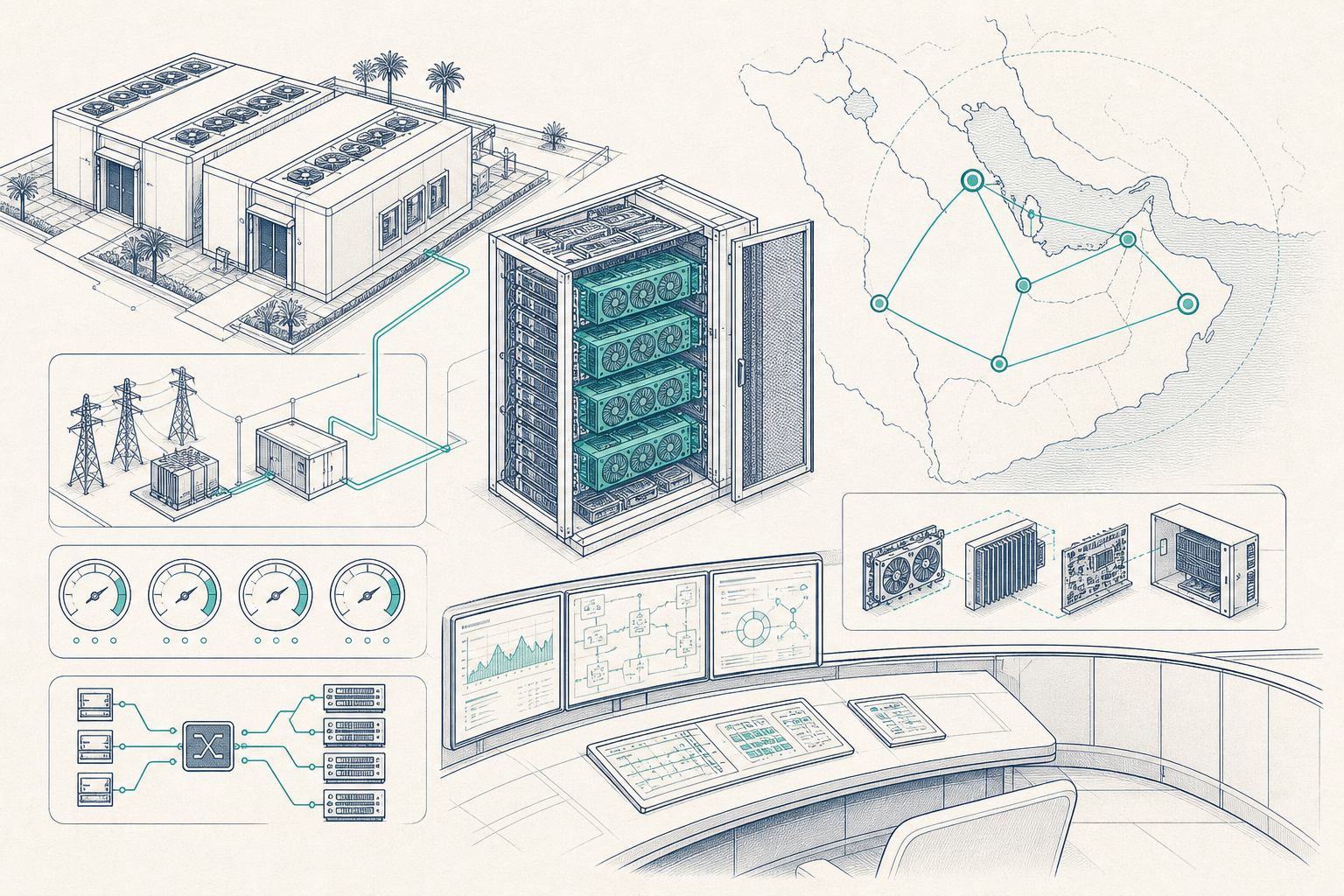
Crusoe's raise changes the modular AI conversation
On September 17, 2026, Crusoe announced a $3.9 billion funding round to build large data centers and small modular AI factories. The round was co-led by Atreides Management, Mubadala Capital, and Valor Equity Partners, with participation from QIA and GIC, according to TechCrunch. The numbers matter, but the investor mix matters too. Mubadala Capital and QIA put GCC capital directly behind distributed AI capacity, while GIC adds another sovereign investor with long duration infrastructure expectations.
For GCC operators, this is not only a hyperscale story. It is a signal that AI capacity is being financed in more than one shape: large campuses, modular deployments, and smaller factories closer to power, land, users, or sovereign data boundaries. That creates a practical question for operators who own a quarter rack, one rack, or a few racks of GPU and CPU hardware. Does modular deployment increase utilization and sovereignty, or does it create a fragmented estate that is harder to schedule, meter, secure, and operate?
The answer depends less on the container, pod, or room and more on the control plane. Small modular GPU capacity can be economically useful if the operator can pool demand, partition accelerators, keep tenants isolated, replicate only the data that needs replication, enforce quota, and price usage by the GPU-hour, CPU-hour, storage tier, and power envelope. Without that, each small site becomes its own island. Islands are easy to explain on a floor plan and difficult to monetize.
ClastIQ is built for this operational layer on the operator's own hardware. It is not tied to one accelerator vendor or one site size. It combines bare-metal provisioning, Kubernetes and VM tenancy on the same fleet, GPU partitioning where supported, Ceph storage, metering, chargeback, quotas, policy, air-gap operation, and local support. The aim is straightforward: make a small or mid-size GPU estate governable enough to behave like a region, even when the hardware sits in a university room, a government facility, a telco edge site, or a privately operated data hall.
The bottleneck is not buying modules, it is pooling them
A modular AI site sounds simple when described as capacity in smaller blocks. In practice, the bottleneck is that workloads do not arrive in the same shape as the hardware. Training jobs want many GPUs with low latency between them. Inference jobs want predictable throughput, lower queue time, and often smaller slices of accelerators. Data science users want interactive notebooks. Enterprise tenants may ask for VMs because their security model, license server, or appliance image depends on them. Public sector tenants may require that datasets remain inside Oman, the UAE, Saudi Arabia, Qatar, Bahrain, or Kuwait, sometimes inside a particular facility.
A quarter rack can be fully booked on paper and still underutilized in silicon. Eight GPUs may sit in four servers, but a tenant asks for six GPUs and 30 TB of local scratch. Another tenant needs two GPUs today, but only if they can be partitioned for four inference endpoints. A third tenant has a CPU-heavy preprocessing pipeline that blocks storage throughput before it blocks GPUs. If the operator cannot schedule across these constraints, capacity fragments.
This is where many small estates lose economics. They do not fail because the hardware is weak. They fail because the operating model is too manual. Engineers allocate machines with spreadsheets, tenant access is created by hand, GPU sharing policies differ from node to node, and chargeback arrives weeks after the workload has finished. That makes utilization invisible until the bill is already political.
A system like ClastIQ addresses the pooling problem at several layers:
| Operator problem | Control plane requirement | ClastIQ role |
|---|---|---|
| Bare metal sits idle between tenants | Fast server reprovisioning and inventory control | MAAS and Juju based bare-metal lifecycle |
| Some users need Kubernetes and others need VMs | One fleet, multiple tenancy modes | Kubernetes and VM tenancy on shared hardware pools |
| GPUs are too coarse for small inference jobs | Partitioning and time-slice policy | MIG where available, time-slicing, and quota rules |
| Storage becomes a second silo per site | Shared and policy driven storage | Ceph backed pools with tenant level controls |
| Finance cannot see real usage | Metering and chargeback | GPU-hour, CPU-hour, memory, storage, and tenant reporting |
| Sovereign workloads cannot cross boundaries | Placement policy and air-gap support | Region, site, and tenant policies for data locality |
The table is deliberately operational. Modular capacity only helps if the operator can turn metal into a service catalog that maps to tenant demand. Otherwise, the site becomes another room full of expensive exceptions.
GCC and MENA relevance is concrete
The GCC has a specific reason to care about distributed AI capacity. Sovereign capital, government AI programs, energy economics, Arabic language workloads, regulated data, and national cloud strategies are converging. Not every workload should run in a remote hyperscaler region. Not every organization can wait for a multi-year mega campus. Ministries, universities, hospitals, research centers, oil and gas operators, telcos, and industrial groups may need local GPU capacity in smaller increments.
Small does not mean casual. A few racks can still require national data handling rules, audit trails, tenant separation, controlled remote access, and predictable billing. In some GCC environments, the first constraint is not procurement. It is whether the estate can prove where the data ran, who accessed it, how much resource was consumed, and why a workload was placed on one site rather than another.
The Crusoe round is relevant because it validates a financing direction: build AI capacity as infrastructure, not as a one-off lab purchase. For GCC operators below hyperscaler scale, the lesson is not to copy hyperscaler footprint. It is to copy the discipline: standardized provisioning, repeatable tenancy, utilization measurement, chargeback, and policy enforcement.
If one site in Muscat, another in Abu Dhabi, and another in Doha all run as separate manual environments, the operator owns three small problems. If they run under a consistent catalog and policy model, the operator can sell capacity as a regional service while respecting sovereign placement rules. That is the difference between distributed capacity and scattered hardware.
Worked example: utilization and revenue per megawatt
Consider a private GCC operator with 24 GPUs across three small sites, eight GPUs per site. The estate is mixed CPU and GPU hardware. Some accelerators support hardware partitioning, some are allocated as whole devices, and some are time-sliced for inference. The operator has 720 hours in a 30 day month.
Total theoretical GPU capacity is:
24 GPUs x 720 hours = 17,280 GPU-hours per month
Before orchestration, manual allocation leaves average useful utilization at 38 percent. That means:
17,280 x 0.38 = 6,566 useful GPU-hours per month
Assume the monthly ownership and operating cost is built from three lines:
Hardware and network amortization: $16,000 per month Power and cooling: 28 kW average IT load x 1.35 PUE x 720 hours x $0.11 per kWh = $2,994 per month Operations, software, and support labor allocation: $8,000 per month
Total monthly cost is $26,994. At 38 percent utilization, the internal cost per useful GPU-hour is:
$26,994 / 6,566 = $4.11 per useful GPU-hour
Now assume the operator introduces a common control plane, a tenant catalog, partitioning for small inference jobs, automated bare-metal reprovisioning, quotas, and chargeback. Useful utilization rises to 68 percent because smaller jobs can fit into slices, idle servers return to the pool faster, and batch jobs run in off-peak windows.
17,280 x 0.68 = 11,750 useful GPU-hours per month
The cost base is similar, so the cost per useful GPU-hour becomes:
$26,994 / 11,750 = $2.30 per useful GPU-hour
If the operator charges an average internal or external recovery price of $3.40 per useful GPU-hour, monthly GPU revenue or chargeback recovery is:
11,750 x $3.40 = $39,950 per month
The facility draw including cooling is 28 kW x 1.35 = 37.8 kW, or 0.0378 MW. Revenue recovery per MW-month is:
$39,950 / 0.0378 = $1,056,878 per MW-month
Before improving utilization, the same price would have recovered:
6,566 x $3.40 = $22,324 per month
$22,324 / 0.0378 = $590,582 per MW-month
The point is not that every operator will reach 68 percent utilization, or that $3.40 is the right market price. The point is that utilization, chargeback, and power density are connected. If GCC operators want revenue per megawatt, not just GPU count, they need a control plane that makes useful GPU-hours visible and allocatable.
Scheduling across small sites creates hard edges
A small modular estate hits scheduling edges earlier than a large homogeneous cluster. The first edge is accelerator shape. A training job may need four or eight full GPUs with high bandwidth between them. A computer vision inference service may need one third of a GPU during the day and almost none at night. A classroom environment may need 40 user sessions, each with a small GPU share for 3 hours. If the scheduler treats every GPU as indivisible, inference and interactive workloads waste capacity. If the scheduler slices without policy, noisy neighbors and unpredictable latency appear.
The second edge is host lifecycle. Operators often keep machines assigned to tenants long after jobs finish because reprovisioning is risky. Bare-metal automation changes the economics. With inventory, imaging, firmware awareness, and declarative configuration, a server can return to the pool as a known quantity. MAAS and Juju are useful here because they reduce the amount of hand work between a physical machine and an application platform.
The third edge is tenancy type. Kubernetes is suitable for many AI services, pipelines, and batch workloads. VMs remain necessary for tenants with fixed images, license constraints, security tooling, or legacy dependencies. An operator running only Kubernetes will push some tenants away. An operator running only VMs will lose scheduling density. The practical answer is to run both on the same fleet, with policies deciding which pool, site, and accelerator mode a tenant can use.
A simple quota definition should be readable by both engineering and finance. For example:
clastiq tenant create research-a --site muscat-1
clastiq quota set research-a --gpu-hours 1200 --cpu-hours 8000 --storage-tb 25
clastiq policy set research-a --gpu-mode partitioned,whole --data-residency oman
clastiq meter report --tenant research-a --period 2026-09
The commands are illustrative, but the operating principle is real. Tenants need explicit quotas, policies, and reports. Otherwise the operator cannot arbitrate between a paying inference tenant, a government research workload, and an internal experiment that has been running since last month.
Storage replication can erase the modular advantage
GPU operators often focus on accelerator scheduling and discover later that storage is the limiting factor. Modular sites make this worse if every site keeps its own data copy without policy. AI datasets are large, change at different rates, and carry different sovereignty requirements. Replicating everything everywhere consumes WAN capacity, increases storage cost, and complicates deletion. Replicating nothing creates cold starts and long queue times.
Ceph gives small and mid-size operators a way to build resilient storage pools on owned hardware, but it still needs policy. A tenant with regulated health data may require that primary and replica copies stay inside one country. A media inference workload may allow derived artifacts to move but not raw content. A model development team may need shared object storage across two sites, while scratch data can remain local and expire after 7 days.
ClastIQ's role is to connect storage policy to tenant policy. It is not enough to create a bucket or volume. The platform needs to know which tenant owns it, which site can host it, how much it costs, whether it is metered as hot or cold storage, and whether compute placement must follow data placement. That prevents a scheduler from placing a job in a site where the GPUs are idle but the data cannot legally or economically move.
For GCC and MENA operators, this is particularly important because cross-border data movement may be more sensitive than intra-campus movement. A regional operator may want one commercial catalog, but the control plane must still understand national boundaries. Sovereignty is not a slogan at runtime. It is a placement constraint.
Power management is part of scheduling
In small GPU estates, power is not an abstract facilities issue. It directly affects how many jobs can run and when. A quarter rack in an existing room may have a fixed breaker limit. A modular site may have a generator, UPS, or cooling constraint that limits peak load even when nameplate IT capacity looks available. If the scheduler ignores power, operations staff become the scheduler by phone call.
GPU partitioning helps, but only if tied to policy. A time-sliced inference service can run within a lower power envelope than a full training burst. Batch jobs can be shifted to off-peak windows if tenant service levels allow it. CPU preprocessing can be scheduled near data without lighting up every accelerator. Power caps can also be used to keep a site inside its contracted envelope.
The economic metric is revenue per megawatt, not just cluster occupancy. A site that runs hot with poorly priced work may look busy while under-recovering cost. A site with disciplined quotas and pricing can leave some headroom for high priority workloads and still perform better financially. The control plane should expose power-aware placement, utilization, and recovery in the same reporting chain.
For mixed hardware estates, this reporting must be hardware-agnostic. Some nodes may have NVIDIA accelerators with MIG support. Others may use AMD accelerators or CPU-only servers. Some may be better for inference, others for memory-heavy preprocessing. Operators need a catalog that describes capabilities without forcing every tenant to understand vendor details.
What ClastIQ brings to the operator model
ClastIQ is a GPU and CPU orchestration platform for operators who own real hardware but do not operate a hyperscaler. The platform is aimed at estates from a quarter rack to a few racks, including sovereign and air-gapped environments. It is hardware-agnostic across NVIDIA, AMD, and mixed CPU or GPU fleets.
The relevant capabilities for a modular AI strategy are:
- Bare-metal provisioning, so physical servers can be discovered, imaged, configured, returned to the pool, and audited without manual rebuilds.
- Kubernetes and VM tenancy on the same fleet, so operators can support modern AI pipelines and tenants that still need VM boundaries.
- GPU partitioning policy, including MIG where supported and time-slicing where appropriate, so small inference and interactive jobs do not strand whole accelerators.
- Ceph storage integration, so local and shared storage can be governed by tenant, site, retention, and cost policy.
- Metering and chargeback, so GPU-hours, CPU-hours, storage, and tenant consumption become a monthly operating report, not an argument.
- Quotas and placement policy, so sovereignty, site limits, power envelopes, and service tiers are enforced before workloads start.
- Air-gap and local support options, which matter for GCC public sector, research, and regulated enterprise deployments.
None of these removes the need for good facility design, network planning, or financial discipline. They make those decisions enforceable. That is the difference between a modular AI announcement and an operable GPU service.
What to do this week
- Inventory every accelerator, CPU node, storage pool, switch, power feed, and cooling limit by site. Include firmware state and current tenant ownership.
- Calculate useful GPU-hours for the last 30 days, not allocated hours. Separate training, inference, interactive, and idle capacity.
- Define a tenant catalog with at least three service classes: whole GPU, partitioned or time-sliced GPU, and CPU plus storage only.
- Write data residency rules before expanding to another modular site. Decide which datasets can move, which derived artifacts can move, and which jobs must follow local data.
- Build a chargeback model that includes power and cooling. Report cost per useful GPU-hour and revenue or recovery per MW-month.
- Test one reprovisioning path from bare metal to Kubernetes tenant and one path from bare metal to VM tenant. Measure the time, manual steps, and audit trail.
ClastIQ runs this on the operator's own hardware: request a demo.
Sources
TechCrunch, Crusoe raises $3.9B to build massive data centers and small modular AI factories