Crusoe’s raise is a power and utilization signal
On September 17, 2026, TechCrunch reported that Crusoe raised $3.9 billion to build AI data centers and smaller modular AI factories. The reported plan is not only about larger campuses. It also combines three business models that matter to operators of much smaller estates: colocation capacity, Crusoe-owned GPUs, and inference compute sold as a service.
That combination is the useful part of the story. It says the AI infrastructure market is no longer just buying accelerators and finding tenants later. The operator problem has moved to power availability, phased capacity planning, tenant mix, and the economics of inference workloads that may be steady, bursty, latency-sensitive, or tied to local data rules.
For a GCC or MENA operator with a quarter rack, one rack, or a few racks, the lesson is not to copy a hyperscale campus. The lesson is to run the small estate like a region: every watt has an owner, every GPU-hour is metered, every tenant has a quota, and every procurement decision has to answer whether the next workload should run on owned hardware, rented capacity, or a hybrid path.
A platform such as ClastIQ is aimed at that operating layer. It does not assume one hardware vendor or one tenancy model. It provisions bare metal, runs Kubernetes and VM tenancy on the same fleet, partitions GPUs where the hardware supports it, meters usage per tenant, applies quotas and policy, and keeps the estate governable in air-gapped or sovereign deployments.
The bottleneck is not only GPUs
Most small GPU estates do not fail because a GPU is missing from a spreadsheet. They fail because one of four constraints is not continuously managed.
First is power headroom. A rack may physically accept eight GPU servers, but the room may only have 12 kW, 18 kW, or 24 kW available after redundancy and cooling limits. In many enterprise rooms, the contractual or electrical limit arrives before the rack unit limit.
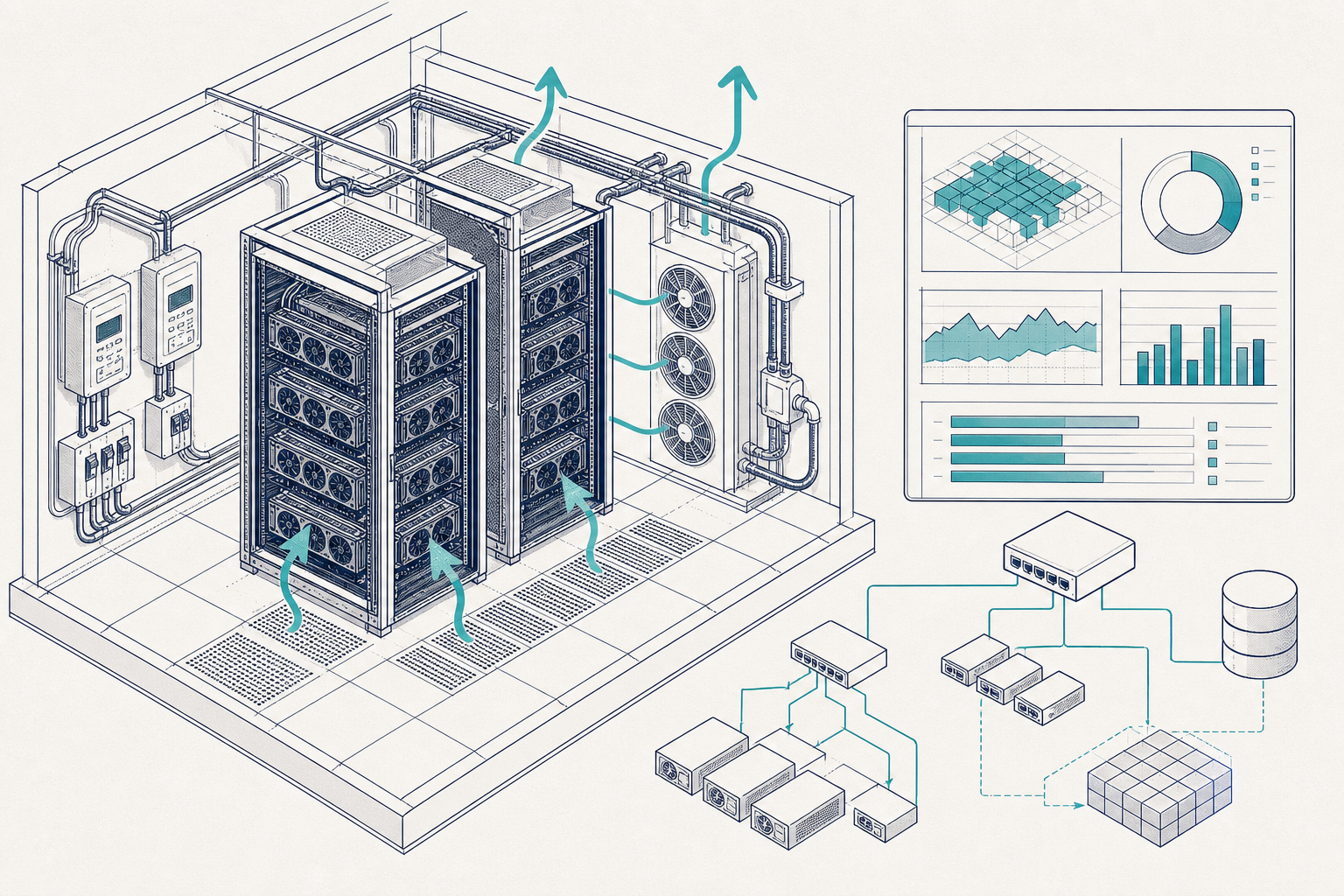
Second is cooling density. Air-cooled estates can be productive, but only if the operator respects intake temperature, hot-aisle containment, blanking, fan curves, and the practical difference between average and peak power. A fleet that looks safe at average load can trip breakers or thermal alarms during simultaneous training jobs.
Third is utilization quality. A dashboard showing 70% GPU allocation can hide poor economics if many jobs reserve full GPUs for light inference, if tenants strand memory, or if schedulers cannot place mixed CPU, memory, storage, and accelerator requests efficiently.
Fourth is commercial granularity. If the operator cannot show which tenant used which GPU slice, for how many hours, with which storage and network footprint, there is no credible chargeback. Without chargeback, every department asks for priority, no one gives capacity back, and expansion planning becomes political.
Crusoe’s raise is interesting because it points to these constraints at very large scale. Smaller operators hit the same constraints earlier and with less room for error.
What changes for a quarter rack to a few racks
A small estate has one advantage: it can be disciplined from the beginning. The operator does not need to wait for a giant internal platform project. It can build the control plane before the fleet grows.
The right unit of planning is not the server. It is the sellable or accountable unit: GPU-hour, GPU slice-hour, vCPU-hour, VM-hour, TB-month, and watt-hour. Once those units exist, the operator can compare options:
- keep a workload on owned GPUs;
- burst it to rented capacity;
- sell idle capacity to a local customer;
- reserve a pool for sovereign or air-gapped inference;
- defer procurement because utilization is still low;
- buy more power before buying more GPUs.
ClastIQ’s role in that model is orchestration and accounting on hardware the operator already owns or plans to own. Bare-metal provisioning through MAAS and Juju establishes repeatable server lifecycle management. Kubernetes supports containerised inference, batch, and platform services. VM tenancy supports tenants that need operating system control, legacy software, or isolation patterns that are easier to manage as virtual machines. Ceph gives the estate a local storage substrate for images, datasets, tenant volumes, and service state.
The important point is that the same estate can serve more than one tenant model. A university lab may need Jupyter-style access. A local integrator may need VMs. A government project may need an air-gapped deployment. A startup may need inference endpoints with a predictable monthly cap. The platform has to allocate and meter all of those without turning every request into a manual ticket.
The Crusoe pattern, scaled down
Crusoe is monetizing several layers of the stack: physical site capacity, owned accelerators, and inference compute. A small GCC or MENA operator can use the same mental model at smaller scale.
| Layer | Large operator question | Small-estate translation |
|---|---|---|
| Power and site | How many MW can be energised and cooled? | How many kW are usable per rack after redundancy and thermals? |
| GPU ownership | When do owned GPUs beat rented GPUs? | Which steady tenants justify capex, and which bursts should be rented? |
| Inference | How is low-latency demand packaged? | Which models need local serving, quotas, and per-token or per-GPU-hour billing? |
| Tenancy | How are customers isolated? | Which teams need Kubernetes, VMs, bare metal, or dedicated pools? |
| Accounting | How is capacity monetized? | Can every GPU-hour, slice-hour, VM, and TB-month be charged back? |
This is especially relevant in GCC and MENA markets. Many operators are balancing sovereign AI ambitions, local data residency, Arabic and domain-specific models, constrained data center power, and the need to show return on expensive accelerators. The estate may be small compared with a hyperscale region, but the governance requirements are not small.
The practical question is: can the operator make one rack behave economically like a managed region rather than like a shared lab?
A worked example: 32 GPUs in two air-cooled racks
Assume an operator has 32 GPUs across two racks. The all-in facility draw is 37.8 kW after IT load, networking, storage, cooling overhead, and power usage effectiveness are included. The month has 730 hours.
At theoretical maximum, the estate has:
32 GPUs × 730 hours = 23,360 GPU-hours per month.
Before policy and metering, suppose average useful utilization is 42%. That means:
23,360 × 0.42 = 9,811 useful GPU-hours per month.
If the monthly all-in cost is $80,000, including depreciation or lease cost, facility cost, support labor, networking, and storage overhead, then the cost per useful GPU-hour is:
$80,000 ÷ 9,811 = $8.15 per useful GPU-hour.
Now assume the operator introduces stricter tenancy controls: GPU partitioning for light inference where supported, time slicing for bursty notebooks, quotas per tenant, scheduled maintenance windows, and metering that makes idle reservations visible. Useful utilization rises to 68% without adding hardware:
23,360 × 0.68 = 15,885 useful GPU-hours per month.
The same $80,000 monthly cost is now spread over more work:
$80,000 ÷ 15,885 = $5.04 per useful GPU-hour.
If the operator charges internal or external tenants a blended $7 per useful GPU-hour, monthly recognized usage value is:
15,885 × $7 = $111,195 per month.
Annualised revenue per MW of facility draw is:
$111,195 × 12 ÷ 0.0378 MW = $35.3 million per MW-year.
That number is not profit. It is a way to compare estate productivity. At 42% utilization, the same blended rate produces:
9,811 × $7 × 12 ÷ 0.0378 MW = $21.8 million per MW-year.
The difference is not a new GPU generation. It is operating discipline: placement, partitioning, quotas, tenant behavior, and chargeback. On a constrained site, that is often the highest-return project available.
Partitioning changes the inference equation
Inference economics are usually harmed by coarse allocation. A tenant serving a small model or a low-traffic endpoint may not need a full accelerator all day. If the platform only offers whole GPUs, the operator either overcharges the tenant or silently absorbs waste.
Hardware-agnostic does not mean every feature is identical across vendors. It means the platform should expose the best safe allocation model available on the hardware present. On some NVIDIA GPUs, MIG can create isolated GPU instances. On other accelerators or mixed fleets, time slicing, node pools, admission controls, or whole-device allocation may be more appropriate. For AMD and mixed CPU/GPU estates, the policy model still matters even when the partitioning mechanism differs.
ClastIQ’s operator value is to make those allocation choices part of tenancy policy rather than one-off engineering. A tenant can be assigned a quota for full GPUs, GPU slices, CPU, memory, storage, and namespace or VM count. A batch tenant can be allowed to burst when the estate is quiet. A sovereign inference tenant can be pinned to a local pool with stricter network and storage rules. A research tenant can get time-sliced development capacity while production inference uses dedicated devices.
This is how a small operator avoids the worst pattern: buying more accelerators while existing accelerators are reserved, idle, or mismatched to workloads.
A basic runbook view
The exact commands vary by deployment, but the operator needs a routine way to inspect allocation, quota, storage, and node pressure. In a ClastIQ-managed environment, these checks would sit behind the platform workflow, but the underlying operational questions are familiar:
kubectl get nodes -L accelerator,pool,tenant-policy
kubectl top nodes
kubectl describe resourcequota -n tenant-a
kubectl get pods -A --field-selector=status.phase=Running
ceph status
ceph df
The point is not that an operator should live in a terminal. The point is that the platform must maintain a consistent source of truth. If Kubernetes says capacity is available, the bare-metal inventory, VM layer, Ceph cluster, and chargeback ledger cannot tell a different story.
Kubernetes and VMs on the same fleet
Many small GPU operators are pushed into a false choice: build a Kubernetes platform or offer virtual machines. Real tenant demand is messier.
AI platform teams often prefer Kubernetes because it supports containers, autoscaling patterns, service discovery, and GitOps-style deployment. Enterprise tenants may still need VMs for licensed software, custom kernels, Windows workloads, appliance-style deployments, or a familiar operational boundary. Some tenants need bare metal for performance or compliance reasons.
If each model becomes a separate island, utilization falls. One pool is full while another is idle. Storage is duplicated. Metering is inconsistent. Policies are enforced differently.
ClastIQ is designed around the idea that Kubernetes and VM tenancy should coexist on the same physical estate. The operator can decide which nodes are assigned to which pool and can change that assignment as demand changes. Bare-metal provisioning gives the lifecycle control needed to rebuild, repurpose, patch, or isolate nodes. Ceph provides common storage patterns without requiring every tenant to bring its own storage system.
For a small estate, this flexibility is more important than it looks. A single eight-GPU server stranded in the wrong pool can represent a large percentage of total capacity.
Metering is an engineering control, not a finance afterthought
Chargeback often gets introduced late, after users have learned that reservations are free. That is backwards. Metering should be part of the technical design from day one because it changes behavior.
A useful metering model should capture at least:
- allocated GPU-hours and observed active GPU-hours;
- GPU slice-hours where partitioning is used;
- CPU and memory allocation for VM and Kubernetes workloads;
- Ceph capacity in TB-months and high-performance volume classes;
- public or private network egress if it is material;
- reserved capacity that blocks other tenants, even when idle.
For internal estates, the charge may be a showback report rather than an invoice. That is still valuable. It lets leadership see whether a tenant is consuming 30% of the estate to produce 5% of the measurable output. It also makes procurement defensible. The request becomes: tenant demand at current quota will exceed supply in six weeks, and utilization is already above the policy threshold. That is different from: teams are asking for more GPUs.
For external estates, metering is the revenue engine. If the operator cannot bill accurately, it cannot price confidently.
Power policy belongs in the scheduler conversation
Power is usually treated as a facilities topic until it becomes an outage. GPU estate operators should bring power into scheduling and quota decisions.
At small scale, the question is simple: can every tenant burst at the same time without violating rack, circuit, or cooling limits? If not, the scheduler and policy layer need to know that. This does not require pretending to be a hyperscaler. It requires clear pools and operational rules.
Examples include:
- limiting simultaneous high-power training jobs per rack;
- separating inference nodes from batch training nodes;
- reserving headroom for storage recovery and maintenance;
- using off-peak batch windows where the site power contract or cooling profile benefits;
- tagging nodes by rack, circuit, or cooling zone.
In GCC and MENA deployments, the thermal context matters. Air-cooled rooms may face higher seasonal cooling stress, and edge or sovereign sites may not have the same mechanical resilience as a purpose-built campus. A few degrees of intake temperature and a few kilowatts of headroom can decide whether the estate is stable during peak load.
Sovereignty and air-gap are operating modes
The Crusoe story is global, but the GCC/MENA translation must include sovereignty. Operators in the region are often serving government, finance, energy, healthcare, education, or Arabic language workloads where data movement is restricted or politically sensitive.
Sovereignty is not only where the server sits. It is also how images are built, how updates are applied, how tenant access is logged, where model artifacts are stored, how backups are handled, and whether support can operate without uncontrolled external access.
ClastIQ’s air-gap and sovereign deployment focus matters here. A small estate may need local package mirrors, controlled update bundles, offline installation paths, local identity integration, and human-led support that understands the physical environment. The platform must be governable when the internet link is restricted or intentionally absent.
This is another reason to avoid tying the whole estate to one accelerator assumption or one cloud operating model. Sovereign operators need leverage across NVIDIA, AMD, CPU-heavy nodes, and mixed generations because procurement availability, export conditions, budget timing, and workload requirements can all change.
When to rent versus own
Crusoe’s model includes owned GPUs and inference compute. Smaller operators should make rent-versus-own decisions with the same discipline.
Own capacity when demand is steady, local, governed, and power is available. Examples include production inference for local applications, regulated datasets that cannot leave the country, university or enterprise platforms with predictable semester or business cycles, and tenants willing to reserve capacity.
Rent capacity when demand is spiky, experimental, geographically flexible, or tied to a short project. If a tenant needs a large training run for ten days and then nothing for two months, renting may protect the local estate from overbuying. If the workload uses public data and has no sovereignty constraint, off-estate capacity may be rational.
Hybrid is often best. Keep baseline inference and sensitive data local. Burst training, evaluation, or non-sensitive batch jobs elsewhere. But hybrid only works if the local estate has clear accounting. Otherwise the operator cannot compare a rented GPU-hour with an owned GPU-hour honestly.
What ClastIQ resolves for the operator
For a small or mid-size GPU estate, the control plane has to answer five questions every day.
What hardware exists, and what state is it in? Bare-metal provisioning and inventory management keep servers reproducible rather than artisanal.
Who can use capacity, and under which limits? Tenancy, quotas, and policy decide access before the cluster becomes a queue of favours.
How should workloads be placed? Kubernetes, VMs, GPU partitioning, node pools, storage classes, and power-aware labels turn business intent into scheduling rules.
What did each tenant consume? Metering and chargeback translate technical usage into financial and governance signals.
Can the estate operate under local constraints? Air-gap support, sovereign deployment patterns, Ceph storage, and local human-led support make the platform viable outside a hyperscaler region.
That is the practical implication of the Crusoe news for operators with real hardware but not hyperscale scale. The market is valuing power-to-compute conversion. Small estates need to prove the same conversion inside 20 kW, 50 kW, or 150 kW footprints.
What to do this week
- Build a power and cooling map by rack, circuit, and node. Record usable kW, not only nameplate capacity.
- Calculate last month’s useful GPU-hours and cost per useful GPU-hour. Include idle reservations that blocked other tenants.
- Split tenants into steady, bursty, sovereign, and experimental categories. Decide which belong on owned hardware.
- Define quota units now: full GPU-hours, slice-hours where supported, vCPU-hours, VM-hours, and TB-months.
- Audit whether Kubernetes, VMs, Ceph, and bare-metal inventory share one source of truth for tenant ownership.
- Set an expansion trigger based on utilization and power headroom, not on anecdotal demand.
ClastIQ runs this on the operator’s own hardware: request a demo.