Deepgram buying Daily is an infrastructure signal
On 29 October 2026, TechCrunch reported that Deepgram acquired Daily, the company behind the Pipecat open source framework for building voice and multimodal AI agents. The financial terms were not disclosed in the report. The important change is not only ownership. It is the bundling of speech recognition, voice agent tooling, and real time communications infrastructure into one stack aimed at developers building interactive agents.
For GPU cluster operators, that matters because voice AI does not behave like the text inference workloads most teams use to size their first cluster. Text benchmarks often reward tokens per second under relatively tidy request patterns. Voice workloads add audio capture, preprocessing, speech to text, language model reasoning, tool calls, text to speech, echo handling, barge in, and session state. They also punish jitter. A user may tolerate a slow document summary. The same user notices a 400 millisecond pause in a phone call.
Daily and Pipecat sit in the part of the stack where sessions, streams, and agents meet. Deepgram sits in speech recognition and voice AI services. Their combination points to a broader market shift: voice agents are moving from demos to infrastructure products. Operators in the GCC and MENA should read this as a capacity planning event. If Arabic, Gulf dialects, English, Hindi, Urdu, Tagalog, and other regional languages need to be served locally for sovereignty or latency reasons, the bottleneck will not be only model size. It will be orchestration.
A quarter rack to a few racks can run useful voice AI. It can also become uneconomic quickly if GPUs are pinned to idle sessions, if tenants are not metered per actual use, or if a single noisy customer consumes low latency capacity needed by others. The question is not whether voice agents need GPUs. The question is how many milliseconds, GPU fractions, CPU cores, network paths, and storage operations each tenant is allowed to consume, and how those limits are billed.
Why voice exposes problems hidden by text benchmarks
A text chatbot usually arrives as discrete requests. Even streaming text output can be treated as a burst of inference followed by idle time. Voice is different. It is a live session with many small deadlines.
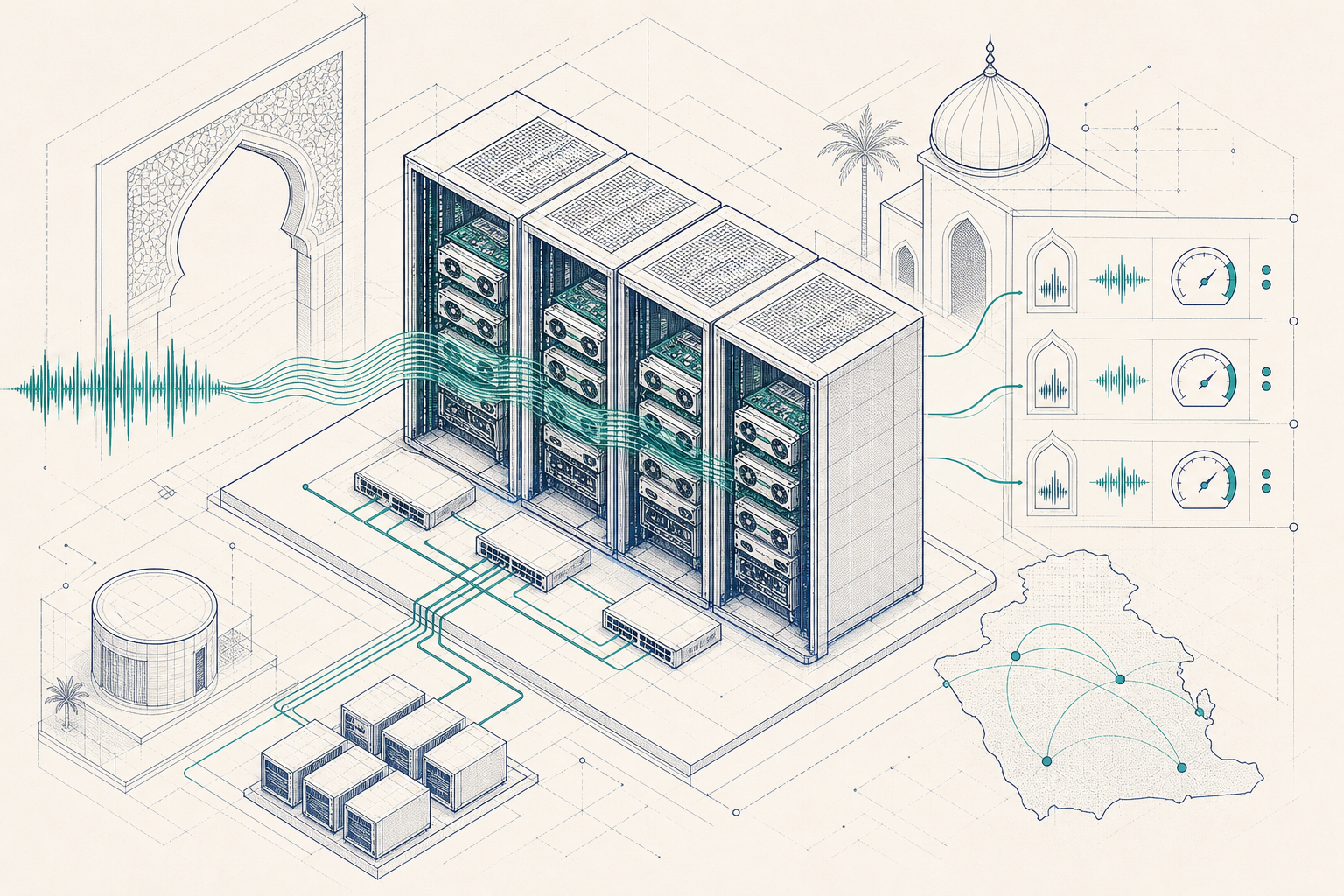
A practical voice agent pipeline may include these stages:
- WebRTC or telephony ingress, including jitter buffers and codec handling.
- Voice activity detection to decide when speech starts and stops.
- Audio normalization, resampling, and optional noise suppression.
- Streaming speech recognition.
- An LLM or smaller intent model.
- Tool calls to CRM, booking, payment, or government systems.
- Text to speech.
- Egress back to the caller or browser.
- Logging, redaction, transcript storage, and billing.
Each stage has a different infrastructure profile. Voice activity detection may be CPU friendly. Noise suppression may fit on CPUs, GPUs, or accelerators depending on implementation. Speech recognition can run well on GPUs when batched, but batching conflicts with latency. Text to speech often needs low latency GPU access. The LLM step may be a small model for intent routing or a larger model for open conversation.
The operator therefore faces a scheduling problem. The cluster must keep enough capacity hot for real time sessions, while still using spare cycles for batch jobs such as offline transcription, summarization, quality review, training adapters, or synthetic data generation. If every service team asks for whole GPUs, utilization collapses. If every GPU is oversubscribed, call quality collapses.
This is where a small estate differs from a hyperscaler region. A hyperscaler can absorb uneven demand across thousands of accelerators. A local operator with 8, 32, or 96 GPUs cannot rely on statistical smoothing alone. The cluster needs explicit partitions, quotas, tenant isolation, and chargeback.
The first bottleneck is not always the model
Many voice pilots start by asking which model to run. Operators should start one layer lower. The first bottleneck is often concurrency under a latency objective.
Assume a local operator wants to host Arabic and multilingual voice agents for banks, clinics, travel companies, and internal government services. A typical session might use:
| Pipeline stage | Latency sensitivity | Main pressure | Operator control |
|---|---|---|---|
| Audio ingress | Very high | Network jitter, CPU interrupts | Placement, CPU reservation, local peering |
| Speech recognition | High | GPU memory, streaming concurrency | MIG, time slicing, batching policy |
| LLM reasoning | Medium to high | GPU memory, KV cache, tool latency | Model catalog, quotas, routing |
| Text to speech | Very high | GPU scheduling, audio chunking | Dedicated slices, warm pools |
| Logging and transcripts | Low to medium | Storage IOPS, retention rules | Ceph pools, tenant policies |
This table is intentionally operational rather than architectural. The real constraint is not one component. It is the handoff between components under tenant pressure.
A voice workload may use only a fraction of a GPU most of the time, but it needs that fraction predictably. That is a poor fit for static whole GPU allocation. It is a better fit for GPU partitioning where supported, time slicing where acceptable, and policy based placement. MIG on compatible NVIDIA hardware is one method. Other hardware families have their own isolation and scheduling capabilities, and some mixed estates rely more heavily on node pools, device plugins, and workload placement. The operator should keep the design hardware agnostic: advertise capacity classes, not vendor assumptions.
Examples of useful classes are realtime small, realtime large, batch speech, batch LLM, and training. Tenants request a class. The platform maps it to actual hardware partitions, CPU reservations, storage pools, and network paths.
How a Clastiq style estate would place the workload
Clastiq is designed for operators who own the hardware, from a quarter rack to a few racks, and need the estate to behave like a governed region. For this voice AI use case, the relevant pieces are bare metal provisioning with MAAS and Juju, Kubernetes and VM tenancy on the same fleet, GPU partitioning, Ceph storage, metering, quota and policy engineering, and support for air gap or sovereign deployments.
A practical layout for a small operator could look like this:
- A realtime Kubernetes node pool for speech recognition and text to speech services.
- A separate LLM inference pool with larger GPU memory profiles.
- A CPU intensive pool for media ingress, voice activity detection, redaction, and API gateways.
- A VM tenancy pool for customers that need their own hardened appliance or licensed telephony software.
- Ceph backed object and block storage for transcripts, audio snippets, model artifacts, and audit logs.
- Metering at namespace, tenant, model, and GPU partition level.
- Quotas for concurrent sessions, GPU hours, storage retention, and egress.
The important point is that Kubernetes and VMs share the same physical fleet without turning every tenant into a special case. Some customers will want containers. Some will arrive with a VM image, SIP software, or a compliance appliance. Voice infrastructure in GCC and MENA often crosses old and new systems: PBX, contact center, WhatsApp workflows, banking APIs, government identity services, and Arabic NLP services. A platform that forces one tenancy model will create integration drag.
Bare metal automation matters because voice clusters will change shape. During a pilot, the estate may run one model on a few GPUs. After launch, operators may need more low latency partitions, more storage, or a separate sovereign zone for a regulated tenant. Reinstalling nodes manually is not an operations model. MAAS and Juju let the operator provision, redeploy, and manage lifecycle without treating every server as a snowflake.
Partitioning strategy: hot sessions versus pooled inference
Voice AI forces a decision between continuous low latency allocation and pooled batch efficiency.
Continuous allocation keeps GPU capacity warm for sessions. It reduces first token and first audio latency. It also risks idle waste because callers pause, agents wait on tools, and not every tenant reaches peak concurrency.
Pooled inference improves utilization by batching requests from many tenants. It is attractive for offline transcription, after call summaries, compliance review, and analytics. It can hurt live conversations if batching windows grow too large.
A well governed estate should run both. The question is how much capacity is reserved for each class, and how tenants are charged for crossing from one class into the other.
For example, a GCC operator with 24 GPUs might set the following starting policy:
- 8 GPUs or equivalent partitions reserved for realtime speech recognition and text to speech.
- 8 GPUs for LLM inference with strict per tenant concurrency limits.
- 4 GPUs for batch transcription and summaries.
- 2 GPUs for development and model validation.
- 2 GPUs held as maintenance and failure headroom.
On compatible hardware, the realtime pool may be split into smaller isolated GPU instances. On other hardware, the same policy may be implemented through node pools and scheduler controls. Either way, the contract exposed to tenants is capacity class, latency objective, quota, and price.
A simple Kubernetes operator view might look like this:
kubectl create namespace tenant-bank-a
kubectl label namespace tenant-bank-a clastiq.io/tier=realtime
kubectl label namespace tenant-bank-a clastiq.io/region=oman
kubectl apply -f quota-voice-realtime.yaml
kubectl get pods -n tenant-bank-a -o wide
The labels are not magic. They are governance hooks. They let admission control, placement rules, metering, and reports connect infrastructure consumption to a commercial or sovereign policy.
Worked example: utilization and chargeback
Consider a 16 GPU estate used for local multilingual voice agents. Assume each GPU has an internal cost basis of 2.20 dollars per GPU hour, including depreciation, power, cooling, data center space, support contracts, and operator labor. The operator charges tenants 4.00 dollars per billable GPU hour for realtime reserved capacity, and 2.80 dollars per GPU hour for batch inference. These are example numbers, not Clastiq pricing.
There are 16 GPUs and 24 hours in a day, so the estate has:
16 x 24 = 384 GPU hours per day.
Before partitioning, three tenants each reserve 4 whole GPUs for voice services, and the platform team reserves 2 GPUs for testing. That allocates 14 GPUs, but metering shows average useful GPU utilization of only 32 percent because sessions are bursty.
Useful GPU hours per day are:
14 x 24 x 0.32 = 107.52 useful GPU hours.
The internal daily cost of the full estate is:
384 x 2.20 = 844.80 dollars.
If tenants are charged only for the 107.52 useful GPU hours at 4.00 dollars, revenue is:
107.52 x 4.00 = 430.08 dollars per day.
That does not cover the estate. The problem is not that voice AI is impossible. The problem is the allocation model.
Now apply capacity classes. Reserve 6 GPUs for realtime partitions, 6 GPUs for pooled LLM and speech inference, 2 GPUs for batch jobs, and keep 2 GPUs for maintenance and burst. With partitioning, better placement, and pooled workloads, assume the realtime pool reaches 55 percent useful utilization, the pooled inference pool reaches 70 percent, and the batch pool reaches 80 percent.
Billable daily usage becomes:
Realtime: 6 x 24 x 0.55 = 79.20 GPU hours.
Pooled inference: 6 x 24 x 0.70 = 100.80 GPU hours.
Batch: 2 x 24 x 0.80 = 38.40 GPU hours.
Total billable usage is 218.40 GPU hours per day.
If realtime is billed at 4.00 dollars, pooled inference at 3.40 dollars, and batch at 2.80 dollars, daily revenue is:
79.20 x 4.00 = 316.80 dollars.
100.80 x 3.40 = 342.72 dollars.
38.40 x 2.80 = 107.52 dollars.
Total revenue is 767.04 dollars per day.
That is still below the full daily cost of 844.80 dollars, but the gap has narrowed from 414.72 dollars to 77.76 dollars. The operator can close it by improving utilization, increasing the realtime reserve price, adding tenants, using idle maintenance capacity during safe windows, or reducing cost per GPU hour through power and procurement improvements.
At 65 percent blended billable utilization across 14 active GPUs, billable usage would be:
14 x 24 x 0.65 = 218.40 GPU hours, the same as above.
At 75 percent blended utilization, it becomes:
14 x 24 x 0.75 = 252.00 GPU hours.
If the average realized price is 3.50 dollars per GPU hour, revenue is:
252.00 x 3.50 = 882.00 dollars per day.
Now the estate is above the 844.80 dollar daily cost. This is why chargeback and partitioning are not accounting details. They determine whether a local GPU estate can sustain voice workloads without becoming a subsidized lab.
For revenue per megawatt, assume the 16 GPU estate plus CPUs, storage, networking, and cooling draws 22 kW average at the facility boundary. Daily energy normalized to one megawatt of continuous draw is a multiplier of:
1,000 kW / 22 kW = 45.45.
At 882.00 dollars per day, the normalized revenue per MW day is:
882.00 x 45.45 = 40,086.90 dollars per MW day.
This is a blunt metric, but it helps operators compare AI workloads with colocation, cloud resale, or private hosting. For GCC operators facing power allocation constraints, revenue per megawatt is often as important as gross revenue.
Sovereignty, Arabic voice, and GCC operations
The GCC relevance is direct. Many voice agent use cases involve regulated or sensitive data: banking calls, clinic appointments, insurance claims, government services, education records, logistics, and customer identity. Sending audio and transcripts outside the country may be unacceptable, or may require legal review that slows deployment. Even where cross border processing is allowed, round trip latency can damage the voice experience.
Arabic adds another operational layer. Modern voice systems may need Modern Standard Arabic, Gulf dialects, code switching with English, and common expatriate languages. That can mean multiple speech recognition models, custom vocabularies, tenant specific phrase lists, and retention rules for audio. Storage policy is part of the AI system.
Ceph is useful here because the operator can provide tenant separated storage pools, lifecycle rules, and durable object storage for transcripts and audio artifacts. Some tenants may require 30 day retention. Others may require deletion after 24 hours. A government workload may require an air gapped zone with no external model calls. A commercial contact center may allow periodic export of redacted analytics. These policies should be encoded, not handled by tickets.
Sovereign deployment also changes support expectations. A local operator cannot depend on a remote team waking up in another time zone to debug packet loss in a media node. Human led local support, clear runbooks, and ownership of the hardware are part of the service. The platform should make the cluster observable enough that support can tell whether a failed call was caused by GPU saturation, CPU steal, storage latency, network jitter, or an upstream application.
Metering must follow the session, not just the pod
GPU metering alone is not enough for voice AI. A tenant can consume value through concurrent sessions, reserved warm capacity, storage, model loading, and egress even when GPU utilization appears low.
Useful chargeback dimensions include:
- Reserved realtime GPU partition hours.
- Actual pooled GPU hours.
- Concurrent session peaks.
- Speech recognition audio minutes.
- Text to speech generated audio minutes.
- LLM input and output tokens where applicable.
- Transcript and audio storage by retention class.
- Cross zone or internet egress.
Operators do not need to expose all of these as separate line items on day one. They do need to collect them. Without granular metering, a tenant with long silent calls can look cheap while blocking capacity. Another tenant with short batch jobs can look expensive while improving utilization. Good policy depends on good measurement.
Quotas should also match the workload. A standard Kubernetes CPU and memory quota is necessary but insufficient. Voice tenants need limits such as maximum concurrent calls, maximum realtime GPU partitions, maximum batch queue depth, maximum retained audio, and maximum model replicas. The right failure mode is graceful rejection or downgrade, not cluster wide contention.
Power and thermal behavior matter more than pilots suggest
Voice workloads can create uneven power draw. Realtime pools may stay warm, while batch jobs surge at night. If batch jobs start exactly when cooling is constrained or when another tenant launches a training job, the operator may violate power caps or degrade service.
This is another reason to treat voice as an estate level workload. Schedulers should know which nodes are in realtime pools, which are safe for batch backfill, and which are under maintenance. Batch transcription can be delayed. A live emergency services call cannot. If the facility has a power cap, the policy engine should prioritize low latency reserved services over opportunistic work.
For smaller GCC and MENA estates, this is not theoretical. Power availability, cooling design, and data center expansion timelines can define the business. A platform that improves utilization without increasing peak power can increase revenue per megawatt. A platform that chases utilization blindly can create thermal and service incidents.
What operators should take from the Deepgram and Daily deal
The acquisition is a reminder that voice AI is becoming an infrastructure category, not only an application feature. Frameworks such as Pipecat make it easier for developers to assemble agents. Speech platforms make recognition and synthesis more accessible. That shifts pressure onto operators. More teams will ask for local voice agents. They will expect realtime behavior, tenant separation, transcripts, dashboards, and predictable pricing.
A small to mid size GPU estate can serve this market if it is engineered as a governed utility. It needs bare metal repeatability, mixed Kubernetes and VM tenancy, hardware agnostic GPU allocation, storage policy, chargeback, quotas, and local support. Buying more GPUs without these controls mostly buys a larger scheduling problem.
Clastiq fits this layer: it runs on the operator's own hardware, uses bare metal provisioning, supports Kubernetes and VM tenancy on the same fleet, handles GPU partitioning policy, integrates Ceph storage, and provides metering and chargeback foundations for sovereign or air gapped environments. The goal is not to imitate a hyperscaler brand. It is to bring hyperscaler discipline to a quarter rack or a few racks that must produce utilization, governance, and revenue under local constraints.
What to do this week
- Map your voice pipeline stages and write down latency targets for ingress, speech recognition, LLM, text to speech, and storage. Do not size GPUs until the pipeline is visible.
- Create three capacity classes: realtime, pooled inference, and batch. Assign initial GPU, CPU, storage, and concurrency quotas to each.
- Start metering by tenant for GPU hours, concurrent sessions, audio minutes, transcript storage, and egress, even if billing remains simple.
- Test Arabic and multilingual sessions locally with realistic silence, interruptions, noisy audio, and tool calls. Synthetic clean audio is not enough.
- Reserve maintenance and failure headroom. Do not sell every GPU partition as realtime capacity.
- Review data residency and retention rules for each tenant, especially audio recordings and transcripts.
Clastiq runs this on the operator's own hardware, request a demo.
Sources
TechCrunch, Deepgram acquires Daily, reported 29 October 2026