What changed
TechCrunch reported in September 2026 that Anthropic had detailed distillation campaigns involving Alibaba, Moonshot AI, and DeepSeek. The reported issue is not only legal or competitive. For infrastructure operators, the practical signal is that model capability is being compressed into smaller deployable variants, often by using outputs from larger frontier models to train or tune smaller models.
That changes the infrastructure conversation. A frontier model may require dense multi-node GPU capacity, high-speed interconnect, and a large inference budget. A distilled model may fit into a single accelerator, a fraction of a high-memory GPU, or a smaller mixed CPU/GPU estate. The same user-facing task can move from scarce 80 GB or 192 GB VRAM classes into 24 GB, 48 GB, or partitioned memory classes, depending on quantisation, context length, batch size, and latency target.
For an operator with a quarter rack to a few racks, this is the important part: model size is becoming a scheduling variable. Distillation can increase the number of useful workloads that fit on-prem, but it can also create a new governance problem. Tenants will ask to run many smaller models locally because local inference improves data control, latency, and unit economics. At the same time, the operator must protect scarce GPU memory for workloads that actually need it and that generate higher revenue per watt.
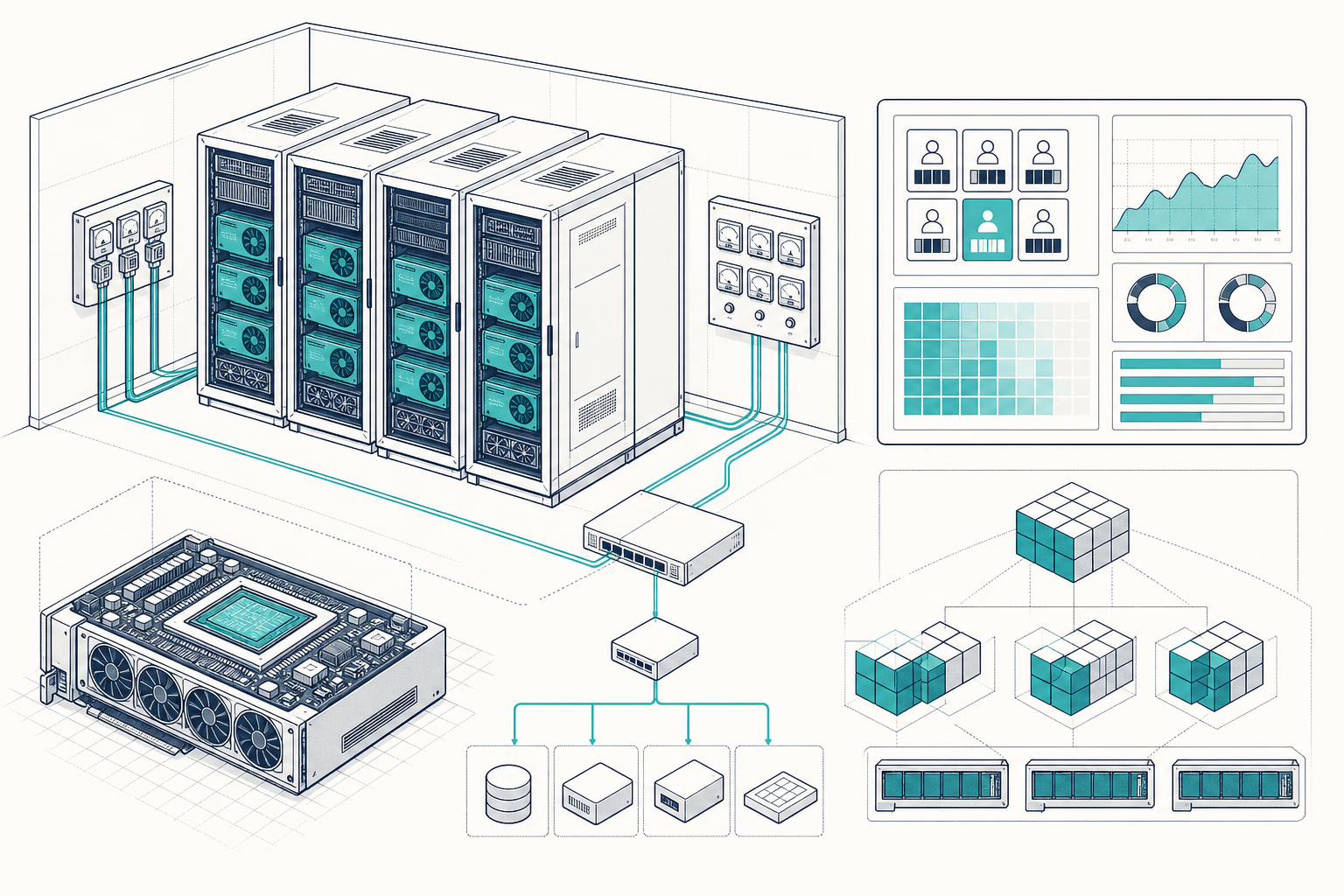
Clastiq is built for this operating shape: real hardware, mixed tenants, bare-metal provisioning, Kubernetes and VM tenancy on the same fleet, GPU partitioning where supported, Ceph-backed storage, metering, quotas, policy, and local support. The point is not to declare that smaller models make large GPUs unnecessary. They do not. The point is to stop treating every model as a full-device, best-effort job and instead turn model fit into a governed resource plan.
The infrastructure bottleneck is VRAM fit, not model fashion
The debate around distillation often focuses on model lineage, benchmark deltas, and whether a smaller model can reproduce enough behavior from a larger one. Cluster operators should translate the story into four hard constraints.
First, VRAM is the capacity boundary. Parameters, key-value cache, activations, batch size, context length, and serving framework overhead all consume memory. A model that appears to fit at rest can fail under longer context or concurrent sessions. This is why a small model with a long-context product promise may still pressure memory more than expected.
Second, memory fragmentation matters. A tenant reserving an entire high-memory GPU for a lightly used distilled model can strand capacity that another tenant needs for fine-tuning, rendering, simulation, or high-throughput inference. On a small estate, one bad placement decision is visible in the monthly utilization report.
Third, interconnect is not the only scarce component. Large training jobs care about fabric. Distilled inference fleets often care more about memory slices, CPU cores for tokenization and pre/post-processing, local NVMe scratch, Ceph throughput for model pulls, and predictable tenant isolation.
Fourth, sovereignty requirements become more practical, not less. If a bank, ministry, university, telco, or industrial operator can run a smaller model locally, the question becomes whether the cluster can prove where the data went, who consumed the GPU-hours, which model artifact was used, and whether the workload respected quota and policy.
This is especially relevant in GCC and MENA estates that are not hyperscaler regions in miniature. Many operators own facilities, power, and hardware, but they do not have infinite spare capacity or unlimited software engineering teams. The economic question is direct: can a few racks behave like a governed region, with chargeback, tenancy, air-gap options, and policy controls, without forcing every workload through one manually curated queue?
Distilled models change the tenant mix
A traditional small GPU cluster often develops a simple hierarchy. Full GPUs go to research, fine-tuning, or high-value inference. CPU nodes handle general services. Storage is shared as best as possible. When contention appears, an operator intervenes manually.
Distillation breaks that model because it creates a wider middle class of workloads. These are too important to run on unmanaged workstations, but not large enough to justify exclusive access to the most expensive GPU class. Examples include Arabic and bilingual assistants, code copilots for internal teams, document extraction, call-centre summarization, retrieval-augmented generation, and small vision-language services for inspection workflows.
The right operating response is to define service classes, not just node names.
| Workload class | Typical fit question | Operator control |
|---|---|---|
| Small local inference | Can it run in a GPU slice or smaller card? | Partitioning, time-slicing, per-tenant quota |
| Latency-sensitive inference | Does it need reserved memory and predictable placement? | Dedicated class, admission policy, metering |
| Fine-tuning or evaluation | Does it need burst access to full GPUs? | Scheduled windows, project quotas, Ceph datasets |
| High-margin full-GPU work | Does it require large VRAM or multi-GPU placement? | Priority class, reservation, chargeback rate |
| Sovereign or air-gapped workloads | Can artifacts and logs remain local? | Local registry, local storage, audit controls |
This table is simple, but it is the difference between a cluster that becomes a shared lab and a cluster that can be run as infrastructure. Distilled models are not automatically cheap if they consume the wrong resource class.
A worked example: why utilization and chargeback must move together
Consider a 16-server estate with 64 accelerators. The hardware may be NVIDIA, AMD, or a mixed fleet; the arithmetic does not depend on a specific vendor. Assume the average facility draw for GPU servers, CPU headroom, storage, switching, and cooling allocation is 55 kW. The operator accounts for depreciation, maintenance, support contracts, facility allocation, power, and staff at 110,000 USD per 30-day month.
The theoretical monthly capacity is:
64 GPUs x 24 hours x 30 days = 46,080 GPU-hours.
Before governance, assume the estate averages 38 percent billable utilization. That is:
46,080 x 0.38 = 17,510 billable GPU-hours.
The cost per billable GPU-hour is therefore:
110,000 / 17,510 = 6.28 USD per billable GPU-hour.
Now add a governed distilled-model tier. Smaller inference services are admitted to partitioned or time-sliced capacity where supported. Full GPUs remain available for workloads that need large memory. Quotas stop one tenant from consuming all inexpensive slices. Idle night capacity is opened to batch evaluation and internal model testing.
If utilization rises to 68 percent, billable capacity becomes:
46,080 x 0.68 = 31,334 billable GPU-hours.
The same monthly cost divided by that used capacity is:
110,000 / 31,334 = 3.51 USD per billable GPU-hour.
That does not mean every tenant should be charged 3.51 USD. Chargeback should reflect scarcity and service class. For example, the operator might price a full high-memory GPU class at 7.50 USD per hour, a standard full GPU class at 4.50 USD per hour, and a partitioned inference slice at 1.25 USD per slice-hour. If the monthly mix produces 138,000 USD of internal chargeback or external revenue on a 55 kW average draw, the annualised revenue per MW is:
138,000 x 12 / 0.055 = 30.1 million USD per MW-year.
The exact number will vary by market, power price, depreciation schedule, and pricing policy. The operating lesson is stable: distilled models improve estate economics only when they increase useful utilization without displacing higher-value jobs. That requires metering, quotas, placement policy, and clear service classes.
How to schedule model size instead of just jobs
A small-to-mid estate needs to expose capacity in terms tenants understand while retaining controls operators can enforce. In Kubernetes, that usually means resource classes, namespaces, quotas, priority classes, and node labels. In VM estates, it means flavors, GPU profiles, placement groups, and metered allocations. On bare metal, it means repeatable provisioning and lifecycle control rather than one-off server builds.
A quota for a tenant running small inference services might look like this:
apiVersion: v1
kind: ResourceQuota
metadata:
  name: tenant-a-inference-quota
  namespace: tenant-a
spec:
  hard:
    requests.cpu: 64
    requests.memory: 256Gi
    requests.storage: 4Ti
    limits.cpu: 96
    limits.memory: 384Gi
    pods: 40
    example.com/gpu-slice: 8
    example.com/full-gpu: 2
The resource names here are illustrative. In a real deployment they should map to the operator's device plugin, partitioning mode, GPU profile, or VM flavor. The important point is that the tenant receives an explicit allowance for slices and full devices. A small model can no longer occupy a full high-memory accelerator by accident for an entire month.
Clastiq's role is to make this policy operational across the stack. Bare-metal provisioning through MAAS and Juju brings nodes into a known state. Kubernetes hosts containerised inference and batch jobs. VM tenancy supports teams that need appliance-style deployments, legacy software, or stronger tenant separation. Ceph provides shared durable storage for model artifacts, datasets, checkpoints, and logs. Metering connects GPU-hours, slice-hours, storage, and power allocation to chargeback.
For operators, the value is consistency. The same estate can support a tenant running a small local assistant in containers, another tenant running a VM-based model appliance, and a third tenant reserving full GPUs for evaluation or fine-tuning. The scheduler should understand the difference.
Partitioning is useful, but it is not magic
GPU partitioning and time-slicing are often discussed as if they automatically solve utilization. They do not. They are mechanisms, not policies.
Hardware partitioning can provide stronger isolation where supported, especially for memory and compute slices. Time-slicing can improve sharing for bursty inference or development workloads, but noisy-neighbour effects and latency variance must be measured. Some accelerators support mature partitioning modes; others rely on software-level scheduling or VM profiles. A hardware-agnostic estate must describe the service guarantee, not only the vendor feature.
A practical policy might be:
- full GPU only for jobs above a defined VRAM threshold, latency-sensitive production inference, or approved fine-tuning;
- GPU slice for small distilled models, internal copilots, and low-to-medium concurrency inference;
- time-sliced development class for notebooks, tests, and evaluation;
- CPU-only class for retrieval, embedding post-processing where feasible, and data preparation;
- reservation windows for tenants with predictable business demand.
This protects high-memory devices from becoming a parking lot for models that could run elsewhere. It also gives tenants a path to start small and request more capacity with evidence.
Storage and model provenance become first-class controls
Distillation stories also raise provenance questions. If a model is trained using outputs from another model, the operator may need to know whether the resulting artifact is allowed in a given environment. Open weights, source-available licenses, commercial restrictions, national data rules, and internal compliance policies are not the same thing.
For a sovereign or air-gapped deployment, the cluster should not pull model artifacts directly from the public internet at runtime. Operators should maintain a local registry or artifact repository, scan and approve model files, pin versions, and record which tenant used which artifact. Ceph can back the artifact store and provide durable local capacity, but process matters as much as storage.
Minimum useful metadata includes model name, version, checksum, license, source, approval status, allowed tenants, allowed data classification, and retirement date. This is not bureaucracy. It prevents a small convenience model from becoming an untracked production dependency.
In GCC and MENA environments, this is often the difference between a pilot and a deployable service. Many organizations want local Arabic or bilingual inference, local data retention, and clear accountability for where workloads ran. Smaller models make that technically possible. Governance makes it acceptable.
Power is the hidden scheduler
A few racks can be power-bound before they are space-bound. Distilled models help if they move work to smaller profiles, improve batching, or run during off-peak windows. They hurt if every team launches always-on replicas with low utilization.
Operators should meter power at least at rack or server group level and connect it to tenancy. If direct per-tenant power measurement is not possible, allocate power cost by GPU-hours, CPU-hours, and storage consumption. The formula does not need to be perfect on day one. It needs to be visible, consistent, and good enough to change behavior.
For example, if the 55 kW estate uses 39,600 kWh in a 30-day month and power plus cooling is accounted at 0.13 USD per kWh, the energy component is 5,148 USD. That is small compared with depreciation in many GPU estates, but it still matters for revenue per MW and facility planning. More importantly, a tenant that leaves idle replicas consuming reserved GPU memory is not only using capital; it is consuming power envelope that might block another workload.
Clastiq's operating model treats power, GPU memory, storage, and tenancy as connected resources. A chargeback report that shows only GPU-hours is incomplete. A report that shows GPU-hours by class, storage footprint, quota breaches, average utilization, and estimated power allocation gives management a basis for pricing and expansion decisions.
What Clastiq resolves in this pattern
The operator problem created by distilled models is not that the models are small. It is that small models multiply demand. Without orchestration, a few racks become a collection of exceptions: one server reserved for a team, one VM nobody wants to patch, one GPU held for a demo, one storage share full of duplicate checkpoints, and one spreadsheet that no longer matches reality.
Clastiq addresses that pattern in five ways.
First, it standardizes provisioning. Bare-metal lifecycle control means nodes can be rebuilt, repurposed, and placed into the correct pool without artisanal intervention.
Second, it supports mixed tenancy. Kubernetes and VMs can run on the same fleet, which matters because AI services rarely arrive in one packaging format. Some tenants want containers; others need a VM boundary or an appliance-like deployment.
Third, it exposes GPU capacity as governed classes. Partitioned, time-sliced, and full-device profiles can be mapped to quotas and policies. The operator can reserve scarce VRAM for workloads that need it.
Fourth, it ties usage to metering and chargeback. The economic gain from distillation only appears if the estate can count slice-hours, GPU-hours, storage, and tenant allocations.
Fifth, it supports local and sovereign operation. Air-gap and local-support requirements are not edge cases for many real hardware owners. They are design inputs.
None of this depends on one accelerator vendor. A hardware-agnostic estate should support NVIDIA, AMD, and mixed CPU/GPU pools, while making clear which partitioning and isolation guarantees are available on each class.
The operator takeaway
Anthropic's reported account of distillation campaigns involving Alibaba, Moonshot AI, and DeepSeek is a reminder that model capability will keep moving across size classes. Some workloads that once seemed to require remote frontier inference will be plausible on-prem. Some will fit into smaller VRAM envelopes. Some will not. The operator's task is to make that distinction measurable.
For small and mid-size GPU estates, the winning move is not to chase every new model. It is to build a scheduling and governance layer that can absorb model churn. When a tenant brings a smaller model, the operator should be able to ask: what is its VRAM requirement at target context length, what is its concurrency target, what storage does it need, what data classification does it handle, what quota should apply, and what will it pay or be charged internally?
If those questions are answered manually every time, utilization will suffer. If they are encoded into service classes, quotas, metering, and chargeback, distilled models become a way to raise useful utilization while preserving sovereign control.
What to do this week
-
Inventory every model currently running on the estate, including parameter size, quantisation, context length, measured VRAM at peak, owner, and data classification.
-
Define at least three GPU service classes: full-device, partitioned inference, and development or time-sliced. Publish the admission rule for each class.
-
Add tenant quotas for GPU-hours or slice-hours, not just namespace access. Review the top ten idle reservations from the last 30 days.
-
Create a local model artifact register with checksum, license, source, approval status, and allowed tenants. Do not rely on runtime pulls from public repositories for governed workloads.
-
Build a monthly chargeback view that includes GPU class, utilization, storage footprint, and estimated power allocation. Use it to decide which workloads deserve scarce VRAM.
Clastiq runs this on the operator's own hardware; request a demo.