Dropbox buys storage capacity for the AI path
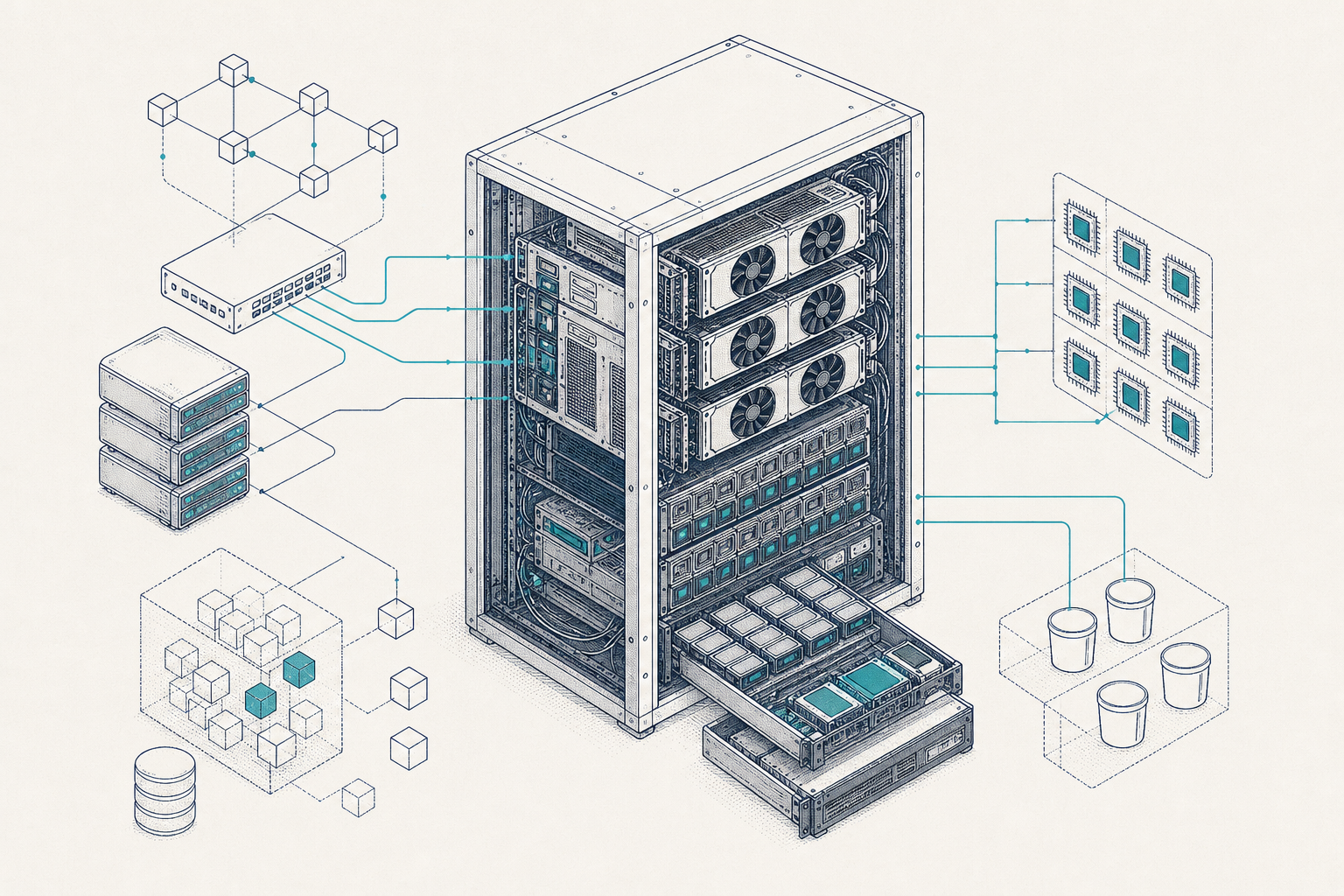
On Nov. 5, 2026, TechCrunch reported that Dropbox acquired Tigris Data for $350 million to strengthen its AI infrastructure. Tigris Data is associated with object storage, data movement, and developer-facing storage workflows. The useful signal for GPU cluster operators is not only the valuation. It is the direction of investment. A company with large existing storage operations is still buying specialized storage infrastructure as AI workloads increase pressure on throughput, locality, and data movement.
For operators of a quarter rack to a few racks, the story translates into a familiar problem: the GPU is often not the first component to fail, but it is usually the most expensive component to leave waiting. Training and inference pipelines depend on datasets, checkpoints, embeddings, logs, model artifacts, and tenant outputs moving through the estate at predictable rates. When the storage layer is undersized or badly placed, utilization drops even if the GPUs, CPUs, and schedulers look healthy on paper.
This is the practical point for small and mid-size estates. Hyperscalers can hide a great deal of storage complexity behind internal networks, regional object stores, and teams that specialize in data placement. An independent operator cannot assume that luxury. The storage design has to be intentional from the start, because one underpowered shared filesystem or one oversubscribed uplink can become the throttle for the entire commercial model.
A system such as ClastIQ is meant to manage that problem as part of the platform, not as an afterthought. Bare-metal provisioning, Kubernetes and VM tenancy on the same fleet, GPU partitioning, Ceph storage, tenant metering, quota engineering, and policy enforcement all have to work together. The question is not whether a cluster has storage. The question is whether storage behavior is visible and governable enough to keep the GPUs earning.
The bottleneck moves from compute to data movement
AI estates tend to be planned around GPU count first. That is understandable. GPU procurement drives capital cost, power design, cooling, and customer expectations. But the data path determines whether those GPUs spend time doing useful work.
Common data movement patterns include initial dataset staging, repeated epoch reads, checkpoint writes, model artifact reads during inference, vector index updates, and tenant backup exports. Each of these has different behavior. Dataset staging is often bursty. Training reads may be sequential or random depending on format and preprocessing. Checkpoints are write-heavy bursts, often synchronized across many workers. Inference may appear light until model replicas, retrieval data, and logging traffic are counted.
In a few-rack estate, the danger is consolidation without policy. A single shared object or file layer may serve all tenants, all checkpoint writes, all container image pulls, all logs, and all administrative backups. That looks efficient when the cluster is quiet. Under load, the same design can produce noisy-neighbor effects that are hard to explain to tenants and harder to charge for.
The storage bottleneck usually appears in one of five places:
| Bottleneck | Operator symptom | Likely cause | Control needed |
|---|---|---|---|
| Dataset staging | GPUs idle before jobs start | Slow ingest from external object storage or tenant upload path | Pre-stage policy, cache quota, ingest windows |
| Training reads | GPU utilization oscillates | Cache misses, weak metadata path, poor data format | Local NVMe cache and dataset layout guidance |
| Checkpoint writes | Cluster pauses every save interval | Shared storage write bursts | Per-tenant write limits and checkpoint tiers |
| Egress | Margins shrink after job completion | Unpriced exports to public cloud or remote region | Metered egress and chargeback rules |
| Network fabric | Storage looks slow, but disks are idle | Oversubscribed east-west links | Placement-aware scheduling and network telemetry |
Dropbox buying storage infrastructure reinforces the same lesson at a larger scale. Data locality and object performance matter because AI systems are not pure compute systems. For smaller operators, that lesson is sharper because the margin for oversizing everything is limited.
What a quarter-rack operator will actually hit
Consider a compact estate with 16 high-power GPUs across 4 servers, each with local NVMe, connected to a storage pair or small Ceph cluster. The operator offers Kubernetes notebooks, batch training, inference services, and a few VM tenants on the same fleet. This is a realistic shape for a private AI lab, a university center, a national development program, or a regional service provider starting with real hardware rather than cloud resale.
The first pain point is dataset arrival. Tenants may bring 2 TB to 20 TB datasets. If the estate has a 10 Gbps internet or private WAN link and that link is shared with administration, images, backups, and user access, the first day of a job becomes a staging exercise. The GPUs may be installed and provisioned, but the job cannot start at productive speed.
The second pain point is checkpoint traffic. A training job using 8 GPUs may write hundreds of gigabytes per checkpoint. If multiple tenants checkpoint around the same interval, the storage layer gets write bursts that affect unrelated jobs. Telling users to checkpoint less often is not a governance model. The platform needs a place to put checkpoint policy, quota, and metering.
The third pain point is cache confusion. Local NVMe is extremely useful, but if it is treated as untracked scratch space, it becomes a source of tenant conflict. One tenant fills local cache with datasets, another loses warm data, and the operator has no defensible chargeback record. A platform should expose local NVMe as a governed resource, not as a hidden side effect of whichever user logged in first.
The fourth pain point is egress. Training is not finished when the last GPU kernel exits. Tenants export model artifacts, reports, logs, vectors, and generated data. If the operator pays for external transit or inter-region replication and does not meter it per tenant, the storage design silently consumes margin.
A practical storage pattern for small GPU estates
A useful architecture separates storage by temperature and function.
Hot data sits on local NVMe close to the GPU servers. This layer is for active shards, tokenized datasets, temporary preprocessing output, and short-lived training scratch. It should be fast, but also quota controlled. It is not the only copy of important data.
Warm shared storage sits on Ceph or a similar distributed layer inside the estate. This layer holds shared datasets, model artifacts, tenant volumes, checkpoints, and replicated working sets. It should be visible to Kubernetes and VM tenants under policy. It also provides a sovereign storage base when data cannot leave the facility or country.
Cold or external storage holds archived datasets, completed artifacts, backups, and lower-frequency objects. This may be on-premises object storage, another sovereign site, or a public object store where allowed. The key is that movement into and out of this tier is measured and priced.
This pattern is not about copying hyperscaler architecture in miniature. It is about recognizing that an independent estate has to make placement decisions explicitly. If a dataset is used daily by multiple tenants, keeping it local may increase GPU revenue. If a dataset is rarely touched, keeping it on expensive hot storage is wasteful. If a checkpoint is needed for rapid recovery, it belongs on warm storage. If it is retained only for audit, it can move to a colder tier.
ClastIQ can fit this pattern by treating provisioning, tenancy, storage, and metering as one operating surface. MAAS and Juju handle repeatable bare-metal and service deployment. Kubernetes schedules containerized workloads. VM tenancy remains available for tenants that need isolated operating system control or legacy tooling. MIG and time-slicing allow GPUs to be partitioned when the workload allows it. Ceph provides an on-premises storage foundation. Metering and quota policy connect consumption to tenant accountability.
The important point is integration. GPU quota without storage quota is incomplete. Storage quota without network awareness is incomplete. Kubernetes scheduling without local cache policy leaves performance to chance. A small estate needs fewer layers of abstraction, not more, but those layers must share enough state to make policy enforceable.
Numeric example: utilization, chargeback, and revenue per megawatt
Assume a 16 GPU estate operating for a 30 day month. The available GPU capacity is:
16 GPUs x 24 hours x 30 days = 11,520 GPU-hours.
Before storage tuning, the operator measures 52 percent useful GPU utilization. Jobs are allocated, but GPUs frequently wait on dataset staging and checkpoint writes. Useful GPU-hours are:
11,520 x 0.52 = 5,990.4 useful GPU-hours.
The operator charges tenants $2.20 per useful GPU-hour. Monthly GPU chargeback revenue is:
5,990.4 x $2.20 = $13,178.88.
After adding governed local NVMe caching, staging windows for large datasets, checkpoint write policy, and per-tenant storage metering, useful GPU utilization rises to 78 percent:
11,520 x 0.78 = 8,985.6 useful GPU-hours.
At the same $2.20 chargeback rate, revenue becomes:
8,985.6 x $2.20 = $19,768.32.
The monthly improvement is $6,589.44 from the same GPUs. No GPU count changed. The operator improved the data path and reduced idle time.
Now include power. Suppose the GPUs draw 11.2 kW at the IT layer, and CPUs, memory, network, and storage add 6.8 kW. Total IT load is 18.0 kW. With a PUE of 1.35, facility load is:
18.0 kW x 1.35 = 24.3 kW.
At 78 percent utilization, this 24.3 kW footprint produces 8,985.6 useful GPU-hours per month. Scaled to 1 MW of facility power, the estate shape would fit 1,000 / 24.3 = 41.15 similar units. Useful GPU-hours per MW-month are:
8,985.6 x 41.15 = 369,878 useful GPU-hours, rounded.
At $2.20 per useful GPU-hour, that is about $813,732 per MW-month. At the earlier 52 percent utilization, the same power envelope would produce about $542,488 per MW-month. The difference is not theoretical. For any operator constrained by power allocation, transformer capacity, or cooling, storage-induced idle time directly lowers revenue per megawatt.
This is why the Dropbox and Tigris story matters beyond large consumer platforms. AI infrastructure economics are increasingly governed by the weakest path between data and accelerator.
Turning storage into a governed resource
The first operational step is to classify storage consumption the same way GPU time is classified. Tenant A may use 4 GPUs for 10 hours and write 2 TB of checkpoints. Tenant B may use 1 GPU for 20 hours but read 8 TB of shared data and export 500 GB. Both are legitimate workloads. They do not have the same infrastructure cost.
Chargeback does not need to be punitive. It needs to be legible. A useful model has separate line items for GPU-hours, persistent storage, hot cache reservation, checkpoint storage, and egress. Tenants can then change behavior. If checkpoint retention is expensive, they can retain fewer checkpoints. If hot cache is limited, they can schedule staging earlier. If egress has a visible cost, they can compress, deduplicate, or keep artifacts local.
Quota policy should cover at least these resources:
- GPU allocation by tenant, including full devices, MIG profiles, or time-sliced shares where supported.
- CPU and memory allocation for preprocessing, data loaders, and inference sidecars.
- Persistent storage quota on warm shared storage.
- Hot cache quota on local NVMe or node-local volumes.
- Egress quota or budget for external movement.
- Checkpoint write rate or retention limits.
This is where platform orchestration matters. If Kubernetes knows only about GPUs and CPU, tenants will overrun storage. If the storage system knows only about volumes, it cannot understand job priority. If billing sees only monthly totals, it cannot explain a noisy day. ClastIQ's role is to align these surfaces for operators who need governance without building an internal hyperscaler team.
Scheduling should account for data placement
A scheduler that sees GPU availability but not data locality may place a job on a node with empty cache while another node already holds the required dataset. That decision may be acceptable for small data. For 10 TB datasets, it can waste a day.
Operators can start simply. Label nodes by cache pool, expose dataset placement metadata, and place jobs close to data when it matters. For Kubernetes workloads, even basic labels and taints are useful when combined with policy.
kubectl label node gpu-node-01 cache-pool=nvme-a
kubectl label node gpu-node-02 cache-pool=nvme-a
kubectl label node gpu-node-03 cache-pool=nvme-b
kubectl label node gpu-node-04 cache-pool=nvme-b

kubectl get nodes -L cache-pool
The label is not the architecture. It is an operating handle. The platform still needs to decide who may reserve cache, when stale data is evicted, and how cache use is metered. But without placement handles, every job looks identical to the scheduler until performance falls.
For VM tenants, the equivalent is image and volume placement. A VM running preprocessing near the same Ceph pool or NVMe-backed volume as the training job can reduce unnecessary east-west traffic. Mixed Kubernetes and VM tenancy is common in real estates because tenants have different maturity levels. The platform should not force all users into one runtime just to make accounting easier.
Network design is part of the storage design
A shared storage layer can keep GPUs utilized only if the network path is sized and monitored. Operators often buy enough switch ports but not enough nonblocking throughput for worst-case east-west storage traffic. The result is confusing: disks are not full, CPUs are not full, GPUs are not full, but job throughput is poor.
For a quarter rack, the minimum practical question is whether GPU servers have enough uplink capacity to read training data and write checkpoints at the same time. For a few racks, the question expands to leaf-spine oversubscription, storage replication traffic, backup windows, and tenant isolation. East-west congestion is especially painful because it can make one tenant's checkpoint storm look like another tenant's bad code.
A hardware-agnostic platform should not assume one accelerator vendor or one storage medium. NVIDIA, AMD, and CPU-heavy mixed estates all create data movement pressure. The exact GPU partitioning method may differ, but the operating need is the same: measure the paths, apply quotas, and place workloads intelligently.
Sovereignty and GCC or MENA operations
Although the Dropbox acquisition is a global infrastructure story, it is especially relevant to GCC and MENA operators building sovereign or local AI capacity. Many organizations in the region need data to remain in-country, inside a government-approved facility, or inside a specific enterprise boundary. In that setting, solving the storage bottleneck by sending everything to a remote public object store may be impossible or commercially unattractive.
Local object storage, Ceph-backed volumes, air-gap installation patterns, and human-led local support become operational requirements rather than preferences. Dataset staging may occur through physical transfer, private fiber, or controlled cross-domain processes. Egress policy may be a compliance control as much as a cost control. Chargeback may be needed not only for external customers, but also for ministries, business units, universities, or research groups sharing a national AI facility.
The same applies to power. In hot climates and dense facilities, the operator's scarce resource may be cooling headroom or electrical allocation, not rack space. Improving useful GPU utilization through better storage and cache design increases output per megawatt without asking for a new utility feed.
What to do this week
- Measure GPU wait states during data-heavy jobs. Separate true compute saturation from time spent on dataset reads, checkpoint writes, image pulls, and preprocessing.
- Inventory data paths. List where datasets enter, where they are staged, where checkpoints land, where artifacts are exported, and which links each path crosses.
- Define storage tiers. Assign hot NVMe cache, warm shared storage, and cold archive roles. Write down what data belongs in each tier and who can reserve capacity.
- Add tenant-level storage and egress accounting. Even if billing is not active yet, collect per-tenant metrics for persistent capacity, cache reservation, checkpoint volume, and outbound transfer.
- Test a checkpoint storm. Run two or three representative jobs that write checkpoints at overlapping intervals. Watch GPU utilization, storage latency, and switch counters.
- Put placement policy into the scheduler. Start with node labels, cache pools, and storage class rules, then connect them to quota and chargeback.
The operator lesson
Dropbox's reported $350 million acquisition of Tigris Data is a reminder that AI infrastructure is not won by accelerators alone. Storage throughput, object behavior, locality, checkpoint handling, and egress economics are now part of the accelerator business model.
For a small or mid-size GPU estate, the lesson is to treat storage as a first-class scheduled and metered resource. A cluster can have excellent GPUs and still produce poor economics if datasets arrive slowly, checkpoints block tenants, and egress is unpriced. Conversely, a disciplined storage and cache design can raise utilization, improve tenant fairness, and increase revenue per megawatt without changing the hardware fleet.
ClastIQ's approach is relevant because the operational problem crosses boundaries: bare-metal provisioning, Kubernetes, VM tenancy, GPU partitioning, Ceph storage, quota policy, metering, air-gap requirements, and local support. The storage bottleneck is not solved by one appliance or one setting. It is solved by making the data path governable from installation through daily chargeback.
Sources
TechCrunch, Dropbox acquires Tigris Data for $350M to bolster its AI infrastructure