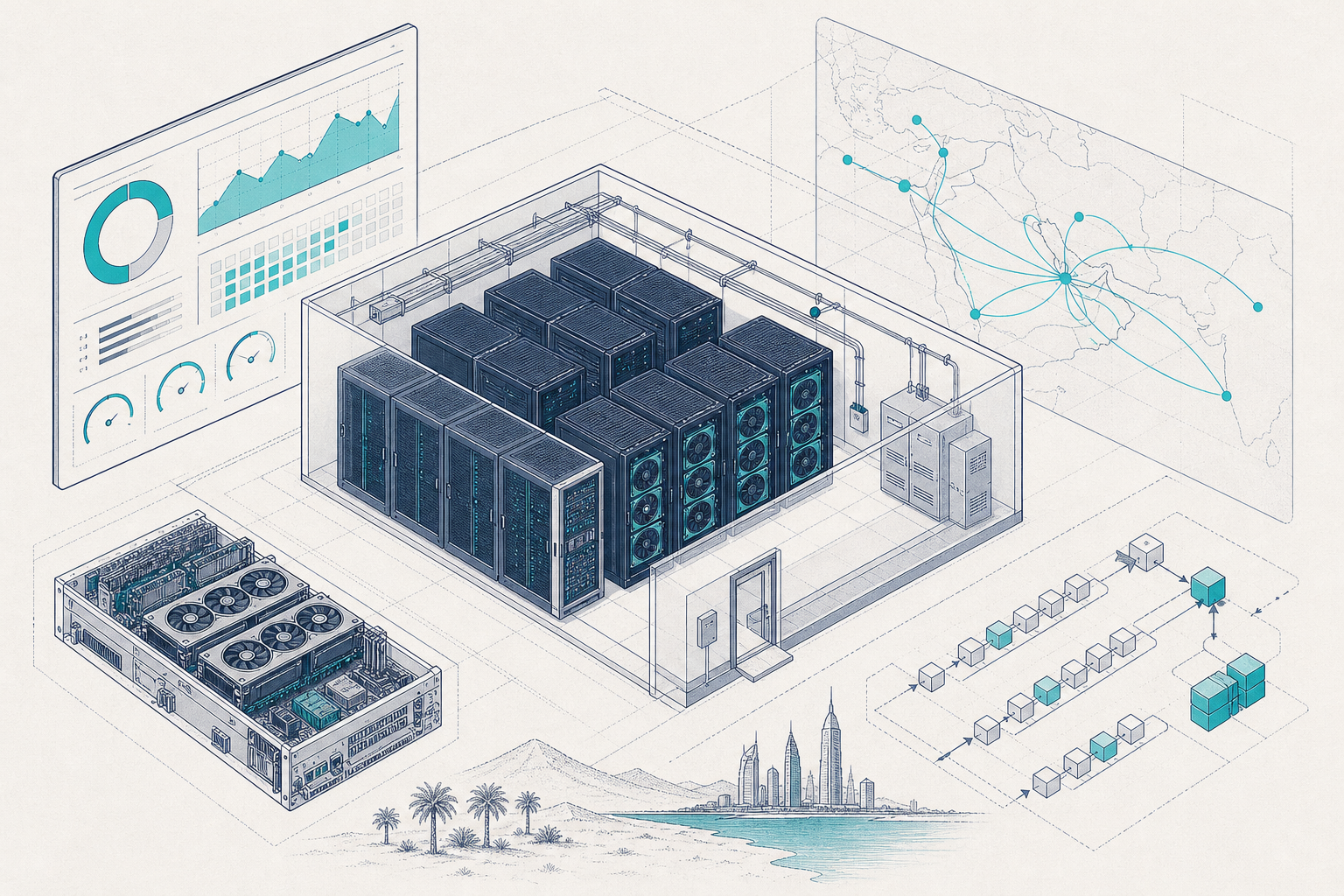
Fal's funding round is an infrastructure signal
On 3 November 2026, TechCrunch reported that Fal raised $1.3 billion at a $16 billion valuation, doubling its valuation as demand for open model inference surged. The same report named Baseten, Fireworks AI, and Modal as rapidly expanding competitors in the inference platform market. The headline is about capital, but the operational signal is more useful: high volume generative inference has become a distinct infrastructure business, not just a feature of model hosting.
Fal's demand profile is especially relevant because image, video, and audio generation behave differently from chat completion. They create spiky request patterns, variable run times, large intermediate artifacts, and strong user sensitivity to queue delay. A consumer campaign, design workflow, game asset batch, or short video generation product can swing from low load to thousands of jobs in minutes. A hyperscale inference platform can absorb that burst across a very large fleet. A quarter rack, a half rack, or a few racks cannot hide behind statistical smoothing to the same degree.
That difference matters for operators in the GCC and wider MENA region. Many local GPU estates are being built for universities, public sector AI programs, media groups, Arabic language products, industrial digital twins, and private enterprise inference. They often have real hardware, sovereign data requirements, local support expectations, and power constraints. They do not have infinite GPUs, infinite WAN egress, or the economic room to keep expensive accelerators idle for the sake of occasional bursts.
The lesson is not that small operators should imitate Fal, Baseten, Fireworks AI, or Modal feature by feature. The better question is narrower: should a small regional operator specialize in latency sensitive, sovereign, regional inference, while using disciplined scheduling, partitioning, metering, and chargeback to keep the fleet economically honest? For many GCC operators, the answer can be yes, but only if the platform is run as infrastructure, not as a collection of one off GPU servers.
The bottleneck a quarter rack will actually hit
Consider a compact estate with 16 GPU servers, each with 4 accelerators, for 64 GPUs total. That is a serious local asset, but it is still small compared with hyperscale inference pools. If those GPUs are assigned manually to teams, the first bottleneck is not raw FLOPS. It is fragmentation.
One tenant wants eight full GPUs for video generation during evenings. Another wants many small partitions for image generation experiments. A third wants low latency Arabic speech inference with strict residency. A fourth wants VM access for a vendor appliance that cannot run cleanly inside Kubernetes. The storage team needs artifact retention and tenant separation. Finance wants per tenant cost recovery. The data protection officer wants proof that regulated workloads stayed in country. Facilities wants power draw and heat to remain predictable.
The operator soon sees the same failure modes:
- Full GPUs reserved for services that use them only part of the day.
- Small inference services blocked because large training or batch jobs occupy whole nodes.
- Image and video generation queues growing while other GPUs sit idle due to incompatible tenancy boundaries.
- No trusted cost per request, cost per tenant, or cost per model.
- No clean way to decide whether to accept, throttle, defer, or reject burst traffic.
- Difficulty proving that sovereign workloads did not spill into an external region.
Hyperscale inference companies solve part of this with fleet size. Small and mid size operators must solve it with control. That is where an orchestration platform such as ClastIQ is relevant: bare metal provisioning, Kubernetes and VM tenancy on the same fleet, GPU partitioning, storage, quota, metering, policy, and local operational support on hardware the operator already owns or controls.
Specialization beats copying hyperscale
A regional operator cannot win by offering every model, every region, every batch size, and every price tier. It can win where locality, governance, and service integration matter.
For the GCC, that usually means one or more of the following:
- Low latency inference for users in Muscat, Riyadh, Doha, Dubai, Abu Dhabi, Manama, Kuwait City, and nearby markets.
- Data residency for government, regulated enterprise, healthcare, education, media, and critical infrastructure workloads.
- Arabic and bilingual product workflows where model selection, moderation, and evaluation are tuned locally.
- On premises or sovereign deployments where outbound data movement is restricted.
- Predictable support from engineers who can work with the operator's racks, power, network, and procurement reality.
This does not require the operator to ignore global inference platforms. Some burst overflow may still go to external providers when policy allows. But the regional estate should be designed around the workloads it can serve better than a distant region: latency sensitive requests, private datasets, regulated artifacts, and customers who need a local commercial relationship.
That specialization changes the technical design. The goal is not just maximum benchmark throughput. The goal is governed utilization. Every GPU hour should have an owner, a policy context, and a cost trail. Every tenant should have quotas. Every model should have a placement policy. Every queue should express business priority, not just arrival order.
A practical scheduling model for generative inference
Image, video, and audio generation create mixed workloads. Some requests are interactive and should start quickly. Others are batch jobs that can wait. Some models use a whole GPU efficiently. Others fit inside a partition or can share a GPU by time slicing. Some jobs require GPU memory isolation. Others can tolerate co tenancy if performance is stable enough.
A small estate should separate workload classes before it tries to optimize them.
| Workload class | Typical requirement | Operator control |
|---|---|---|
| Interactive image generation | Low queue delay, moderate duration | Reserve partitioned GPU pool, strict per tenant rate limits |
| Video generation | Long duration, high memory, bursty | Batch queue, admission control, full GPU or large slice placement |
| Audio generation and transcription | Latency sensitive, often smaller models | MIG or time slice pools, priority queues |
| Enterprise private inference | Residency and auditability | Tenant isolation, placement policy, storage separation |
| Research and experiments | Variable use, lower priority | Preemptible or off peak quotas |
The scheduling rule should be simple enough to explain to tenants. For example: interactive queues get a guaranteed floor, batch queues get opportunistic capacity, regulated tenants get placement restrictions, and experiments can be preempted when revenue workloads arrive. Without this policy layer, the loudest tenant gets the GPUs and utilization data becomes politically useless.
ClastIQ's role is to make those controls operational on a mixed estate. Bare metal provisioning through MAAS and Juju establishes repeatable node builds. Kubernetes runs containerized inference services. VM tenancy supports appliances, legacy stacks, and tenants that need stronger administrative boundaries. GPU partitioning through MIG where supported, or time slicing where appropriate, lets the operator create smaller allocatable units. Ceph provides shared storage for model weights, generated artifacts, logs, and tenant volumes. Metering and chargeback turn usage into a billable or accountable record.
Model multiplexing is useful, but not magic
Model multiplexing means serving multiple models from the same GPU pool, often by loading and unloading weights, sharing runtime servers, or placing compatible models together. It can raise utilization, but it also introduces failure modes. Loading large image or video models repeatedly can create cold start delays. Keeping too many models warm wastes memory. Mixing tenants without policy can create noisy neighbor complaints. Caching generated artifacts can reduce recomputation, but it can also create storage growth and governance risk.
For a quarter rack operator, the best approach is usually tiered.
First, identify the top models by revenue or strategic importance and keep them warm. Second, group long tail models into a lower priority pool with explicit cold start expectations. Third, require tenants to declare whether a request is interactive or batch. Fourth, meter GPU seconds, storage, and queue delay per tenant so that product teams can see the cost of keeping rarely used models warm.
A practical control file might look like this:
apiVersion: inference.clastiq.example/v1
kind: ModelPolicy
metadata:
  name: arabic-image-premium
spec:
  tenant: media-tenant-a
  residency: oman
  gpuClass: mixed-supported
  placement: dedicated-or-mig
  minWarmReplicas: 2
  maxReplicas: 8
  queue:
    priority: interactive
    maxWaitSeconds: 12
  metering:
    labels:
      product: image-generation
      chargebackCode: MEDIA-A-IMG
The point is not the exact schema. The point is that placement, residency, scaling, queue priority, and chargeback need to live together. If they are configured in separate spreadsheets, shell scripts, and ticket comments, the estate will not remain governable.
Worked example: utilization, chargeback, and revenue per MW
Assume a regional operator has 64 GPUs. Each GPU is available 24 hours per day, so the monthly theoretical supply is:
64 GPUs x 24 hours x 30 days = 46,080 GPU hours per month.
Before orchestration, average billable utilization is 32 percent because of static reservations, idle overnight capacity, fragmented nodes, and unmetered experiments. Billable usage is:
46,080 x 0.32 = 14,746 GPU hours per month, rounded to the nearest GPU hour.
If the internal or external chargeback rate is $2.40 per GPU hour, monthly recognized revenue or cost recovery is:
14,746 x $2.40 = $35,390.40.
Now assume the operator introduces policy based queues, GPU partitioning for smaller inference services, batch scheduling for video jobs, and quotas that move experiments to off peak capacity. Billable utilization rises to 61 percent without adding GPUs:
46,080 x 0.61 = 28,109 GPU hours per month.
At the same $2.40 rate, monthly recognized revenue is:
28,109 x $2.40 = $67,461.60.
The difference is $32,071.20 per month, or $384,854.40 per year, before considering storage, support, network, or premium latency tiers.
Power economics make the same point. Suppose the 64 GPU estate, including servers and proportional cooling overhead, averages 72 kW during normal operation. Annual energy capacity at that draw is:
72 kW x 8,760 hours = 630,720 kWh, equal to 0.63072 GWh.
Annual recognized revenue at 32 percent utilization is $424,684.80. Annual recognized revenue per MW of average IT and cooling load is:
$424,684.80 / 0.072 MW = $5,898,400 per MW year.
At 61 percent utilization, annual recognized revenue is $809,539.20. Revenue per MW year becomes:
$809,539.20 / 0.072 MW = $11,243,600 per MW year.
This example is simplified, but it shows why utilization governance matters. The operator did not buy more hardware, negotiate a new power feed, or change accelerators. It changed allocation, admission, partitioning, and metering. For a GCC data center where power, rack space, import lead times, and support windows all matter, that is often the highest return project available.
Autoscaling in a small estate means admission control
Autoscaling means something different when the operator owns a finite number of GPUs. In a hyperscale cloud, scale out can mean adding many instances in another zone. In a quarter rack, scale out means taking capacity from another queue, starting a replica on an idle partition, preempting lower priority work, or refusing new work until the queue clears.
That is why autoscaling must be connected to quotas and admission control. A video generation tenant should not be allowed to create 200 long running jobs that starve speech inference for a hospital or a government service. A research team should not keep warm replicas of a rarely used model during peak commercial hours unless it pays for that reservation. A premium tenant that pays for low queue delay should have a measurable service class.
Useful autoscaling signals include:
- Queue depth by tenant and model.
- Oldest request age by workload class.
- GPU memory pressure and partition availability.
- Tokens, frames, seconds of audio, or images generated per GPU hour.
- Cold start frequency and model load time.
- Power and thermal headroom.
The last item is easy to overlook. In a small room or edge facility, the limiting factor may be power density or cooling, not scheduler intent. A platform that understands the hardware estate can help operators avoid a policy that looks good in Kubernetes but overloads the facility. ClastIQ's hardware agnostic approach matters here because GCC estates are rarely perfectly uniform. Operators may mix NVIDIA and AMD accelerators, CPU heavy nodes, older GPUs, newer GPUs, and storage nodes across procurement cycles.
Metering must reach the tenant and the model
For inference, node level utilization is not enough. Operators need to know who consumed the GPU, which model was served, what workload class it belonged to, and which storage and network resources were attached. Otherwise chargeback turns into a monthly argument.
A workable meter for generative inference should record at least:
- Tenant ID and project ID.
- Model ID and version.
- GPU type or partition type.
- Start time, end time, and GPU seconds.
- Queue wait time and execution time.
- Number of generated images, video seconds, audio minutes, or requests.
- Storage written and retained.
- Residency policy and placement zone.
This lets the operator price different services honestly. Interactive image generation may be priced per GPU second plus a premium for guaranteed queue delay. Video generation may be priced per GPU minute with a batch discount. Private enterprise inference may include reserved capacity and storage retention. Internal research may be charged at cost, but still counted.
The CLI surface can be simple. Operators should be able to ask what a tenant used and what it cost:
clastiq meter report \
  --tenant media-tenant-a \
  --from 2026-11-01 \
  --to 2026-11-30 \
  --group-by model,queue,gpu_class \
  --show gpu_hours,queue_p95,storage_gb,cost_usd
Even if the implementation integrates multiple systems underneath, the management view needs to be coherent. Finance, operations, and tenants should not depend on three inconsistent dashboards.
Sovereignty is a scheduling constraint
In the GCC and MENA, sovereignty is not an abstract feature. It affects customer eligibility, legal risk, and public sector trust. If an inference request includes citizen data, confidential media, energy infrastructure imagery, medical audio, or unreleased product content, the operator may need to prove where the request ran, where artifacts were stored, and who had administrative access.
This is why sovereignty cannot be bolted on after the inference stack is popular. It must appear in provisioning, identity, placement, storage, backup, logging, and support processes. Air gap and sovereign deployments also change update management. Model weights, container images, security patches, and observability tools may need controlled import processes rather than direct pulls from public registries.
For small operators, the risk is that an urgent scaling decision violates a residency promise. A queue grows, an engineer points a workload at external capacity, and a customer commitment is broken. The safer pattern is to encode residency as policy. If a job is marked sovereign, it can run only on approved nodes and store artifacts only in approved Ceph pools. If capacity is unavailable, the scheduler queues or rejects the request. It does not silently spill.
Storage is part of inference economics
Image, video, and audio generation can turn storage into a cost center quickly. Model weights are large. Intermediate files may be larger. User artifacts may be retained for days, months, or permanently depending on the product. Logs and evaluation outputs add more data. If storage is not metered, tenants will treat it as free.
Ceph is useful because it can provide object, block, and file storage patterns on operator owned hardware, but it still needs policy. Hot model weights should be placed for fast access. Generated artifacts should have lifecycle rules. Tenant data should be separated. Replication and erasure coding choices should reflect the value and access pattern of the data. Backup should match residency commitments.
For chargeback, storage should not be buried inside the GPU rate. If a media tenant generates 200 TB of retained video artifacts, its economics differ from an audio tenant that retains transcripts for seven days. GPU hours, storage GB months, and egress should be visible line items.
What a ClastIQ style control plane changes
The infrastructure pattern is straightforward. Provision the hardware consistently. Segment tenants cleanly. Run Kubernetes and VMs on the same fleet where each makes sense. Partition GPUs where supported. Use time slicing where appropriate. Put queues and quotas in front of inference services. Meter consumption. Keep storage governed. Tie everything back to policy.
For an operator, the value is not a single feature. It is the ability to operate a small or mid size GPU estate with the same economic discipline expected from a larger region. ClastIQ is designed for operators who own the hardware, from a quarter rack to a few racks, and need bare metal provisioning, Kubernetes and VM tenancy, GPU partitioning, Ceph storage, metering, quota engineering, air gap options, and human led local support. It remains hardware agnostic across NVIDIA, AMD, and mixed CPU and GPU estates.
Fal's funding round shows that inference demand is large enough to support specialized platforms. It also shows that burst absorption is becoming a competitive advantage. Small GCC operators should not pretend they have hyperscale burst capacity. They should build a different advantage: local latency, sovereign operation, transparent cost, and high utilization on the hardware they control.
What to do this week
- Classify current and expected inference workloads into interactive image, video batch, audio, private enterprise, and research queues.
- Calculate monthly theoretical GPU hours, actual billable GPU hours, and utilization by tenant.
- Define a first chargeback model with GPU hours, storage GB months, and premium queue classes as separate line items.
- Mark which workloads require in country placement, air gap operation, or restricted artifact storage.
- Test GPU partitioning or time slicing on one non production pool, then compare queue delay and utilization against full GPU allocation.
- Create an admission control rule for the largest burst workload before it reaches production.
ClastIQ runs this on the operator's own hardware, request a demo.
Sources
TechCrunch, AI inference startup Fal doubles its valuation to $16B as demand surges