Fal’s funding points to the next operating problem
On November 3, 2026, TechCrunch reported that Fal raised $1.3 billion at a $16 billion valuation as demand for AI inference increased. The company is associated with serving generative media workloads, including image, video, and audio generation, where demand arrives as API traffic rather than long scheduled training jobs.
The valuation is not the operating lesson. The useful signal for a GPU estate owner is that inference is becoming the near term demand center for open models. Training remains important, but the day to day pressure on many operators will come from many tenants asking for low latency model execution, often with unpredictable bursts, many model variants, and uneven request sizes.
That changes the infrastructure problem. A training cluster can often be scheduled in large blocks. A team books 8, 16, or 64 GPUs for a known period. Utilization is still hard, but the shape is visible. Inference is different. One tenant may need a text model at a steady rate. Another may run bursts of image generation after a marketing campaign. A third may test audio models for 2 hours, then disappear for a week. Video generation may consume memory, GPU time, CPU preprocessing, and object storage bandwidth in uneven proportions.
For a hyperscaler, this is absorbed by large regional pools, custom schedulers, mature metering, and internal demand diversity. For an operator with a quarter rack to a few racks, the margin for error is smaller. If 4 GPUs sit idle because a model server is pinned to the wrong node, that can be a material part of the estate. If a single tenant fills GPU memory with a large context workload, smaller requests may queue behind it even while other devices are underused. If chargeback is based only on allocated GPUs, the operator cannot see which models, tenants, or API routes are consuming the estate.
ClastIQ, styled with IQ in the accent color, exists for this operating gap. The product of Cognition AI and Technology Innovation SPC in Oman is a GPU and CPU orchestration platform for operators who own physical infrastructure but are not hyperscalers. The relevant question is not whether an estate can run inference. It is whether it can keep utilization, isolation, quota, metering, storage, and power aligned while demand shifts hour by hour.
The bottleneck is no longer only GPU count
The first instinct after seeing inference demand is to buy more GPUs. Sometimes that is correct. More often, the first constraint is the control plane.
A small to mid size estate serving open models will hit several practical bottlenecks before it simply runs out of silicon.
First, model placement becomes fragmented. A node may have enough compute available, but not enough GPU memory for the model and its KV cache. Another node may have memory, but the model weights are cold on local storage, adding startup delay. A third node may be reserved for a VM tenant and therefore unavailable to Kubernetes jobs.
Second, request batching determines effective throughput. If every request is sent directly to an isolated worker, GPUs spend too much time on small batches. If batching is too aggressive, latency targets fail. Image, video, text, and audio workloads each need different batch behavior.
Third, KV-cache management becomes an economic issue. For text and multimodal models, cache memory can improve latency and reduce repeated computation, but it also reserves scarce memory. Long context tenants can crowd out short queries unless quota and policy are explicit.
Fourth, isolation is not optional. A government entity, bank, university, or media tenant may require its workloads, data, model artifacts, and logs to remain separated. In the GCC and MENA region, sovereign operation is often not a presentation slide. It affects where systems are installed, how updates are moved into an air-gapped site, which staff have access, and how logs are retained.
Fifth, storage becomes part of the serving path. Model weights, adapters, generated media, request logs, and metering data all need durable placement. If every worker downloads large weights from outside the facility, the estate will waste network and time. If weights are copied manually, version drift becomes a support issue.
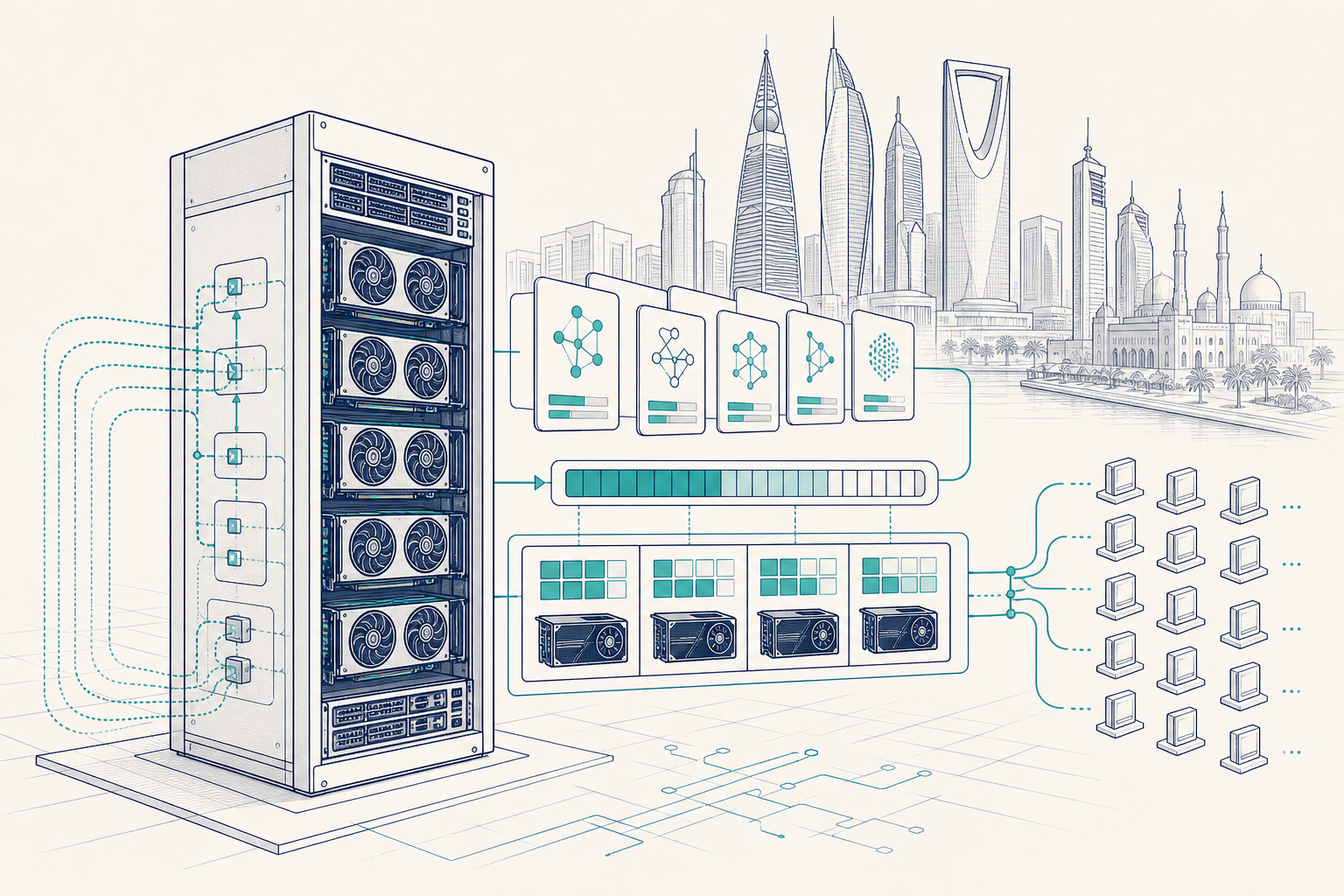
A platform such as Clastiq addresses these as one estate problem rather than separate tickets. Bare-metal provisioning brings nodes into service in a known state. Kubernetes and VM tenancy allow different tenant models on the same fleet. GPU partitioning, including MIG where available and time slicing where appropriate, lets operators avoid dedicating whole devices to small or bursty workloads. Ceph provides a storage substrate for model artifacts and generated outputs. Metering and chargeback connect technical use to financial accountability.
What a quarter rack actually needs for inference
A quarter rack or small room deployment can be economically meaningful, but only if it is operated as a pool. The wrong pattern is to assign fixed hardware to each tenant and hope utilization averages out. That usually creates idle islands.
The better pattern is to separate the estate into policy classes. Some capacity is for latency sensitive inference. Some is for batch generation. Some is for VMs that require stable device attachment. Some is for maintenance, upgrades, and failed node absorption. The pool boundaries should be configurable, not hardwired.
A useful control plane for open model inference should handle the following layers.
| Layer | Operator risk | Control needed |
|---|---|---|
| Bare metal | Drift between nodes, slow rebuilds | Repeatable provisioning and firmware inventory |
| GPU partitioning | Whole GPUs wasted on small tenants | Slices, time sharing, and device class policy |
| Scheduling | Models placed where cache or memory is wrong | Topology aware placement and quotas |
| Storage | Weight copies drift, generated media fills disks | Shared object and block storage with lifecycle policy |
| Tenancy | Noisy neighbors, unclear ownership | Namespaces, VM boundaries, network policy, access control |
| Metering | Revenue detached from consumption | Per tenant GPU hours, slice hours, storage, and egress records |
| Sovereignty | Data and logs leave the jurisdiction | Air-gap capable updates, local audit, local support |
This is also where hardware agnosticism matters. A regional operator may not have a single clean hardware generation. One rack may contain high memory accelerators. Another may contain older devices that are still useful for smaller models, embeddings, or preprocessing. CPUs may be mixed. Some tenants may bring workloads validated on one accelerator vendor, while others only need a standard container interface. The orchestration layer should describe capabilities and policy, not assume every node is identical.
Clastiq’s role is to make that mixed estate governable. Bare-metal tools such as MAAS and Juju can establish a repeatable base. Kubernetes handles elastic inference services and batch workers. VM tenancy supports users that need dedicated operating environments or legacy stacks. GPU partitioning maps the available hardware to workload shapes. Metering turns consumption into invoices, internal chargeback, or research allocations.
Dynamic loading, batching, and cache policy are utilization features
For inference, utilization is not just a dashboard number. It is built into how models are loaded and requests are admitted.
Dynamic model loading matters because open model demand is broad. A tenant may need one base model with several adapters. Another may need a video model only during a nightly production window. Keeping every model resident on a dedicated GPU will consume the estate before requests arrive. Loading on demand, warming popular models, and evicting cold models should be an explicit policy.
Request batching matters because small requests underfill GPUs. A single image request, one short audio clip, or a short text completion may not use the device efficiently. Batching improves throughput, but it must respect latency classes. A tenant paying for interactive service cannot be mixed blindly with low priority batch generation.
KV-cache policy matters because memory is the limiting resource for many text and multimodal workloads. Operators need per tenant limits on cache size, context length, and admission. Without those limits, a few long context sessions can reduce the number of concurrent users that fit on the estate.
The exact interface will vary by environment, but the operational intent should be concrete enough to automate:
clastiq quota set tenant-media \
  --gpu-slices 12 \
  --gpu-hours-month 2500 \
  --burst-gpu-slices 8 \
  --burst-window 02:00-08:00

clastiq policy set inference-gold \
  --max-context-tokens 32000 \
  --kv-cache-gb 320 \
  --batch-latency-ms 250

clastiq meter export --month 2026-11 --group-by tenant,model,gpu_class
The point is not the command syntax. The point is that quota, cache, burst rights, and metering should live in the same operating model. If they are split across spreadsheets, manual tickets, and ad hoc dashboards, the estate will look larger on paper than it behaves in production.
A worked example: 32 GPUs, bursty inference, and chargeback
Consider a 32 GPU estate in a GCC or MENA facility. The GPUs average 700 watts each under load. CPU servers, storage, and networking add 15 kW of IT load. The site power usage effectiveness used for planning is 1.4. The month has 720 hours.
The estate has 32 x 720 = 23,040 available GPU hours per month.
Before orchestration changes, the operator statically assigns capacity:
- 8 GPUs for image generation, averaging 25 percent useful utilization
- 8 GPUs for video generation, averaging 35 percent useful utilization
- 4 GPUs for audio workloads, averaging 15 percent useful utilization
- 12 GPUs reserved for VM tenants and future demand, averaging 10 percent useful utilization
Useful GPU hours are:
- Image: 8 x 720 x 0.25 = 1,440
- Video: 8 x 720 x 0.35 = 2,016
- Audio: 4 x 720 x 0.15 = 432
- Reserved pool: 12 x 720 x 0.10 = 864
Total useful GPU hours are 4,752. Estate utilization is 4,752 divided by 23,040, or 20.6 percent.
Now assume the operator pools most capacity under policy. Four GPUs remain reserved for maintenance and hard isolation. The remaining 28 GPUs are scheduled across Kubernetes inference services and VM tenants. Dynamic model loading reduces idle model residency. Batching improves device occupancy for short requests. GPU partitioning allows smaller tenants to use slices instead of whole devices. Admission policy limits runaway long context sessions.
The 28 scheduled GPUs now average 55 percent useful utilization. Useful GPU hours are 28 x 720 x 0.55 = 11,088. Measured against the full 32 GPU estate, utilization is 11,088 divided by 23,040, or 48.1 percent.
That is an increase of 6,336 useful GPU hours in the same month, without adding a GPU.
Now attach simple economics. Suppose the operator’s fully loaded monthly estate cost is 96,000 dollars. This includes hardware depreciation or lease cost, facility allocation, power, network, software operations, and support labor. The cost per available GPU hour is 96,000 divided by 23,040, or 4.17 dollars.
Under the static model, cost per useful GPU hour is 96,000 divided by 4,752, or 20.20 dollars. If internal chargeback or external billing is set at 12 dollars per useful GPU hour, the estate recovers only 57,024 dollars. It runs below cost.
Under the pooled model, cost per useful GPU hour is 96,000 divided by 11,088, or 8.66 dollars. At the same 12 dollar chargeback rate, monthly recovery is 133,056 dollars. The estate now produces 37,056 dollars above the fully loaded monthly cost.
Revenue per megawatt also changes. The GPU load is 32 x 0.7 kW = 22.4 kW. Add 15 kW for CPU, storage, and network to get 37.4 kW of IT load. At 133,056 dollars per month, annualized revenue is 1,596,672 dollars. Divided by 0.0374 MW, that is about 42.7 million dollars per MW per year. Under the static model, annualized revenue is 684,288 dollars, or about 18.3 million dollars per MW per year.
These numbers are illustrative, not a benchmark. The important lesson is that utilization engineering affects power economics. In markets where data center capacity, grid connection, and cooling are constrained, revenue per MW is not an abstract metric. It determines whether a small AI facility can expand, remain sovereign, and price services competitively.
Why this is especially relevant in GCC and MENA
The Fal funding story is global, but the operating implications are direct for GCC and MENA infrastructure owners. Many organizations in the region want local AI capacity for sovereignty, latency, procurement control, Arabic and regional language use cases, and regulated data handling. They may not want to send prompts, media, logs, or generated outputs to an external region.
At the same time, many estates are not hyperscale. A ministry innovation lab, telecom operator, university, media group, bank, or industrial company may operate from a quarter rack to a few racks. The estate must serve many stakeholders with different priorities. Some workloads are public sector sensitive. Some are commercial. Some are research. Some are revenue generating services for third parties.
This mix requires governance as much as compute. A tenant should know its quota. The operator should know who consumed each GPU hour. Finance should receive a monthly allocation report that can be reconciled. Security should know where model weights and generated media are stored. Operations should know which nodes can be patched without breaking a service level commitment.
Air-gap and sovereign deployment requirements make this more important. If an estate cannot rely on a public control plane, SaaS metering endpoint, or external artifact registry, then the platform must work locally. Updates, images, policies, logs, and usage records need an offline path. Human-led local support matters because the problem is physical as well as software. Firmware, cabling, power draw, failed disks, and accelerator health all affect the service.
Clastiq is positioned for these conditions: hardware agnostic, oriented around real assets, and designed for operators that need bare-metal provisioning, Kubernetes and VM tenancy, GPU partitioning, Ceph storage, metering, chargeback, quotas, policy engineering, air-gap operation, and local support. That combination is what turns a rack of accelerators into a governed inference estate.
Isolation and metering should be designed before the first invoice
Inference makes weak tenancy visible. If multiple tenants share a device through time slicing or partitions, the operator must define what is isolated and what is not. Device memory boundaries, process isolation, network paths, container privileges, image provenance, and log visibility all need policy. Some tenants may accept shared infrastructure with logical separation. Others may require dedicated nodes or VMs.
The same applies to metering. A simple allocated GPU count is not enough for bursty inference. Operators should meter at least five dimensions:
- GPU hours or slice hours by tenant
- Model or service identifier
- Storage consumed by model weights, adapters, inputs, and outputs
- Data movement, especially external egress if allowed
- Priority class, because interactive and batch capacity have different value
Chargeback does not have to mean commercial billing. In a public institution or enterprise, it can mean internal accountability. Without it, every tenant asks for peak capacity, because there is no cost to over reservation. With it, tenants can make rational choices. They may choose slower batch windows, smaller context limits, or a lower priority class if the price reflects the infrastructure reality.
Quotas should also include burst rules. A tenant with a 2,500 GPU hour monthly quota may still need 3 times its normal capacity for 2 hours. The platform should allow that if there is unused pool capacity, while protecting other tenants. This is where policy engineering has direct financial value. It increases sellable utilization without turning the estate into a free for all.
Storage and power complete the inference picture
Open model inference produces storage pressure. Model weights are large. Fine tunes and adapters multiply versions. Image, video, and audio outputs are bulky. Logs and metering records are small individually but important for audit. A Ceph based layer gives operators a way to provide block, object, and file style services inside the sovereign estate, while applying lifecycle rules and capacity reporting.
For example, a generated video tenant may not need outputs retained forever on premium storage. A policy can keep outputs on fast storage for 7 days, move them to a lower tier for 30 days, and delete them after a contractual period. Model artifacts can be pinned, versioned, and replicated across failure domains. Metering records can be retained separately for finance and audit.
Power should also be integrated into scheduling discussions. Operators often know the breaker limit before they know the demand curve. If a rack cannot run every GPU, CPU, and storage node at peak simultaneously, the scheduler needs power awareness or at least power policy. Low priority batch inference can move to off peak periods. Tenants can receive incentives for overnight work. Maintenance windows can be aligned with thermal and power constraints.
This is why the relevant metric is not only requests per second. For a small estate, the operating metrics are useful GPU hours, queue time by class, cache hit behavior, tenant cost recovery, storage growth, and revenue per MW. These are the numbers that determine whether the next purchase should be GPUs, storage, power capacity, networking, or orchestration work.
What to do this week
-
Inventory the estate by capability, not just node count. Record GPU type, memory size, partitioning support, CPU, RAM, local storage, network speed, firmware level, and power draw. Mixed hardware is usable only if the scheduler can see the differences.
-
Measure useful utilization for one full week. Separate allocated GPU hours from active GPU hours. Break the data down by tenant, model, and workload class. If the current tools cannot do this, that is the first control plane gap to close.
-
Define three inference classes. For example: interactive, standard batch, and opportunistic batch. Assign latency targets, batch policy, cache limits, and preemption rules to each class. Do not let every workload enter the estate as highest priority.
-
Create a model artifact policy. Decide where weights, adapters, generated media, and logs live. Define who can publish a model, how versions are approved, and how long outputs are retained. Put this in storage policy, not tribal knowledge.
-
Build a chargeback draft before expanding hardware. Use GPU hours or slice hours, storage, and priority class. Run it for one month as a shadow bill. Show tenants what they would have paid and ask which reservations they still need.
-
Test an air-gap operating path. Confirm that container images, model artifacts, updates, metering exports, and support bundles can move through approved offline procedures. This is especially important for GCC and MENA organizations with sovereignty or regulated data requirements.
The operator lesson from Fal’s raise
Fal’s raise shows that inference demand can grow quickly when developers build on open models and generative media APIs. For GPU estate operators, the conclusion is practical. The next constraint may not be model research or accelerator availability. It may be the ability to operate many inference workloads on a small physical fleet without wasting devices, losing isolation, or billing incorrectly.
A quarter rack can be a serious inference platform if it is pooled, metered, and governed. A few racks can support multiple tenants if quotas, partitioning, storage, and power policy are designed as part of the same system. Without that operating layer, the estate can look full while producing too few useful GPU hours.
The near term work is therefore not to imitate a hyperscaler in size. It is to imitate the useful parts of hyperscale discipline: repeatable provisioning, workload placement, utilization measurement, tenant isolation, chargeback, and local control. That is the infrastructure bottleneck that inference demand is now exposing.
Sources
Related product: vLLM