Firecrawl's Series B makes the data plane the operator problem
On September 13, 2026, Firecrawl raised a $75 million Series B for web-to-LLM data infrastructure. The company describes a product that crawls webpages and converts them into LLM-ready markdown or structured data, with an ambition to build a large repository of web knowledge. For application teams, that looks like a cleaner path from public web content to retrieval, agents and evaluation sets. For a GPU estate operator, it changes the bottleneck.
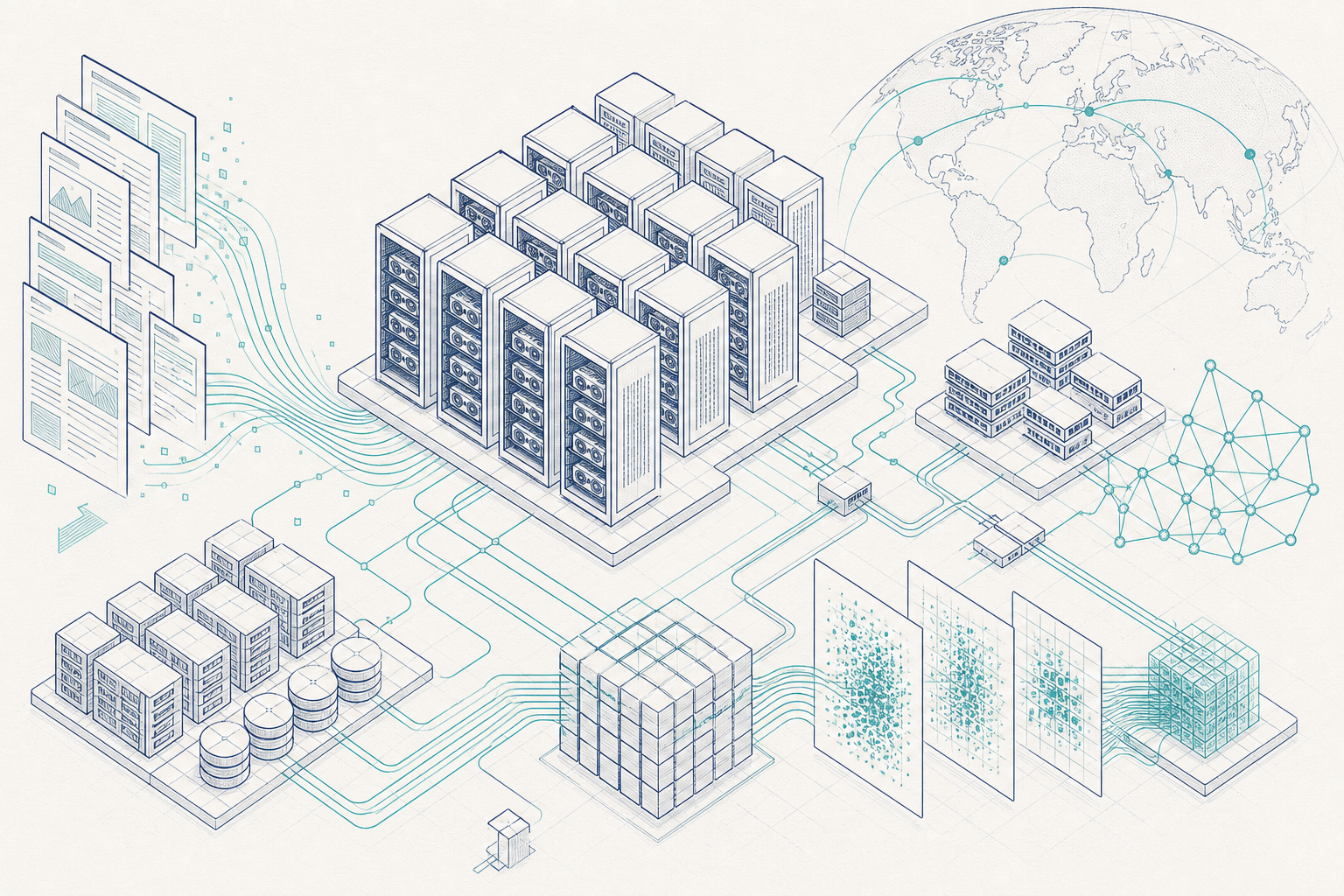
The constraint is no longer only how many accelerators can serve a model. A retrieval or agent workload also needs raw crawl retention, parsed documents, embeddings, vector indexes, metadata, snapshots, refresh jobs and lineage. Each layer has different I/O behavior. Raw HTML is write-heavy and cheap to keep. Clean markdown is smaller but needs versioning. Embedding jobs are bursty, CPU and GPU hungry. Vector indexes are latency sensitive. Refresh pipelines introduce constant background load. If the same quarter rack or few racks are also selling inference, the ingestion system competes for GPUs, memory bandwidth, local NVMe, Ceph throughput and east-west network capacity.
That is where regional operators can lose margin. A hyperscaler can hide this with large pools, separate storage tiers and reservation systems. A small-to-mid GPU estate cannot. It needs explicit orchestration, partitioning, quotas and metering, or the data plane will quietly consume the economics that made the cluster worth building.
The bottleneck is not the crawler, it is the refresh loop
A one-time crawl is manageable. The operational problem is the loop: crawl, parse, chunk, embed, index, serve, measure, refresh, delete and repeat. Every step creates state. Every refresh has to decide what changed, what can be reused and what must be recomputed.
For a regional operator hosting tenants that build retrieval augmented generation, agent search, compliance assistants or customer support copilots, the storage footprint can exceed the model footprint quickly. A 70 billion parameter model may occupy tens to hundreds of gigabytes depending on precision and serving layout. A tenant's web knowledge base can occupy tens of terabytes before embeddings and indexes are included. If multiple tenants are crawling similar domains and keeping separate snapshots for governance, storage duplication is the default unless policy prevents it.
The main pressure points are practical:
| Layer | Operator pressure | Typical failure mode |
|---|---|---|
| Raw crawl objects | Capacity growth and namespace sprawl | No retention rule, object store fills first |
| Parsed markdown and JSON | Versioning and auditability | Tenants keep every snapshot forever |
| Embedding jobs | GPU, CPU and memory bursts | Batch jobs starve inference queues |
| Vector indexes | Low latency storage and RAM | Index placement ignores network topology |
| Refresh pipelines | Repeated background load | Nightly jobs collide across tenants |
| Metering | Chargeback granularity | Storage and GPU costs are billed as one flat fee |
This is a scheduling and accounting problem as much as a storage problem. If embeddings are treated as ordinary batch jobs, tenants will run them when developers push code, not when the cluster has spare power, cooling and network headroom. If vector index storage is treated as generic persistent volume capacity, index shards may land far from the GPUs serving them. If raw crawl retention is not priced, tenants have no reason to delete stale data.
A platform such as ClastIQ is relevant because it controls the fleet rather than only the application layer. It can provision bare metal, place Kubernetes and VM tenants on the same hardware pool, partition GPUs, expose storage classes, apply quotas and meter usage by tenant. The point is not to make crawling glamorous. The point is to stop ingestion from becoming an unpriced tax on inference.
What a quarter rack actually hits first
Consider a compact estate with 8 servers in a quarter rack. Each server has 4 GPUs, dual CPUs, local NVMe and 100 GbE. The estate has 32 GPUs total and about 400 TB of usable Ceph capacity after replication or erasure coding policy. Some tenants run inference APIs. Others run retrieval pipelines that periodically crawl and embed web content.
At full availability, the cluster has:
32 GPUs x 24 hours x 30 days = 23,040 GPU-hours per month.
In an unmanaged setup, average billable utilization might be 42 percent because inference has peaks, embedding jobs are delayed by contention and some GPUs sit fragmented by tenant reservation. That produces:
23,040 x 0.42 = 9,676.8 billable GPU-hours per month.
If the operator charges an internal or external rate of $4.50 per GPU-hour, monthly GPU revenue is:
9,676.8 x $4.50 = $43,545.60.
Assume the rack draw including servers, storage, switching and overhead allocation is 50 kW, or 0.05 MW. Monthly revenue per MW is:
$43,545.60 / 0.05 = $870,912 per MW-month equivalent.
Now apply explicit orchestration. Inference gets priority queues. Embedding runs in scheduled windows or on preemptible partitions. MIG or time-slice profiles are used for smaller embedding and reranking tasks where supported by the hardware, while full GPUs are reserved for jobs that need full memory. Ceph pools separate raw crawl, parsed documents and hot indexes. Tenant quotas prevent a single refresh pipeline from filling storage or saturating GPUs. With better placement and scheduling, billable utilization rises to 65 percent:
23,040 x 0.65 = 14,976 billable GPU-hours.
At the same $4.50 rate:
14,976 x $4.50 = $67,392 per month.
At the same 0.05 MW allocation:
$67,392 / 0.05 = $1,347,840 per MW-month equivalent.
The difference is $23,846.40 per month on the same hardware and power envelope. This is not because the model is faster. It is because ingestion, inference and storage are no longer fighting without policy.
The same logic applies to chargeback. Suppose a tenant keeps 60 TB of raw crawls, 12 TB of parsed markdown and JSON, and 8 TB of vector index and metadata. That is 80 TB, or 80,000 GB using decimal units. At $0.018 per GB-month, storage chargeback is:
80,000 x $0.018 = $1,440 per month.
If the same tenant uses 1,500 GPU-hours for embedding and reranking at $3.20 per GPU-hour, the GPU charge is $4,800. Add 5 TB of billable external transfer at $0.04 per GB, or $200. The monthly chargeback becomes:
$1,440 + $4,800 + $200 = $6,440.
Without this breakdown, the tenant sees only an AI platform fee. With it, the tenant can decide whether to reduce retention, refresh less often, deduplicate pages or buy more quota. The operator can see whether storage, GPUs or network is the binding constraint.
Why mixed tenancy matters
Web-to-LLM pipelines are mixed workloads. The crawler and parser may run well on CPUs. Deduplication may want memory and local NVMe. Embedding may use GPUs. Vector databases may prefer RAM, fast storage and stable network latency. Some tenants want Kubernetes. Others bring VM-based data appliances or licensed software that is not ready for containers.
For a small estate, separating these into dedicated islands is inefficient. A VM island, a Kubernetes island and a storage island each leave stranded capacity. The operator needs one fleet with hard tenancy boundaries and workload-aware placement.
ClastIQ's model is to provision bare metal with MAAS and Juju, then operate Kubernetes and VM tenancy on the same hardware fleet. That matters for this class of workload because the ingestion path is not one application. It is a chain. The crawler might run in Kubernetes, the vector database in a VM, the embedding workers as GPU pods and the evaluation service as another namespace. The operator still needs one view of quota, policy and metering.
GPU partitioning is part of the answer, but not the whole answer. MIG on supported accelerators can isolate slices for embedding, reranking or light inference. Time-slicing can raise utilization for bursty tasks where hard isolation is less important. On hardware that does not support MIG, the policy still matters: queueing, node labels, taints, priority classes and admission control decide whether ingestion can interrupt inference. ClastIQ is hardware-agnostic, so the policy must describe the intent rather than assume one accelerator vendor or one GPU feature.
A simple operator policy sketch might look like this:
clastiq quota set tenant-rag \
  --gpu-hours-month 1800 \
  --ceph-gb 90000 \
  --ingest-window 22:00-06:00 \
  --max-concurrent-index-jobs 4 \
  --preemptible-gpu-class embed-small
The exact interface will differ by environment. The important part is the contract. This tenant can store up to 90 TB, consume 1,800 GPU-hours, run ingestion mostly overnight and use preemptible smaller GPU partitions for embedding. If the tenant needs a daytime refresh for a production incident, that can be approved and metered. If not, the default protects the rest of the estate.
Storage design for retrieval estates
Ceph is useful here because it can provide object, block and file interfaces under one operational model. But Ceph is not a magic pool where all data has the same value. A retrieval pipeline should normally separate at least three classes.
First, raw crawl objects. These need capacity, durability and lifecycle rules. They are not usually latency sensitive. They should have retention policy by tenant and by source category. If a tenant cannot explain why raw data must be kept for a year, the default should be shorter.
Second, processed documents. Markdown, structured JSON, chunks and metadata need versioning because application quality depends on reproducibility. If an answer changed, the team may need to know which document snapshot and embedding model produced it. This data benefits from clear dataset IDs and immutability rules.
Third, hot indexes. Vector indexes, lexical indexes and hybrid search metadata need placement close to serving workloads. They need latency and predictable IOPS more than cheap capacity. They should not compete with raw crawls in the same unmanaged pool.
For a quarter rack, the most common storage mistake is to size for model weights and logs, then discover that crawls and indexes dominate. The second mistake is to meter GPU-hours but not storage growth. The third is to ignore rebuild and recovery traffic. When a storage node is recovering, embedding jobs can amplify network pressure and inference latency at the same time.
ClastIQ's role is to surface these as operational classes, not as hidden volumes. A tenant should see the cost and quota of raw retention separately from hot index capacity. The operator should see Ceph pool utilization, recovery state and per-tenant growth before the cluster reaches an emergency threshold.
GCC and MENA implications
Although the Firecrawl funding story is global, the infrastructure lesson is especially relevant for GCC and MENA operators. Many organizations in the region want AI services that respect data residency, sector rules and procurement realities. Public web data may be global, but the enriched knowledge base can become sensitive once combined with internal documents, user queries, analytics and customer workflows.
A sovereign or air-gapped deployment changes the data plane. You may need controlled allowlists for crawling. You may need local mirrors of approved web content. You may need to prove that tenant A's crawl data, embeddings and indexes never mix with tenant B's. You may need to operate in Arabic and English, with refresh rules that account for local news sources, government sites and enterprise portals. You may also need local support that can work on the actual hardware rather than a remote-only service model.
For GCC operators, power is also a commercial metric. A GPU estate is often judged by utilization and revenue per megawatt, not only by model latency. If ingestion runs at the wrong time, it can raise demand during peak cooling conditions and still fail to produce billable inference. Scheduling ingestion windows around tariff structures, cooling headroom and customer service levels is an infrastructure policy decision.
ClastIQ is designed for operators who own the hardware, from a quarter rack to a few racks. It is a product of Cognition AI and Technology Innovation SPC, registered in Oman. The platform's relevance in this context is practical: keep tenants separated, keep GPUs allocated to the highest value job at the right time, keep storage governed, and keep the deployment on the operator's own infrastructure where sovereignty requirements can be enforced.
The governance layer is part of capacity planning
Retrieval systems create governance questions that turn into infrastructure requirements. Who can crawl which domains? How long is raw content retained? Can a tenant export embeddings? Are indexes encrypted per tenant? Can a regulator or internal auditor reconstruct which data produced a response? What happens when a source requests removal or when a page changes materially?
If those questions are answered after the pipeline is built, the operator pays twice. Data has to be reprocessed, storage has to be reorganized and tenants argue about who caused the load. It is better to make policy part of provisioning.
At minimum, each tenant should have:
- A storage quota by data class, not only a total quota.
- A GPU-hour budget for embedding, evaluation and refresh.
- A maximum concurrency level for ingestion jobs.
- A defined refresh window and exception process.
- A retention policy for raw and processed data.
- A chargeback report that separates compute, storage and transfer.
This is also how an operator avoids overbuying. If all ingestion is invisible, the answer to every slowdown is more GPUs or more storage. If the estate is metered, the operator can see whether the next purchase should be NVMe, capacity disks, network ports, CPUs, memory or accelerators. In many retrieval estates, the next bottleneck is not the most expensive component.
Hardware agnostic does not mean policy agnostic
Firecrawl's raise is a reminder that AI infrastructure is moving toward data supply chains. Those supply chains will run across NVIDIA, AMD and mixed CPU/GPU estates. Operators should not bind their business model to one partitioning feature or one serving stack. They should define service classes: full GPU inference, partitioned GPU embedding, CPU parsing, hot index storage, raw object storage and preemptible batch.
Once those classes exist, the hardware can change underneath. A cluster may add new accelerators, repurpose older GPUs for embeddings, or move CPU-heavy parsing to nodes with more memory. The tenant contract remains understandable. That is the difference between a governed estate and a collection of servers.
A system like ClastIQ gives the operator the control plane to express those classes on real hardware. Bare-metal provisioning keeps node state consistent. Kubernetes and VM tenancy support the messy reality of application stacks. MIG and time-slicing improve utilization where appropriate. Ceph provides a common storage substrate. Metering, quotas and policy turn shared infrastructure into a billable service rather than an internal best-effort pool.
The operator still has to make choices. How much raw data is worth keeping? Which tenants get daytime refresh rights? Which workloads can be preempted? What is the minimum margin per GPU-hour? What revenue per megawatt justifies expansion? The platform does not remove those questions. It makes them measurable.
What to do this week
- Inventory retrieval data by class: raw crawl, parsed document, embedding, vector index, logs and snapshots. Measure growth per tenant.
- Separate ingestion from inference in scheduling policy. Define priority, preemption and approved refresh windows.
- Add chargeback lines for storage and GPU-hours used by embedding and refresh, not only served inference.
- Review Ceph pool design for raw capacity, processed datasets and hot indexes. Check recovery traffic impact on inference.
- Define tenant quotas for GPU-hours, storage, concurrency and retention before the next large crawl is approved.
- Model revenue per megawatt under current utilization and under a governed scheduling target.
ClastIQ runs this on the operator's own hardware, request a demo.