What changed
TechCrunch reported on 9 September 2026 that Harvey, the legal AI company, reached a valuation of $15.5 billion after raising another $550 million. The report says this came only months after Harvey had been valued at $11 billion. The company operates in a category where customers are enterprises, usage is document-heavy, and inference demand can be continuous once the software is embedded into daily workflows.
For GPU operators, the important part is not the valuation. It is what the funding round says about the shape of demand. Enterprise AI SaaS companies that move from pilots into production create persistent token load. They do not only need occasional training capacity. They need predictable inference throughput, enough headroom for user spikes, isolation for regulated customers, and cost models that survive heavy usage.
A legal AI product is a useful example because it combines several infrastructure stressors: long documents, retrieval-augmented generation, multi-step reasoning chains, confidential data, audit requirements, and work that often arrives in bursts around deadlines. Similar patterns appear in finance, healthcare, insurance, government, energy, engineering, and customer operations. A quarter rack to a few racks can serve this type of demand, but only if the operator treats the estate as a measured utility rather than a set of expensive servers waiting for jobs.
The bottleneck is therefore not just access to accelerators. It is the ability to turn owned hardware into sellable, governable, high-utilisation capacity without losing control of tenancy, power, storage, quotas, and local data rules.
The bottleneck is sustained inference, not launch-day capacity
Small and mid-size GPU estates are often planned around peak hardware capability: number of GPUs, aggregate memory, interconnect, CPU cores, storage capacity, and rack power. Those numbers matter, but inference-heavy customers expose another question: how many useful GPU-hours can the operator sell every month, at what latency tier, and with what policy controls?
The practical bottlenecks appear in five places.
First, utilization is uneven. Interactive inference needs spare capacity for latency, while batch summarization and embedding jobs can run opportunistically. If all customers receive the same scheduling treatment, either the operator over-reserves and wastes GPUs, or oversubscribes and misses service expectations.
Second, tenancy is not optional. Enterprise AI vendors need separation by customer, project, jurisdiction, or sensitivity level. That separation may be implemented through Kubernetes namespaces, virtual machines, bare-metal nodes, network policy, storage pools, and identity controls. In small estates, rigid separation can strand capacity unless orchestration is designed across the full fleet.
Third, metering has to map infrastructure consumption to commercial units. A customer may think in tokens, documents, users, or matters. The operator pays in power, cooling, hardware depreciation, facility cost, connectivity, storage, and staff time. The bridge between those worlds is GPU-hour, CPU-hour, memory, storage, I/O, egress, and reservation accounting.
Fourth, data locality and audit matter. In GCC and MENA markets, sovereign and sector-specific requirements can make a local GPU estate more attractive than a remote region, but only if the operator can prove where workloads run, which tenants share physical resources, and how data is stored and retained. The same applies in any jurisdiction where legal, health, financial, or public-sector data is constrained.
Fifth, power becomes a commercial metric. Revenue per megawatt is a better management number than raw cluster size. A small site with disciplined utilization and pricing can outperform a larger but poorly governed estate.
What a few racks must do differently
A hyperscaler hides much of this behind regional capacity pools, managed services, and internal chargeback. A regional operator with a quarter rack to a few racks cannot rely on surplus. The estate must be composed carefully.
Bare-metal provisioning remains the base layer. Operators need repeatable installs, firmware control, network profiles, storage attachment, GPU driver management, and the ability to rebuild nodes without manual drift. MAAS and Juju are useful here because the same estate may need Kubernetes workers, VM hosts, storage nodes, and direct bare-metal tenants.
Above that, the operator needs mixed tenancy. Some customers want Kubernetes for model serving and batch pipelines. Some want VMs because their application stack, compliance process, or licensing model assumes that boundary. Some need bare metal for low-level tuning or dedicated security posture. If these are run as separate islands, utilization falls. If they are placed on the same fleet without policy, governance fails.
GPU partitioning is the next control point. On supported NVIDIA hardware, MIG can expose smaller GPU slices with stronger isolation properties for compatible workloads. Time-slicing can improve utilization for lighter inference or development jobs where strict isolation is less important. AMD and mixed estates need equivalent scheduling policies, device-plugin integration, and clear allocation rules. Hardware agnosticism does not mean pretending every accelerator behaves the same. It means exposing a consistent operational model while preserving each platform's constraints.
Storage is also part of inference throughput. Retrieval systems, embeddings, vector indexes, document stores, checkpoints, logs, and audit records create constant pressure on capacity and I/O. Ceph gives an operator a common storage substrate for block, object, and file use cases, but it must be metered and tied to tenant policy. Otherwise cheap storage becomes an unpriced subsidy that erodes GPU margins.
ClastIQ is designed for this operating model: bare-metal provisioning with MAAS and Juju, Kubernetes and VM tenancy on the same fleet, GPU partitioning through MIG and time-slice policies where the hardware supports it, Ceph storage, tenant metering and chargeback, quota and policy engineering, air-gap and sovereign deployment patterns, turnkey installation, and human-led local support. It is hardware-agnostic across NVIDIA, AMD, and mixed CPU/GPU estates, and is a product of Cognition AI and Technology Innovation SPC, registered in Oman.
The point is not to make a small estate look large. It is to make every watt, GPU-hour, storage terabyte, and reserved slice accountable.
A worked example for a quarter rack
Consider an operator running a compact estate for enterprise inference and batch AI workloads:
- 8 GPU servers
- 8 accelerators per server
- 64 GPUs total
- Average IT load for the GPU estate: 55 kW, including servers and local storage share
- 30-day month
- Fixed monthly cost allocated to the estate: $86,000
The theoretical monthly GPU capacity is:
64 GPUs × 24 hours × 30 days = 46,080 GPU-hours
If the estate is only 45% billable, the operator sells:
46,080 × 0.45 = 20,736 GPU-hours
To cover $86,000 before margin, the estate needs:
$86,000 ÷ 20,736 = $4.15 per billable GPU-hour
If orchestration, partitioning, quotas, and batch backfill raise billable utilization to 72%, the operator sells:
46,080 × 0.72 = 33,178 GPU-hours, rounded
Break-even then becomes:
$86,000 ÷ 33,178 = $2.59 per billable GPU-hour
That difference is the business case for governance. It is not only a technical improvement. The same hardware can support lower prices, higher margin, or both.
Now apply tiering:
| Capacity tier | Monthly GPU-hours | Price per GPU-hour | Monthly revenue | Operator policy |
|---|---|---|---|---|
| Reserved inference | 18,000 | $5.50 | $99,000 | Guaranteed quota and latency headroom |
| Scheduled batch | 10,000 | $2.20 | $22,000 | Runs in defined windows or queues |
| Preemptible jobs | 6,000 | $1.20 | $7,200 | Can be evicted for higher-priority work |
| Total | 34,000 | blended $3.77 | $128,200 | 73.8% billable utilization |
The estate is using 34,000 of 46,080 possible GPU-hours. That is 73.8% billable utilization. At 55 kW, the monthly revenue per MW is:
$128,200 ÷ 0.055 MW = $2.33 million per MW-month
Annualised, that is about $27.96 million per MW-year. This is not a claim that every estate will achieve that number. It is a way to force the commercial discussion into infrastructure terms. If a tenant asks for a lower GPU-hour rate, the operator can test the impact against utilization, priority, reserved capacity, storage, and power.
The same model can be connected to token economics. If a tenant's model serving stack produces 420,000 output tokens per GPU-hour at an acceptable latency tier, then a $5.50 reserved GPU-hour implies an infrastructure cost of:
$5.50 ÷ 420,000 × 1,000,000 = $13.10 per million output tokens
If optimization raises throughput to 600,000 output tokens per GPU-hour, the infrastructure cost falls to $9.17 per million output tokens. If context length, retrieval, or concurrency reduces throughput to 250,000 output tokens per GPU-hour, it rises to $22.00 per million output tokens. The operator does not have to price directly in tokens, but the metering system should make this conversion visible to the customer and finance team.
Policy is the profit control
The operator-grade response is to stop treating all AI jobs as equal. A Harvey-like enterprise SaaS vendor, or any similar document-heavy AI provider, will run several workload classes at once:
- interactive inference for users
- batch document analysis
- embeddings and index refresh
- evaluation and regression testing
- model fine-tuning or adapter training
- development environments
These should not share one undifferentiated queue. Interactive serving needs reserved capacity and autoscaling limits. Batch analysis can accept windows. Embeddings can be paused. Development should be capped. Fine-tuning may require larger contiguous devices but does not always need prime-time priority.
In Kubernetes, part of the control is visible as namespaces, quotas, labels, taints, tolerations, and priority classes. In VM estates, similar controls appear as flavors, placement groups, host aggregates, and scheduling policy. ClastIQ's role is to make these policies part of the estate operating model rather than a one-off cluster configuration.
A simple namespace policy shape might look like this:
kubectl create namespace tenant-legal-ai
kubectl annotate namespace tenant-legal-ai \
  clastiq.io/cost-centre=legal-ai \
  clastiq.io/data-zone=local \
  clastiq.io/priority=reserved-inference

kubectl create quota tenant-legal-ai-quota \
  --namespace tenant-legal-ai \
  --hard=requests.cpu=256,requests.memory=1024Gi,limits.nvidia.com/gpu=8,persistentvolumeclaims=40,requests.storage=80Ti
The exact resource names differ by device plugin, accelerator vendor, and partitioning mode. The important point is the operating pattern: every tenant has an identity, a quota, a data zone, a priority, and a billable meter.
For MIG or other partitioned GPU approaches, the operator should decide which profiles are sellable products. Too many slice sizes create scheduling fragmentation. Too few push small jobs onto whole GPUs and waste memory. A practical catalog may include whole-GPU reserved instances, small inference slices, medium development slices, and preemptible time-sliced capacity. Each SKU should have a placement rule, a metering rule, and an eviction rule.
Sovereignty and GCC/MENA relevance
Although the Harvey funding news is global, the inference economics are especially relevant in GCC and MENA markets. Many organizations in the region want AI capability close to their data, under local commercial and legal control, with support available in-country or nearby. Public-sector, financial, energy, legal, and healthcare data may have residency or procurement constraints. Even where cloud use is allowed, latency, predictable spend, and sovereignty can justify owned regional infrastructure.
That does not mean every operator should build a hyperscaler substitute. It means a local estate must be governable enough to host serious tenants. Air-gap options, sovereign deployment patterns, controlled software supply, local metering, and audit-ready tenancy are not extras. They are the reason a customer can move from proof of concept to production on non-hyperscaler infrastructure.
For an operator in Oman, Saudi Arabia, the UAE, Qatar, Kuwait, Bahrain, or nearby markets, the commercial question is practical: can a few racks support enterprise AI workloads at a price that reflects power, cooling, hardware, support, and capital risk, while preserving data locality? The answer depends less on the headline GPU count and more on whether utilization, policy, and chargeback are engineered from day one.
Storage, power, and chargeback cannot be afterthoughts
Inference estates often underprice storage. A customer may reserve 8 GPUs but keep 80 TB of source documents, indexes, embeddings, logs, and output artifacts. If storage is not separately metered, the GPU price silently subsidises it. Ceph helps by making capacity and performance tiers visible across block, object, and file, but the operator still needs chargeback rules.
A workable bill might include:
- reserved GPU-hours or GPU slices
- burst GPU-hours
- CPU and memory for application services
- Ceph capacity by tier
- storage operations or performance class where relevant
- backup and retention
- network egress or private connectivity
- support and managed operations
Power should also be allocated, even if not shown directly to every tenant. If a workload drives high sustained accelerator utilization, it consumes more energy than an idle reservation. Power-aware reporting lets the operator see which tenants improve revenue per kilowatt and which consume headroom without matching revenue.
Metering is not only for invoices. It is for decisions. When a tenant asks for more capacity, the operator should know whether to approve quota, move the tenant to a different tier, preempt lower-value work, add nodes, or renegotiate the contract. Without accurate metering, every capacity discussion becomes anecdotal.
How ClastIQ fits the operator workflow
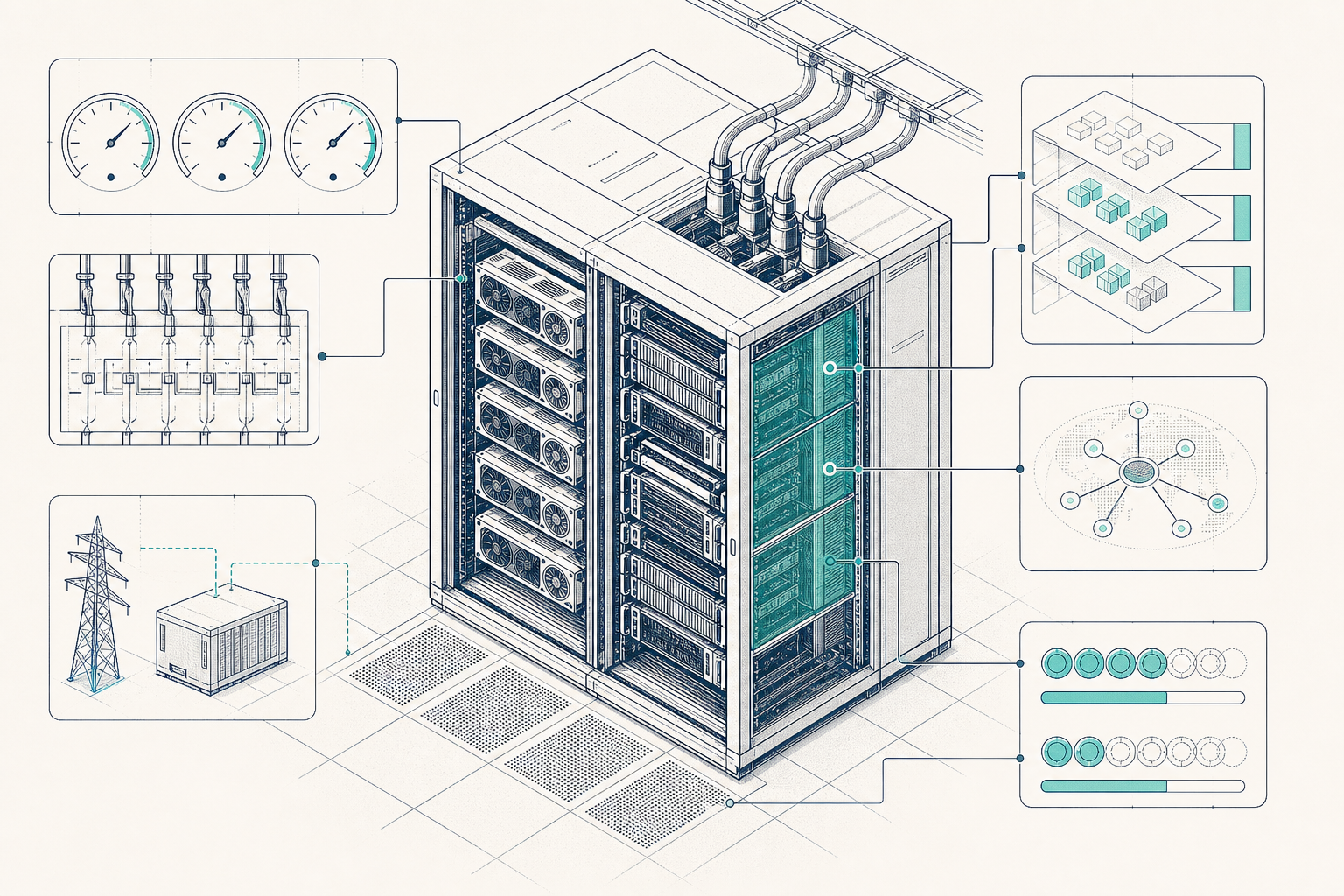
For a small-to-mid estate, the useful abstraction is not a single AI platform. It is an operating plane across bare metal, Kubernetes, VMs, GPU partitions, Ceph storage, and tenant accounting.
ClastIQ starts with the hardware the operator owns. It does not require the estate to standardize on one accelerator vendor. NVIDIA, AMD, and mixed CPU/GPU fleets can be brought under a common operational approach, while respecting hardware-specific capabilities such as MIG support or vendor-specific scheduling integrations.
The installation path matters. A few racks do not have the staffing model of a hyperscaler region. Turnkey installation and human-led local support reduce the chance that the cluster becomes a collection of custom scripts known only to one engineer. MAAS and Juju provide repeatability at the provisioning and lifecycle layer. Kubernetes and VM tenancy allow different customer environments to coexist. Ceph provides the storage substrate. Metering, quotas, and policy engineering turn the estate into a billable service.
For air-gapped or sovereign deployments, the same principles apply with stricter controls around images, packages, updates, identity, and observability. The operator needs to know what enters the environment, what runs where, and what leaves. This is operational work, not a slide in a compliance deck.
What to do this week
-
Build a GPU-hour model for the current estate. Calculate theoretical GPU-hours, billable utilization, fixed monthly cost, break-even GPU-hour price, and revenue per MW.
-
Split workloads into at least three tiers: reserved inference, scheduled batch, and preemptible. Assign quota, priority, eviction, and metering rules to each tier.
-
Audit tenant storage consumption. Separate GPU charges from Ceph capacity, retention, backup, and performance tiers so storage does not become an unpriced subsidy.
-
Define the GPU partition catalog. Decide which whole-GPU, MIG, or time-sliced profiles are sellable, and remove profiles that create fragmentation without revenue.
-
Add data-zone labels to tenants and nodes. Even in a global workload, make locality, sovereignty, and audit boundaries visible in scheduling and reporting.
-
Review power and revenue together. Track revenue per kW or per MW, not only cluster utilization, and use it in pricing and expansion decisions.
ClastIQ runs this operating model on the operator's own hardware: request a demo.