HeyBreez turns voice AI into an operating problem
On August 19, 2026, Wamda reported that HeyBreez, a MENA-born enterprise voice AI startup, raised a $2.5 million oversubscribed seed round led by Lunara Partners, with participation from Jabbar Group, DASH Ventures and angel investors. The company was founded in 2025, operates with offices in Amman and Dubai, and says it is already processing more than one million calls per month for clients across MENA, Europe and the US.
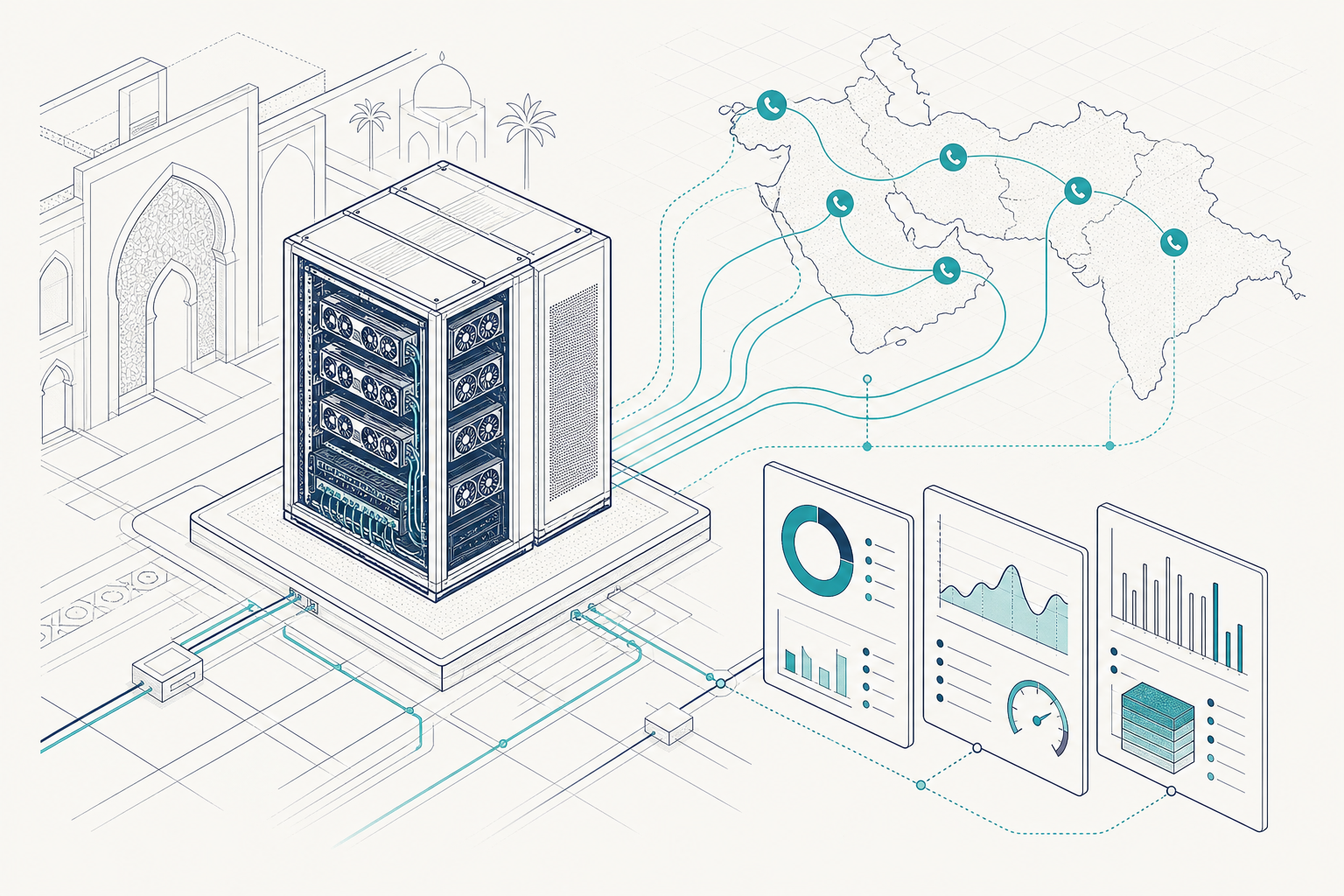
The important part for infrastructure operators is not only the funding number. It is what HeyBreez is building: infrastructure for deploying and managing enterprise voice AI agents. That includes telephony, callbacks, follow-ups, integrations and workflows around voice interactions. In practice, this moves voice AI from a demo workload into a production operations workload.
A voice agent is not a single model endpoint. It is a latency chain. Audio arrives through a carrier or SIP trunk. Speech has to be transcribed, normalised, routed through a business workflow, answered by a reasoning or dialogue layer, converted back to speech, logged, evaluated, and often followed up through CRM, ticketing, payments or delivery systems. If the user asks for a callback, the system becomes stateful. If the call crosses Arabic dialects, English, Urdu, Hindi or French, the model mix can change mid-call. If the customer is a bank, government entity, healthcare provider or regulated enterprise, data placement and audit trails matter.
For MENA operators, this is a useful signal. Enterprise voice AI demand is becoming regional, multilingual and latency-sensitive. It will not always be acceptable to send every call path to a distant public cloud region. Some customers will require local hosting for sovereignty, commercial control, telecom integration or procurement reasons. That creates a practical question for owners of small and mid-size GPU estates: can a quarter rack, one rack or a few racks be run with enough discipline to support this class of workload?
That is the layer ClastIQ is designed for: bare-metal provisioning, Kubernetes and VM tenancy on the same physical fleet, GPU partitioning, Ceph storage, metering, chargeback, quotas, policy engineering, air-gap options and local human support on hardware the operator owns.
The bottleneck is not only model capacity
A small GPU estate can run models. The harder task is running several kinds of inference at once while keeping the estate governable.
Voice AI creates a mixed workload profile:
- real-time speech-to-text with tight latency budgets;
- dialogue and tool-calling models with variable token use;
- text-to-speech generation, sometimes with voice cloning controls;
- batch analytics for call summaries, quality review and compliance;
- integration workers for CRM, ticketing, ERP, payments and notification systems;
- storage for recordings, transcripts, embeddings, prompts, call metadata and audit logs;
- tenant separation between clients, business units or public-sector entities.
The traffic shape is also uneven. Call centres have daily peaks. Ramadan trading hours, public-sector service windows, delivery spikes, airline disruptions and payment deadlines can all create sharp demand. A model server sized for the monthly average will fail at peak. A fleet sized only for peak will sit idle for much of the month.
This is where operators without hyperscaler scale feel the pressure. A hyperscaler can hide burstiness across thousands of tenants and regions. A local operator with 8, 16, 32 or 64 accelerators cannot rely on statistical smoothing to the same extent. The operating model has to create its own efficiency: hard quotas, burst pools, partitioning, tenant metering and rapid reprovisioning.
The risk is building a single-purpose voice AI island: a few expensive GPU nodes manually configured for one platform, billed with spreadsheets, monitored separately from the rest of the estate, and difficult to repurpose. That may work for a pilot. It is a weak model for production services across multiple enterprises.
A worked example for a small MENA voice AI estate
Assume an operator is supporting a voice AI platform with one million calls per month. Use simple planning numbers, not vendor benchmarks:
- average call length: 3 minutes;
- monthly voice traffic: 3,000,000 call minutes;
- call-hours per month: 50,000;
- month length: 720 hours;
- average concurrent calls: 50,000 / 720 = 69.4;
- busy-hour peak: 5 times average = about 347 concurrent calls.
After local testing, assume the operator rates one full GPU for 80 concurrent sessions for this specific voice stack and latency target. The peak then needs 347 / 80 = 4.34, so 5 full GPUs of equivalent capacity.
If the operator dedicates five full GPUs to that tenant for the whole month, the reservation is:
5 GPUs × 720 hours = 3,600 reserved GPU-hours per month.
But the average load is only 69.4 / 80 = 0.87 GPU equivalent, or:
0.87 × 720 = about 626 active GPU-hours.
Utilisation of the dedicated reservation is therefore:
626 / 3,600 = 17.4%.
That is the economic problem. The customer needs peak headroom, but the operator cannot afford to strand more than 80% of the reservation if the same GPUs could support other tenants, batch jobs or development environments.
Now change the operating model. Give the voice tenant a guaranteed baseline of two GPUs and a burst quota up to five GPUs during defined windows, with scheduling priority for live calls. The billable capacity might be:
- baseline: 2 GPUs × 720 hours = 1,440 GPU-hours;
- burst: 3 additional GPUs × 80 peak hours = 240 GPU-hours;
- total: 1,680 billable GPU-hours.
At an internal chargeback rate of $1.40 per GPU-hour, the monthly chargeback is:
1,680 × $1.40 = $2,352.
The tenant gets a clear bill. The operator keeps three GPUs available outside peak windows for other use. Finance can compare revenue and cost per GPU-hour instead of treating the GPU rack as a shared sunk cost.
For power economics, assume a 16-GPU estate. Each accelerator averages 700 W at assigned load, and the rest of the IT load across CPUs, memory, networking and storage averages 6.8 kW. IT load is:
16 × 0.7 kW + 6.8 kW = 18.0 kW.
With facility overhead at 1.25 PUE, facility load is:
18.0 kW × 1.25 = 22.5 kW, or 0.0225 MW.
If the fleet reaches 65% chargeable GPU utilisation across all tenants:
16 GPUs × 720 hours × 65% = 7,488 GPU-hours per month.
At $1.40 per GPU-hour, monthly chargeback is:
7,488 × $1.40 = $10,483.
Revenue per MW-month is:
$10,483 / 0.0225 MW = about $466,000 per MW-month.
At 25% utilisation, the same estate produces:
16 × 720 × 25% × $1.40 = $4,032 per month,
or about $179,000 per MW-month. The difference is not a small optimisation. It is the difference between a rack that looks fully consumed and a rack that is economically productive.
What ClastIQ changes in that operating model
ClastIQ is not a voice AI application. It is the control plane that lets an operator turn owned hardware into a governed GPU and CPU service for workloads such as voice AI.
The first requirement is bare-metal repeatability. GPU nodes need consistent firmware, operating system images, network configuration, accelerator drivers, storage clients and observability agents. ClastIQ uses MAAS and Juju patterns for bare-metal provisioning and service orchestration so the estate is not maintained one node at a time. That matters when the operator has mixed hardware, replacement nodes or separate pools for production and staging.
The second requirement is tenancy. Some voice AI components fit Kubernetes well: model servers, autoscalers, API workers, event queues and integration services. Other components may need VMs: legacy telephony appliances, vendor-specific SBC integrations, customer-provided middleware, or regulated workloads that need stronger administrative separation. ClastIQ is built for Kubernetes and VM tenancy on the same fleet, so the operator does not have to split scarce hardware into isolated islands.
The third requirement is GPU partitioning. Real-time voice inference often benefits from smaller, predictable slices rather than exclusive access to a full accelerator. Depending on the hardware and model profile, an operator may use MIG-style partitioning, time-slicing, or full-device assignment. ClastIQ’s role is to expose those choices as policy: which tenant can use which partition class, what is guaranteed, what can burst, and what is pre-emptible.
The fourth requirement is metering. Voice AI cannot be governed only by Kubernetes pod counts. Operators need GPU-hours, CPU-hours, memory, storage, network egress, persistent volume consumption and sometimes per-tenant power allocation. Without metering, chargeback becomes political. With metering, finance can see which tenants are consuming the scarce part of the estate.
| Bottleneck | Operator control needed | ClastIQ layer |
|---|---|---|
| Peak call concurrency | Baseline and burst GPU quotas | Kubernetes and VM tenancy with policy |
| Idle reserved GPUs | Partitioning and shared pools | MIG, time-slice or full-device assignment |
| Regulated call data | Local storage and audit boundaries | Ceph, tenant separation, sovereign deployment |
| Mixed hardware | Hardware-aware scheduling | Bare-metal inventory and placement policy |
| Unclear economics | Per-tenant chargeback | Metering for GPU, CPU, storage and usage |
Policy has to be written down
A voice AI tenant should not receive informal access to a GPU node. It should receive an explicit policy: baseline capacity, maximum burst, priority class, storage class, data retention, backup target, maintenance window and escalation path.
A simplified Kubernetes quota sketch might look like this for a production namespace. The exact resource names will depend on the accelerator vendor, partitioning mode and device plugin used in the estate.
apiVersion: v1
kind: ResourceQuota
metadata:
  name: voice-ai-prod-quota
  namespace: voice-ai-prod
spec:
  hard:
    requests.cpu: 64
    requests.memory: 256Gi
    requests.storage: 20Ti
    persistentvolumeclaims: 40
    limits.nvidia.com/gpu: 2
---
apiVersion: scheduling.k8s.io/v1
kind: PriorityClass
metadata:
  name: live-voice-priority
value: 900000
globalDefault: false
description: Live call inference before batch summarisation
That is not the whole policy. It is the start of making the intent executable. The operator still needs cluster queues or equivalent scheduling rules for burst capacity, admission controls for images and secrets, tenant network policy, storage encryption choices, and metering tags that map usage back to a customer or internal cost centre.
For AMD estates, mixed CPU/GPU estates, or environments using full GPUs rather than partitions, the same principle holds: expose capacity through labelled, metered and governed pools. Do not let application teams bind themselves permanently to node names.
Storage is part of the inference platform
Voice AI creates more storage pressure than many teams expect. A million calls per month with recordings, transcripts and metadata can become a compliance and retrieval problem quickly.
Assume the same million monthly calls, with 3 minutes per call. If compressed audio plus metadata averages 1.5 MB per minute, raw monthly ingest is:
3,000,000 minutes × 1.5 MB = 4,500,000 MB, or about 4.5 TB per month.
Add transcripts, summaries, embeddings, evaluation artefacts and logs, and a practical planning number may be 6 to 8 TB per month before replication and retention. With a 12-month retention policy and replicated storage, this can become a material part of the rack design.
This is why Ceph belongs in the same conversation as GPUs. The voice path needs fast enough storage for active workloads, durable object or block storage for recordings and transcripts, and isolation between tenants. Operators also need lifecycle policy: hot data for recent calls, colder placement for older recordings, and deletion workflows that satisfy contractual and regulatory requirements.
In GCC and wider MENA markets, storage placement is often a sales and compliance issue. A bank in Saudi Arabia, a public-sector entity in the UAE, a healthcare provider in Jordan, or an enterprise serving multiple jurisdictions may ask where recordings and derived data reside. If the operator owns the hardware and can run an air-gapped or sovereign deployment, the answer can be architectural rather than contractual hand-waving.
Hardware-agnostic does not mean hardware-blind
ClastIQ is hardware-agnostic across NVIDIA, AMD and mixed CPU/GPU estates. That does not mean treating all nodes as identical. Operators need inventory and placement discipline.
A practical estate may include:
- high-memory GPUs for larger dialogue models;
- smaller or partitioned GPUs for speech-to-text and text-to-speech;
- CPU-heavy nodes for telephony, queues, API gateways and business logic;
- storage nodes for Ceph OSDs;
- separate management nodes for MAAS, Juju, monitoring and identity;
- network segmentation for tenant, storage, management and public ingress traffic.
For voice AI, the scheduler has to know which pool is suitable for live inference and which pool is suitable for batch work. It should be possible to keep live call paths away from noisy neighbour experiments. It should also be possible to drain and patch nodes without taking down a tenant’s entire call stack.
The operational question is not whether a single model can saturate a single GPU. It is whether the estate can keep useful work on the GPUs while respecting tenant boundaries, maintenance windows and latency classes.
Sovereignty is an operating mode, not a label
MENA operators will see different sovereignty requirements by country and sector. Some customers will accept regional public cloud services. Others will require local hosting, private connectivity, local support, data residency, or disconnected operation. Voice data can be sensitive because it may include identity information, payment discussions, health information, complaints, addresses and employee records.
A sovereign voice AI deployment needs more than local compute. It needs controlled images, repeatable installation, local identity integration, logging that stays inside the boundary, backup policy, patch handling, and an answer for how support is performed. In an air-gapped environment, the operator also has to manage model artefacts, container registries, OS repositories and vulnerability updates without assuming open internet access.
This is where turnkey installation and local human support matter. The platform has to be operable by the team that owns the facility, power contracts, network handoffs and customer escalations. The operator should not need to become a hyperscaler to provide a governed service.
What to do this week
-
Build a voice AI capacity sheet. Start with call volume, average handle time, busy-hour multiplier, target latency, model mix and retention period. Convert it into concurrent sessions, GPU-hours, CPU-hours and monthly storage growth.
-
Define tenant classes before onboarding demand. Separate live inference, batch summarisation, development, evaluation and customer integration environments. Give each class quotas and priority rules.
-
Test partitioning on your own models. Do not assume a generic GPU capacity number. Measure the speech, dialogue and TTS chain you intend to run, then decide where full GPUs, partitions or time-slicing make sense.
-
Put metering into the first production design. Track GPU-hours, CPU, memory, storage, namespace or VM ownership, and burst usage from day one. Retrofitting chargeback after tenants are live is harder.
-
Treat storage and sovereignty as first-order requirements. Size Ceph for recordings, transcripts, logs and retention. Decide what must remain in-country, what can be replicated, and what must be deleted.
-
Rehearse failure and maintenance. Drain a GPU node, fail a storage device, rotate a model image and patch a tenant environment. Voice AI exposes operational gaps quickly because users are waiting on the line.
ClastIQ runs this on the operator’s own hardware — request a demo.