Anthropic changed the early-stage inference budget
On October 6, 2026, Anthropic expanded its Claude for Startups program with a free year of Claude Team and $1,000 in API credits for eligible startups, according to TechCrunch. The announcement is not only a startup funding story. For operators of quarter-rack to few-rack GPU estates, it changes the near-term demand curve for inference capacity.
A founder who was about to buy, lease, or colocate a small GPU server for a prototype now has another option: consume a hosted frontier model until the credits are exhausted, the product requires lower latency, the data can no longer leave a jurisdiction, or unit economics force a move to owned capacity. That can delay a hardware purchase by weeks or months. In some cases it can eliminate the first purchase entirely.
For a small GPU operator in the GCC or wider MENA region, that is not an abstract market signal. It affects fill rate, tenant onboarding, pricing, and power planning. A tenant may ask for local GPUs for fine-tuning and private retrieval, but route general summarization, coding assistance, or agent planning to Anthropic while credits last. Another tenant may keep production inference local for data residency, but allow development traffic to burst to a hosted API. A third may use hosted access as a fallback when the local queue is full.
The infrastructure question is therefore not whether hosted APIs are good or bad. The operator question is more specific: which requests should run on owned hardware, which should burst to an external API, and how should the estate measure cost, latency, data residency, fallback behavior, and quota burn across both paths?
The bottleneck is no longer only GPU supply
Small and mid-size GPU estates usually start by solving physical and provisioning problems. They need nodes racked, cabled, imaged, secured, monitored, and assigned to tenants. They need Kubernetes, VM tenancy, storage, networking, and a method for slicing accelerators. That remains necessary. But subsidized hosted model access introduces a second bottleneck: economic scheduling.
A cluster scheduler can decide whether a pod fits on a node. It does not automatically know whether a chat completion should spend scarce local accelerator time, consume a startup credit from a hosted API, wait in a queue, or fail closed because the prompt contains regulated data. That decision sits above basic scheduling and below commercial policy. It is where utilization, margin, sovereignty, and tenant trust meet.
In a quarter rack, the problem can be sharper than in a hyperscaler region. There may be only 8 to 32 GPUs, mixed generations, different memory sizes, and limited spare power. A few long-running inference deployments can crowd out batch jobs. A burst of evaluation traffic can raise latency for paying production users. One tenant with a generous hosted credit can appear cheap on Monday and expensive on Friday when credits run out. If metering does not capture both GPU-hours and token spend, the operator cannot explain the bill or tune placement.
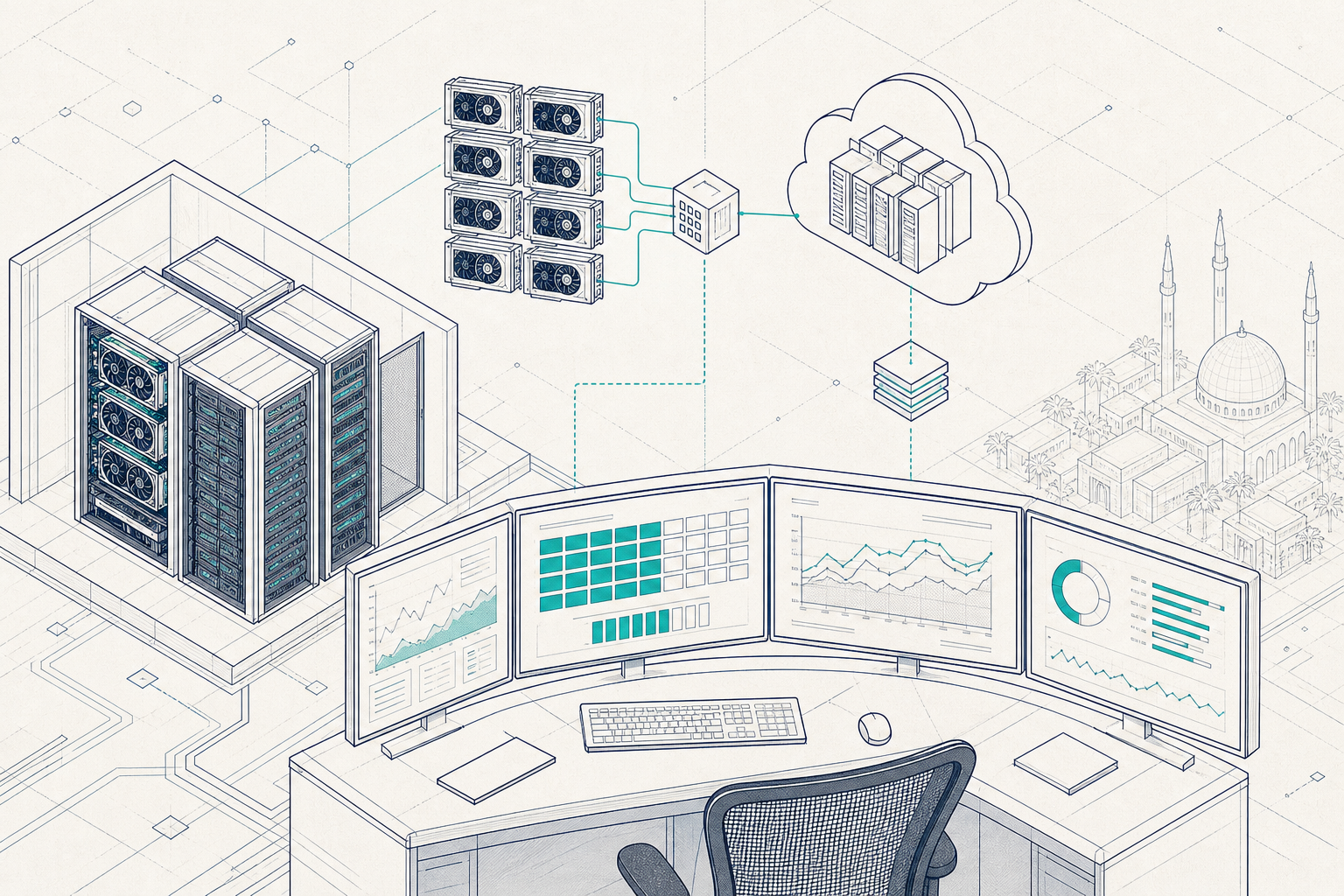
ClastIQ is designed for this class of operator: organizations that own real hardware, but do not operate at hyperscaler scale. The platform brings bare-metal provisioning through MAAS and Juju, Kubernetes and VM tenancy on the same fleet, GPU partitioning through mechanisms such as MIG and time-slicing where supported, Ceph storage, per-tenant metering, quota and policy engineering, and air-gap or sovereign deployment patterns. The important point in this story is not that local GPUs replace hosted APIs. It is that owned capacity and hosted APIs need to be governed as one estate.
Treat hosted credits as a temporary capacity class
Operators should model free or subsidized hosted credits as a capacity class with special accounting, not as free compute. The cash price is temporarily lower, but the request still consumes quota, creates latency expectations, may transfer data outside the tenant's chosen jurisdiction, and can disappear when the program ends.
A practical policy catalog might define four execution classes:
| Class | Typical workload | Preferred path | Main control |
|---|---|---|---|
| Sovereign local | Regulated data, government, finance, health | Owned GPUs only | Residency and audit policy |
| Local performance | Low latency inference, private models, fine-tuning | Owned GPUs first | GPU quota and queue priority |
| Hosted burst | Non-sensitive prompts, overflow, evaluation | Hosted API when allowed | Token quota and credit balance |
| Best effort | Development tests, demos, notebooks | Lowest cost available path | Spend cap and preemption |
This table looks simple, but it has real operational implications. The scheduler needs tenant labels and policy. The metering plane needs to record GPU-hours, GPU slices, CPU time, storage, token usage, external API spend, and request outcome. The support team needs a common language when a tenant asks why a job was delayed locally while another request was routed outside.
In the GCC and MENA context, the residency row matters. Some tenants will accept global hosted inference for development, but require production prompts, embeddings, logs, vector indexes, and fine-tuning data to remain in-country or within a defined sovereign environment. Others will require air-gapped operation. A platform serving these tenants cannot treat external API routing as a hidden application decision. It must be explicit, measured, and enforceable.
A worked example for a small estate
Consider an operator with 16 GPUs installed in a small colocation footprint. Assume each GPU has an internal cost target of $1.35 per GPU-hour. This target includes server amortization, power, cooling, rack space, support, and maintenance. At full calendar capacity, the estate has:
16 GPUs x 24 hours x 30 days = 11,520 GPU-hours per month.
If the operator achieves 45 percent billable utilization, billable usage is:
11,520 x 0.45 = 5,184 GPU-hours per month.
At a chargeback rate of $2.40 per GPU-hour, monthly GPU revenue is:
5,184 x $2.40 = $12,441.60.
The gross margin before overhead not included in the internal cost target is:
5,184 x ($2.40 minus $1.35) = $5,443.20.
Now introduce a tenant with Anthropic startup credits. Before the credits, that tenant planned to run 1,200 GPU-hours per month of local inference and evaluation. After the credits, the tenant routes half of its non-sensitive generation requests to the hosted API for two months. Local usage falls by 600 GPU-hours per month.
If the estate has no replacement demand, utilization drops from 45 percent to:
(5,184 minus 600) / 11,520 = 39.8 percent.
Monthly GPU revenue falls by:
600 x $2.40 = $1,440.
That is the direct hit. But the story is not always negative. If those 600 GPU-hours were causing peak-hour contention, moving them to hosted inference may reduce queue delay for sovereign or latency-sensitive tenants. If the operator can refill the released capacity with higher priority local workloads at $3.10 per GPU-hour, the economics improve:
600 x $3.10 = $1,860 replacement revenue.
The same physical estate then earns $420 more than before for those hours, while the startup consumes external credits for suitable traffic. The operator's job is to know which of these cases is happening. Without metering and policy, the operator only sees lower GPU usage and hears mixed complaints about latency.
Revenue per megawatt is also affected. Suppose the 16 GPU estate draws 22 kW at the rack level under average load, including servers, networking, and storage but excluding facility overhead. At 45 percent billable utilization and $12,441.60 monthly GPU revenue, annualized revenue is $149,299.20. Normalized to 1 MW of similar IT load:
$149,299.20 / 0.022 MW = $6.79 million per MW per year.
At 39.8 percent utilization with no replacement demand, monthly revenue is $11,001.60, annualized at $132,019.20. Revenue per MW becomes:
$132,019.20 / 0.022 MW = $6.00 million per MW per year.
That gap is visible to any operator trying to justify power allocation. Hosted credits can therefore become a power economics issue, not just an application architecture choice.
What ClastIQ has to coordinate
A quarter-rack to few-rack estate needs a control plane that maps physical assets to commercial and policy outcomes. In this scenario, there are six practical layers.
First, bare-metal provisioning must be repeatable. Nodes should not become snowflakes because one tenant needs Kubernetes and another needs VMs. MAAS and Juju give operators a way to provision and model services consistently across CPU and GPU nodes. That matters when demand shifts quickly. If hosted credits reduce one tenant's local inference footprint, the operator should be able to repurpose nodes for another tenant, a different accelerator profile, or a storage-heavy workload without rebuilding the estate by hand.
Second, tenancy needs to span Kubernetes and VMs. AI teams are not uniform. Some want containers, Helm charts, and autoscaling. Some want a VM with a specific driver stack, a lab image, and direct control. A useful platform must meter and govern both, otherwise the chargeback model is incomplete.
Third, GPU partitioning must match the workload. MIG, where available, can isolate slices for smaller inference services. Time-slicing can improve apparent utilization for bursty or development workloads. Full GPU allocation remains appropriate for training, large batch inference, or models that need the memory. The operator should not expose all GPUs as identical units if the economics are different.
Fourth, storage must be part of the schedule. Ceph-backed storage can support tenant volumes, model artifacts, checkpoints, logs, and datasets. If the decision is local versus hosted, the operator must know where the data lives and whether it is allowed to move. A prompt routed to an external API may be harmless if it contains public text. A retrieval request with tenant documents may not be.
Fifth, metering must combine local and external cost units. GPU-hours, GPU slice-hours, CPU cores, RAM, storage, ingress, egress, tokens, hosted API spend, and failed requests should be visible per tenant. Token credits should be shown as a balance with an expiration assumption, not as a permanent reduction in cost.
Sixth, fallback behavior must be engineered. If a hosted API is unavailable, rate limited, or no longer covered by credits, should the request queue locally, switch to a smaller local model, return an error, or require tenant approval? The wrong default can create data leakage, surprise bills, or production outages.
Policy should be visible in the cluster
Operators can start with labels and quotas before building complex brokers. The point is to make intent machine-readable. A namespace can declare whether external inference is allowed, whether data must remain local, and what quota applies to local GPU and hosted tokens.
A simple operational pattern might look like this:
kubectl label namespace tenant-a residency=local-only
kubectl label namespace tenant-b residency=hosted-allowed
kubectl label namespace tenant-b hosted-credit=anthropic-startup
kubectl annotate namespace tenant-b monthly-token-budget=50000000
kubectl annotate namespace tenant-b local-gpu-hour-budget=300
Those labels are not enough by themselves, but they give admission controllers, service meshes, metering collectors, and routing gateways a common source of truth. In a ClastIQ deployment, this fits into the wider operating model: provision hardware, expose Kubernetes and VM tenancy, apply GPU partitioning, attach storage policy, meter usage, then enforce quotas and chargeback.
For hosted routing, operators should avoid embedding policy only in application code. Application teams change libraries and frameworks often. A central inference gateway or approved SDK can enforce tenant policy consistently, emit usage records, and decide whether a request can leave the local environment. It can also attach a reason code to every routing decision:
local_residency_requiredlocal_latency_targethosted_credit_availablehosted_rate_limitlocal_queue_fulltenant_quota_exceeded
Reason codes are boring until the monthly review. Then they become the difference between a useful chargeback conversation and a dispute.
GCC and MENA operators need a sovereignty default
For GCC and MENA operators, hosted frontier-model credits are attractive because they lower experimentation cost. They also complicate sovereign AI positioning. A local GPU estate may be funded because an organization wants local control over data, power, procurement, support, and commercial terms. If tenants quietly route sensitive traffic to global APIs, the estate is not delivering its governance purpose.
The correct response is not to ban hosted APIs in all cases. That would be impractical for many startups and product teams. The correct response is to define classes of data and workloads, then enforce them.
Public marketing copy, synthetic tests, open-source code review, and non-sensitive prototypes may be acceptable for hosted burst. Internal documents, citizen data, regulated financial records, oil and gas operational data, defense workloads, and health data may require local-only routing. Some tenants may require an air-gapped environment with no hosted fallback at all.
This is where a small operator can compete on trust rather than scale. Hyperscalers have vast regions and deep service catalogs. A local operator can provide known physical location, local support, clear chargeback, and tenant-specific policy. But that promise must be backed by logs, quotas, and repeatable operations. It cannot depend on a verbal instruction to developers.
Power is part of sovereignty too. Many GCC markets are planning AI capacity under constrained power, cooling, and land assumptions. If hosted credits temporarily suppress local utilization, operators should not overreact by pausing all capacity planning. Instead, they should separate durable local demand from temporary credit-driven routing. The durable demand is usually tied to residency, latency, model ownership, data gravity, and predictable unit cost. Temporary demand is tied to free credits, launch campaigns, and experimentation.
Build a blended cost model
A useful blended model does not need to be perfect. It needs to be consistent enough to steer behavior. At minimum, each tenant should see four numbers:
- Local GPU cost by allocation type, such as full GPU, MIG slice, or time-sliced share.
- Hosted API token spend, including credits consumed and estimated post-credit price exposure.
- Latency distribution by route, including queue time for local jobs.
- Policy blocks and fallbacks, including requests denied for residency or quota reasons.
The operator can then create pricing that reflects scarcity. Sovereign local production inference may pay a premium because it reserves capacity and support. Development notebooks may use preemptible time-sliced GPUs at a lower rate. Hosted burst may include a management fee or pass-through accounting, depending on the commercial model. The key is that no path is invisible.
This also helps with hardware-agnostic planning. ClastIQ is not tied to a single accelerator vendor. Operators may run NVIDIA, AMD, and mixed CPU/GPU estates. The cost model should therefore be based on delivered service classes, not brand names alone. A tenant buying low-latency local inference needs a service level, quota, and price. The platform can then map that need onto the available hardware profile.
What to do this week
- Classify current workloads into local-only, local-preferred, hosted-allowed, and best-effort categories. Do this per tenant, not only per application.
- Add routing labels and quotas to namespaces, VM projects, or tenant records so residency and hosted API permission are visible to the control plane.
- Start metering hosted token usage beside GPU-hours, even if the first version is a daily import from billing exports.
- Review peak-hour GPU queues and identify workloads that can safely burst to hosted APIs without violating data policy.
- Model the end of credits. For each tenant using subsidized API access, estimate the local GPU demand or cash cost when credits expire.
- Update chargeback reports to show reason codes for local placement, hosted burst, quota blocks, and fallback events.
ClastIQ runs this operating model on the operator's own hardware, from a quarter rack to a few racks, with local orchestration, tenancy, metering, and policy control. request a demo