Journify's round is about the pipeline, not only the model
On 4 November 2026, Wamda reported that Journify raised $12 million at a fourfold valuation increase. The company has operations in Dubai and Riyadh, and the round included Al Mada Ventures, Silicon Badia, Shorooq, Du Ventures, and other investors named in the report. The product area matters for GPU operators in the region: AI-driven data-quality infrastructure, especially the continuous monitoring and repair of high-volume data connections.
That is not the most visible AI workload. It does not look like a public chatbot, a large model training run, or a marketing demo. It looks like connectors, change-data-capture streams, warehouse synchronization, event validation, deduplication, identity resolution, observability, and repair jobs that run before and after inference. For enterprises in the GCC and wider MENA region, these systems decide whether an AI use case is reliable enough to put near a customer, a regulator, or a revenue process.
The funding signal is useful because it points to demand that a small-to-mid GPU estate can actually serve. A local operator with a quarter rack to a few racks does not need to behave like a hyperscaler to sell useful AI infrastructure. It does, however, need to stop thinking of GPUs as isolated accelerators. The paid workload is a pipeline: ingestion, storage, data quality, feature preparation, inference, audit logs, tenant reports, and chargeback. If any one of those layers is weak, the GPU will sit idle or become impossible to bill cleanly.
For ClastIQ's market, this is the practical reading: regional enterprises may buy inference capacity, but they will also need managed data infrastructure around it. A provider that can host both, on local hardware, with sovereign controls and per-tenant economics, has a more durable offer than a provider selling raw GPU hours alone.
The hidden workload in data-quality AI
Data-quality infrastructure is not just a database appliance. Modern enterprise data estates contain SaaS exports, payment events, call center transcripts, IoT readings, ERP records, CRM changes, consent flags, and customer identity graphs. AI projects add more pressure because pipelines must produce data that is fresh, traceable, and usable by models.
The GPU footprint varies by stage. Some jobs are CPU and storage heavy, such as connector polling, schema validation, data normalization, and checksums. Some are memory and network heavy, such as joining large event streams or comparing high-cardinality records. Some can use GPUs efficiently, such as embedding generation, fuzzy matching, vector indexing, anomaly detection, media enrichment, and batch inference against new records.
This mix is exactly where small GPU estates often lose money. If the estate is set up only for full-GPU model serving, a tenant with continuous low-level GPU demand is awkward. The tenant may need one eighth of a GPU for embeddings, two full GPUs for a nightly repair batch, 40 TB of storage, 10 TB per day of east-west movement, and detailed cost allocation across business units. If the operator cannot partition GPUs, meter the storage, enforce quotas, and bill by tenant, the commercial model collapses into manual spreadsheets.
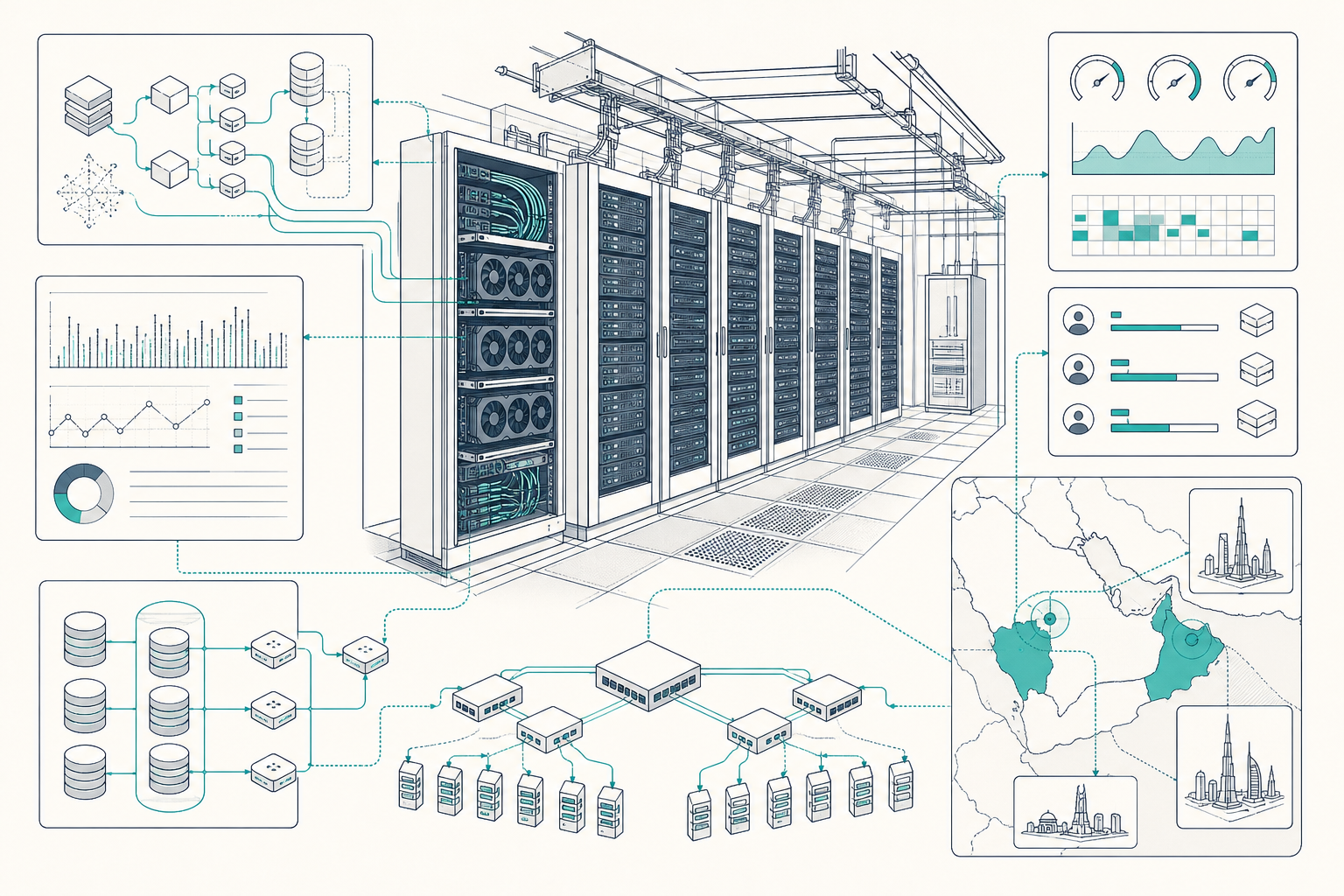
The operational bottleneck is therefore not just GPU availability. It is the coordination of four planes:
| Plane | What breaks first | Operator control needed |
|---|---|---|
| Compute | Full GPUs are stranded by fractional workloads | MIG, time-slicing, Kubernetes quotas, VM tenancy |
| Storage | Raw data, features, logs, and repair history fill disks | Ceph pools, storage classes, retention policy, tenant metering |
| Network and ingestion | Connectors fail silently or overwhelm shared links | Namespace isolation, observability, rate limits, placement policy |
| Commercial control | Tenants consume shared services without clean billing | Per-tenant metering, chargeback, showback, quota engineering |
A data-quality and inference platform only becomes profitable when all four planes are operated together. This is why a local GPU cluster built with bare-metal provisioning, Kubernetes, VM tenancy, Ceph, and metering is a different product from a rack of accelerators with SSH access.
Why GCC and MENA operators should care
The MENA relevance is direct. Journify's reported Dubai and Riyadh presence places this funding signal in the same buying environment as banks, telcos, retailers, logistics firms, energy companies, government entities, and large family businesses that are trying to operationalize AI without moving all sensitive data offshore.
Three regional constraints shape the infrastructure design.
First, data residency is not an afterthought. Some workloads can use global SaaS platforms. Others cannot, or they require careful control over which records, logs, embeddings, and model outputs leave the jurisdiction. A regional operator must be able to offer local deployment, private networking, audit trails, and air-gap or restricted-egress patterns where required.
Second, latency is not only about user experience. Data repair loops are often tied to operational systems. If a payment event, customer profile, shipment status, or risk alert is wrong, the business wants correction quickly and close to the source system. Local compute reduces dependency on distant regions and gives operators a reason to bundle ingestion, data-quality checks, vector services, and inference.
Third, buyers increasingly expect internal chargeback. Large regional organizations may have multiple subsidiaries or departments using the same hosted AI environment. They need to know which team consumed GPUs, object storage, block storage, network egress, and support time. Without that, the central AI program becomes a cost center with no defensible allocation model.
For an operator in Oman, the UAE, Saudi Arabia, Bahrain, Qatar, Kuwait, Egypt, Jordan, or elsewhere in MENA, this is a chance to sell a governed local utility. The value is not that every customer gets a dedicated cluster. The value is that several tenants can safely share the same fleet while each receives quotas, invoices, usage reports, and policy boundaries.
The small-estate failure mode
Consider a provider with a few racks and 64 mixed GPUs. The estate may include current and previous generation NVIDIA accelerators, AMD GPUs, and CPU-heavy nodes for ingestion and storage services. The operator has enough power and cooling for the fleet, but not enough spare capital to leave accelerators idle for months.
A naive offer is raw GPU rental. This works for a few bursty jobs, but it creates three problems.
The first problem is utilization shape. Enterprise data pipelines do not always need whole GPUs. A tenant may need fractional GPU service all day for embeddings, then a larger batch window at night. If the estate cannot support MIG where available, time-slicing where appropriate, and CPU-only placement for non-accelerated jobs, the operator either overprovisions or turns the tenant away.
The second problem is state. Inference can be stateless at the endpoint, but the surrounding pipeline is not. Data-quality workloads need persistent storage, versioned datasets, logs, quarantine areas, model artifacts, and audit history. If storage is not integrated into tenancy and metering, the operator underprices the service.
The third problem is evidence. Enterprise buyers ask what they used, when they used it, where their data lived, which controls applied, and why an invoice is correct. If these answers require manual reconstruction from Prometheus dashboards, Ceph commands, Kubernetes events, and firewall logs, the service will not scale beyond a handful of friendly accounts.
This is the infrastructure bottleneck behind the Journify story. Demand for data-quality AI increases the number of always-on, mixed-resource tenants. The bottleneck becomes orchestration and accounting, not only accelerator supply.
How ClastIQ maps the workload to real hardware
ClastIQ is designed for operators who own physical infrastructure and need it to behave like a governed regional cloud without becoming a hyperscaler. The stack is hardware-agnostic, so the estate can include NVIDIA GPUs, AMD GPUs, CPU-only servers, storage nodes, and mixed generations where scheduling policy accounts for capability differences.
At the metal layer, bare-metal provisioning through MAAS and Juju gives the operator repeatable installation, lifecycle control, and a clean inventory of nodes. That matters when the fleet is small. In a 64 GPU estate, losing track of firmware, NIC layout, GPU topology, or disk roles can remove a visible percentage of sellable capacity.
At the tenancy layer, Kubernetes and VM tenancy can coexist on the same fleet. This is important for data-quality infrastructure because not every tenant component wants the same runtime. Streaming services, inference APIs, batch embedding jobs, and observability agents usually fit Kubernetes. Legacy data integration tools, commercial appliances, or customer-controlled environments may need VMs. A common operator plane allows these to share the same physical estate without pretending every workload is cloud-native.
At the GPU layer, partitioning is commercial control. MIG-capable devices can be divided into smaller profiles for steady fractional workloads. Time-slicing can improve access for compatible jobs that tolerate shared scheduling. Full GPUs remain available for heavier batches and latency-sensitive inference. The operator's job is not to maximize the number of slices in isolation. It is to match slice size, isolation, model profile, and billing unit to the workload.
At the storage layer, Ceph provides a common substrate for block, object, and file patterns, depending on design. Data-quality pipelines can keep raw landing zones, validated datasets, feature stores, model artifacts, and logs under tenant-aware pools and quotas. Storage metering is as important as GPU metering because a tenant that uses 2 GPUs and 80 TB of retained event history is not a small tenant.
At the policy layer, quotas, namespace controls, placement rules, and chargeback turn shared infrastructure into a product. A tenant can be granted 6 GPU equivalents, 30 TB of object storage, 10 TB of block storage, specific ingress limits, and a monthly budget alert. If the tenant needs a nightly batch expansion, policy can allow it inside a defined window rather than relying on informal operator intervention.
A worked utilization and chargeback example
Assume a regional operator runs 64 GPUs in a few racks, supported by CPU nodes, Ceph storage, networking, and facility overhead. For a 30 day month, available accelerator capacity is:
64 GPUs x 24 hours x 30 days = 46,080 GPU-hours.
Assume the fully loaded monthly cost allocated to this service is $310,000. That includes hardware financing or depreciation, power and cooling, colocation or facility allocation, support labor, network cost, software operations, and spares. The cost per available GPU-hour is:
$310,000 / 46,080 = $6.73 per available GPU-hour.
If the operator sells only raw GPU access and reaches 35 percent billable utilization, it bills:
46,080 x 0.35 = 16,128 GPU-hours.
The effective cost per billable GPU-hour becomes:
$310,000 / 16,128 = $19.22.
If the market will only pay $14.50 per GPU-hour for this class of capacity, the raw rental model loses money before storage and support are properly accounted for.
Now assume the operator packages managed data-quality infrastructure with inference. Fractional GPU jobs run continuously, nightly repair batches use full GPUs, and CPU-heavy ingestion services are billed separately. Better partitioning, quotas, and scheduling raise billable GPU utilization to 62 percent:
46,080 x 0.62 = 28,570 GPU-hours.
At $14.50 per GPU-hour, GPU revenue is:
28,570 x $14.50 = $414,265.
Add $35,000 in monthly platform charges for managed storage, connector operations, observability, and tenant reporting. Total monthly revenue becomes $449,265. Against the same $310,000 cost base, the gross contribution is $139,265.
The power view is also useful. If the service consumes an allocated 80 kW critical load, revenue per MW-month is:
$449,265 / 0.08 MW = $5,615,812 per MW-month.
This number is not a benchmark and not a promise. It is a planning lens. It shows why utilization, storage attachment, and chargeback discipline affect revenue per megawatt more than headline GPU count.
A tenant invoice can then be built from measured components rather than estimates:
| Line item | Quantity | Unit price | Monthly charge |
|---|---|---|---|
| GPU usage | 2,400 GPU-hours | $14.50 | $34,800 |
| Object storage | 18 TB-months | $45 | $810 |
| Block storage | 6 TB-months | $95 | $570 |
| Managed connectors | 12 connectors | $250 | $3,000 |
| Observability and reports | 1 tenant plan | $1,500 | $1,500 |
| Total | $40,680 |
The important part is not the specific tariff. Each operator will price according to hardware, power, support scope, and local market. The important part is that the units are measurable, explainable, and enforceable.
Quotas should be treated as product design
A small estate cannot absorb unlimited tenant behavior. Quotas are not only defensive controls. They are how the operator defines what has been sold.
For example, a tenant running continuous data-quality checks may receive a Kubernetes namespace, a storage class mapped to a Ceph pool, a GPU profile allocation, and a policy for batch expansion. A simplified Kubernetes quota might look like this:
apiVersion: v1
kind: ResourceQuota
metadata:
  name: tenant-data-quality-quota
  namespace: tenant-a
spec:
  hard:
    requests.cpu: 96
    requests.memory: 384Gi
    limits.cpu: 128
    limits.memory: 512Gi
    requests.storage: 30Ti
    persistentvolumeclaims: 80
    nvidia.com/gpu: 4
An operator might pair that with storage and utilization checks during the billing cycle:
kubectl top pods -n tenant-a
kubectl describe resourcequota tenant-data-quality-quota -n tenant-a
ceph df
ceph osd pool stats
In production, the reporting should be automated and tenant-specific. The point of the command block is operational: the bill must trace back to enforceable limits and observable consumption. If the operator cannot connect quota, telemetry, and invoice, disputes will consume support time and reduce margin.
GPU partitioning also needs policy. MIG profiles are not interchangeable from a workload perspective, and time-sliced GPUs are not appropriate for every latency or isolation requirement. A data-quality tenant doing embeddings may tolerate time-slicing. A regulated inference endpoint may require a dedicated profile or full device. A nightly batch repair job may need temporary access to full GPUs between 01:00 and 05:00 local time. These are product terms, not just scheduler settings.
Sovereignty and air-gap patterns
For GCC and MENA operators, sovereign deployment is often a sales requirement and an engineering constraint. The question is not simply whether the server is located in the country. It is where logs go, where images are pulled from, where backups are stored, who can access the management plane, and how updates are reviewed.
A practical regional design should support several deployment modes.
The first is connected sovereign hosting, where the workload runs locally but approved outbound paths exist for updates, monitoring, or selected integrations. The second is restricted-egress hosting, where outbound traffic is blocked by default and allowed only through governed proxies. The third is air-gap or near-air-gap operation, where installation media, container images, patches, and model artifacts are staged through controlled processes.
Data-quality workloads make these choices visible. A connector may want to call a SaaS API outside the country. A model may generate embeddings that are derived from customer records. An observability system may collect payload samples by default. A support workflow may request diagnostic bundles. Each of these needs policy before the first enterprise tenant goes live.
ClastIQ's role in this context is to provide an operator-grade foundation on the operator's own hardware: bare-metal provisioning, Kubernetes and VM tenancy, GPU partitioning, Ceph storage, metering, quota engineering, and local human-led support. It does not remove the need for legal review, data classification, or customer-specific controls. It gives the operator a consistent platform on which those controls can be implemented and audited.
Should local providers bundle data quality and inference
The Journify financing suggests that the answer is yes, but with discipline. Local providers should not try to become every customer's data engineering department. They should sell the parts that map naturally to their infrastructure advantage.
A good bundle could include managed landing zones, connector hosting, data validation jobs, embedding generation, vector database hosting, batch repair windows, inference endpoints, tenant dashboards, and monthly chargeback reports. The provider owns the infrastructure reliability and metering. The customer owns business rules, data definitions, access approvals, and application logic.
This bundle is stronger than raw inference for three reasons. It keeps GPUs busy with a mix of fractional and burst workloads. It attaches storage and managed services revenue to the accelerator estate. It creates a local sovereignty story that is concrete: the customer's data pipeline, model serving, logs, and reports can remain inside a defined regional operating boundary.
The risk is overreach. If the operator accepts unlimited custom connectors, unclear data ownership, unbounded retention, and manual reporting, the service becomes consulting with expensive hardware attached. The safer model is a catalog: standard connector patterns, standard storage tiers, standard GPU profiles, standard retention windows, standard evidence packs, and priced exceptions.
For small and mid-size GPU estates, standardization is not bureaucracy. It is capacity protection. Every exception consumes engineering time and may strand scarce GPUs, disks, or network bandwidth.
What to do this week
-
Measure your current billable GPU utilization for the last 30 days, then calculate cost per available GPU-hour and cost per billable GPU-hour.
-
Inventory data-adjacent demand already in your pipeline: connectors, embeddings, vector search, batch enrichment, validation, log retention, and customer reporting.
-
Define 3 standard tenant profiles: fractional continuous GPU, nightly batch GPU, and regulated dedicated GPU. Attach CPU, memory, storage, and support limits to each.
-
Build a simple chargeback model that includes GPU-hours, TB-months, managed connectors, observability, and support plan fees. Test whether it improves revenue per MW against raw GPU rental.
-
Review sovereignty controls for one target market, including image sources, logging, backup location, remote access, outbound traffic, and diagnostic bundles.
-
Run a quota drill on a non-production namespace or VM tenant. Confirm that compute, storage, and GPU limits are enforced and that usage can be turned into an invoice line.
ClastIQ runs this on the operator's own hardware: request a demo.
Sources
Wamda, Journify raises $12 million with fourfold valuation increase