Lambda's reported raise is a signal about dedicated AI compute
On October 6, 2026, TechCrunch reported that Lambda is seeking $4 billion in financing ahead of a planned IPO. The number is large, but the important signal for infrastructure operators is not only the size of the round. It is that capital markets still see dedicated AI compute as a scarce and financeable asset class.
That matters far beyond the largest GPU clouds. If a specialist provider can justify a multibillion dollar financing plan, smaller operators face a sharper version of the same question: can a finite pool of accelerators produce enough useful GPU hours, tenant revenue, and sovereign capacity to justify the power, cooling, storage, networking, and staffing around it?
For a quarter rack to a few racks, the constraint is not usually whether AI demand exists. It is whether the estate can absorb bursty demand without becoming either idle or oversold. Training jobs want long contiguous allocations. Fine-tuning jobs need short access windows, often with specific memory profiles. Inference wants steady availability, low queue time, and predictable latency. Research teams tolerate preemption if the price is right. Enterprise tenants often do not.
The operator has to convert this demand mix into a schedule, a quota model, a chargeback model, and a capacity plan. The work is operational, not abstract. It includes GPU partitioning, tenant isolation, storage throughput, power envelopes, maintenance windows, and the decision point where leasing overflow is cheaper than buying another node.
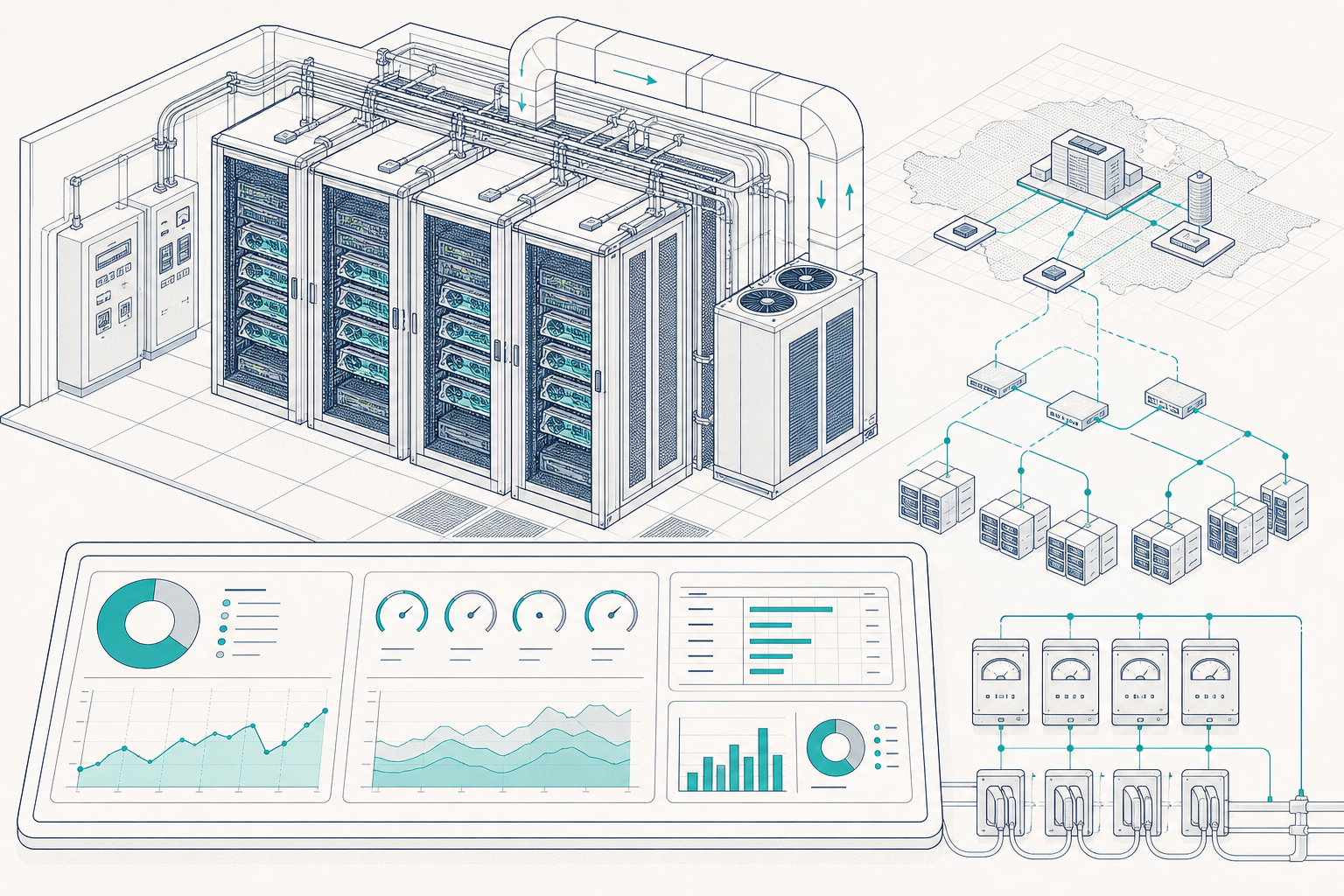
ClastIQ is built for that operator profile: organizations that own real hardware, but do not operate like hyperscalers. It combines bare-metal provisioning, Kubernetes and VM tenancy on the same fleet, GPU partitioning, Ceph storage, per-tenant metering, chargeback, quota engineering, air-gap deployment patterns, and local human support. The purpose is simple: make a small or mid-size GPU estate governable and economically measurable.
The bottleneck is not only GPU count
A small estate can look sufficient on a spreadsheet and still fail in production. Suppose an operator has 16 or 32 accelerators. The theoretical monthly supply looks clear: GPU count multiplied by hours in the month. But tenants do not consume time in neat blocks.
A university AI lab may ask for 8 GPUs for 36 hours, then nothing for a week. A bank model risk team may need confidential VM access to 4 GPUs with no internet egress. A media company may run inference every evening. A startup may want fine-tuning overnight at a lower price, but can accept preemption. A government unit may require that all data stays in country, and that logs remain available for audit.
If these jobs land on manually assigned servers, utilization drops. If they land on a shared cluster without quotas, the loudest tenant wins. If they run without metering, finance cannot see cost recovery. If storage is undersized, expensive GPUs wait for checkpoints, datasets, and model artifacts. If cooling headroom is ignored, the rack power plan becomes the hidden scheduler.
For GCC and MENA operators, these issues are especially visible. Power contracts, high ambient conditions, data residency requirements, and national AI programs all put pressure on GPU estates to be both utilized and governable. Buying accelerators is only one part of the investment. The other part is proving that a sovereign or local cluster can deliver a usable price per GPU hour, with policies that match regulated workloads.
The practical bottleneck is therefore a stack of constraints:
| Constraint | Operator question | Control needed |
|---|---|---|
| GPU memory | Does the job need full devices or slices? | MIG, time-slicing, node labels, placement rules |
| Tenant priority | Who can interrupt whom? | Queues, quotas, preemption classes |
| Storage | Can checkpoints and datasets keep GPUs fed? | Ceph pools, throughput tiers, cache placement |
| Power and cooling | Can the rack sustain the schedule? | Power caps, maintenance windows, thermal policy |
| Economics | Is demand worth new hardware? | Metering, chargeback, overflow comparison |
A financing headline about a large AI cloud should push smaller operators toward these controls. Scale helps, but discipline matters earlier.
Build the capacity model before buying the next node
The first useful model is a GPU-hour model. It should be conservative enough for operations, not polished for a board slide.
Assume a regional operator runs 32 accelerators in a mixed CPU and GPU estate. The month has 720 hours. Gross capacity is:
32 GPUs x 720 hours = 23,040 GPU hours per month
No operator can sell all of that. Reserve time for firmware updates, driver changes, failed jobs, node drains, cluster upgrades, and tenant onboarding. If the operator reserves 5 percent, sellable capacity becomes:
23,040 x 0.95 = 21,888 GPU hours per month
At 45 percent utilization of sellable capacity, consumption is:
21,888 x 0.45 = 9,850 GPU hours, rounded
At an internal or commercial chargeback rate of $2.20 per GPU hour, monthly recognized usage is:
9,850 x $2.20 = $21,670
If orchestration, quotas, partitioning, and preemptible pools raise utilization to 70 percent, consumed usage becomes:
21,888 x 0.70 = 15,322 GPU hours
15,322 x $2.20 = $33,708
The difference is $12,038 per month from the same hardware. That is not pure profit, and it does not include all costs. It is a way to measure whether operations are improving the asset.
Now connect the same estate to power. Suppose the IT load for the GPU servers, CPU nodes, storage, and networking averages 55 kW. With a facility PUE of 1.35, the facility draw is 74.25 kW. Over 720 hours, that is 53.46 MWh per month.
At 70 percent utilization and $33,708 of recognized monthly usage, the estate is producing:
$33,708 / 0.07425 MW = $454,653 per MW-month
At 45 percent utilization, it produces:
$21,670 / 0.07425 MW = $291,852 per MW-month
This metric is blunt, but useful. It forces the operator to connect scheduling to scarce power and cooling capacity. In GCC markets where power planning, heat rejection, and facility expansion can determine deployment speed, revenue per MW-month is often more actionable than average GPU utilization alone.
Partitioning is an economic control
GPU partitioning is often described as a technical feature. For operators, it is a yield tool.
Some workloads need a whole accelerator. Large training jobs, memory-heavy inference, and jobs with tight communication patterns may not tolerate sharing. Other workloads do not need a full device. Fine-tuning smaller models, notebooks, batch inference, and teaching workloads often need less memory or can accept time-sliced access.
MIG, where available, creates hardware-backed slices with defined memory and compute profiles. Time-slicing can multiplex workloads where isolation and predictability requirements allow it. On mixed estates, the exact mechanism depends on the accelerator vendor and generation. The policy principle is hardware-agnostic: do not allocate a full scarce device when a partition is enough, and do not partition workloads that need isolation, memory, or latency guarantees that sharing cannot provide.
ClastIQ treats this as a scheduling and tenancy problem. Bare-metal nodes can be provisioned consistently. Kubernetes can run containerized AI jobs. VMs can support tenants that need their own operating system image, stronger administrative separation, or legacy tooling. The same physical fleet can carry both models, rather than forcing every tenant into one runtime.
A practical partitioning catalog might include:
- Full GPU, non-preemptible, for paid training and regulated inference.
- Full GPU, preemptible, for research and batch fine-tuning.
- GPU slice, non-preemptible, for small inference services.
- GPU slice or time-sliced access, preemptible, for notebooks and development.
- CPU-only tier, for data preparation, evaluation, and orchestration tasks.
The catalog lets finance and operations speak the same language. A tenant does not only request a model name or a node. They request a service class with price, priority, quota, and preemption behavior.
Quotas prevent one tenant from becoming the scheduler
Without quotas, cluster fairness becomes social negotiation. That does not survive serious demand.
A quota model should separate entitlement from consumption. Entitlement says what a tenant can access. Consumption says what they actually used. This matters because many tenants overestimate needs. If quotas are treated as purchases, hardware sits reserved but idle. If quotas are too loose, a single active tenant can block everyone else.
A workable starting point is:
- Guaranteed quota for critical tenants.
- Burst quota for opportunistic use.
- Preemptible quota for discounted workloads.
- Project or cost center labels for chargeback.
- Expiry dates for temporary allocations.
For Kubernetes tenants, a simple quota may look like this. The GPU resource name will depend on the device plugin and vendor. Replace it for the local accelerator stack.
kubectl create namespace tenant-medai
kubectl label namespace tenant-medai clastiq.io/tenant=medai

cat <<EOF | kubectl apply -f -
apiVersion: v1
kind: ResourceQuota
metadata:
  name: medai-monthly-quota
  namespace: tenant-medai
spec:
  hard:
    requests.cpu: 128
    limits.cpu: 256
    requests.memory: 512Gi
    limits.memory: 1Ti
    requests.nvidia.com/gpu: 8
    requests.storage: 20Ti
EOF
This is not a complete policy system. It is a visible starting point. Operators also need priority classes, namespace isolation, image controls, network policy, storage classes, and admission rules. VM tenants need equivalent controls through the virtualization layer. The important point is that quota belongs in the platform, not in a spreadsheet maintained after the fact.
ClastIQ adds the surrounding operating model: provisioning, tenancy patterns, metering, and policy design, so that quotas map to the way the operator actually bills, recovers cost, or allocates sovereign capacity.
Metering should measure the scarce thing
Many organizations begin with server-based costing because it is easy. A node costs a certain amount per month, so the tenant using the node gets charged. That breaks down when GPUs are partitioned, time-sliced, or shared with CPU workloads.
Metering should capture the resources that are actually scarce:
- GPU hours, by device class or partition class.
- GPU memory allocation, where slices are used.
- CPU hours for preprocessing and evaluation.
- Storage capacity, by tier.
- Storage throughput or high-performance cache usage, where measurable.
- Egress, if external network capacity is constrained.
- Reserved quota versus consumed quota.
Chargeback does not always mean an invoice. In public sector, university, and enterprise settings, it may mean showback to a department or program. The operational value is the same. Tenants change behavior when idle reservations are visible.
Consider a tenant with a guaranteed allocation of 8 GPUs and a 60 percent monthly commitment. The committed GPU hours are:
8 x 720 x 0.60 = 3,456 GPU hours
At $2.00 per committed GPU hour, the monthly base charge is:
3,456 x $2.00 = $6,912
If the tenant also consumes 620 preemptible burst GPU hours at $1.20, the burst charge is:
620 x $1.20 = $744
Total monthly chargeback is $7,656. The report should also show whether the tenant actually used the committed amount. If they used only 2,400 guaranteed GPU hours, 1,056 committed hours were paid but idle. That is a governance discussion, not a scheduler mystery.
For operators in the GCC, this matters when GPU estates are shared across ministries, research centers, enterprises, and local AI companies. A sovereign cluster can meet residency goals only if it also has a fair allocation model. Otherwise, high-priority demand will bypass local infrastructure and buy external capacity, or low-priority demand will consume local capacity without visibility.
Storage can erase GPU utilization gains
The GPU-hour model is incomplete without storage. AI workloads are storage-sensitive in different ways. Training may stream large datasets and write frequent checkpoints. Fine-tuning may read base models repeatedly. Inference may need fast model loading and reliable artifact storage. Evaluation pipelines may produce many small files.
If storage throughput is weak, utilization metrics become misleading. A GPU can appear allocated while waiting for data. A tenant can hold quota while blocked on a slow checkpoint. A cluster can show high demand and still produce poor useful work.
Ceph is useful for small and mid-size estates because it provides a flexible storage foundation across block, object, and file use cases. It is not magic. It still needs planning for media type, network design, replication or erasure coding, failure domains, and performance tiers. The operator should decide which workloads need high-throughput scratch, which need durable object storage, and which can live on lower-cost capacity pools.
A practical policy is to meter storage separately from GPU time. If every tenant treats storage as free, datasets accumulate, checkpoints remain forever, and backup policies become unclear. If storage classes are visible, tenants can choose between performance and cost.
For example, an operator might define:
- Fast scratch, limited retention, high throughput, charged per TiB-day.
- Project storage, replicated, moderate throughput, charged per TiB-month.
- Archive object storage, lower performance, longer retention.
- Regulated storage pool, restricted access and audit logging.
The scheduler can then place jobs near appropriate data pools, and the chargeback report can show the true cost of long-running AI projects.
Overflow leasing is a capacity policy, not a failure
Owning hardware does not mean every burst should be served locally. The decision is economic and sovereign.
Some workloads cannot leave the operator's facility or country. They need local execution because of law, contract, latency, or data sensitivity. Other workloads are portable. Synthetic data generation, public benchmark runs, non-sensitive training experiments, and low-priority batch jobs may be suitable for overflow leasing.
The mistake is to treat overflow as an emergency. It should be a defined tier in the service catalog.
Use the capacity model to set a threshold. Suppose the operator can add an 8 GPU node. After amortization, support, power, cooling, networking, and software operations, assume the fully loaded internal cost is $1.60 per GPU hour at 70 percent utilization. The node's sellable monthly capacity is:
8 x 720 x 0.95 x 0.70 = 3,830 GPU hours
At $1.60 cost, the monthly cost basis is about $6,128. If leased overflow costs $3.40 per GPU hour, then buying the node is economically justified only when recurring portable overflow is materially above:
$6,128 / $3.40 = 1,802 GPU hours per month
Below that level, leasing may be cheaper, especially if demand is irregular. Above that level, adding hardware may make sense, provided power, cooling, rack space, and staffing are available. Sovereign workloads should be excluded from this comparison unless the overflow environment meets the same residency and control requirements.
ClastIQ helps by making the local estate measurable first. If the operator cannot see real utilization, preemption, tenant demand, storage bottlenecks, and reserved capacity, the buy versus lease decision becomes guesswork.
Sovereignty requires operational evidence
Data sovereignty is not achieved by placing servers in a local building. It requires repeatable controls: who can access the cluster, where data is stored, how images are introduced, how logs are retained, how tenants are separated, and how exceptions are approved.
For GCC and MENA operators, this is central. National AI capacity is increasingly tied to language models, public services, energy, health care, finance, and defense-adjacent research. Some workloads can use global clouds. Others need local or sovereign infrastructure. The operator's job is to make the local option credible, auditable, and economically sustainable.
Air-gap and disconnected deployment patterns are part of that. So are local package mirrors, controlled image registries, license tracking, and documented upgrade procedures. A cluster that cannot be patched safely will eventually become a security risk. A cluster that depends on ad hoc internet access may not be suitable for regulated tenants.
Bare-metal provisioning also matters. MAAS and Juju-based patterns give operators a way to rebuild, redeploy, and standardize nodes rather than preserve snowflake servers. When a GPU node fails, the goal is not heroics. The goal is known state, known firmware, known drivers, known tenancy policy, and known metering recovery.
This is where a platform approach is different from a collection of scripts. Scripts can start a cluster. An operating model keeps it governable when tenants, hardware generations, and policy requirements change.
What a small operator should track weekly
The most useful dashboard is not the most complex one. It should answer whether the estate is producing useful GPU hours under policy.
Track these weekly:
- Gross GPU hours, sellable GPU hours, and consumed GPU hours.
- Utilization by service class, full GPU, partitioned, preemptible, and VM.
- Queue wait time by tenant and priority.
- Preemption count and failed restart count.
- Storage throughput during GPU jobs.
- Power draw versus rack and facility limits.
- Chargeback by tenant, including reserved but unused quota.
- Jobs rejected because of quota, policy, or capacity.
The rejected jobs are especially important. They are the demand signal for expansion, overflow, or policy change. A rejected sovereign workload suggests local capacity may be undersized. A rejected preemptible experiment may simply indicate that the discount tier is doing its job.
Operators should also review fragmentation. A cluster can have enough total free GPU hours but not enough contiguous devices for an 8 GPU job. This is where scheduling policy, maintenance timing, and reservation windows matter. For small estates, one poorly timed long job can block many shorter jobs, or one urgent full-node tenant can strand partitions that no one can use.
How ClastIQ fits the operating model
ClastIQ is not a hyperscaler region in miniature. It is an orchestration and operations layer for organizations that own the hardware and need to run it with discipline.
The platform approach covers the core requirements:
- Bare-metal provisioning for repeatable node lifecycle management.
- Kubernetes and VM tenancy on the same fleet.
- GPU partitioning through the appropriate vendor mechanisms, including MIG where available and time-slicing where suitable.
- Ceph storage for durable, operator-controlled data services.
- Per-tenant metering and chargeback for showback, cost recovery, or commercial billing.
- Quota and policy engineering so access is defined before contention occurs.
- Air-gap and sovereign deployment patterns for local control.
- Turnkey installation and human-led local support.
The hardware remains the operator's choice. NVIDIA, AMD, CPU-only nodes, and mixed estates all need the same operational fundamentals: provisioning, scheduling, storage, policy, and measurement.
The Lambda financing report is a reminder that AI compute demand remains capital-intensive. For smaller operators, the lesson is not to copy the scale. It is to copy the financial discipline: know the cost per GPU hour, know the utilization target, know which tenants create revenue or public value, know when to preempt, and know when not to buy.
What to do this week
- Calculate gross, sellable, and consumed GPU hours for the last 30 days. Use real maintenance and failure time, not theoretical availability.
- Build a tenant table with guaranteed quota, burst quota, preemptible access, storage allocation, and chargeback owner.
- Identify workloads that can use partitioned GPUs or time-sliced access, then protect full devices for jobs that truly need them.
- Measure storage throughput during active GPU jobs. If allocated GPUs are waiting on data, treat storage as a utilization bottleneck.
- Define an overflow rule. Set the monthly GPU-hour threshold where leasing portable workloads is cheaper than adding hardware.
- Review sovereign and regulated workloads separately. Mark which jobs must remain on local hardware and which can burst elsewhere.
ClastIQ runs this operating model on the operator's own hardware, from a quarter rack to a few racks. request a demo