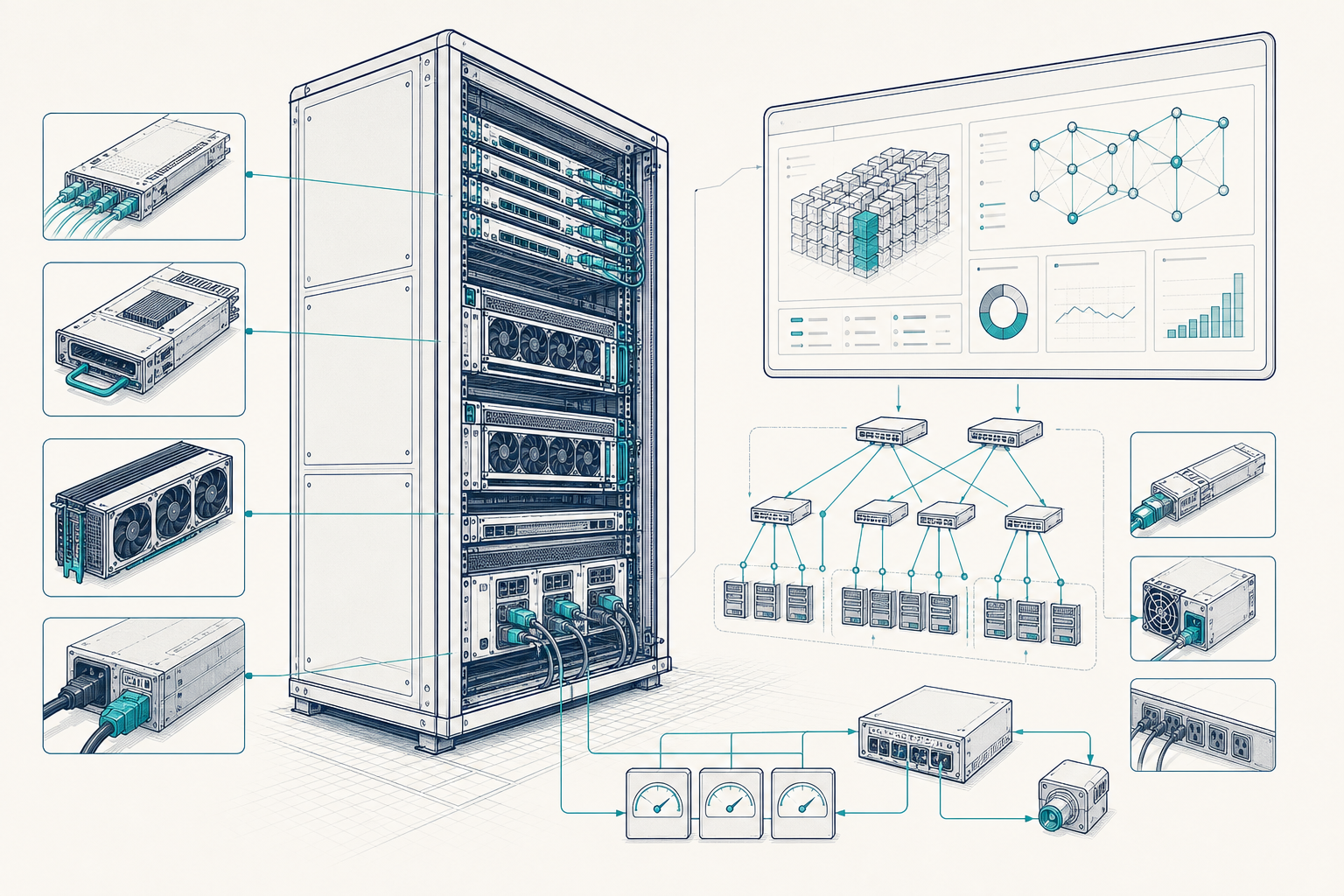
Lumai made optical inference a scheduling question
On October 22, 2026, TechCrunch published its Disrupt 2026 Startup Battlefield 200 coverage, updated on October 23, with Lumai presenting optical compute for the inference era. The specific change for infrastructure operators is not that GPUs became obsolete overnight. It is that another class of accelerator is being positioned against the highest growth part of AI operations, inference, where cost per token, latency per watt, and capacity availability now decide whether a cluster is profitable or just busy.
For a hyperscaler, a new accelerator category can be absorbed into a multi-year silicon program, a custom software stack, dedicated data center halls, and an internal customer base large enough to fill whatever is built. For an operator with a quarter rack, one rack, or a few racks, the problem is different. The question is not, “Is optical compute better than a GPU?” The question is, “Can this device be introduced without breaking tenancy, storage paths, observability, security boundaries, quotas, support workflows, and chargeback?”
That is the practical reading of Lumai's Disrupt appearance. Optical inference challenges the assumption that the only route to lower inference cost is to add more conventional GPU servers. But for operators in the GCC, MENA, and other markets building sovereign or local AI capacity, the immediate bottleneck is deployment choice. New silicon only helps if it can be qualified, scheduled, metered, and sold as part of a governed service catalog.
The bottleneck is not only accelerator speed
Inference platforms are already heterogeneous, even before optical compute enters the room. A production serving path can involve CPU preprocessing, GPU or accelerator execution, host memory, device memory, local NVMe, shared Ceph storage, high speed networking, service mesh policies, tenant identity, logging, tracing, and billing export. When a new accelerator arrives, each of those layers has to be checked.
The first mistake is to compare a new accelerator to a GPU as if each request is a standalone benchmark. Operators do not sell benchmark graphs. They sell a service level under constraints: rack power, cooling, procurement lead time, local support, data residency, and the ability to keep several tenants isolated on the same estate.
A quarter-rack operator may have 8 to 16 accelerator servers, not hundreds. A few-rack operator may have enough capacity to run multiple tenants, but not enough spare capacity to hide integration mistakes. One bad scheduling policy can strand expensive hardware. One unsupported model path can force jobs back to the general GPU pool. One metering gap can turn a promising accelerator into an unbillable exception.
Optical inference also changes the qualification conversation. Many inference workloads are not pure matrix operations from start to finish. They include tokenization, prompt assembly, retrieval, safety filters, cache lookups, postprocessing, and streaming response management. Large language model serving may be compute bound in one phase and memory bound in another. Vision models may have very different batch and latency behavior. Recommendation systems may depend on embedding tables and memory access patterns that are not accelerated by the same mechanism as dense math.
So the operator question becomes: which workloads can be routed to an optical inference pool, which remain on NVIDIA or AMD GPU pools, which can run on CPU, and how should tenants see those choices without needing to understand every device detail?
A heterogeneous pool needs a qualification matrix
Before a new accelerator is offered to tenants, it should be placed behind a workload qualification process. That process does not need to be academic. It needs to answer whether a workload can run, whether it can run predictably, whether it can be isolated, and whether it can be billed.
| Qualification area | Operator question | Resulting policy |
|---|---|---|
| Model support | Does the serving stack support the model format and operators? | Eligible, restricted, or unsupported |
| Memory behavior | Is the workload limited by device memory, host memory, or cache? | Batch size and placement rules |
| Latency profile | Does the accelerator improve p50 only, or also p95 and p99? | Tenant SLA class |
| Integration path | Does it fit Kubernetes, VM tenancy, or bare metal only? | Service catalog entry |
| Metering | Can accelerator time, tokens, watts, or jobs be measured? | Chargeback unit |
| Isolation | Can tenants be separated at device, process, network, and storage layers? | Multi-tenant or single-tenant pool |
This is where a system like ClastIQ matters. ClastIQ is designed for operators who own real hardware, from a quarter rack to a few racks, and need the estate to behave more like a governed cloud region than a collection of manually administered servers. The platform is hardware-agnostic across NVIDIA, AMD, and mixed CPU/GPU estates. The same operating model can be extended to new accelerator pools when the device integration is mature enough.
ClastIQ does not make an unsupported accelerator magically production ready. What it does is give the operator the control plane around it: bare-metal provisioning with MAAS and Juju, Kubernetes and VM tenancy on the same fleet, GPU partitioning through MIG and time-slicing where available, Ceph storage, tenant metering, quotas, policy engineering, air-gap deployment patterns, and local human-led support.
That surrounding system is the difference between a lab node and a sellable inference service.
Serving stacks will decide the first deployments
The first production question for optical inference is likely to be software compatibility. Most AI serving operations have standardized around frameworks and runtimes such as PyTorch, ONNX paths, Triton, vLLM, model-specific servers, or custom microservices. Even when the accelerator has its own compiler, runtime, or SDK, the operator has to decide how tenants will request it.
There are several patterns.
One pattern is the appliance model. The accelerator is exposed as a dedicated inference service with a narrow API. Tenants send requests to an endpoint, and the operator handles model onboarding. This can work for high volume use cases where the model set is controlled. It is less flexible for tenants who expect to bring arbitrary models.
Another pattern is the Kubernetes device model. Nodes are labeled by accelerator class, a device plugin advertises capacity, and workloads request that resource. This is familiar to GPU operators, but it depends on scheduler integration, container images, drivers, and observability being ready.
A third pattern is VM or bare-metal tenancy. A tenant gets a host or slice of hosts and manages the runtime directly. This can reduce operator integration work, but it increases the risk of underutilization unless metering and lease policy are strict.
For small and mid-size estates, the best answer is usually not one pattern forever. It is a catalog with clearly defined service classes. General purpose GPU inference remains available. Qualified optical inference is added for models that pass tests. CPU inference remains for lightweight workloads and control plane services. VM tenancy is used where a tenant needs more control. Kubernetes tenancy is used where the operator wants density and consistent policy.
A simple node classification pattern might look like this:
kubectl label node gpu-a100-01 accelerator.vendor=nvidia accelerator.class=gpu pool=inference-general
kubectl label node gpu-mi300-01 accelerator.vendor=amd accelerator.class=gpu pool=inference-general
kubectl label node opt-infer-01 accelerator.vendor=lumai accelerator.class=optical pool=inference-qualified
kubectl taint node opt-infer-01 accelerator=optical:NoSchedule
That does not solve integration by itself. It creates an operational boundary. Workloads have to opt into the qualified pool. The scheduler does not place generic inference jobs on the optical node by accident. Policies, quotas, and metering can then be attached to the pool.
Partitioning and tenancy still matter
Operators often discuss new accelerators in terms of performance per watt. That matters, but utilization is usually the larger financial lever in a small estate. A device that is twice as efficient but idle half the month is not a win. A device that can only serve one tenant at a time may be useful for reserved capacity, but not for shared inference unless the economics support it.
Conventional GPUs already require partitioning decisions. NVIDIA MIG can create hardware-isolated GPU instances on supported devices. Time-slicing can improve sharing for lighter or bursty jobs, with weaker isolation. AMD and other platforms have their own capabilities and constraints. CPUs can be oversubscribed in familiar ways, but memory and NUMA placement still matter. Optical accelerators will need the same kind of scrutiny: can the operator split the device, queue across tenants, enforce rate limits, and prevent noisy neighbor behavior?
In ClastIQ terms, the tenant should not be handed raw hardware without policy. The operator should define pools, quota classes, and billing units. For example:
- Bronze inference, CPU and shared GPU time-slice, best effort.
- Silver inference, GPU partition or qualified accelerator queue, defined p95 target.
- Gold inference, reserved GPU or reserved accelerator capacity, tenant-specific SLA.
- Sovereign inference, air-gapped or locally isolated environment, approved storage and network paths.
This service catalog is especially relevant in the GCC and MENA. Many operators are trying to provide local AI capacity to government, finance, energy, education, health, and enterprise tenants that cannot treat data location as an afterthought. If an optical accelerator reduces inference cost but requires data to leave the sovereign environment for compilation, telemetry, support, or model management, it may not qualify for those tenants. Air-gap and sovereign deployment checks must sit beside performance tests.
Storage and memory assumptions cannot be ignored
Inference is not only accelerator math. Models have to be stored, staged, versioned, loaded, and rolled back. Tenant datasets and retrieval indexes may live in object storage, block volumes, or shared filesystems. Logs and traces have to be retained according to policy. If an accelerator requires a different model artifact format, the storage system has to track that variant and its provenance.
Ceph is useful in this model because it gives the operator a common storage substrate across VM and Kubernetes tenancy. Model artifacts can be stored and replicated according to policy. Tenant volumes can remain within the operator estate. Snapshots can support rollback and test promotion. The accelerator pool can then consume approved artifacts rather than creating a separate island of storage.
Memory is the harder issue. Many inference systems depend on high bandwidth memory, KV cache management, and interconnect assumptions. If a workload's cost problem is actually cache residency rather than matrix throughput, a faster compute path may not reduce end-to-end cost. If the accelerator is excellent at a dense phase but requires extra host transfers, the operator must measure total request latency and total power, not just device runtime.
A practical qualification run should measure at least these values: tokens per second, requests per second, p50 and p99 latency, device utilization, host CPU utilization, host memory pressure, network throughput, model load time, error rate, and watts per served request. The result should be stored as an internal profile and tied to placement policy.
Worked example: utilization changes the bill
Consider a small regional inference operator with 4 servers, each with 8 conventional GPUs. The estate has 32 GPUs. Assume the operator accounts for the full installed cost of the GPU pool at 2.40 dollars per installed GPU-hour, including hardware amortization, support labor, space, power, cooling, networking, and storage share.
There are 720 hours in a 30 day month.
Installed GPU-hours per month:
32 GPUs x 720 hours = 23,040 installed GPU-hours
Monthly cost basis:
23,040 x 2.40 dollars = 55,296 dollars
If the pool averages 35 percent billable utilization, the operator sells:
23,040 x 0.35 = 8,064 billable GPU-hours
Break-even chargeback rate:
55,296 dollars / 8,064 GPU-hours = 6.86 dollars per billable GPU-hour
Now assume the operator introduces a qualified heterogeneous inference catalog. Some workloads remain on GPUs. Some bursty small jobs move to CPU. A specific high volume model qualifies for a new accelerator pool, which reduces queue pressure on the GPU pool. Better scheduling and quotas raise billable GPU utilization to 60 percent without adding GPUs.
Billable GPU-hours at 60 percent:
23,040 x 0.60 = 13,824 billable GPU-hours
Break-even chargeback rate:
55,296 dollars / 13,824 GPU-hours = 4.00 dollars per billable GPU-hour
The important point is not that the new accelerator directly replaces every GPU-hour. It is that qualification and routing reduce stranded capacity. The operator can lower internal chargeback, improve margin, or both. If the same 32 GPU pool draws 24 kW at the rack level and is charged back at 5.00 dollars per billable GPU-hour, then annualized revenue per MW changes materially.
At 35 percent utilization:
8,064 GPU-hours x 5.00 dollars x 12 = 483,840 dollars per year
0.024 MW rack draw gives:
483,840 / 0.024 = 20.16 million dollars per MW-year
At 60 percent utilization:
13,824 GPU-hours x 5.00 dollars x 12 = 829,440 dollars per year
829,440 / 0.024 = 34.56 million dollars per MW-year
That is the operator-grade issue. Revenue per MW improves because the estate is scheduled, metered, and sold more effectively. A new accelerator can contribute to that improvement only if it fits the control plane.
Metering has to cover more than GPU-hours
Once heterogeneous inference pools exist, a single GPU-hour metric is not enough. Operators may need several metering units: GPU-hours, accelerator-hours, CPU-hours, memory GB-hours, storage GB-months, egress, tokens, requests, reserved capacity, and support class. The trick is to keep the bill understandable while keeping the economics accurate.
A tenant should be able to see why a workload landed in a certain class. The operator should be able to prove that quota was enforced. Finance should be able to allocate cost by tenant, project, department, or reseller. Engineering should be able to detect when a tenant is using a Gold pool for Bronze work.
ClastIQ's role is to keep those controls close to the infrastructure. Quotas and policies are not spreadsheet afterthoughts. They are enforced through Kubernetes, VM tenancy, storage policy, accelerator pools, identity, and metering export. That matters for any accelerator, but it matters more when the estate becomes mixed. Without a common chargeback model, every new device becomes a billing exception.
Sovereignty and support are deployment constraints
The GCC and MENA relevance is direct. Many local operators are not trying to copy a hyperscaler region at hyperscaler scale. They are trying to provide governed AI capacity inside national, sectoral, or enterprise boundaries. That means hardware-agnostic orchestration, local support, air-gap options, and clear operational ownership.
If optical inference becomes a useful category, regional operators will still need to answer procurement, spares, driver lifecycle, firmware provenance, telemetry controls, license terms, and support escalation. They will also need a fallback plan. If a model update no longer qualifies for the optical pool, it must fall back to GPU or CPU capacity without becoming an outage or a billing dispute.
This is why ClastIQ treats accelerators as part of a fleet, not as isolated islands. Bare-metal provisioning gets nodes into a known state. Juju-managed operations reduce bespoke configuration. Kubernetes and VM tenancy support different customer operating models on the same hardware base. Ceph keeps storage within the estate. Metering, quotas, and policy make the service governable. Local support matters because a small estate cannot afford weeks of remote ambiguity when a cluster is the business.
What to do this week
-
Build a workload inventory. List the top 10 inference workloads by monthly GPU-hours, latency target, model type, framework, batch behavior, and tenant criticality.
-
Define accelerator pool classes before buying hardware. Separate general GPU, partitioned GPU, CPU inference, experimental accelerator, and reserved tenant pools in your catalog.
-
Add qualification gates. Require model compatibility, p99 latency, host CPU load, memory pressure, power draw, isolation, and metering checks before any new accelerator is offered to tenants.
-
Normalize chargeback. Decide which units you will bill or allocate across GPU-hours, accelerator-hours, tokens, storage, and reserved capacity. Do not let pilot hardware become unmetered capacity.
-
Test fallback paths. For every qualified workload, document where it runs if the new accelerator pool is full, offline, or incompatible with the next model revision.
-
Review sovereignty constraints. Confirm whether compilers, telemetry, support bundles, model artifacts, and logs can remain inside your operating boundary, especially for GCC and MENA regulated tenants.
ClastIQ runs this orchestration, tenancy, metering, storage, quota, and support model on the operator's own hardware, request a demo.