What changed on October 7, 2026
On October 7, 2026, Mecka AI announced a $60 million raise from Sequoia for robot-data infrastructure, according to TechCrunch. The company is addressing a part of the AI stack that is easy to underestimate: the data system behind robots that see, move, fail, recover, and generate continuous multimodal evidence.
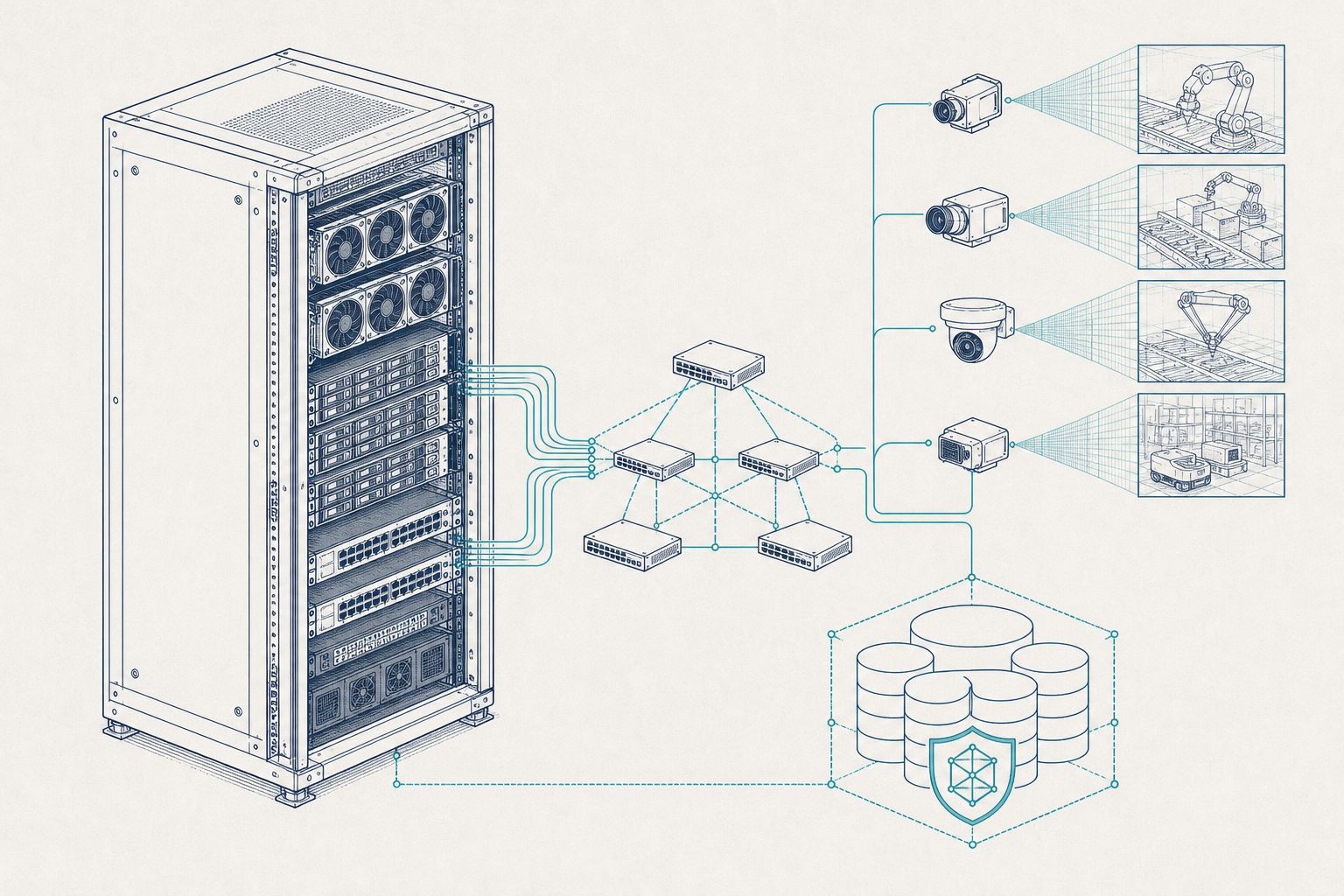
The useful signal for GPU estate operators is not the funding round itself. It is the workload shape. Robot data is not a neat set of text prompts or a periodic model training job. It is a flow of video, sensor traces, control events, labels, simulation artifacts, and repeated training or fine-tuning runs. It lands every day. It must be filtered, transformed, indexed, retained, and served back into model development. If part of that loop crosses a border, uses public cloud storage, or depends on a remote GPU queue, the economic and governance model changes.
For operators running a quarter rack to a few racks, including in the GCC and MENA, this is the practical question: which parts of a robot-data pipeline should run on local GPUs, which parts should stay in sovereign object storage, and when do storage and network costs erase the apparent advantage of owning the GPU fleet?
Clastiq exists for this class of decision. It is a GPU and CPU orchestration platform for operators who own real hardware but are not hyperscalers. It combines bare-metal provisioning with MAAS and Juju, Kubernetes and VM tenancy on the same fleet, GPU partitioning, Ceph storage, per-tenant metering and chargeback, quotas, policy engineering, and support for air-gap and sovereign deployments. The goal is not to make a small estate look large on a slide. The goal is to make its utilization, chargeback, sovereignty, and revenue per megawatt measurable enough to manage.
Robot data turns AI into an ingest problem
A robot-data workload begins before a model sees a batch. Cameras and sensors create a continuous stream. The stream may include front, rear, wrist, depth, thermal, event camera, LIDAR, IMU, force, audio, joint state, and operator annotation data. Not every project uses all of these, but the direction is clear: more modalities, more frames, and more attempts to preserve context.
The first bottleneck is ingestion. A small operator can fill a storage cluster long before the GPUs look busy. Ten robots with 8 cameras each, at 8 Mbps per camera, generate 640 Mbps of compressed video. That is 80 MB per second, about 6.9 TB per day before derived data. Add metadata, extracted frames, intermediate crops, embeddings, labels, and failed run retention, and a monthly footprint above 250 TB is plausible even for a modest pilot.
The second bottleneck is preprocessing. Video has to be decoded, sampled, cleaned, synchronized, and sometimes anonymized or redacted. Some steps run well on CPUs. Some benefit from GPU acceleration. Some are bursty and should run on slices, not whole cards. If preprocessing waits behind training jobs, data ages. If training waits behind preprocessing, GPUs sit idle while storage fills.
The third bottleneck is iteration. Robot-data teams rarely train once. They test a policy, discover edge cases, mine the logs, relabel or synthesize data, and run another fine-tune. That pattern creates many medium jobs, not only a few huge jobs. A quarter rack estate must stop treating the GPU fleet as a single queue owned by the loudest tenant.
The fourth bottleneck is governance. In GCC and MENA deployments, sovereign data requirements may apply because the video contains people, buildings, industrial facilities, vehicle movements, or critical infrastructure context. Even when law permits cloud use, an operator may decide that bulk video and derived metadata should remain in-country or on-premises. That pushes the architecture toward local object storage, local preprocessing, and controlled egress, with only selected artifacts leaving the site if policy allows.
The estate view: not one workload, but four queues
A robot-data platform on a small GPU estate usually becomes four queues sharing the same hardware:
| Queue | Typical unit | Main bottleneck | Operator control needed |
|---|---|---|---|
| Ingest and validation | Streams, files, objects | Network and storage write path | Tenant buckets, lifecycle rules, ingress quotas |
| Preprocessing | Decode, sample, crop, embed | CPU, GPU slices, scratch I/O | Batch priority, GPU partitioning, scratch limits |
| Training and fine-tuning | Jobs, experiments | Full GPUs, memory, checkpoint I/O | Reservations, fair share, chargeback |
| Inference and review | APIs, notebooks, dashboards | Latency, small GPU allocations | Time-slicing, namespace quotas, metering |
The failure mode is familiar. A team buys GPUs for training, then discovers that the storage nodes are underdesigned. Another team moves preprocessing to the same cards, then training utilization collapses. A third tenant starts an annotation service that needs low latency, so it competes with batch jobs. Finance asks for chargeback, but the logs show only server uptime, not GPU-hours by tenant and pipeline stage.
This is where orchestration matters. Clastiq treats the estate as a governed pool rather than a pile of servers. Bare metal can be provisioned through MAAS and Juju. Kubernetes can run notebook, preprocessing, labeling, and inference services. VM tenancy can support teams that need their own operating system image, proprietary tools, or isolation model. GPUs can be allocated as whole devices, MIG profiles where supported, or time-sliced resources for lighter inference and preprocessing work. Ceph provides local storage primitives for object, block, and file use cases, with data placement policies aligned to the operator's resilience and cost requirements.
The important point is not that every robot-data task should run locally. The point is that the operator needs a control plane that can price and govern the choice.
A worked example for a few-rack operator
Consider a local operator with 16 modern GPUs across several servers, plus CPU nodes, Ceph storage, and 100 GbE switching. The operator supports three tenants: a robotics lab, an industrial inspection team, and an internal model operations group. Assume the GPUs draw an average of 700 W each under load, and the full IT load of the small estate, including CPUs, storage, and networking, averages 18 kW when active.
Monthly GPU capacity is:
16 GPUs x 24 hours x 30 days = 11,520 GPU-hours.
At 55 percent billable utilization, the estate sells or allocates:
11,520 x 0.55 = 6,336 GPU-hours per month.
At 75 percent billable utilization, it allocates:
11,520 x 0.75 = 8,640 GPU-hours per month.
Now define a conservative monthly cost model for the GPU portion of the estate:
- Depreciation on GPU servers and direct infrastructure: 480,000 dollars over 36 months = 13,333 dollars per month.
- Power for the active estate: 18 kW x 720 hours x 0.11 dollars per kWh = 1,426 dollars per month.
- Storage, network, support contracts, spares, and operations allocation: 4,500 dollars per month.
Total monthly cost: 19,259 dollars.
At 55 percent utilization, cost per billable GPU-hour is:
19,259 / 6,336 = 3.04 dollars.
At 75 percent utilization, cost per billable GPU-hour is:
19,259 / 8,640 = 2.23 dollars.
If the operator charges tenants 4.20 dollars per GPU-hour on a blended internal rate, monthly GPU revenue at 75 percent utilization is:
8,640 x 4.20 = 36,288 dollars.
Annualized revenue is 435,456 dollars. Divided by the 0.018 MW average IT load, the estate produces:
435,456 / 0.018 = 24.2 million dollars per MW-year.
This is not a benchmark or a claim about any Clastiq deployment. It is the arithmetic an operator should do before accepting a robot-data workload. The delta between 55 percent and 75 percent utilization is worth more than a minor discount on hardware. It is the difference between a GPU estate that looks expensive and one that can fund storage growth, support, and power upgrades.
The robot-data-specific issue is that utilization cannot be raised by running training jobs alone. The operator must keep the pipeline moving. Preprocessing should consume idle slices. Inference review should use small allocations. Large fine-tunes should reserve whole GPUs when needed. Storage lifecycle policies should stop raw video from crowding out current working sets.
Where Clastiq fits in the pipeline
For a robot-data workload, Clastiq's role is to make the operational boundaries explicit.
First, provisioning. Bare-metal installation matters because GPU and storage nodes are not interchangeable once cabling, PCIe layout, NICs, firmware, and power envelopes enter the picture. MAAS and Juju provide a repeatable path to bring servers into service, apply roles, and avoid artisanal host configuration.
Second, mixed tenancy. Some tenants will want Kubernetes jobs for preprocessing and training. Others will require VMs because their robotics toolchain, simulator, licensing server, or kernel dependency does not fit cleanly into containers. A small estate cannot afford separate clusters for every preference. Running Kubernetes and VM tenancy on the same fleet allows the operator to sell the same capacity without turning every exception into a new island.
Third, GPU partitioning. Robot-data pipelines contain both heavy and light stages. A full card may be justified for a training run. It is usually wasteful for thumbnail generation, embedding jobs, small annotation models, review dashboards, or low-rate inference APIs. Where hardware supports MIG, fixed GPU instances can provide stronger isolation. Where time-slicing is more appropriate, lighter tenants can share capacity with metering and quotas. Clastiq is hardware-agnostic, so the policy model should not assume a single vendor across the estate.
Fourth, storage locality. Ceph can back object storage for raw and derived data, block volumes for VM workloads, and file-like access patterns where needed. Robot data should be tiered by value. Raw compressed video may require a retention period. Extracted clips tied to failures may need longer retention. Transient decode outputs should expire quickly. Checkpoints need a separate policy from raw video. Without lifecycle rules, storage consumption becomes a silent tax on every GPU-hour.
Fifth, metering and chargeback. The operator needs to know which tenant used full GPUs, which tenant used slices, which tenant filled object storage, and which tenant consumed the network during peak ingest windows. Chargeback does not need to be punitive. It needs to show the cost of decisions. If a tenant keeps 200 TB of raw video online for 12 months, that should not be hidden inside a generic platform fee.
Sixth, sovereignty and air-gap operation. For GCC and MENA operators, especially those serving government, energy, ports, aviation, defense supply chains, smart city, or industrial automation projects, video and telemetry can be sensitive even when the model code is not. An air-gapped or sovereign deployment changes the update, support, and audit process. The platform must be operable without assuming permanent public cloud connectivity.
Quotas make the pipeline legible
The fastest way to lose control of a small GPU estate is to let every namespace request anything. Robot-data workloads need quotas by tenant and by workload type. Training may get reservations during a defined window. Preprocessing may run opportunistically. Review applications may get small guaranteed slices.
A Kubernetes quota is not the whole platform, but it shows the control model. For example:
apiVersion: v1
kind: ResourceQuota
metadata:
  name: robotics-lab-gpu-quota
  namespace: robotics-lab
spec:
  hard:
    requests.cpu: 320
    requests.memory: 1Ti
    requests.nvidia.com/gpu: 8
    limits.ephemeral-storage: 40Ti
    ceph.rook.io/bucket-quota: 120Ti
For operators with mixed GPU vendors or slice profiles, the actual resource names and admission policy will differ. The key is that quotas should reflect the pipeline, not only the hardware. A tenant that needs 8 full GPUs for 4 hours should request that explicitly. A batch of video decode and embedding jobs should be steered to cheaper capacity or slices when possible. A review service should have a steady allocation and a latency objective, not a blank check.
Clastiq's policy engineering layer is where these decisions become standard operating procedure. The scheduler view, storage view, and chargeback view need to agree. If metering says a tenant used 1,000 GPU-hours, finance should be able to reconcile that with quotas and job history. If storage says the same tenant holds 140 TB against a 120 TB policy, the platform should expose the exception before a Ceph pool reaches an uncomfortable fill level.
The network and storage trap
Owning GPUs does not guarantee cheaper AI. Robot data is one of the cases where storage and network can dominate the decision.
Start with the earlier ingest example: 6.9 TB per day of compressed camera data. Over 30 days that is 207 TB of raw compressed video. If derived artifacts add 50 percent, the logical monthly footprint is about 310 TB. With triple replication, the raw storage requirement is 930 TB before headroom. With erasure coding at roughly 1.5x overhead, it is 465 TB before headroom. Add 20 percent operational headroom, and the operator is planning for about 558 TB of raw Ceph capacity for that single month of retained logical data under erasure coding.
This is where a local GCC or MENA operator must be disciplined. Keeping every frame forever on high-performance storage is rarely economic. Sending every frame to an overseas cloud object store may violate policy, introduce retrieval costs, or create latency that slows iteration. A practical architecture often keeps sovereign object storage on the operator's site, applies lifecycle rules, and moves only approved summaries, model artifacts, or selected datasets across external links.
Network design follows the same logic. Ingest traffic, Ceph replication or erasure coding traffic, checkpoint writes, and tenant access should not fight on an underbuilt fabric. A 25 GbE network may be acceptable for a pilot. It can become the bottleneck once multiple robots, labeling tools, and training jobs run together. At a few racks, the operator should plan for clear separation of management, storage, and workload traffic, with enough observability to identify who saturated a path.
Operating principles for small robot-data estates
The first principle is locality by default, not locality by superstition. Keep bulk sensitive data local when sovereignty, cost, and iteration speed justify it. Allow controlled external movement only for data products that policy permits.
The second principle is that GPU-hours and terabytes must be priced together. A tenant that asks for cheap GPU-hours but stores large volumes indefinitely is shifting cost to the platform. A tenant that preprocesses aggressively may spend more GPU-hours now but reduce storage and training waste later. Chargeback should reveal the trade.
The third principle is to protect interactive and production services from batch work. Annotation dashboards, inference APIs, and review tools often need small GPU allocations. If they wait behind long training jobs, the human workflow stalls. MIG, time-slicing, and separate priority classes are operational tools, not features to display in a diagram.
The fourth principle is to reserve whole GPUs only when the job earns them. Fine-tuning and larger training jobs often do. Decode, filtering, embedding, and review often do not. This is where small estates recover utilization.
The fifth principle is to measure revenue per megawatt, even when the platform is internal. In power-constrained markets, especially in parts of GCC and MENA where data center capacity, cooling, and grid planning are board-level issues, megawatts are a scarce input. The relevant question is not only how many GPUs are installed. It is how much governed, billable, useful work the estate produces per MW-year.
What to do this week
-
Build a robot-data sizing sheet that starts with cameras, bitrates, robots, retention period, derived-data multiplier, and Ceph overhead. Do this before buying more GPUs.
-
Split the pipeline into ingest, preprocessing, training, and inference queues. Assign each queue a quota, priority class, and chargeback metric.
-
Decide which datasets are sovereign by policy. Mark what can leave the site, what must remain local, and what requires air-gap handling.
-
Run the utilization math for your current estate at 55 percent, 65 percent, and 75 percent billable GPU utilization. Include power, storage, network, support, and depreciation.
-
Review whether your GPU partitioning policy matches the workload. Use whole GPUs for jobs that need them, and use MIG or time-slicing where lighter pipeline stages can safely share.
-
Set storage lifecycle rules for raw video, extracted clips, checkpoints, embeddings, and scratch data. Treat unbounded retention as a capacity incident in slow motion.
Clastiq runs this on the operator's own hardware, from a quarter rack to a few racks. request a demo