Meta buys Conductor, and the workload shape changes
On 4 November 2026, TechCrunch reported that Meta had acquired Conductor, an agentic coding platform built around parallel workspaces. The reported product pattern is important for infrastructure operators: a developer can ask for one coding task, but the system can fan that request out into multiple concurrent agents, each working in its own workspace, trying different implementations, tests, or refactors. Conductor also told users that its cloud service would shut down on 20 November 2026, giving customers a short window to retrieve projects and adjust workflows.
The acquisition may be a talent or product move for Meta. For operators of small and mid-size GPU estates, the more useful lesson is operational. Agentic coding is not a single chat session with a code model. It is a bursty, multi-tenant workload that creates simultaneous pressure on GPU memory, CPU build runners, source repositories, secrets, storage snapshots, network egress, and project accounting.
That matters for an organization running a quarter rack to a few racks of real hardware. A small GPU cluster can handle a few developers using code assistants. It can fail in subtle ways when those assistants become parallel agents. One user request can become 4, 8, or 16 model sessions. Each session may hold a large context window, maintain KV cache, call tools, run tests, create containers, and write artifacts. If the cluster is shared by engineering, data science, security, and internal platform teams, the infrastructure problem becomes tenancy, not only inference.
For GCC and MENA organizations, the issue is sharper. Source code, prompts, tickets, credentials, internal APIs, and architecture diagrams are often sensitive. Public cloud routing may be unacceptable for sovereignty, regulatory, contractual, or customer reasons. At the same time, buying enough local GPUs to satisfy every burst is uneconomic. The operator has to decide what runs locally, what is queued, what is partitioned, and what can be routed elsewhere without leaking controlled data.
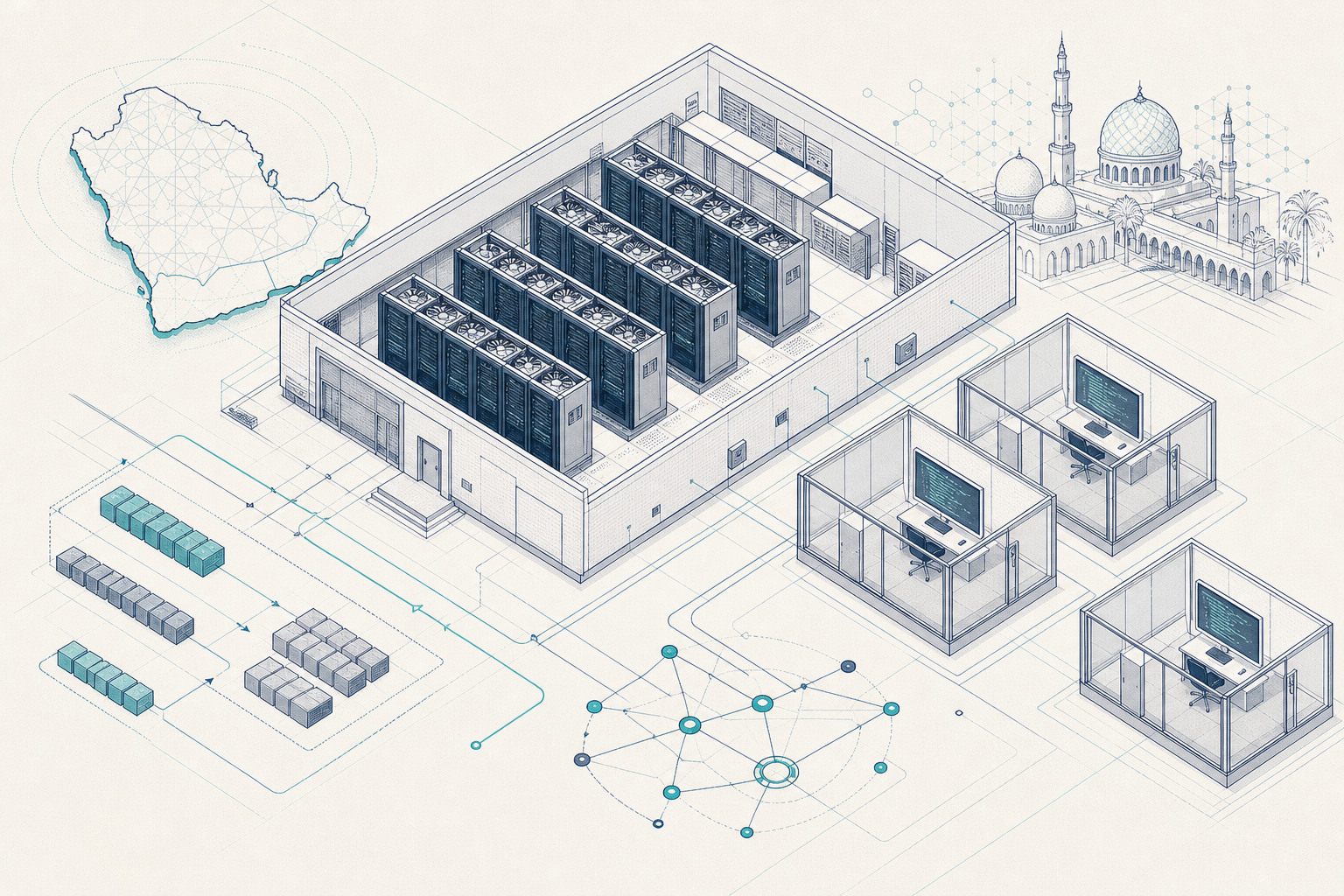
A platform such as ClastIQ is relevant here because it treats the estate as a governed fleet, not as a pile of GPU servers. Bare-metal provisioning, Kubernetes tenancy, VM tenancy, GPU partitioning, Ceph storage, metering, quotas, and policy are the controls that turn agentic coding from an experiment into a service the operator can run on owned hardware.
Why parallel coding agents hurt small clusters first
A normal interactive code assistant has a familiar resource profile. A developer sends a prompt, the model produces a response, and the workload is mostly inference. There is still pressure on GPU memory and tokens per second, but a platform team can often estimate demand by counting active users.
Parallel workspaces break that assumption. A request such as improve the payment reconciliation test suite may create several branches. One agent writes tests. Another changes the data model. Another searches for flaky integration failures. Another attempts a smaller patch. Each agent may call a local code model repeatedly, run a build, execute tests, inspect logs, and compare output.
The bottlenecks then arrive together:
| Pressure point | Failure mode | Operator control |
|---|---|---|
| GPU memory and KV cache | One project evicts or blocks others | MIG, time-slicing, quotas, admission control |
| CPU and build runners | Agents wait on compilation, not tokens | Kubernetes and VM pools on the same fleet |
| Workspace storage | Forks and artifacts fill local disks | Ceph volumes, snapshots, lifecycle policy |
| Secrets and repositories | Tokens leak into prompts or logs | Namespace isolation, secret policy, egress rules |
| Cost attribution | AI spend is invisible by project | Per-tenant metering and chargeback |
| Burst demand | Users see random latency | Queues, priorities, local versus cloud routing |
The small estate feels this faster than the hyperscaler region because there is less statistical smoothing. A few teams starting parallel agents at 10:00 can consume the same pool needed for model training, retrieval jobs, batch inference, and VM tenants. Without quotas, the loudest workflow wins. Without metering, the highest consuming project may look free. Without storage policy, abandoned workspaces accumulate until the cluster has a capacity incident.
The operator-grade conclusion is simple: agentic coding should be onboarded as a tenant service with defined classes, not as a generic GPU workload.
The first bottleneck is not always tokens per second
Many platform teams begin by asking which code model to run and how many tokens per second it can deliver. That matters, but it is not the only constraint. Parallel coding agents consume memory while thinking, not only while generating. Long prompts containing repository maps, diffs, logs, documentation, and test output increase KV-cache pressure. Multiple agents created from one user request multiply that pressure.
On a GPU with fixed memory, the operator has several choices. Run fewer sessions with larger contexts. Run smaller models. Use quantization where quality allows. Partition GPUs for predictable tenancy. Time-slice lower priority sessions. Queue requests when the memory budget is exceeded. None of these choices is only technical. They are product and financial decisions for the internal platform.
MIG, where available, can give hard GPU partitions for teams that need isolation and predictable service. Time-slicing can improve utilization for interactive workloads that do not keep the accelerator busy every millisecond. Mixed estates may include NVIDIA, AMD, and CPU-only nodes. ClastIQ is hardware-agnostic, so the scheduling model should not assume one vendor or one accelerator generation. The control objective is to expose useful resource classes, then meter them.
A practical catalog might include small interactive code assistant sessions, medium parallel workspace jobs, large repository analysis jobs, and restricted sovereign code jobs that cannot leave the local estate. Each class needs limits: maximum parallel agents, maximum context size, maximum wall time, maximum workspace age, and maximum external egress.
Workspace isolation is the tenancy boundary
For agentic coding, a workspace is not just a directory. It is the security and accounting boundary for source code, tool calls, secrets, build artifacts, and logs. If the platform treats all workspaces as the same user on a shared VM, it becomes difficult to prove that one project cannot read another project, or that a contractor cannot access a sovereign repository.
On a governed estate, each project should map to a namespace or tenant, with separate identities, volumes, secrets, network policy, and logs. Some teams will need VMs because their build toolchains or license servers do not fit Kubernetes cleanly. Others will run well in containers. The important point is that Kubernetes and VM tenancy share the same physical fleet without becoming unmanaged islands.
This is where bare-metal provisioning and orchestration matter. MAAS and Juju can provide a repeatable base for hardware lifecycle, operating systems, storage, Kubernetes, and service deployment. ClastIQ then sits in the operational role of making these resources usable by tenants: who gets which class of compute, how GPU partitions are exposed, which projects can create workspaces, how storage is provisioned, and how usage is reported.
A simple Kubernetes policy start could look like this:
kubectl create namespace agentic-code-finance
kubectl label namespace agentic-code-finance \
  tenant=finance data-class=source-code-sovereign \
  egress=restricted gpu-class=partitioned
kubectl apply -n agentic-code-finance -f quota.yaml
And the quota file might express the first guardrail:
apiVersion: v1
kind: ResourceQuota
metadata:
  name: agentic-code-quota
spec:
  hard:
    requests.cpu: "64"
    requests.memory: 256Gi
    persistentvolumeclaims: "20"
    requests.storage: 5Ti
    pods: "80"
That example does not show every GPU control because vendors and device plugins vary. The principle is what matters: put the project in a governed namespace before users scale parallel workspaces. GPU shares, partitions, or device resources should then be added as explicit quota, not discovered through best effort scheduling.
Local versus cloud routing is a policy decision
Parallel coding agents create burst demand. No small estate should assume that every burst must be served immediately on owned GPUs. But no sovereign organization should assume that every overflow can go to a public endpoint.
The routing policy needs data classification. A prompt that contains public open source code may be eligible for external routing. A prompt containing unreleased internal code, customer data, security findings, or national infrastructure details may be local only. A GCC bank, energy operator, government integrator, telco, or defense supplier may need source code and prompts to remain in country, or at least under a specific legal and operational boundary.
This is not solved by a developer checkbox. It needs enforcement at the orchestration layer. The scheduler needs labels and admission rules. The network layer needs egress controls. The secrets layer needs policy on which credentials can be mounted into which workspace. The metering layer needs to distinguish local GPU-hours from external API usage if both are allowed.
The Conductor cloud shutdown date, 20 November 2026, highlights a related risk: portability. If an agentic coding service stores workspace state, prompts, branches, evaluations, and artifacts in a hosted system, an operator must know how to export them and how long that export takes. For regulated teams, the question is not only can we download our data. It is whether the data format can be restored into another system, whether audit logs are preserved, and whether deleted hosted workspaces are actually outside future processing.
A sovereign operating model should assume that tools will change. The owned cluster should hold the durable assets: repositories, approved model endpoints, vector indexes where used, workspace snapshots, logs, and cost records. Hosted services can be useful, but they should not be the only place where operational state exists.
A numeric example for a 16 GPU estate
Consider an operator running 16 GPUs across several servers in a small data center room. The estate supports agentic coding during office hours, batch inference overnight, and occasional model fine-tuning. There are 720 hours in a 30 day month, so the physical capacity is:
16 GPUs x 720 hours = 11,520 GPU-hours per month.
Before governance, assume measured useful utilization is 30 percent. Useful means work that is allocated to a project and producing value, not idle time, failed jobs, abandoned notebooks, or blocked sessions. That gives:
11,520 x 0.30 = 3,456 useful GPU-hours per month.
Assume the all-in internal cost to run the fleet is 27,648 dollars per month, including depreciation, support labor allocation, data center charges, power, cooling, and maintenance reserves. The physical cost per available GPU-hour is:
27,648 dollars / 11,520 = 2.40 dollars per available GPU-hour.
But at 30 percent useful utilization, the cost per useful GPU-hour is:
27,648 dollars / 3,456 = 8.00 dollars per useful GPU-hour.
Now add tenant quotas, workspace expiry, partitioned interactive GPU classes, batch backfill, and chargeback reports. If useful utilization rises to 65 percent, useful monthly consumption becomes:
11,520 x 0.65 = 7,488 useful GPU-hours.
The same monthly cost divided by useful work is:
27,648 dollars / 7,488 = 3.69 dollars per useful GPU-hour.
This is not a benchmark claim. It is the arithmetic of fixed assets. Better scheduling does not make GPUs cheaper. It spreads the fixed cost across more accountable work.
Now look at chargeback. Suppose the operator charges internal projects 5.00 dollars per useful GPU-hour. At 7,488 useful GPU-hours, monthly recovery is:
7,488 x 5.00 dollars = 37,440 dollars.
If facility draw for the cluster is 19.6 kW including cooling allocation, the annual chargeback run rate is:
37,440 x 12 = 449,280 dollars per year.
Revenue or recovery per MW-year is:
449,280 dollars / 0.0196 MW = 22.92 million dollars per MW-year.
That number is useful because power is often the hard constraint in GCC and MENA data centers. The operator may have space for racks but limited power reservation, transformer capacity, or cooling headroom. Revenue per megawatt is not only a hyperscaler metric. A university AI center, national lab, telco, or enterprise platform team can use it to compare low value idle capacity against governed internal services.
Metering has to follow the agent, not only the user
Chargeback for agentic coding is easy to get wrong. If the platform bills only by developer identity, one senior engineer experimenting with 12 parallel workspaces can hide a large cost inside a team budget. If it bills only by namespace, a shared platform project can become a dumping ground. If it bills only by model endpoint, CPU builds, storage, and egress disappear.
A better record has several dimensions: tenant, project, repository, workspace, model class, GPU resource class, CPU hours, storage GiB-months, external egress, and wall clock time. The billing unit can be simplified for humans, but the raw meter should keep enough detail for disputes and optimization.
This also helps engineering management. If a project spends 2,000 dollars on agentic coding to remove a release blocker, that may be excellent value. If a project spends the same amount producing abandoned branches, the operator can show the pattern without debating model quality. Metering makes the economic conversation factual.
For GCC organizations building local AI capability, this matters politically as well as financially. Central AI infrastructure is often funded as a strategic asset. Without chargeback, every team asks for priority and the platform team becomes the allocator of favors. With transparent quotas and usage reports, the organization can align scarce GPU capacity to funded priorities, sovereign workloads, and revenue producing services.
Storage and power are part of the coding platform
Agentic coding produces storage churn. Workspaces clone repositories, create branches, write build outputs, store logs, and sometimes cache dependencies. Ten parallel attempts at the same task can create ten similar trees. If those workspaces are not expired, the storage platform becomes a graveyard of partial work.
Ceph is useful in this pattern because it can provide shared, resilient storage services across the estate, including volumes for Kubernetes and VM workloads. The operator still needs lifecycle rules. Workspace volumes should have owners, creation time, last access time, data classification, and expiry. Snapshots should be deliberate. Logs should move to the right retention tier. Build caches should be separated from source-bearing volumes.
Power is equally practical. Interactive coding traffic peaks during human work hours. Batch inference and evaluation can backfill nights and weekends. If the orchestrator understands priorities, the same fleet can run low latency sessions during the day and throughput jobs when developers are offline. If it does not, the operator sees both poor user experience and poor asset utilization.
This is why Kubernetes alone is not the full answer, and neither is a VM farm alone. Agentic coding touches bare metal, GPUs, CPU scheduling, storage, identity, secrets, network policy, and accounting. The operator needs one fleet view and several tenancy surfaces.
What to do this week
-
Inventory code assistant and agentic coding usage. Count users, repositories, tools, external endpoints, and whether prompts include source code, tickets, logs, or secrets.
-
Define data classes for prompts and workspaces. Mark which projects are local only, which can use approved external services, and which require GCC or in-country handling.
-
Create a small resource catalog. Start with interactive, parallel workspace, batch evaluation, and restricted sovereign classes. Set initial limits for parallel agents, wall time, storage, and egress.
-
Add metering before broad rollout. Capture GPU-hours, CPU hours, storage, workspace count, tenant, project, and model class. Publish a simple monthly showback even if chargeback comes later.
-
Test portability. Export workspaces, prompts, logs, and artifacts from any hosted agentic coding service. Restore them into a local environment and measure the time, gaps, and data loss.
-
Reserve capacity for critical tenants. Do not let experimental parallel agents starve security fixes, production model serving, or executive reporting workloads.
ClastIQ runs this pattern on the operator's own hardware, from a quarter rack to a few racks, with provisioning, tenancy, GPU partitioning, Ceph storage, metering, quotas, and local support. request a demo