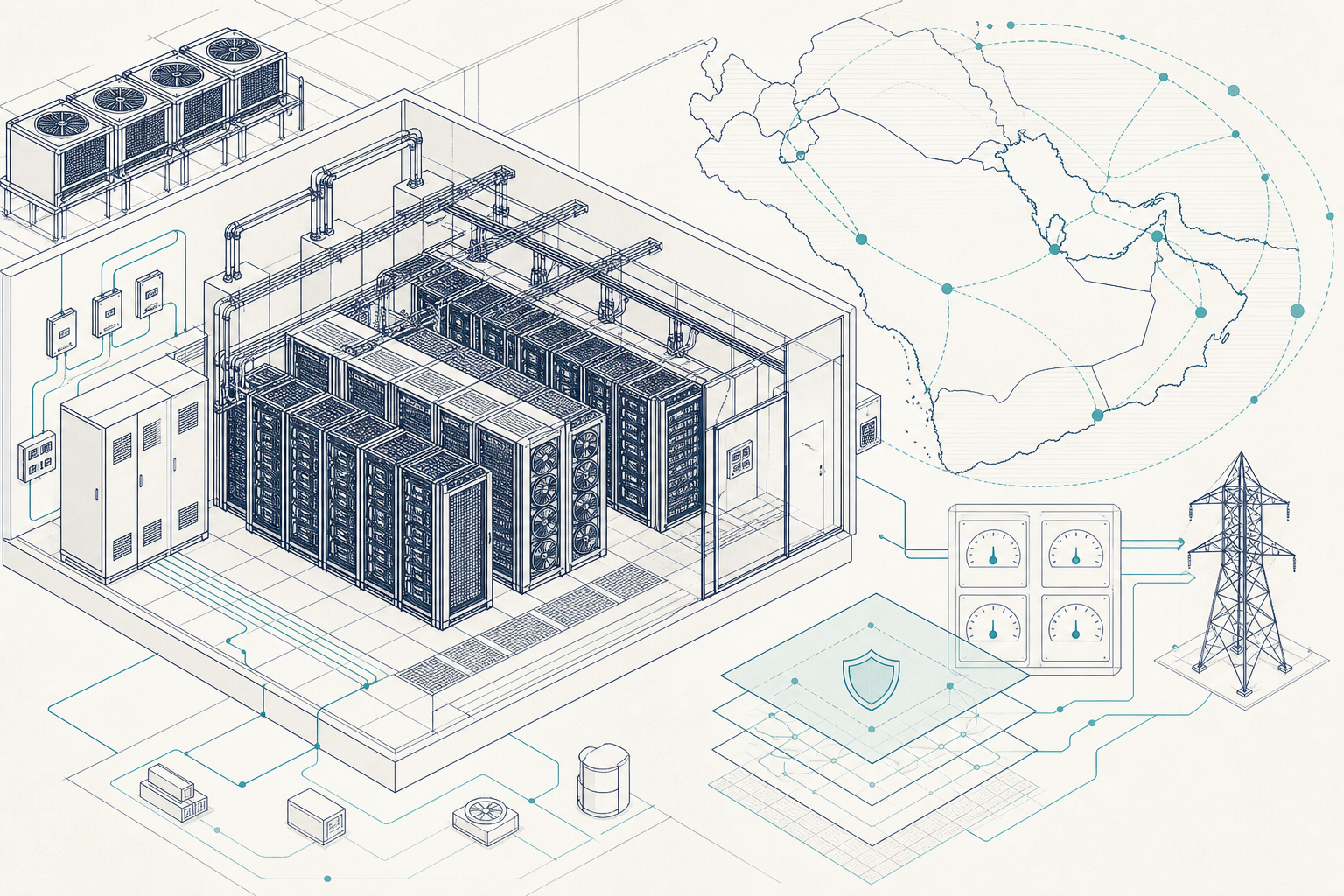
Mistral’s funding makes sovereignty an infrastructure problem
On 9 September 2026, Mistral raised €3 billion to expand compute capacity, infrastructure and international operations, with sovereign AI positioned as a core commercial driver. The news matters to GPU operators in the GCC because it changes the buyer conversation. A government entity, bank, energy company, Arabic media group or healthcare operator can now point to a European model company raising hyperscale-level capital and say: local model access is not a side project. It is becoming a procurement category.
For a small or mid-size GPU estate, that procurement category lands as a scheduling and governance problem. The operator may own a quarter rack, one rack, or a few racks. It may have a mix of newer accelerators, older accelerators, CPU-only nodes, Ceph storage, an air-gapped management network and a requirement to keep certain data inside a national boundary. It cannot solve the problem by copying a hyperscaler region. It has to make a smaller fleet behave like one: high utilisation, hard tenancy boundaries, auditable metering, quotas, policy controls, storage isolation and predictable power use.
That is the bottleneck behind the headline. Sovereign AI demand is not just demand for GPUs. It is demand for locally hosted models, local inference endpoints, local fine-tuning environments, local logs, local billing evidence and local operational support. If those controls are not designed into the platform, the operator will either strand GPUs for compliance reasons or overcommit them for revenue reasons. Both outcomes are expensive.
ClastIQ is built for this middle ground: operators who own real hardware, but are not running a hyperscaler. The platform brings bare-metal provisioning with MAAS and Juju, Kubernetes and VM tenancy on the same fleet, GPU partitioning through MIG and time-slicing where supported, Ceph storage, per-tenant metering, chargeback, quota engineering, policy controls, air-gap support and local human-led installation. The point is not to hide the hardware. The point is to make the operator’s own NVIDIA, AMD or mixed CPU/GPU estate schedulable, billable and governable.
The GCC version of the bottleneck
GCC sovereign AI projects have a different shape from generic enterprise AI. The data boundary is often national. The buyer may need Arabic and English workloads. The application may touch citizen services, financial records, oil and gas operational data, legal documents, education content or healthcare workflows. Even when the model weights are open or commercially licensed, the inference logs, prompts, embeddings, fine-tuning data and evaluation outputs may need to remain in-country.
That pushes demand toward local GPU estates. But local does not automatically mean efficient. A small operator quickly runs into five constraints.
First, model choice becomes a capacity decision. Hosting every open or sovereign model is not feasible when VRAM, rack power and storage are limited. A 70B-class model, a smaller Arabic-tuned model, an embedding model and a reranker model have different memory and latency profiles. The operator must decide which ones are always hot, which are cold-started, and which are not offered.
Second, tenancy becomes mixed. One tenant may need Kubernetes for inference services. Another may need VMs for a regulated fine-tuning environment. A third may need bare-metal access for a short evaluation window. If these tenancy modes are operated as separate islands, utilisation falls.
Third, GPU partitioning becomes a policy issue, not just a feature. MIG can carve a supported GPU into isolated slices. Time-slicing can improve throughput for smaller jobs but may not satisfy a tenant that needs stronger isolation or predictable latency. The scheduler needs to know the difference.
Fourth, storage locality matters. Model weights, datasets, evaluation corpora and tenant outputs should not be copied casually between environments. Ceph can provide shared block, file and object storage, but it still needs per-tenant pools, quotas, encryption posture and operational rules.
Fifth, power is a commercial metric. In GCC markets, power availability, cooling capacity and data-centre density shape the economics of AI. The operator is not only selling GPU-hours. It is trying to raise revenue per megawatt without violating policy or degrading service.
From model catalogue to schedulable services
The practical starting point is to treat each model as an infrastructure product with a bill of materials. A model entry should include accelerator class, VRAM requirement, CPU and RAM requirement, storage footprint, expected tokens per second range, tenant eligibility, data residency rule, logging rule and whether it can run on a partitioned GPU.
A small estate might maintain three service classes rather than an unconstrained catalogue:
| Service class | Typical use | Infrastructure control |
|---|---|---|
| Shared inference | Internal chat, retrieval, summarisation | Kubernetes, GPU partitioning, strict namespace quotas |
| Dedicated inference | Regulated department or enterprise endpoint | VM or dedicated Kubernetes node pool, reserved GPU quota |
| Fine-tuning and evaluation | Short training runs, benchmark windows | Scheduled reservations, dataset-scoped storage, expiry policy |
This table is simple, but it prevents a common failure: offering model access without a resource contract. If a government tenant expects a local model endpoint with predictable latency, it should not be scheduled the same way as a university research job running batch experiments overnight. If a bank needs an isolated environment for fine-tuning, that workload should not inherit the storage rules of a shared demo namespace.
ClastIQ’s role is to turn these service classes into operational controls. MAAS can provision the bare-metal nodes. Juju can compose the platform services. Kubernetes can run shared inference and batch workloads. VM tenancy can support regulated or legacy environments. Ceph can present storage with tenant-aware quotas. Metering can attribute GPU-hours, CPU-hours, RAM, storage and network use to the right tenant. Quotas and policy engineering keep the catalogue aligned with capacity.
A worked utilisation example
Consider a GCC operator with 32 accelerators across one to two racks. Assume each accelerator is available 24 hours per day for a 30-day month.
Total monthly capacity is:
32 GPUs × 24 hours × 30 days = 23,040 GPU-hours
Before orchestration discipline, the estate averages 35 percent billable utilisation. Some GPUs sit idle because a tenant reserved whole devices for light inference. Some are blocked by long-running notebooks. Some cannot be used because the operator cannot prove that a workload stayed in the correct tenant boundary.
Billable use is:
23,040 GPU-hours × 35 percent = 8,064 GPU-hours
Assume the monthly estate cost allocated to this fleet is USD 93,000. This includes hardware amortisation, facility cost, power, support labour, software operations and a storage share. The effective cost per billable GPU-hour is:
USD 93,000 ÷ 8,064 = USD 11.53 per GPU-hour
Now apply three controls: partition smaller inference workloads, reserve whole GPUs only for tenants that need them, and enforce quotas so idle reservations expire. Utilisation rises to 70 percent without adding hardware.
23,040 GPU-hours × 70 percent = 16,128 GPU-hours
The same USD 93,000 monthly estate cost is now spread across more useful work:
USD 93,000 ÷ 16,128 = USD 5.77 per GPU-hour
If the operator charges back internally, or invoices externally, at USD 8.00 per GPU-hour for the blended service, monthly chargeable revenue becomes:
16,128 × USD 8.00 = USD 129,024
Assume average IT power for this small estate is 40 kW, or 0.04 MW. The annualised revenue per MW at that utilisation and chargeback rate is:
USD 129,024 × 12 ÷ 0.04 = USD 38.7 million per MW-year
This is not a benchmark and not a recommended price. It is arithmetic. The operator’s real numbers will depend on accelerator type, depreciation, local power tariffs, cooling, staffing and utilisation profile. The lesson is still useful: sovereignty requirements can lower utilisation if they create manual islands, but they can raise revenue quality if they are converted into schedulable products with metering and quotas.
Where partitioning helps and where it does not
GPU partitioning is one of the first levers a smaller estate reaches for, but it should not be treated as a universal answer. MIG, where supported, is useful for carving a physical accelerator into hardware-isolated instances. It can support smaller inference services, embeddings, rerankers, development environments and evaluation jobs. Time-slicing can increase concurrency where workloads tolerate shared execution and softer isolation.
The operator needs a policy matrix. A public-sector tenant handling sensitive citizen data may require a dedicated device or a dedicated node pool. A media tenant generating summaries may accept time-sliced GPUs for batch work. A developer sandbox may receive a small partition and a low monthly quota. A production inference endpoint may need reserved capacity during business hours and burst capacity at night.
The scheduler must express those differences. For example, Kubernetes namespaces can carry quotas and node selectors, while the underlying node labels reflect residency, GPU type and partition profile. A simplified operating pattern might look like this:
kubectl label node gpu-a17 residency=saudi tier=shared-inference gpu-profile=mig-small
kubectl label node gpu-b03 residency=uae tier=dedicated gpu-profile=whole-device

kubectl create namespace tenant-ministry-ai
kubectl annotate namespace tenant-ministry-ai residency=saudi isolation=dedicated chargeback=enabled

kubectl apply -n tenant-ministry-ai -f quota-gpu-hours.yaml
kubectl get resourcequota -n tenant-ministry-ai
The exact implementation varies by accelerator, device plugin and tenancy model. The key is that labels, quotas and metering are not afterthoughts. They are the mechanism by which sovereignty becomes enforceable rather than aspirational.
Kubernetes and VMs on the same fleet
Many sovereign AI environments need both Kubernetes and VMs. Kubernetes is efficient for shared inference services, autoscaling front ends, batch jobs, retrieval pipelines and platform components. VMs remain important for regulated tenants, vendor appliances, legacy workflows, Windows-based tools, or cases where the tenant expects an environment boundary that looks like a private server.
If the operator splits the physical fleet into a Kubernetes cluster and a separate virtualisation island, utilisation suffers. The Kubernetes side may be full during the day while the VM side is idle. At night the reverse may happen. A platform for smaller estates should be able to provision bare metal, assign nodes into Kubernetes or VM pools, reclaim them, and meter both modes using the same tenant model.
This is where bare-metal provisioning matters. MAAS gives the operator a repeatable path from powered hardware to known node state. Juju helps deploy and manage the services that sit above it. ClastIQ uses this foundation to avoid artisanal rebuilds. A GPU node can enter the estate, receive firmware and network configuration, join the right pool, expose its accelerator profile and become billable capacity. When a tenant reservation ends, the node can be wiped, reprovisioned and returned to the available pool.
For GCC operators, this also supports sovereign deployment patterns. An estate may need to run disconnected from public clouds, receive updates through controlled media, integrate with local identity providers and keep logs inside the facility. Air-gap and sovereign operations are not just procurement phrases. They affect package repositories, image registries, model weight distribution, vulnerability management and support workflows.
Storage is part of the sovereignty boundary
AI operators often focus on GPU scheduling and then discover that storage is the harder audit problem. Model weights are large. Fine-tuning datasets can be sensitive. Embeddings can leak information about source documents. Evaluation outputs may contain prompt data. Logs can become regulated data.
Ceph gives a small or mid-size estate a way to provide block, object and file storage from the operator’s own hardware. But the operator still needs to design the tenancy model. Each tenant should have a storage allocation, an owner, a retention rule, a backup policy and a deletion process. Shared model weights should be separated from tenant data. Fine-tuning outputs should not be written into a general scratch bucket that multiple tenants can browse.
Metering should include storage. A tenant that keeps 60 TB of datasets warm for six months consumes power, disks, replication overhead and operational attention even if its GPUs are idle. Chargeback that only counts GPU-hours will push tenants to hoard storage. A better model attributes GPU-hours, reserved GPU capacity, CPU and RAM, persistent storage, object storage, and exceptional support work.
This is also a commercial protection for the operator. Sovereign AI buyers may start with a pilot, then keep model variants, datasets and logs online indefinitely. Without quotas and lifecycle rules, the pilot becomes a permanent storage subsidy.
Policy controls prevent utilisation from becoming risk
The temptation in a constrained GPU estate is to chase utilisation at any cost. That is dangerous in sovereign environments. A high utilisation graph is not a success if regulated workloads run on the wrong node pool, if logs leave the country, or if one tenant can infer another tenant’s activity.
The operating target should be governed utilisation. This means every unit of consumed capacity has a tenant, a policy class, a residency tag, a metering record and an expiry condition. Shared services must be explicitly shared. Dedicated reservations must have start and end dates. Exceptions must be visible to the operator and priced accordingly.
A few controls make a material difference:
- Namespace and project quotas for GPUs, CPU, RAM and storage.
- Reservation expiry for dedicated GPUs and VM environments.
- Node labels for residency, accelerator class and isolation level.
- Separate Ceph pools or buckets for tenant data and shared model assets.
- Metering records that support internal chargeback or external invoicing.
- Admission policies that reject workloads without tenant and residency metadata.
A system like ClastIQ does not remove the need for operator judgement. It gives the operator a control plane where those judgements can be encoded, repeated and audited. That is the difference between running a GPU lab and operating a sovereign AI utility.
The Mistral signal for GCC operators
Mistral’s €3 billion round does not mean every GCC operator should host the largest available model tomorrow. It means sovereign model supply and buyer expectations are moving together. More governments and enterprises will ask for local options. More procurement teams will compare US-cloud APIs with regional hosting, European model providers, open-weight models and national AI programmes. More workloads will arrive with explicit data residency clauses.
For a quarter-rack or few-rack operator, the response should be disciplined. Build a small model catalogue that fits the power envelope. Offer clear tenancy classes. Partition where it is safe. Reserve whole devices where policy requires it. Meter everything. Price storage. Keep Kubernetes and VM capacity in the same operational plan. Treat chargeback as a governance tool, not only a finance output.
The operators that do this well will not look like hyperscalers in physical scale. They will look like hyperscalers in operating discipline: clean provisioning, clear quotas, high governed utilisation, auditable tenant boundaries and a measurable revenue-per-megawatt view.
What to do this week
- Inventory every accelerator, CPU node, storage pool and power feed, then tag each item by residency, tenant eligibility and isolation level.
- Create a three-tier model catalogue: shared inference, dedicated inference, and fine-tuning or evaluation. Attach a resource bill of materials to each model.
- Implement or review GPU quotas, reservation expiry and namespace policies so idle dedicated capacity returns to the pool.
- Add storage to chargeback. Track persistent datasets, model variants, logs and backups by tenant, not only GPU-hours.
- Run one utilisation calculation using your real monthly cost, available GPU-hours and billable GPU-hours. Use it to set a governed utilisation target.
- Test an air-gap update path for images, packages and model weights before a regulated tenant asks for it.
ClastIQ runs this control plane on the operator’s own hardware; request a demo.