Modal's reported round is a signal about abstraction
On September 28, 2026, TechCrunch reported that Modal Labs was closing in on a $750 million funding round at a $15.75 billion valuation. The report describes Modal as an inference provider and developer infrastructure company, and the size of the round matters because it prices a clear market belief: buyers want GPU capacity without operating the servers underneath it.
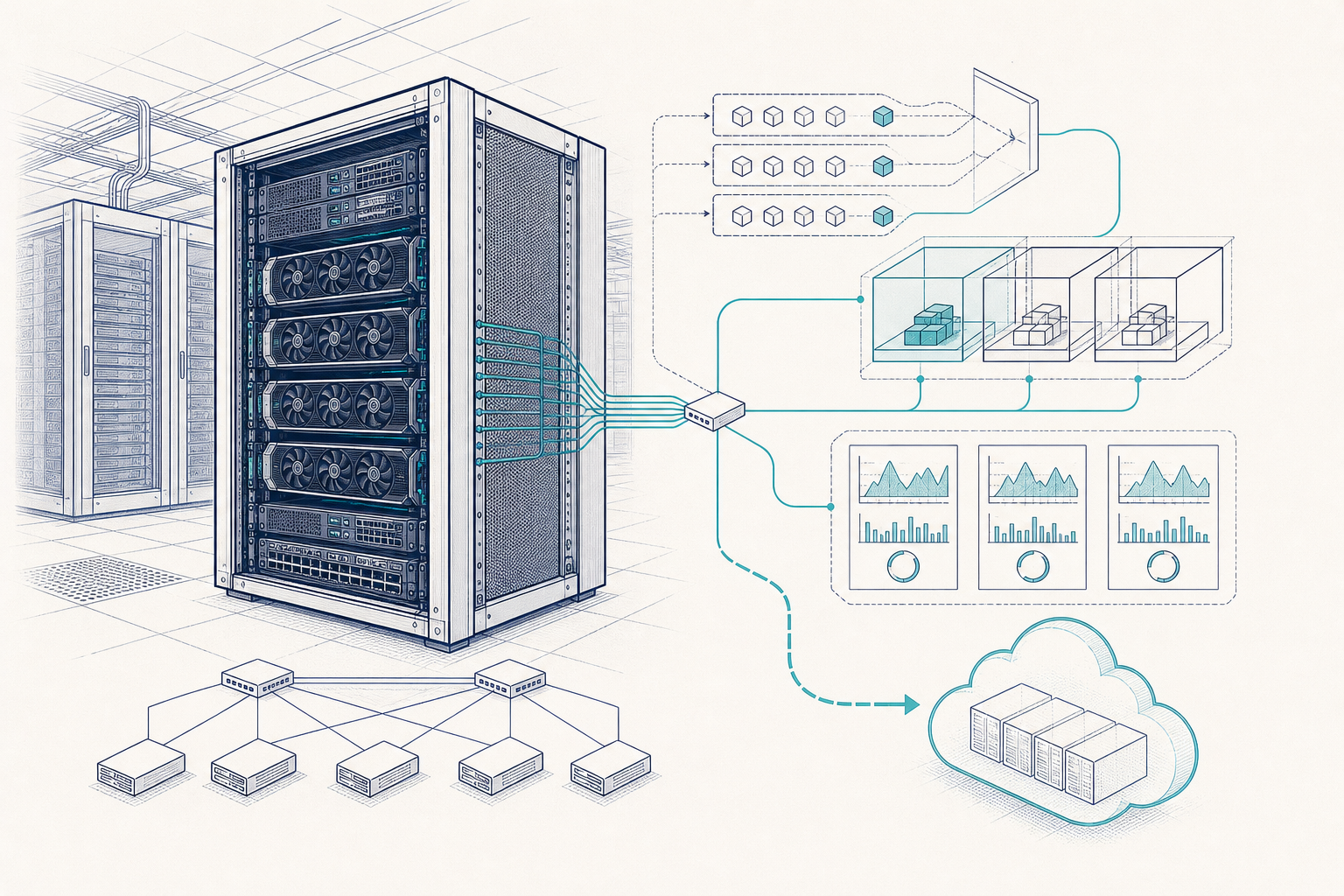
That is not just a venture capital story. It is an infrastructure signal for any operator running a quarter rack, one rack, or a few racks of GPU and CPU systems outside a hyperscaler. Managed platforms are being rewarded because they hide scheduling, images, runtime environments, utilization gaps, queue behavior, observability, and failure recovery behind a clean developer experience. The underlying work does not disappear. It moves into an operational layer.
For a small or mid size on-prem estate, the question is not whether managed inference is useful. It is which workloads should remain local, which should burst elsewhere, and how the operator can make that decision measurable instead of political.
A local GPU estate has different constraints from a cloud region. It has a fixed power envelope, finite floor space, a known set of accelerators, a smaller operations team, and often a stronger requirement for data residency. In the GCC and wider MENA region, those requirements can include sovereign AI programs, regulated government data, bank and telecom workloads, Arabic language data sets, health records, and customer contracts that limit cross border processing. The operator still needs cloud like controls: reliable tenancy, transparent chargeback, fair queuing, fragmentation control, and policy based overflow when the local cluster is full.
The Modal report is useful because it clarifies what users are willing to pay for. They are paying for the removal of infrastructure friction. Owners of real hardware can do the same thing locally, but only if the fleet is treated as a governed platform rather than a collection of servers.
The bottleneck is not only GPU count
Most small GPU estates start with a capacity question: how many GPUs do we need? That question is incomplete. The practical bottleneck is how many useful GPU hours can be delivered to tenants while staying inside policy, power, storage, and staffing limits.
A site with 32 high end GPUs may look large on a procurement sheet. In operation, it can behave like a much smaller estate if workloads are manually placed, if long training jobs block short inference tests, if GPU memory sizes do not match demand, if tenants reserve whole devices for partial workloads, or if the team cannot prove who used what.
Operators usually hit the same set of failure modes:
- Training jobs hold full GPUs while using only part of the memory or compute.
- Interactive notebooks sit idle but keep reservations alive.
- Inference services need low latency, but batch jobs consume the same devices.
- VM tenants and Kubernetes tenants compete through separate processes.
- Storage becomes a hidden choke point because model weights, checkpoints, and data sets move slowly.
- Chargeback is estimated from spreadsheets, not measured from the scheduler and device layer.
- Local saturation leads to ad hoc cloud use, often outside the same identity, logging, and data policy model.
The result is not just lower utilization. It is lower trust. Once tenants believe the platform is unfair or opaque, they over request capacity, hold reservations longer, or buy their own boxes. That fragments the estate further.
The operational target is simple to state and hard to implement: every GPU hour should have an owner, a policy, a price, a priority, a data boundary, and an audit trail.
What a local platform must control
A small or mid size operator does not need to copy every hyperscaler service. It does need the control points that make scarce accelerators usable by multiple teams.
| Control point | Operator question | Required mechanism |
|---|---|---|
| Tenancy | Who can run what, where, and with which data? | Kubernetes namespaces, VM projects, identity mapping, network policy |
| Partitioning | Can one GPU safely serve more than one workload? | MIG where available, time slicing, device classes, workload profiles |
| Queuing | Which job waits, runs, or preempts? | Priority classes, quotas, reservations, admission control |
| Metering | Who consumed the GPU hours and storage? | Per tenant usage records, labels, billing export, audit logs |
| Spillover | What leaves the site when local GPUs are full? | Policy based routing to approved hosted inference or training endpoints |
| Sovereignty | Which workloads must never leave? | Data classification, placement rules, air gap options, approval workflow |
A system like Clastiq sits at this layer. It is not a claim that every workload should be local. It is a way to make the local estate governable first, then connect it to external capacity under rules.
Clastiq uses bare metal provisioning patterns with MAAS and Juju so servers can be installed, rebuilt, and assigned consistently. It supports Kubernetes and VM tenancy on the same fleet, because real estates rarely have only one consumption model. Some tenants want pods and operators. Others need virtual machines for commercial software, regulated environments, or legacy inference stacks.
GPU partitioning is part of the same problem. On NVIDIA systems, MIG can divide supported GPUs into hardware isolated instances. On platforms where MIG is not available, time slicing and scheduler policy can still improve sharing for compatible workloads. AMD and mixed CPU or GPU estates require the same catalog discipline: define device classes, expose what the hardware can actually do, and prevent tenants from treating unlike devices as identical.
Ceph storage matters because accelerators are not useful if data and checkpoints are unavailable. A local AI platform needs shared object and block storage, predictable performance tiers, and quota aligned with compute tenancy. Metering must include more than GPU time. A tenant that stores hundreds of terabytes of checkpoints has a cost profile even when its jobs are idle.
A worked example: the cost of idle local GPUs
Consider an operator in the GCC running a two rack AI estate for universities, government research teams, and internal enterprise users. The estate has 64 GPUs, mixed CPU nodes, Ceph storage, and a 180 kW IT power allocation for the full environment. Assume the GPU fleet is capable of 64 GPUs times 24 hours times 30 days, which equals 46,080 available GPU hours per month.
Before orchestration discipline, measured useful utilization is 38 percent. That means tenants consume 17,510 GPU hours per month, rounded from 46,080 times 0.38. The remaining 28,570 GPU hours are lost to idle reservations, fragmentation, maintenance windows, and jobs waiting for the wrong shape of device.
Assume the monthly fully loaded cost of the GPU estate is $210,000. That includes depreciation or lease cost, support contracts, data center power, cooling allocation, network, storage share, and operations labor. At 38 percent useful utilization, the internal cost per useful GPU hour is:
$210,000 / 17,510 useful GPU hours = $11.99 per useful GPU hour
Now assume the operator introduces enforced queues, tenant quotas, idle notebook cleanup, MIG profiles for smaller inference services, time sliced development pools, and clear VM plus Kubernetes placement rules. Useful utilization rises to 62 percent without buying more hardware. Monthly useful GPU hours become:
46,080 available GPU hours * 0.62 = 28,570 useful GPU hours
$210,000 / 28,570 = $7.35 per useful GPU hour
The operator has not changed the number of GPUs. It has reduced the effective cost per useful GPU hour by $4.64, a 38.7 percent improvement. If the organization charges tenants $9.50 per GPU hour, the first state loses money on a fully loaded basis because cost is $11.99. The second state produces a margin of $2.15 per GPU hour before any premium support or storage charges.
At 28,570 useful GPU hours per month and $9.50 per hour, monthly compute revenue or internal recovery is $271,415. If the site is constrained by a 180 kW IT allocation, monthly annualized revenue per megawatt can be estimated as:
$271,415 monthly recovery * 12 = $3,256,980 per year
180 kW = 0.18 MW
$3,256,980 / 0.18 MW = $18,094,333 per MW per year
This is not a universal benchmark. Hardware type, power price, financing, cooling, and support model will change the result. The point is that utilization policy converts directly into cost per GPU hour and revenue per megawatt. For operators in power constrained markets, including parts of the GCC where AI campuses compete for grid capacity and cooling economics, that number should be reviewed every month.
Local first does not mean local only
The report on Modal points to a managed model where the user does not think about the server. Local operators should learn from that without pretending that all workloads can or should fit inside the building.
The applied question is workload placement.
Some workloads are good local candidates:
- Sensitive data sets with residency obligations.
- Fine tuning on proprietary documents.
- Low latency inference near an internal application.
- Batch jobs that can wait in a local queue.
- Research environments where data movement costs exceed compute savings.
- VM based tenants that need dedicated network or software controls.
Other workloads may be suitable for hosted spillover:
- Stateless inference against non sensitive prompts.
- Public model experimentation.
- Jobs with deadlines that exceed local queue capacity.
- Bursty training when the local estate is already committed.
- Temporary evaluation of a device class not present on site.
The mistake is letting every tenant make that decision independently with a credit card. The platform should classify workloads, then route them. A sovereign workload should not spill over. A low risk inference endpoint can spill over when the local service level would be missed. A training job can be paused, checkpointed, or scheduled overnight if its deadline allows.
This is where orchestration, metering, and policy need to meet. If the local scheduler knows that a tenant has used 85 percent of its monthly quota, that a job is labeled non sovereign, and that the inference endpoint has a maximum latency objective, it can present a controlled choice: wait locally, run in a lower priority pool, or spill to an approved hosted endpoint with the cost recorded to the same tenant.
A practical policy can start small. For example:
clastiq quota set research-lab \
  --gpu-hours-month 2400 \
  --max-gpus-running 12 \
  --storage-tb 80 \
  --spillover allowed \
  --sovereign-data false

clastiq quota set health-ai \
  --gpu-hours-month 1800 \
  --max-gpus-running 8 \
  --storage-tb 120 \
  --spillover denied \
  --sovereign-data true
The exact CLI will differ by deployment, but the intent should be real: quotas belong close to the scheduler, not in a quarterly spreadsheet. Labels such as tenant, data class, device class, and cost center should be mandatory for production workloads.
Fragmentation is the hidden tax
GPU fragmentation is not only about unused devices. It is about unusable shapes.
A tenant may ask for 4 full GPUs for a development service that uses 20 percent of each card. Another may need a single large memory device but find only smaller partitions available. A training job may require 8 identical GPUs on the same fabric, while the estate has capacity in aggregate but not in the right topology. A VM tenant may pin devices for a week because there is no trusted way to return capacity to the pool between runs.
Operators should manage fragmentation at several levels:
- Device class, such as large memory GPU, midrange GPU, CPU only, or inference partition.
- Partition profile, such as full GPU, MIG slice, shared time sliced pool, or exclusive VM pass through.
- Topology, such as same node, same rack, or same high speed fabric island.
- Duration, such as interactive, batch, reserved, or preemptible.
- Data location, such as local Ceph pool, restricted project storage, or replicated read only model catalog.
For a small estate, this is more important than for a hyperscaler. A large cloud can absorb imperfect placement through scale. A 32 or 64 GPU site cannot. One bad reservation can block a whole class of work.
Clastiq's role is to make these shapes explicit. Bare metal provisioning creates known node profiles. Kubernetes and VM layers consume from the same governed inventory. GPU partitioning exposes smaller units where appropriate. Quotas prevent one tenant from occupying all convenient shapes. Metering shows which policies improve utilization and which create queues.
Storage and images are part of the AI scheduler
Accelerator planning often underestimates storage. Model weights, embeddings, vector indexes, checkpoints, and data snapshots move through the estate constantly. If every tenant downloads the same model into private storage, capacity and network are wasted. If checkpoints are not managed, storage fills silently and training jobs fail late.
Ceph gives an operator a common storage substrate for object, block, and file patterns, depending on deployment design. The important operational step is to connect storage quotas to compute quotas. A tenant with 2,000 GPU hours per month may not need 200 TB of high performance storage. Another tenant with modest GPU usage may legitimately need a large data lake allocation. Those should be priced and governed separately.
Image management is similar. A local platform needs approved base images, driver compatibility, runtime versioning, and a process for tenants to bring custom containers or VM images without breaking the fleet. The goal is not to stop experimentation. The goal is to keep experimentation from becoming an operations incident.
For air gapped or sovereign deployments, the image catalog becomes even more important. Operators need a controlled path for importing images, scanning them, signing them if required, and promoting them to tenant visible catalogs. GCC and MENA operators working with government, defense adjacent, health, energy, or financial workloads should treat this as a platform requirement, not an afterthought.
Chargeback changes behavior
Metering is not only for finance. It changes how tenants request capacity.
When GPU access is free at the point of use, tenants rationally over request. They ask for full GPUs instead of partitions, keep notebooks open, duplicate data, and run low priority experiments during peak hours. When usage is measured and shown back to the tenant, behavior improves even before invoices are issued.
A good chargeback report should show:
- GPU hours by tenant, project, device class, and partition type.
- Storage consumption by tier and project.
- Queue wait time by priority class.
- Idle reservation time.
- Spillover spend by endpoint and policy reason.
- Power allocation or energy proxy by tenant where practical.
Operators do not need to start with a complex tariff. A simple internal rate card is enough. For example, full GPU hour, partitioned GPU hour, CPU core hour, high performance storage TB month, capacity storage TB month, and approved spillover pass through cost. The rate card can evolve as utilization data improves.
The key is consistency. A tenant should be able to understand why one workload ran locally at $9.50 per GPU hour, why another used a lower cost shared inference partition, and why a non sensitive urgent job spilled over with a different line item.
What this means for GCC and MENA operators
The GCC and MENA context makes the Modal signal more relevant, not less. Many organizations in the region are building AI capability with a strong preference for local control. Drivers include national AI strategies, Arabic language model development, energy and industrial data, sovereign cloud initiatives, and regulated sector requirements.
At the same time, not every operator can or should build a hyperscaler scale region. A university, ministry backed research center, bank, telecom, hospital group, or local service provider may own a few racks and still need professional platform behavior. The gap between physical ownership and cloud like usability is exactly where orchestration matters.
For these operators, the objective is not to imitate a global cloud provider feature by feature. It is to extract more useful work from owned assets, prove governance, and create a clean boundary for approved external capacity. That means local first for sovereign and latency sensitive workloads, measured spillover for suitable jobs, and a single operating model for both.
Hardware agnosticism matters in this region because procurement can be affected by availability, vendor strategy, financing, and lifecycle timing. Estates may include NVIDIA systems, AMD systems, dense CPU nodes, older accelerators, and new devices arriving in phases. The platform should describe capabilities and policies without assuming a single vendor path. Tenants should request a service class, not memorize the procurement history of the data center.
What to do this week
- Measure useful utilization, not just allocation. Separate running, idle reserved, queued, failed, and maintenance time for each GPU class.
- Create a first tenant catalog. List tenants, owners, cost centers, data classification, allowed device classes, storage quotas, and spillover eligibility.
- Define 3 workload lanes: interactive development, production inference, and batch training. Give each lane a priority, quota model, and preemption rule.
- Identify fragmentation losses. Find jobs that reserve full GPUs while using less than half of memory or compute, then test partitioning or time slicing where safe.
- Build a basic chargeback view. Start with GPU hours, storage TB month, queue wait time, and idle reservations by tenant.
- Write a spillover policy before the next capacity incident. Decide which data classes can leave the site, which hosted endpoints are approved, and how costs are recorded.
Clastiq runs this operating model on the operator's own hardware, from a quarter rack to a few racks, with local support and sovereign deployment options. request a demo