What changed on September 11, 2026
On September 11, 2026, TechCrunch reported that Nscale appointed Fidji Simo to its board as the AI data-center company prepares for a potential IPO. The same report said Nscale was reportedly seeking up to $3.5 billion as it expands its role as a builder of AI data centers.
That is a capital-markets story, but for infrastructure operators it is also a capacity story. Nscale is trying to operate at a scale where financing, land, grid access, procurement, and customer pipeline are joined together. Whether or not the IPO happens, the direction is clear: AI infrastructure is being packaged as a utility-scale business.
A small or mid-size GPU estate cannot copy that model by buying fewer racks and hoping the economics scale down. A quarter rack, one rack, or three racks has a different failure profile, a different power constraint, and a different commercial problem. It does not have spare megawatts, a deep bench of identical nodes, or enough overcapacity to absorb poor scheduling. It may be serving universities, government entities, local enterprises, research groups, internal product teams, or inference tenants with strict data locality requirements. In the GCC and wider MENA region, it may also need to keep data and operations inside a sovereign environment, sometimes air-gapped, while dealing with high ambient temperatures, limited high-density colocation options, and utility constraints.
The lesson from Nscale is not that every operator must become a hyperscaler. The lesson is that hyperscale economics are forcing smaller operators to be precise. They must know which workloads are admitted, which tenants get scarce GPU types, how GPU hours are metered, how power is budgeted, and how failures are handled when there is no hyperscaler-style redundancy behind the curtain.
The bottleneck is not only GPU count
The visible number in AI infrastructure is usually the GPU count. That is the wrong starting point for a small estate. The first bottleneck is usually one of four things: utilization, power, tenancy, or operational recovery.
Utilization is the most obvious. A GPU estate that averages 25 percent useful utilization is not half as good as one at 50 percent. It can be economically nonviable, because the idle capacity still consumes space, power headroom, support effort, capital cost, license cost, and cooling budget.
Power is next. A few racks of accelerators can be constrained by breaker capacity before physical rack units are exhausted. Cooling is part of the same limit. In the Gulf, operators cannot treat thermal design as a background concern. If a site has a fixed power envelope, every idle watt allocated to the wrong workload is lost revenue capacity.
Tenancy is the third bottleneck. A shared GPU estate needs strong separation between tenants without turning every user into a bespoke project. Some tenants need Kubernetes. Some need VMs. Some need bare metal for driver control, low-level benchmarking, or proprietary appliances. If each mode is run as a separate island, the fleet fragments and utilization falls.
Operational recovery is the fourth. GPUs fail. NVMe devices fail. Fans fail. NICs fail. A node can lose one accelerator while the rest of the chassis remains usable. In a hyperscale environment, a scheduler may simply move work to a large pool of equivalent nodes. In a small estate, that failed GPU may represent 3 percent, 6 percent, or 12 percent of a specific tenant's capacity. The platform must detect the failure, remove the resource from scheduling, preserve tenant accounting, and support repair without destroying the economics of the remaining fleet.
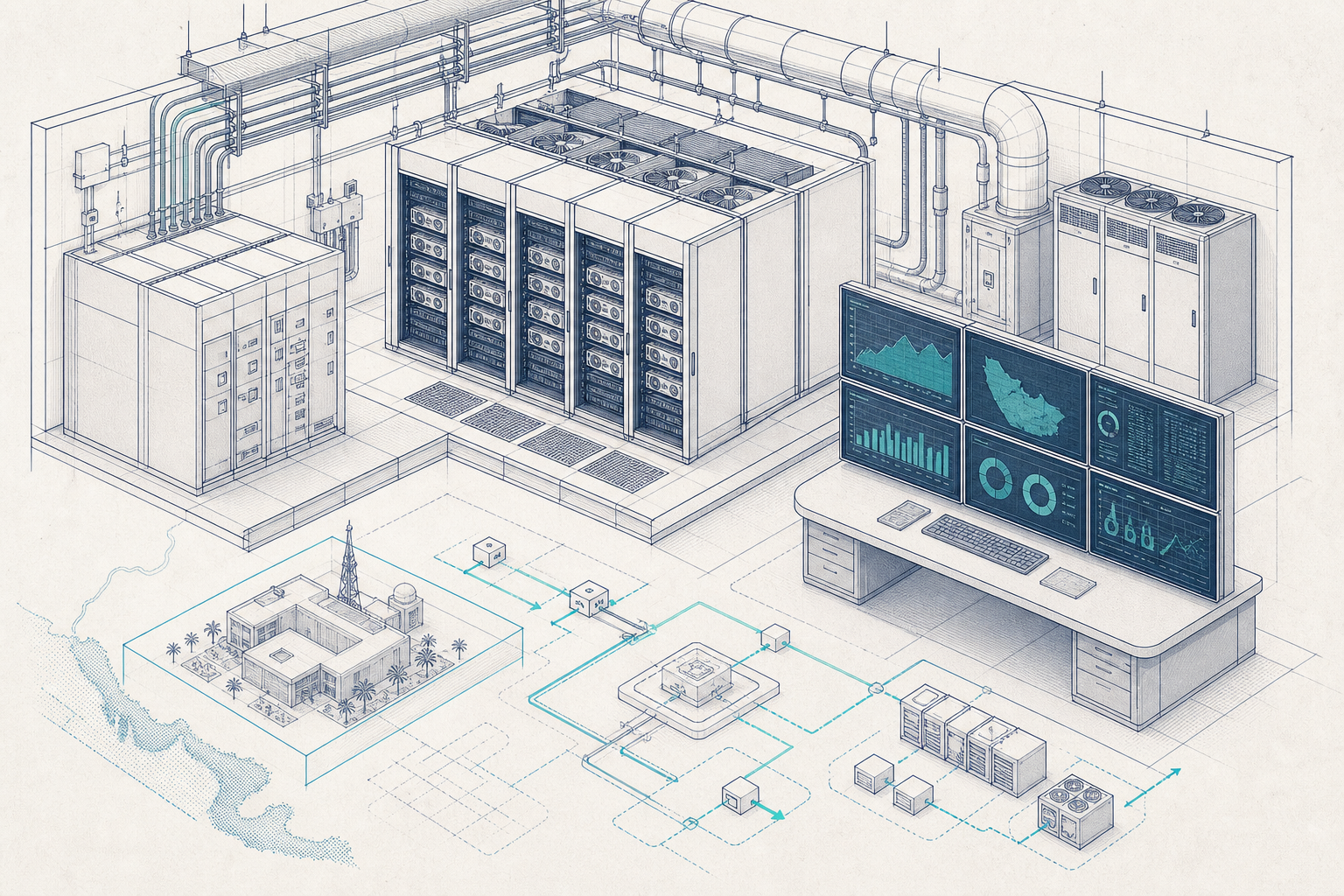
This is where the orchestration layer matters. ClastIQ is designed for operators who own real hardware, from a quarter rack to a few racks, and need bare-metal provisioning, Kubernetes, VM tenancy, GPU partitioning, storage, metering, chargeback, quotas, policy, and local operational support on that hardware.
A worked example: 24 GPUs under a 20 kW IT budget
Consider a GCC operator with one dense rack and 24 modern GPUs across mixed CPU and GPU servers. The site has a 20 kW IT power allocation for the rack after leaving margin for network, storage, and management equipment. The operator wants to sell both internal chargeback and external tenancy.
Assume the all-in monthly infrastructure cost allocated to the GPU service is $92,000. That includes depreciation or lease allocation, colocation or facility charge, support, network, storage allocation, software operations, and power. There are 24 GPUs and a 30 day month.
Maximum theoretical GPU-hours:
24 GPUs x 24 hours x 30 days = 17,280 GPU-hours per month.
If average billable utilization is 35 percent, billable GPU-hours are:
17,280 x 0.35 = 6,048 GPU-hours.
The cost floor is:
$92,000 / 6,048 = $15.21 per billable GPU-hour.
If utilization improves to 65 percent, billable GPU-hours are:
17,280 x 0.65 = 11,232 GPU-hours.
The cost floor becomes:
$92,000 / 11,232 = $8.19 per billable GPU-hour.
Nothing changed in the rack. No new GPUs were purchased. The difference is scheduling discipline, partitioning, quota policy, and workload fit. At 35 percent utilization, a price of $10 per GPU-hour loses money before sales overhead. At 65 percent utilization, the same price can contribute margin, especially if smaller inference slices are priced differently from full accelerator training jobs.
Now map the same rack to revenue per megawatt. If the 20 kW IT allocation supports $130,000 in monthly recognized revenue at higher utilization, normalized monthly revenue per MW is:
$130,000 / 0.020 MW = $6.5 million per MW per month.
That number is not a claim about what a site should earn. It is a planning lens. For a small estate, revenue per megawatt is often more useful than revenue per rack, because power is the hard constraint. If admission control lets low-priority jobs occupy scarce power while higher-value inference queues wait, the operator is not merely underutilizing GPUs. It is underutilizing the electrical allocation.
Where smaller estates can compete
A small GPU operator should not compete with a utility-scale AI data-center builder on raw capacity. It should compete on fit.
The first fit is locality. GCC and MENA organizations often have data placement, procurement, language, support, and latency requirements that are not solved by a remote region alone. Government, energy, finance, telecom, education, and healthcare users may need local operational accountability and clear tenancy boundaries.
The second fit is specialized inference. Many tenants do not need thousands of GPUs for weeks. They need reliable, governed inference for models that are already selected, quantized, or tuned. They may need burst capacity for batch inference, document processing, RAG pipelines, vision workloads, speech, or private assistants. These workloads can often be packed more efficiently than training if the platform supports MIG-style partitioning, time-slicing where appropriate, and policy-based admission.
The third fit is mixed tenancy. An operator may run Kubernetes for cloud-native teams, VMs for enterprise tenants, and bare metal for teams that need direct hardware control. If the platform can move capacity between these modes through provisioning and policy, the estate is not locked into yesterday's demand pattern.
The fourth fit is human-led operations. At small scale, one unresolved driver issue or storage outage can erase the economic benefit of owning the hardware. Local support, documented runbooks, and repeatable provisioning matter because the platform must be understandable by the operator's own team.
What ClastIQ orchestrates in the middle
ClastIQ sits between the physical estate and the tenants that need compute. It is hardware-agnostic, covering NVIDIA, AMD, and mixed CPU/GPU estates. The point is not to hide hardware differences completely. The point is to expose them through a catalog that operators can govern.
At the bottom layer, bare-metal provisioning through MAAS and Juju gives the operator repeatable installation and lifecycle control. Nodes can be commissioned, tagged, deployed, drained, repaired, and returned to service without treating each server as a one-off system.
Above that, Kubernetes and VM tenancy share the same fleet. A tenant that needs Kubernetes namespaces, GPU operators, and service discovery should not force every other tenant into the same model. A tenant that needs a VM with fixed GPU allocation should not require a separate cluster with stranded capacity. The platform's role is to keep the resource pool coherent while honoring different consumption models.
GPU partitioning is the next layer. Depending on hardware capability and workload tolerance, the operator can use MIG-style partitioning, time-slicing, or full-GPU allocation. This is an economic decision as much as a technical one. A full accelerator should be reserved for jobs that need full memory, bandwidth, and isolation. Smaller inference services should not occupy a whole device if they can meet service targets on a partitioned resource.
Ceph storage provides shared storage services for images, datasets, tenant volumes, and platform components. For small estates, storage design must be honest. Not every workload should use the same storage class. Checkpoint-heavy training, small-file data pipelines, VM boot volumes, object storage, and inference model repositories have different patterns. The orchestration layer should make storage classes explicit so that a tenant does not accidentally put a high-write workload on the wrong pool.
Metering and chargeback close the loop. If a tenant sees only a monthly infrastructure allocation, behavior will not change. If a tenant sees GPU-hours, partition-hours, storage consumption, egress, and reservation waste, it can make tradeoffs. Chargeback does not need to be punitive. It needs to be accurate enough that scarce resources stop looking free.
Admission control is a commercial control
When capacity is small, the scheduler cannot be the only gatekeeper. Admission control should include business policy.
A practical policy can classify work into four queues:
| Class | Example workload | Default allocation | Operator rule |
|---|---|---|---|
| Reserved | Paid tenant inference endpoint | Fixed GPU partition or full GPU | Protect service level first |
| Scheduled | Training, fine-tuning, batch inference | Time window with quota | Run when power and capacity allow |
| Opportunistic | Internal experiments, notebooks | Preemptible partition or time-slice | Evict before revenue work |
| Maintenance | Burn-in, diagnostics, repair validation | Isolated node or window | Never share with tenant work |
This table is simple, but it prevents a common failure. Without classes, a research notebook can occupy the same scarce GPU pool as a paying inference endpoint. The platform may show high utilization, but the business outcome is poor. Utilization must be useful utilization.
Policy also protects power. If a rack is limited to 20 kW, the admission controller should know the expected power profile of a job class. A training job that drives all accelerators near maximum draw may be admitted only during a defined window. An inference tenant with predictable load may be given reserved partitions. Batch work may run when measured power and cooling margin are available.
A small CLI check that should become routine
Operators should make resource visibility part of the daily operating rhythm. The exact device plugin and resource names depend on the GPU vendor and cluster configuration, but the habit is the same: inspect allocatable devices, compare requested resources, and check tenant quota before admitting more work.
kubectl get nodes -L accelerator,power-zone,tenant-pool
kubectl describe node gpu-node-07 | grep -A8 Allocatable
kubectl get resourcequota -A
kubectl top pod -A --containers
For a VM or bare-metal tenant, the equivalent check should exist in the provisioning inventory: which node, which accelerator, which storage class, which power zone, which tenant, which end date, and which chargeback code. If that information lives only in tickets or spreadsheets, the estate will drift.
ClastIQ's role is to turn this into an operating model. Hardware is inventoried. Tenants receive governed capacity. Kubernetes, VM, and bare-metal use are measured against policy. The operator can see what is allocated, what is idle, what is failed, and what is reserved.
Failure handling without hyperscaler redundancy
GPU failure management is different in a small estate because there may be no identical spare pool. The platform should assume partial failure.
If a node has eight GPUs and one fails, there are several possible responses. The operator can cordon the whole node, which protects tenants but removes seven healthy GPUs. The operator can remove only the failed device from scheduling if the stack supports it, preserving partial capacity. The operator can move a protected workload to a reserved spare, if one exists. Or the operator can degrade a lower-priority tenant and preserve a higher-priority service.
The correct answer depends on the policy. The wrong answer is discovering the policy during the outage.
A small estate should maintain a failure playbook for each accelerator class and tenancy type. For Kubernetes, that means node labels, taints, device plugin health, and workload disruption budgets. For VMs, it means host evacuation rules, tenant notification, and GPU passthrough mapping. For bare metal, it means reinstall and validation workflow. For storage, it means Ceph health, recovery bandwidth limits, and the impact of rebuilds on tenant performance.
Metering must also handle failures. If a tenant reserved a full GPU for 720 hours in a month and the device was unavailable for 6 hours due to platform failure, the chargeback record should show the adjustment. This is not just fairness. It builds trust in the platform's numbers.
GCC and MENA implications
The GCC has strong reasons to build local AI capacity: sovereignty, latency, economic diversification, Arabic language services, energy-sector use cases, national cloud programs, and regulated data. But the region also has constraints that make operational discipline necessary.
Power may be available nationally, but not always at the right site, at the right density, with the right cooling envelope. Import timelines and support logistics can affect repair duration. Some environments require air-gap or sovereign deployment, which limits reliance on external control planes, remote SaaS management, or cloud-only identity patterns. Procurement may prefer hardware optionality, especially where NVIDIA, AMD, and CPU-heavy nodes coexist over time.
For a small GCC operator, the strategic question is not whether global AI data-center builders will be larger. They will. The question is whether the local estate can be more relevant per watt for the workloads it chooses to serve.
That means a few practical design choices.
First, keep the control plane local when sovereignty requires it. Identity, logging, metering, images, and package repositories should be able to operate in a disconnected or restricted environment.
Second, avoid a single tenancy model. Local demand will be uneven. Some tenants will arrive with Kubernetes skills. Others will ask for a VM. Some will need bare metal. A platform that supports only one mode will strand capacity.
Third, price the scarce resource. If the scarce resource is GPU memory, meter it. If it is full-GPU time, meter it. If it is power during peak thermal conditions, account for it in scheduling policy. If storage IOPS are the constraint, expose storage classes and charge accordingly.
Fourth, make local support part of the architecture. A sovereign GPU platform is not sovereign if every serious incident requires external access that policy will not allow.
The operator's response to Nscale scale
Nscale's reported fundraising target and board appointment show that AI infrastructure is becoming a capital-intensive platform business. Smaller operators should not respond by chasing scale for its own sake. They should respond by removing waste.
Waste appears as idle full GPUs used for small inference. It appears as tenant projects with no end date. It appears as orphaned volumes. It appears as GPU nodes reserved for a team that runs jobs only during office hours. It appears as training jobs admitted during peak demand for paid inference. It appears as a failed device that leaves a whole server unused for days. It appears as power headroom consumed by low-value work.
A system like ClastIQ addresses these problems by making the estate governable. Bare-metal provisioning keeps the hardware lifecycle repeatable. Kubernetes and VM tenancy allow different users to share one physical fleet. GPU partitioning improves fit between workload and device. Ceph storage provides shared infrastructure with explicit classes. Metering and chargeback turn consumption into numbers. Quotas and policy engineering decide which work gets admitted. Air-gap and sovereign deployment patterns keep control where the operator needs it. Human-led local support helps the operator run the system, not just install it.
The economic target is simple to state and difficult to execute: raise useful utilization without losing control. A 24 GPU estate at 65 percent useful utilization can be healthier than a 96 GPU estate at 25 percent utilization, especially when power, cooling, and support are constrained. The smaller estate must be deliberate about every GPU-hour.
What to do this week
- Calculate theoretical GPU-hours for each rack, then compare them with billable or accountable GPU-hours for the last 30 days.
- Classify all current workloads as reserved, scheduled, opportunistic, or maintenance, then decide which class can be preempted.
- Audit tenant allocations for full GPUs that could run on MIG-style partitions, time-sliced resources, smaller accelerators, or CPUs.
- Build a power-aware capacity sheet that maps nodes, accelerator type, rack position, breaker limit, cooling zone, and tenant pool.
- Review the failure playbook for one partial GPU failure, one full node failure, and one Ceph recovery event.
- Replace spreadsheet-only chargeback with metered GPU-hours, storage consumption, reservation waste, and service credits for platform-caused downtime.
ClastIQ runs this operating model on the operator's own hardware, request a demo.
Sources
TechCrunch: Nscale adds former OpenAI exec Fidji Simo to its board ahead of potential IPO