What changed on 4 September 2026
On 4 September 2026, TechCrunch reported that Nscale, a British AI infrastructure company founded two years ago, is seeking up to $3.5 billion in pre-IPO financing and may go public as early as this month. The report followed another large AI-infrastructure financing story: Crusoe was reported on 3 September to have raised $3 billion at a $30 billion valuation.
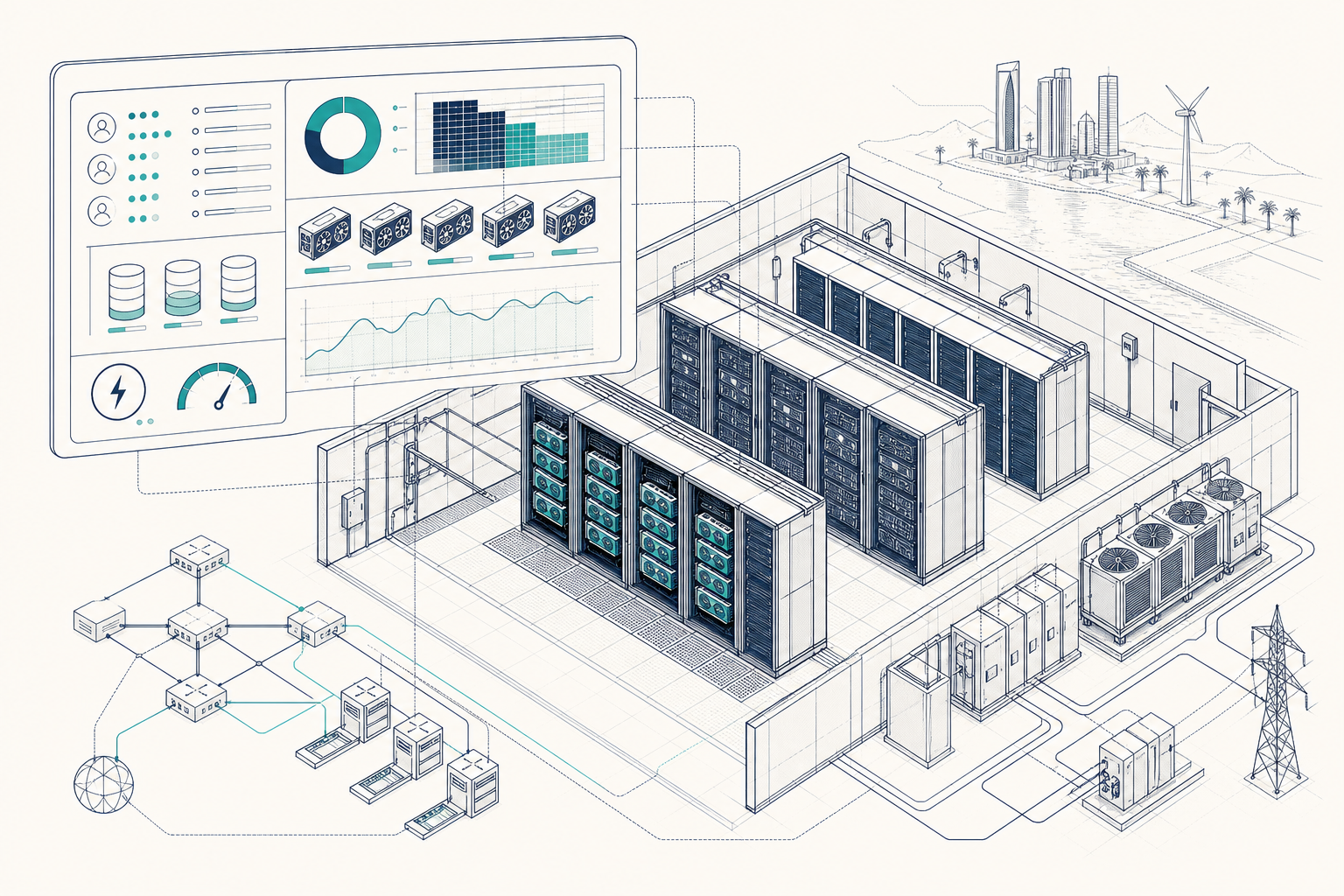
The operational signal is more important than the headline number. AI compute providers are not just buying more accelerators. They are raising capital to industrialize the full stack around those accelerators: power procurement, data-centre capacity, bare-metal lifecycle, GPU cloud, tenancy isolation, customer billing, network design, and support. The market is rewarding providers that can turn constrained megawatts into billable GPU-hours with predictable governance.
For an operator in the GCC or wider MENA region running a quarter rack, one rack, or a few racks, this is not an abstract capital-markets story. The same buyers who compare prices across hyperscalers and larger GPU clouds will increasingly expect the same operating model from local providers: fast provisioning, transparent metering, quota enforcement, tenant separation, sovereign data placement, and useful billing records. They may still want local hosting, Arabic support, private connectivity, lower data movement risk, or a sovereign deployment. But they will not tolerate manual allocation and vague utilization reports for long.
That is the pressure point Clastiq is built around: making real hardware owned by the operator behave like a governed compute region, without requiring the operator to become a hyperscaler.
The bottleneck is not only GPU supply
Small and mid-size GPU estates usually start with a simple question: how many GPUs can we afford, power, cool, and sell? After the first tenants arrive, the harder question appears: how do we share those GPUs safely and profitably without turning the operations team into a ticket queue?
A common first design is coarse-grained. A tenant gets a whole node for a week. Another tenant gets four GPUs for a model-tuning run. A research team gets priority because its work is politically important. An inference workload runs on the same high-end devices as training because nobody has mapped profiles to hardware. A finance team asks for monthly usage per tenant, but the source data is spread across spreadsheets, Grafana screenshots, Kubernetes namespaces, hypervisor logs, and invoices from the colocation provider.
This is where utilization collapses. The estate may look full on paper, but many accelerators are reserved, idle, stranded by memory requirements, or blocked behind maintenance windows. CPU, storage, and network bottlenecks make GPU utilization worse. Tenants over-request because there is no penalty for hoarding. Operators under-sell because they cannot prove isolation or guarantee supply.
Large AI compute providers raise capital to solve these problems at scale. Smaller operators cannot copy their balance sheets, but they can copy the operating discipline.
What consolidation means for GCC and MENA operators
In GCC and MENA markets, local GPU capacity has reasons to exist even when global clouds are available. Some workloads require data residency. Some buyers want local contracting and human support. Some government, healthcare, finance, energy, media, and Arabic-language AI workloads are easier to govern inside national or regional infrastructure. Connectivity to users and private enterprise networks also matters.
But local advantage is not enough. A regional operator still has to answer practical questions:
- Can a tenant get a clean bare-metal or Kubernetes environment without waiting days?
- Can multiple tenants share one fleet without seeing each other’s data, metrics, or control planes?
- Can GPU partitions be sold for inference while full GPUs are reserved for training?
- Can finance see GPU-hours, storage usage, public IPs, support charges, and tenant credits?
- Can policy prevent one tenant from consuming all high-memory devices?
- Can the operator run air-gapped or sovereign environments without losing maintainability?
- Can power and cooling constraints be reflected in scheduling decisions?
If the answer is no, the operator is not only competing with Nscale, Crusoe, hyperscalers, and other GPU clouds on price. It is competing against their operating model.
The small-estate failure mode: manual tenancy
The most damaging pattern in a small GPU estate is manual tenancy. It begins innocently: an engineer creates users, partitions VLANs, installs drivers, labels nodes, and records reservations in a spreadsheet. This works for the first few workloads. Then the fleet starts to mix job types.
Training jobs need multi-GPU nodes with high-speed interconnect and predictable storage throughput. Fine-tuning jobs may need one or two GPUs for bursts. Inference may need fractional GPU access, lower latency, and steady availability. CPU-only preprocessing wants cheap cores and local storage. Some tenants want Kubernetes. Others want VMs. Some need bare metal because they bring their own stack. A sovereign customer may require physical or logical separation from commercial tenants.
Without an orchestration layer across bare metal, Kubernetes, VMs, storage, and metering, every exception becomes an operational tax. The result is familiar:
| Operator symptom | Root cause | Control needed |
|---|---|---|
| GPUs reserved but idle | Static allocation and weak expiry | Quotas, leases, reclaim policy |
| Tenants ask for whole GPUs for small inference | No fractional GPU service | MIG, time-slicing, profile catalogs |
| Finance cannot invoice accurately | Usage data not normalized | Per-tenant metering and chargeback |
| Sensitive workloads are delayed | No repeatable isolation pattern | Tenant pools, network policy, storage boundaries |
| Storage throttles GPU jobs | Compute and Ceph planned separately | Placement and throughput-aware scheduling |
| Power headroom disappears | No link between rack power and workload placement | Power-aware capacity planning |
Clastiq addresses this by treating the estate as one governed fleet rather than separate islands of servers, clusters, and storage. It uses bare-metal provisioning through MAAS and Juju, supports Kubernetes and VM tenancy on the same hardware base, enables GPU partitioning through MIG or time-slicing where the hardware supports it, integrates Ceph storage, and produces per-tenant metering for chargeback and policy enforcement. It is designed for hardware-agnostic estates: NVIDIA, AMD, and mixed CPU/GPU fleets.
A worked example: 32 GPUs, same power, different economics
Consider a regional operator with 32 accelerators across two to three racks, plus CPU nodes, Ceph storage, networking, and management nodes. Assume the estate has 60 kW of IT load when active, including GPUs, CPUs, storage, and network gear. At a PUE of 1.35, the facility draw attributable to the estate is 81 kW. At $0.10 per kWh, monthly energy cost is:
81 kW × 720 hours × $0.10 = $5,832 per month.
Now assume the monthly fixed cost of the estate is:
- Hardware financing or depreciation: $96,000
- Power and cooling energy: $5,832
- Colocation, cross-connects, support, spares, software operations: $18,168
Total monthly cost: $120,000.
The fleet has a theoretical monthly GPU-hour capacity of:
32 GPUs × 720 hours = 23,040 GPU-hours.
If manual scheduling and static reservations produce 38% billable utilization, the operator sells or allocates:
23,040 × 0.38 = 8,755 GPU-hours.
The cost per billable GPU-hour is:
$120,000 ÷ 8,755 = $13.71.
If the operator charges or internally recovers $12 per GPU-hour, it is under-recovering cost before considering sales effort or bad debt. Monthly recovery is:
8,755 × $12 = $105,060.
Now change the operating model, not the hardware. The operator introduces tenant quotas, fractional GPU profiles for inference, expiry on reserved capacity, Kubernetes and VM pools on the same fleet, and metering that makes idle reservation visible. Billable utilization rises to 68%.
23,040 × 0.68 = 15,667 GPU-hours.
The cost per billable GPU-hour becomes:
$120,000 ÷ 15,667 = $7.66.
At the same $12 per GPU-hour recovery rate:
15,667 × $12 = $188,004.
The monthly swing is $82,944 on the same racks, same accelerators, and broadly the same power envelope. Revenue or recovery per MW-month also changes. With an 81 kW facility draw, or 0.081 MW:
- At 38% utilization: $105,060 ÷ 0.081 = $1.30 million per MW-month
- At 68% utilization: $188,004 ÷ 0.081 = $2.32 million per MW-month
This is why scheduling and tenancy are not back-office details. For a constrained GPU estate, they determine whether the operator is selling scarce accelerators or merely owning them.
How Clastiq changes the operating surface
The practical goal is not to make a small estate look large. It is to remove the avoidable friction that makes a small estate less usable than it should be.
First, bare-metal provisioning must be repeatable. Operators need to install, reinstall, test, and return nodes to service without hand-built images and undocumented driver steps. MAAS and Juju provide a foundation for lifecycle management, and Clastiq packages this into an operator workflow for real fleets. This matters when a tenant needs bare metal for performance or licensing reasons, and another needs Kubernetes the same week.
Second, Kubernetes and VMs should not become competing silos. A GPU estate often needs both. Kubernetes is suitable for batch jobs, inference services, notebooks, and internal platforms. VMs remain important for tenants bringing legacy tooling, specific OS images, or more traditional isolation expectations. Clastiq lets the operator govern both tenancy models on the same fleet, instead of dedicating racks permanently to one abstraction.
Third, GPU partitioning must be part of the commercial model. Where supported, MIG can divide compatible GPUs into hardware-isolated instances with defined memory and compute profiles. Time-slicing can help with lighter or bursty workloads, especially when strict isolation is less important. On AMD and other hardware, the exact mechanics differ, so the operator should think in terms of a profile catalog rather than one vendor feature. A profile might be full GPU training, high-memory fine-tuning, fractional inference, CPU-only preprocessing, or storage-heavy analytics.
Fourth, storage cannot be an afterthought. Ceph gives the operator a way to provide block, object, and file-like storage patterns from owned infrastructure, but it still has to be planned. A training tenant reading large datasets can make GPUs wait on storage. An inference tenant may need fast model loading and predictable object access. A sovereign workload may require that data remains in a specific pool or availability zone. Clastiq ties storage into tenancy and metering so that chargeback reflects more than accelerator time.
Fifth, metering must be tenant-native. It is not enough to know cluster-level GPU utilization. Operators need usage by tenant, project, namespace, VM, storage pool, and time window. They need to separate reserved capacity from consumed capacity. They need to show when a tenant blocked capacity and when capacity was reclaimed. This is how finance, sales, and operations stop arguing from different spreadsheets.
A simple operations check might look like this:
kubectl get nodes -L tenant-pool,gpu.vendor,gpu.profile
kubectl -n tenant-a describe resourcequota gpu-quota
kubectl -n tenant-a top pod --containers
kubectl get pods -A --field-selector=status.phase=Pending
Those commands do not replace a platform. They show the shape of the control loop: inventory, quota, live consumption, and blocked demand. Clastiq’s role is to make that loop consistent across bare metal, Kubernetes, VMs, storage, and billing records.
Quotas are commercial controls, not just technical limits
A small GPU estate can lose money by being too generous. If one tenant is allowed to reserve eight high-end GPUs indefinitely, another tenant may be denied service even while the first tenant is idle. If internal users are not charged or at least shown consumption, they will request peak capacity for average workloads. If inference services are placed on full GPUs because fractional profiles are unavailable, the operator burns margin quietly.
Quota engineering should cover at least five dimensions:
- GPU type and profile: full device, partition, time-slice, memory class, interconnect class.
- Duration: maximum lease, renewal process, idle timeout, maintenance windows.
- Tenant priority: paid external tenant, sovereign tenant, internal research, trial user.
- Storage and network: capacity, IOPS expectations, object volume, egress policy.
- Power and placement: rack limits, redundancy, cooling constraints, failure domains.
The policy does not need to be complicated on day one. It needs to be explicit. A tenant should know whether it is buying guaranteed capacity, best-effort capacity, or preemptible capacity. The operator should know which policy applies when demand exceeds supply.
This is also where chargeback changes behavior. Even if the operator is serving internal government or enterprise teams rather than external customers, a monthly usage statement creates discipline. It shows the cost of idle reservations, oversized notebooks, forgotten inference endpoints, and duplicated datasets. In sovereign AI programs, that discipline matters because the constraint is often not only budget. It is megawatts, procurement lead time, imported hardware availability, and skilled staff.
Sovereignty and air gap requirements must be designed in
Many GCC and MENA buyers are not asking only for compute. They are asking where data lives, who can access systems, how updates are introduced, and whether the environment can operate without dependency on a foreign control plane. This makes air-gap and sovereign deployment support operationally significant.
A governed local platform should support controlled image repositories, repeatable builds, local identity integration, auditable administrator access, and tenant-level network boundaries. It should allow the operator to decide when and how software updates enter the environment. It should make it possible to run on the operator’s own hardware in a local facility, rather than requiring workloads to leave the jurisdiction.
This does not remove the need for security review, compliance work, or customer-specific controls. Clastiq should not be read as a substitute for those processes. The point is narrower and practical: sovereignty is much easier to operate when provisioning, tenancy, metering, storage placement, and support workflows are designed for local control from the beginning.
Power is now part of the scheduler conversation
The Nscale and Crusoe financing stories also point to the role of power. AI infrastructure is increasingly a contest for electrical capacity, not just server supply. For small and mid-size operators, power is often fixed before the business model is mature. The rack has a limit. The room has a limit. The utility feed has a limit. The cooling system has a limit.
That makes revenue per megawatt a useful operating metric. It forces the operator to ask whether a GPU is running billable work, whether the workload belongs on that class of accelerator, and whether storage or CPU bottlenecks are wasting the power already being consumed. It also helps compare internal and external uses of the fleet. A sovereign workload may justify lower commercial recovery, but the decision should be visible.
Clastiq does not create power where none exists. It helps the operator use the powered estate with fewer stranded resources by combining placement, quotas, partitioning, and metering. In a constrained market, that may be the difference between needing another rack and reclaiming capacity from the racks already installed.
Competing with larger providers by narrowing the gap
A quarter rack will not out-scale a multi-billion-dollar AI infrastructure provider. It does not need to. The realistic objective is to serve workloads for which local control, support, data placement, and flexible tenancy matter, while closing the operational gap that buyers now expect.
That means offering clean tenant onboarding, credible isolation, clear service profiles, published quotas, monthly usage records, and a path from trial to production. It means the operator can say yes to Kubernetes without saying no to VMs, yes to fractional inference without giving away full accelerators, and yes to sovereign requirements without building every environment by hand.
The capital flowing into Nscale, Crusoe, and similar providers is a reminder that AI compute is becoming an infrastructure business with finance-grade controls. Smaller operators can still win specific markets, especially in GCC and MENA, but not if the fleet is operated as a collection of manually assigned machines.
What to do this week
- Measure billable utilization, not only cluster utilization. Calculate total monthly GPU-hours, reserved GPU-hours, consumed GPU-hours, and idle reserved GPU-hours by tenant.
- Define three to five service profiles. Start with full GPU training, fractional inference, CPU preprocessing, VM tenant, and sovereign tenant pool.
- Put expiry on reservations. Every allocation should have an owner, end date, renewal path, and reclaim rule.
- Connect storage to chargeback. Include Ceph capacity, snapshots, object usage, and high-throughput pools in tenant reporting.
- Review rack power against placement policy. Identify which nodes should not be filled simultaneously and where power-aware scheduling or admission control is needed.
- Produce a sample tenant bill. Even if you do not invoice yet, show GPU-hours, storage, reservations, credits, and policy violations for one month.
Clastiq runs this operating model on the operator’s own hardware; request a demo.