What changed on 29 October 2026
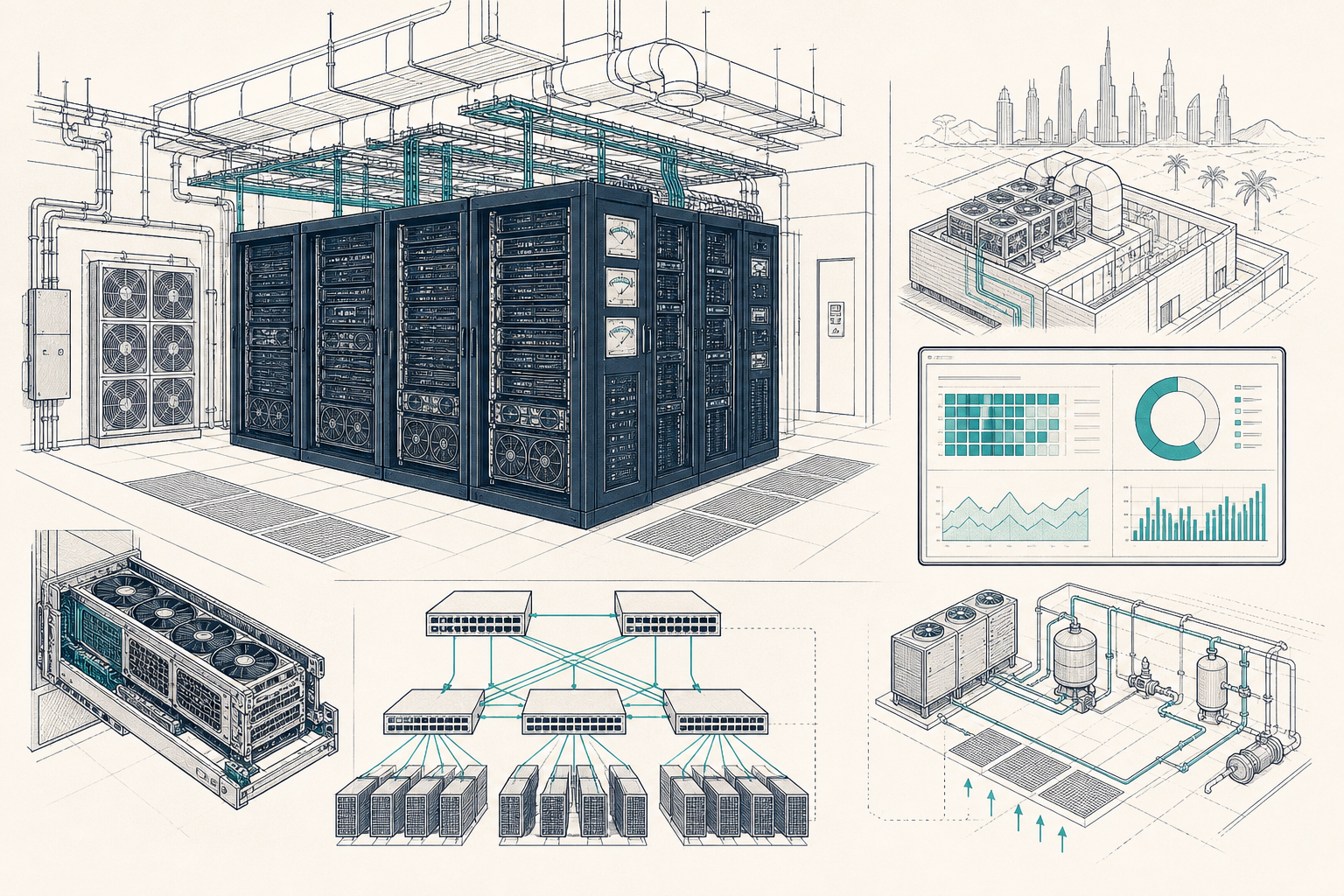
TechCrunch reported in its 29 October 2026 coverage that Nvidia is considering backing Nscale’s AI data center project in West Virginia. The public report matters less because of any single site detail, and more because of what it signals: dedicated AI infrastructure is now being planned, financed, and negotiated at a scale where chip supply, land, grid interconnects, cooling, debt, and anchor tenants are part of one system.
The disclosed public facts are limited. The location is West Virginia. The parties named are Nvidia and Nscale. The reported action is consideration of backing, not a completed financing package. Public terms, megawatts, GPU count, deployment date, and customer commitments were not disclosed in the reference coverage.
For operators with a quarter rack to a few racks, including many private, university, government, telco, and enterprise estates in the GCC and wider MENA region, the lesson is practical. You are not competing with a hyperscaler region by copying hyperscaler scale. You are competing by making compact sovereign capacity predictable, metered, allocatable, and financially understandable before you add the next chassis.
The capital market can finance very large AI campuses only when the infrastructure story is coherent. Power must be reserved. Cooling must be engineered. Network oversubscription must be acceptable for the workload mix. Storage must deliver the right latency and throughput. Tenancy must be enforceable. The operator must know which tenant, project, model, or department consumed each GPU hour. Those same constraints appear in a 12 GPU room, a 64 GPU private cloud, or a 3 rack sovereign inference estate. They just appear sooner, and with less room for error.
The compact estate bottleneck is not only GPU supply
Small and mid-size GPU operators often begin with a procurement question: which accelerators, how many servers, and what price. That is necessary, but it is not enough. The first bottleneck is usually the mismatch between promised capacity and governed capacity.
A team may advertise 32 GPUs to internal users, but 4 are reserved for pilots, 2 are down for firmware work, 6 are attached to jobs that are idle overnight, and 8 are blocked behind a storage workload that cannot feed data fast enough. On paper, there is a GPU estate. In practice, there is a set of stranded islands.
The West Virginia story is a reminder that AI infrastructure is bought in bundles. At any scale, the bundle includes:
| Constraint | Operator question | Control needed |
|---|---|---|
| Power and cooling | Can the room sustain the next 8 to 16 GPUs at peak draw in summer conditions? | Per rack budget, thermal headroom, scheduling policy |
| GPU allocation | Can one fleet serve training, inference, notebooks, VMs, and bare metal users? | Partitioning, quotas, tenancy, reclaim rules |
| Network | Will oversubscription break distributed training or low latency inference? | Fabric inventory, workload placement, policy classes |
| Storage | Can datasets and checkpoints move at the rate GPUs require? | Ceph pools, performance classes, metering |
| Chargeback | Who pays when GPUs are allocated but idle? | Per tenant metering, showback, billable GPU hours |
| Sovereignty | Can operations continue under local control and local data rules? | Air-gap support, local identity, audit trails |
For GCC and MENA operators, this is especially relevant. Sovereign AI capacity is often justified by data residency, local language workloads, public sector control, national research, regulated industries, or latency to regional customers. Those are valid reasons to keep hardware in country. But sovereignty does not remove physics or economics. A sovereign GPU that is idle, power constrained, or unmetered is still an underperforming asset.
A worked example: 64 GPUs in 2 racks
Consider an operator running a compact 2 rack GPU estate. The fleet has 16 GPU servers, each with 4 accelerators, for 64 total GPUs. The estate is hardware agnostic in this example. The accelerators could be NVIDIA, AMD, or a mixed fleet, as long as the scheduler and metering stack represent them accurately.
Assume each GPU node averages 3.2 kW at the IT load when active, including CPUs, memory, local disks, fans, and accelerators. Sixteen nodes therefore draw 51.2 kW. Add 8.8 kW for storage, switching, control plane, and management nodes. The IT load is 60 kW. With a facility PUE of 1.35, the facility draw is 81 kW.
Monthly energy at full facility draw is:
81 kW x 24 hours x 30 days = 58,320 kWh
At $0.11 per kWh, the monthly power bill is:
58,320 x $0.11 = $6,415
Power is not the full cost. Suppose the installed hardware and facility fit out assigned to this estate is $1.6 million, depreciated over 36 months. That is $44,444 per month. Add $8,000 per month for facility operations and maintenance, and $12,000 per month for software operations, support, spares handling, and network services. Total monthly cost is:
$44,444 + $6,415 + $8,000 + $12,000 = $70,859
The maximum possible GPU hours in a 30 day month are:
64 GPUs x 24 hours x 30 days = 46,080 GPU hours
If delivered utilization is 35 percent, the estate produces 16,128 billable GPU hours. The cost per delivered GPU hour is $70,859 divided by 16,128, or $4.39.
If delivered utilization rises to 65 percent, the estate produces 29,952 billable GPU hours. The cost per delivered GPU hour becomes $2.37.
If delivered utilization reaches 80 percent, the estate produces 36,864 billable GPU hours. The cost per delivered GPU hour becomes $1.92.
Nothing in that arithmetic required a hyperscaler footprint. It required inventory, metering, scheduling discipline, and a policy that treats idle allocation as a cost. The improvement from 35 percent to 65 percent utilization is worth 13,824 extra delivered GPU hours per month. At an internal chargeback rate of $3.25 per GPU hour, that is $44,928 of additional monthly recoverable value without buying another GPU.
Revenue per megawatt can also be made explicit. At 65 percent utilization and $3.25 per GPU hour, monthly chargeback is:
29,952 GPU hours x $3.25 = $97,344
Annualized, that is $1,168,128. Since the facility draw is 0.081 MW, the annualized revenue per MW is:
$1,168,128 divided by 0.081 = $14.42 million per MW year
This is not a claim about market price. It is a planning method. If the estate sells external guaranteed inference at $4.50 per delivered GPU hour, the operator can calculate the same metric and decide whether power, cooling, networking, and support can carry the service level. If the estate cannot prove utilization and chargeback, the price is a guess.
Where compact AI estates fail first
The first failure mode is promising guaranteed inference capacity without reserving the full path. A model serving tenant needs accelerator slices or whole GPUs, but also CPU, memory, image registry access, network egress, storage for model weights, logging, and a maintenance window. If a tenant has a commercial promise to a regional customer, a best effort GPU queue is not enough.
The second failure mode is using one scheduling policy for all workloads. A Jupyter notebook, a fine tuning run, a batch inference job, a distributed training job, and a VM with a passed through GPU have different failure characteristics. Time slicing may be good enough for interactive development. MIG or similar partitioning can isolate inference profiles on supported hardware. Whole GPU assignment may be required for performance sensitive training. Bare metal may be required for firmware, driver, or tenant isolation reasons.
The third failure mode is storage underdesign. GPU utilization often collapses because data is not arriving fast enough. Ceph can serve multiple roles in a compact estate, including block, object, and file use cases, but pools need to be designed around the workload. Checkpoints, container images, object datasets, tenant home directories, and VM volumes should not all be treated as identical.
The fourth failure mode is no economic boundary between tenants. In a research or government estate, this appears as a fairness problem. In a commercial estate, it appears as a margin problem. If the platform cannot distinguish allocated GPU hours, used GPU hours, reserved capacity, storage consumption, and network heavy behavior by tenant, there is no defensible chargeback model.
How ClastIQ applies the counter-strategy
ClastIQ is built for operators that own real hardware and need to run it as a governed platform, not as a pile of servers. The operating pattern is compact sovereign capacity: use the existing fleet harder, partition it correctly, meter it by tenant, and expand only when the bottleneck is measured.
Bare metal provisioning is the base layer. With MAAS and Juju patterns, the operator can move from manual server handling to repeatable commissioning, networking, deployment, and lifecycle control. That matters in a small estate because one misconfigured node can represent 6 percent or 12 percent of the total GPU pool.
Above that, ClastIQ supports Kubernetes and VM tenancy on the same fleet. Some tenants want namespaces, containers, queues, and GPU resource requests. Others require VM isolation, custom OS images, or fixed environments. A compact platform cannot afford to dedicate separate clusters for every tenancy type. It needs policy based placement and a clear catalog of what each pool is for.
GPU partitioning is the next lever. On supported NVIDIA hardware, MIG can divide a GPU into isolated instances for compatible workloads. Time slicing can improve access for development and lighter inference profiles. AMD and mixed estates require their own supported device plugin and partitioning model. The point is not to force one vendor method. The point is to expose accelerator profiles as schedulable products with quotas, rather than leaving users to fight over whole devices.
Ceph provides the storage control plane for block, object, and file requirements, with pools mapped to performance and resilience needs. A training checkpoint pool has different behavior from an object dataset pool or a VM image pool. ClastIQ’s role is to make those storage classes visible to tenants and accountable to operators.
Metering and chargeback connect the technical platform to the business case. A tenant that reserves 8 GPUs for a month should see the cost of that reservation. A department that uses 2 GPUs at 20 percent utilization should not consume the same budget line as a team running production inference at 75 percent. Metering also enables quota engineering. Quotas are not only a hard cap. They are a way to protect launch customers, public sector workloads, internal research, and commercial inference from each other.
For air-gap and sovereign deployments, the operator must also own the upgrade and support path. Regional estates in the GCC and MENA may face data residency rules, restricted connectivity, local procurement rules, and requirements for human-led local support. A platform that only works when connected to a remote SaaS control plane will not fit every sovereign scenario. ClastIQ is designed to run on the operator’s own hardware, with deployment patterns appropriate to disconnected or locally controlled environments.
A practical quota and metering pattern
At small scale, policy should be visible enough that operators can reason about it. The following Kubernetes quota pattern is simple, but useful. It limits a tenant namespace to 8 GPUs, 128 CPU cores, 512 GiB of memory, and 20 TiB of persistent volume claims. In an AMD estate, use the relevant AMD device resource name. In a mixed estate, define separate quotas per accelerator class.
apiVersion: v1
kind: ResourceQuota
metadata:
  name: tenant-a-gpu-quota
  namespace: tenant-a
spec:
  hard:
    requests.cpu: 128
    requests.memory: 512Gi
    requests.nvidia.com/gpu: 8
    persistentvolumeclaims: 40
    requests.storage: 20Ti
That quota is only useful if it is paired with labels, metering, and enforcement. Nodes should expose accelerator vendor, model class, partitioning profile, power domain, and tenancy pool. Jobs should carry tenant, project, cost center, and service level labels. VM allocations need the same treatment, otherwise Kubernetes chargeback will show only part of the estate.
A compact daily operator check can be as simple as:
kubectl get nodes -L accelerator.vendor,accelerator.profile,tenant.pool
kubectl get pods -A -l workload.gpu=true --show-labels
kubectl top pods -A --containers
This does not replace a metering platform, but it catches the common failure: GPUs allocated to workloads that are not consuming them, unlabeled jobs that cannot be billed, and nodes drifting out of the intended pool.
Before expanding hardware, test the constraint
The temptation after reading about very large AI data centers is to assume that the answer is always more GPUs. For a quarter rack to a few racks, the better sequence is constraint testing.
First, quantify usable power, not nameplate power. Confirm rack draw, breaker limits, UPS capacity, generator assumptions, and summer cooling conditions. If the room can support only 12 kW more, that may be one dense server, not a new cluster.
Second, model cooling at sustained AI load. GPU servers create different thermal patterns than traditional CPU virtualization nodes. A rack that is stable at average enterprise load can fail under continuous training or inference.
Third, measure network contention. A 3 to 1 oversubscription ratio may be fine for independent inference and notebooks. It may be unacceptable for distributed training that synchronizes heavily. The answer is workload placement, not only bigger switches.
Fourth, test storage throughput with representative data. Synthetic numbers help, but the operator needs to know whether real datasets, real checkpoint sizes, and real container image pulls keep accelerators fed.
Fifth, define the commercial unit. Is the product a whole GPU hour, a MIG slice hour, a VM with accelerator, a reserved inference endpoint, or a managed tenant environment? Each unit needs a metering rule and a cancellation rule.
What to do this week
-
Build a 30 day utilization baseline, including allocated GPU hours, active GPU hours, idle allocation, storage consumed, and tenant labels.
-
Produce a power and cooling headroom sheet per rack, using measured draw where possible and worst case summer assumptions for GCC and MENA sites.
-
Classify workloads into at least 4 pools: development, batch training, production inference, and isolated VM or bare metal tenancy.
-
Add quotas and labels before adding hardware. Every job, VM, namespace, and storage claim should map to a tenant, project, and cost center.
-
Run one storage and network saturation test using real datasets, model weights, checkpoints, and container images, then document the first bottleneck.
-
Set a utilization break-even number for the next purchase. If the estate must reach 60 percent delivered utilization to justify expansion, make that the operating target.
ClastIQ runs this on the operator’s own hardware. request a demo