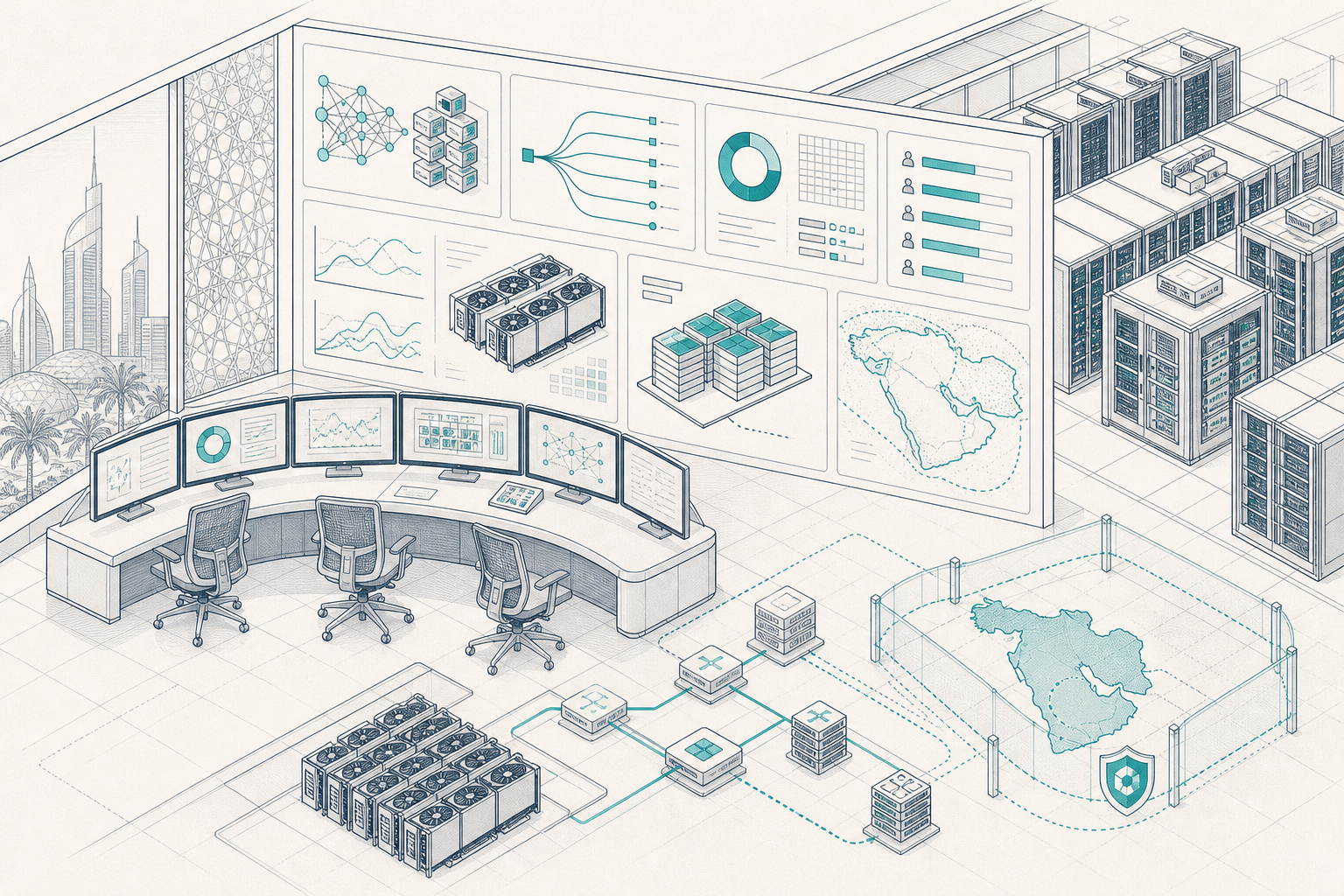
The open model debate is now a capacity plan
On September 18, 2026, TechCrunch framed open versus closed AI as one of the choices shaping the next generation of startups, in a discussion tied to TechCrunch Disrupt 2026 and featuring Nvidia's Nader Khalil and Sydney Sykes. The headline question sounds like a model strategy debate. For operators of real GPU and CPU estates, it is more direct: where will inference and fine tuning actually run, who pays for the tokens, and which data paths are acceptable?
There was no second verified source listed for this story, and this is not a dated product release. It is a theme signal. The practical change is that open and closed AI are no longer only procurement categories for application teams. They are estate management patterns.
Open models let an operator run workloads locally, keep data inside a national or organizational boundary, and tune capacity around known demand. Closed models can reduce software maintenance and provide access to strong hosted capabilities, but they also move dependency to external capacity, internet or private interconnect paths, remote policy terms, and per token billing that is often outside the local operator's chargeback system.
For a small to mid-size GPU estate, from a quarter rack to a few racks, that distinction changes the operating model. The question is not whether open or closed wins. The question is how to route each workload to the right execution venue, account for it, and keep the local fleet busy enough to justify the megawatts, rack space, and support effort.
The bottleneck for a quarter rack is not only VRAM
A small GPU estate runs into constraints differently than a hyperscaler region. Hyperscalers can absorb idle capacity across thousands of tenants and many availability zones. A local operator in Muscat, Riyadh, Doha, Dubai, Manama, Kuwait City, Cairo, or Amman may have 8 to 64 accelerators, a fixed power envelope, a small operations team, and customers who expect both sovereignty and cloud-like access.
Open models intensify four bottlenecks.
First, VRAM becomes a scheduling asset. A model that fits cleanly on one accelerator during testing may need multiple accelerators when context length, batch size, adapters, or concurrent sessions increase. If the scheduler treats every request as a full GPU allocation, utilization stays low.
Second, the software stack becomes part of the service. Open deployment means operators must manage drivers, container runtimes, CUDA or ROCm versions, model servers, vector databases, storage paths, observability, security updates, and model artifact governance. This can be done, but it must be designed as a platform rather than a collection of manual server builds.
Third, tenancy gets harder. One organization may want Kubernetes namespaces for inference APIs. Another may need virtual machines for a regulated analytics environment. A university lab may want bare-metal access for a week. If those tenancy modes live on separate islands, the estate fragments.
Fourth, finance needs useful units. Tokens, GPU-hours, vCPU-hours, storage, egress, and priority classes must map to invoices or internal cost centers. Otherwise, open models look free to users and expensive to operators.
Closed models create different bottlenecks. They can remove some local stack burden, but they add external dependency. GCC and MENA workloads often include government, financial, healthcare, energy, defense adjacent, and family office data with residency or policy constraints. Even when a closed service is technically excellent, the data transfer path, logs, retention policy, and cross-border processing location may not match the workload.
Open and closed become routing classes
The operator-grade answer is to treat open and closed AI as routing classes, not ideology.
A local open model is appropriate when data residency, latency, predictable volume, customization, or auditability matter. A closed model is appropriate when the task needs a capability that the local estate cannot yet provide, when workload volume is bursty, or when the organization accepts external processing for that data class. A hybrid pattern is common: classify, redact, retrieve locally, infer locally where required, and fall back externally only for allowed requests.
| Decision area | Local open model | Closed external model | Operator control point |
|---|---|---|---|
| Data location | Stays on owned hardware if designed correctly | Leaves local estate unless routed through an approved boundary | Policy, network routing, audit logs |
| Cost driver | GPU-hours, storage, operations, power | Tokens, subscriptions, data transfer, premium tiers | Metering and chargeback |
| Capacity risk | Idle GPUs or overloaded GPUs | Provider quotas or network dependency | Quotas and fallback rules |
| Stack burden | Higher local maintenance | Lower local maintenance | Standard images, patching, support runbooks |
| Customization | Strong for fine tuning and adapters | Limited to provider interface | Model catalog and license tracking |
This routing view matters because it lets the operator offer a controlled menu rather than an argument. Tenants can select a service class, but the platform enforces where the job runs, what data may be attached, which GPU slice is used, and how cost is reported.
Total cost per useful token needs local accounting
Per token prices from external services are easy to read. Local costs are harder because they hide inside depreciation, power, cooling, facilities, licenses, support, and idle time. The key metric is not theoretical tokens per second. It is cost per useful token delivered under the operator's real utilization, governance, and support model.
Consider a compact local estate with 16 data center GPUs across 4 servers. The all-in monthly cost assigned to the pod is 20,000 dollars. That includes financing or depreciation, support labor allocation, power, cooling, switching, storage overhead, and facilities allocation. Assume each GPU can deliver paid or internally chargeable work for 720 hours in a 30 day month.
The estate has 16 x 720 = 11,520 possible GPU-hours per month.
If utilization is 28 percent after maintenance windows, queue gaps, tenant fragmentation, and manual reservations, the estate delivers:
11,520 x 0.28 = 3,225.6 useful GPU-hours per month.
The cost per useful GPU-hour is:
20,000 / 3,225.6 = 6.20 dollars per useful GPU-hour.
If better orchestration, partitioning, quotas, and chargeback move useful utilization to 62 percent, the same hardware delivers:
11,520 x 0.62 = 7,142.4 useful GPU-hours per month.
The cost per useful GPU-hour becomes:
20,000 / 7,142.4 = 2.80 dollars per useful GPU-hour.
If the operator charges internal or external tenants 4.50 dollars per useful GPU-hour, monthly chargeback is:
7,142.4 x 4.50 = 32,140.80 dollars.
If the pod averages 20 kW at the facility level, including cooling allocation, that is 0.02 MW. Revenue per MW-month is:
32,140.80 / 0.02 = 1,607,040 dollars per MW-month.
Annualized, that is 19,284,480 dollars per MW-year before considering additional shared overheads, sales costs, taxes, and bad debt. The exact numbers will vary by hardware generation, power tariff, financing cost, support model, and local pricing. The point is stable: utilization turns the economics more than any single model announcement.
This is why open model deployment must be connected to scheduling, metering, and tenant policy. Without that, the operator owns the cost curve but cannot recover it cleanly.
How a platform layer changes the operating model
A system like Clastiq is useful in this problem because it treats the fleet as an estate, not as isolated GPU boxes. The core requirement is to provision, partition, expose, meter, and govern the same physical hardware across multiple tenancy modes.
Bare-metal provisioning matters first. Operators need repeatable installs, firmware awareness, network profiles, storage attachment, and lifecycle control. MAAS and Juju are practical building blocks for that layer because they help turn physical servers into declarative infrastructure rather than snowflake nodes.
The next layer is mixed tenancy. Some users need Kubernetes for inference services, batch jobs, model gateways, and retrieval augmented generation. Others need virtual machines because their stack is not container-ready, their compliance process expects VM isolation, or their software license is tied to a machine image. Some infrastructure teams still need bare-metal pools for performance testing or driver validation. Running Kubernetes and VM tenancy on the same fleet lets the operator increase placement options without buying separate clusters for each demand pattern.
GPU partitioning is the third layer. On supported hardware, MIG can split a GPU into isolated slices with predictable profiles. Time slicing can increase concurrency for lighter workloads, development sessions, notebooks, embedding jobs, and low volume inference. Hardware-agnostic operations also require policy for AMD and mixed CPU/GPU estates, where partitioning, driver stacks, and scheduler integration differ. The platform should expose capacity in terms tenants understand, while preserving enough detail for operators to avoid unsafe overcommit.
Storage is not secondary. Open model operations require a model catalog, container images, checkpoints, adapters, evaluation data, logs, and tenant datasets. Ceph gives operators a way to provide object, block, and file patterns from owned infrastructure. The important design point is not simply having storage. It is connecting storage classes to tenant boundaries, retention policy, snapshot policy, and chargeback.
Metering and chargeback close the loop. If one tenant consumes 1,000 GPU-hours and another consumes 50 GPU-hours, the bill or internal report should show that difference. If one tenant stores 20 TB of checkpoints and another stores 200 GB, that should be visible. If one department insists on full GPU reservations for interactive notebooks, it should see the cost of that choice.
Policy is where sovereignty becomes operational
Sovereignty is often discussed as a legal or national topic. Operators implement it through scheduling, routing, identity, network, storage, and logs.
For GCC and MENA workloads, the policy questions are concrete. Can a ministry workload run on a shared GPU? Can a bank's prompt logs leave the country? Can an energy company use a closed external model for public maintenance manuals but not for reservoir data? Can a hospital use local inference for Arabic clinical summarization while sending only anonymized administrative text to an external endpoint?
The platform should express these answers as policy, not as tribal knowledge. Tenants should have quotas, allowed model classes, approved storage zones, approved network egress, and fallback permissions. Air-gap and sovereign deployments matter when the correct external dependency is no dependency. In other cases, controlled outbound routing may be acceptable, but only if logs, data classification, and approvals are visible.
A simple Kubernetes quota is not enough for the whole problem, but it shows the shape of control. Operators need explicit limits that prevent one tenant from turning an open model experiment into a fleet-wide outage.
apiVersion: v1
kind: ResourceQuota
metadata:
  name: ai-team-monthly-quota
  namespace: tenant-ai-team
spec:
  hard:
    requests.cpu: "160"
    requests.memory: 640Gi
    requests.nvidia.com/gpu: "8"
    limits.nvidia.com/gpu: "8"
    persistentvolumeclaims: "20"
    requests.storage: 40Ti
In a production estate, this would be paired with namespace policy, GPU class labels, storage classes, network policy, image signing rules, tenant metering, and an approval workflow for exceptions. The quota is only the visible tip of the operating model.
Licensing cannot be left to users
Open does not always mean unrestricted. Some models allow commercial use. Some require attribution. Some restrict certain use cases. Some weights are available, but training data lineage or redistribution terms may still matter. Closed models have their own license and acceptable use terms, often tied to provider updates that the operator does not control.
For an operator, model licensing becomes catalog governance. A tenant should not be able to pull any weight file from the internet into a sovereign environment and call it production. The catalog should record model name, version, license, approved use cases, storage location, quantization or serving profile, owner, and retirement date. That catalog should also connect to chargeback, because different models have different serving costs.
This is especially relevant in mixed Arabic and English workloads common across the GCC and MENA. A model that is efficient for English code completion may not be the right model for Arabic customer service, bilingual legal review, or dialect heavy media monitoring. Operators need room to test multiple models locally, but they also need a controlled path from experiment to service.
Fallback routing should be designed before the outage
Closed external services can be a useful fallback when local capacity is full, and local open models can be a useful fallback when external services fail or are not allowed for a data class. The worst time to design that routing is during a customer escalation.
Fallback policy should answer five questions.
Which workloads may leave the local estate? Which fields must be removed or transformed first? Which closed providers are approved for which tenant and country? What is the maximum external spend per tenant per day? What happens when both local GPU capacity and external quotas are exhausted?
The answers belong in the platform, not only in a document. A model gateway can enforce routing decisions, but it needs integration with identity, quota, budget, data classification, and observability. Otherwise, a developer can bypass the intended path with a direct API key.
For small and mid-size estates, fallback routing also protects utilization. If every peak is solved by buying more local hardware, idle time grows after the peak. If every peak is solved externally, the local estate loses volume and the cost per useful token rises. The better pattern is to reserve local capacity for steady, sensitive, and latency critical workloads, then define controlled external escape valves for approved overflow.
Power and cooling are part of the AI architecture
Open model infrastructure is power dense. A few racks can become one of the largest IT loads in a building. In the GCC, where cooling conditions and electricity pricing vary by site and season, power planning is not an afterthought. The operator needs to know which workloads can run at lower priority, which can be scheduled overnight, which need reserved GPUs during business hours, and which can be paused.
This is another reason utilization must be qualified as useful utilization. Running GPUs hot on low value jobs may improve a dashboard while reducing revenue per MW. The goal is not to keep accelerators busy at any cost. The goal is to allocate power to the work with the right policy, margin, and strategic value.
A chargeback system helps here. If a tenant sees that priority inference on full GPUs costs more than batch inference on partitioned capacity, behavior changes. If storage for stale checkpoints is visible, cleanup becomes easier. If idle reservations have a price, teams release capacity sooner.
What Clastiq contributes to this decision
Clastiq's role is not to declare open or closed AI the winner. The platform is designed for operators who own hardware and need cloud-like governance on a smaller footprint. That includes bare-metal provisioning with MAAS and Juju, Kubernetes and VM tenancy on the same fleet, GPU partitioning through MIG and time slicing where supported, Ceph storage, per-tenant metering and chargeback, quota and policy engineering, air-gap and sovereign deployment patterns, turnkey installation, and human-led local support.
Because Clastiq is hardware-agnostic, the operating model is not tied to one accelerator vendor or one estate shape. NVIDIA, AMD, and mixed CPU/GPU environments can be treated as pools with different capabilities, costs, and policy labels. That matters for operators who acquired hardware in phases, inherited CPU estates, or need to support different tenant profiles without pretending every server is identical.
For the open versus closed decision, the practical output is a governed service catalog. Local open models become scheduled, metered services rather than informal experiments. Closed model access becomes a routed, budgeted, and auditable exception or complement. Tenants get access. Operators keep control.
What to do this week
- Inventory every AI workload by data class, latency need, model type, expected tokens, and whether external processing is allowed.
- Calculate current useful GPU utilization, not just allocated utilization, then convert it into cost per useful GPU-hour and cost per useful token.
- Define three routing classes: local only, local preferred with approved fallback, and external allowed with budget limits.
- Create or clean up a model catalog with license, version, owner, serving profile, storage location, and approved tenant list.
- Put quotas on development namespaces and VM pools before the next open model trial consumes production capacity.
- Review power, cooling, and storage growth against expected inference volume, then price priority capacity accordingly.
Clastiq runs this on the operator's own hardware, from a quarter rack to a few racks. request a demo
Sources
TechCrunch: Open or closed AI discussion at TechCrunch Disrupt 2026