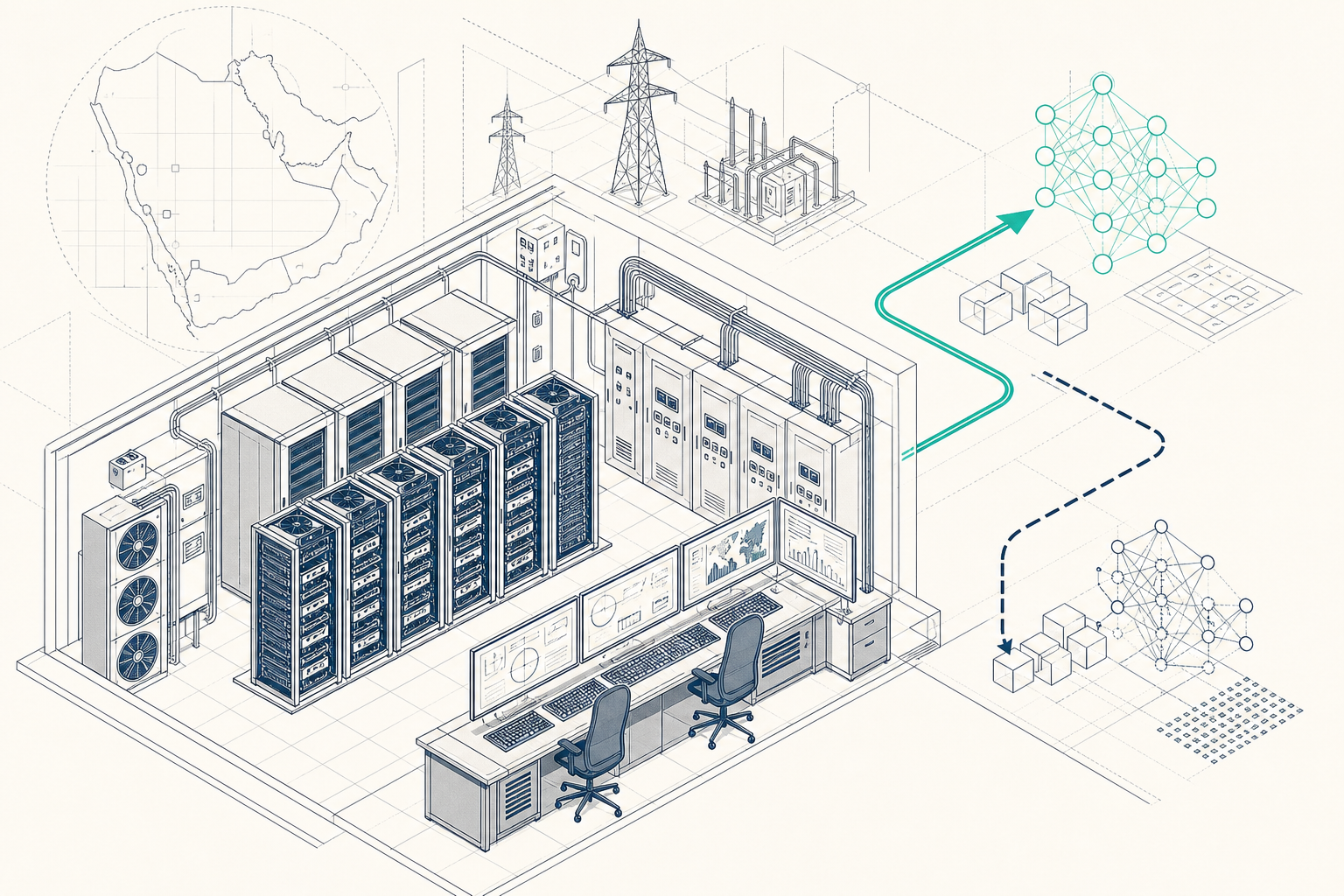
TechCrunch moved the model choice into the data center
TechCrunch Disrupt 2026, held October 13 to 15, 2026, put two connected infrastructure questions in front of founders and AI builders: whether to build on open or closed models, and how AI-designed hardware may reshape the cost curve. TechCrunch previewed the open versus closed discussion on October 5, framing it as a founder decision about what to build on. For operators of real GPU estates, especially quarter-rack to few-rack deployments, the same choice becomes a practical operating model.
A closed model API can reduce day-one complexity. The provider absorbs model hosting, upgrade cadence, safety layers, capacity planning, and much of the serving stack. The tradeoff is dependency on an external region, external pricing, external policy, and often external data movement. An open-weight model can run inside an operator's own facility, on sovereign infrastructure, with local controls over data, access, and retention. The tradeoff is that the operator now owns the failure modes that the API provider used to hide.
Those failure modes are not abstract. They include driver and kernel compatibility, accelerator firmware, CUDA or ROCm stack versions, quantization choices, tokenizer consistency, model artifact security, rollout safety, inference autoscaling, storage throughput, tenant isolation, and GPU fragmentation. They also include commercial questions: who pays for idle GPUs, how departments are charged, how burst demand is limited, and how the estate avoids becoming a sunk-cost science project.
For GCC and MENA operators, the issue is sharper. Many organizations want AI capacity inside national or institutional boundaries for data sovereignty, latency, procurement, or policy reasons. They may not have the scale of a hyperscaler region. They may have 8, 16, 32, or 64 accelerators, plus CPU nodes and storage. At that size, a few bad scheduling decisions, a model upgrade that breaks a kernel path, or a tenant that reserves whole GPUs for intermittent work can move the economics materially.
ClastIQ is designed for this operating layer: bare-metal provisioning, Kubernetes and VM tenancy on the same fleet, GPU partitioning, Ceph storage, metering, chargeback, quota engineering, policy control, air-gap patterns, and local human support on the operator's own hardware. The product does not require the operator to standardize on a single accelerator vendor. The point is to make a small or mid-size estate governable and measurable enough to behave like a compact sovereign compute region.
The bottleneck is not only model access
The open versus closed question is often presented as a developer choice. For an operator, it quickly becomes a capacity planning problem.
If a team chooses a closed API, the local estate may only need CPU services, data preparation, retrieval, policy gateways, and application hosting. The GPU bottleneck moves to the provider. The operator's concerns are network egress, data residency, contract terms, auditability, latency, and unpredictable usage bills.
If a team chooses open weights, the operator must host the model and its full runtime chain. A single model may require one runtime for FP16, another for INT8, another for FP8, and another for speculative decoding. A research team may want maximum context length. A call center application may need low latency at steady concurrency. A government data office may require air-gapped inference. A university lab may need burst access for fine-tuning. These are different workloads, even when they start with the same model family.
The quarter-rack to few-rack operator usually hits five bottlenecks first:
- GPU fragmentation, where single-GPU jobs, fractional inference, fine-tuning, and long-running notebooks compete without a common allocation system.
- Runtime drift, where drivers, container images, kernel modules, model servers, and quantized artifacts fall out of compatibility.
- Storage pressure, because checkpoints, embeddings, vector indexes, logs, and tenant datasets grow faster than planned.
- Tenant ambiguity, where teams reserve capacity without a measured cost signal.
- Power and cooling limits, where the next GPU order is constrained by watts, not rack units.
Open models do not create these issues, but they expose them. Closed APIs externalize them. Sovereign compute internalizes them.
What AI-designed hardware changes for small estates
The hardware-design discussion matters because inference economics are moving from generic accelerator capacity toward tighter alignment between model architecture, compiler, memory hierarchy, and serving engine. If AI systems increasingly help design chips, memory layouts, or accelerators optimized for particular workloads, operators may see more specialized hardware options and shorter optimization cycles.
For large cloud regions, specialization can be absorbed through scale. A hyperscaler can dedicate one pool to one model family, another to another serving path, and another to training. A small estate cannot assume that luxury. It may need one rack to serve multiple tenants, multiple frameworks, and multiple generations of hardware.
The operational risk is lock-in at the wrong layer. If the operator ties tenancy, storage, metering, and policy to one accelerator path, every hardware refresh becomes a platform migration. If the operator hides all hardware detail and treats every accelerator as interchangeable, utilization and cost per token can suffer.
The practical middle ground is to expose hardware capability as a schedulable resource while keeping identity, tenancy, quota, metering, storage, and policy above the hardware layer. That means node pools can differ. Accelerator labels can differ. MIG profiles, time-sliced GPUs, CPU-only VMs, and storage classes can differ. But tenants should still receive a consistent service catalog, bill, quota, and audit trail.
This is where a hardware-agnostic orchestration layer matters. The estate can contain NVIDIA GPUs, AMD GPUs, CPU-only nodes, and storage nodes. The operator can schedule workloads according to actual capability without rewriting the governance model every time a new accelerator arrives.
A worked example: 16 GPUs, open inference, and chargeback
Consider a compact GCC operator running 16 high-end accelerators across 4 GPU servers, plus Ceph storage and management nodes. The facility is not a hyperscale campus. It is a sovereign AI room inside an enterprise, research center, ministry, telecom, or local service provider.
Assume the GPU nodes, storage, network, and overhead draw 18 kW of IT power on average. With a PUE of 1.4, facility draw is 25.2 kW, or 0.0252 MW. The operator allocates 60,000 dollars per month to the estate, including depreciation, support, colocation or facilities cost, software operations, and power.
Raw monthly GPU capacity is:
16 GPUs x 24 hours x 30 days = 11,520 GPU-hours.
Before orchestration, the estate has 32 percent useful utilization. Some GPUs sit idle overnight. Some are reserved by teams that use them intermittently. Some inference jobs hold full GPUs when a partition would be enough. Useful monthly consumption is:
11,520 x 0.32 = 3,686 GPU-hours.
At that utilization, the effective cost per useful GPU-hour is:
60,000 dollars / 3,686 = 16.28 dollars per useful GPU-hour.
Now introduce proper provisioning, partitioning, shared tenancy, quotas, and metering. Long-running inference is placed into fractional GPU profiles where possible. Notebook access is time-boxed. Fine-tuning jobs are queued against project quotas. Idle reservations expire. CPU preprocessing is kept off GPU nodes unless needed. Useful utilization rises to 68 percent:
11,520 x 0.68 = 7,834 GPU-hours.
The same monthly cost now yields:
60,000 dollars / 7,834 = 7.66 dollars per useful GPU-hour.
If the operator charges internal or external tenants 10.50 dollars per metered GPU-hour, monthly recovery is:
7,834 x 10.50 = 82,257 dollars.
That leaves 22,257 dollars of monthly contribution before any additional organizational overhead. Annualized revenue recovery is 987,084 dollars. On the 0.0252 MW facility draw, the annualized revenue per MW for this small GPU estate is:
987,084 / 0.0252 = 39.17 million dollars per MW-year.
The exact number will vary by hardware, power price, depreciation policy, and local tariff. The important point is not the nominal charge. The important point is the direction. Moving from informal allocation to governed utilization can cut effective useful GPU-hour cost by more than half in this example, without buying another accelerator.
Where ClastIQ fits in the stack
ClastIQ is not a model marketplace and does not decide whether an organization should use open weights, closed APIs, or both. Its role is to make the operator's own hardware usable as a governed compute estate.
A typical small-to-mid AI estate needs these layers to work together:
| Layer | Operator problem | ClastIQ role |
|---|---|---|
| Bare metal | Reinstalling and recovering nodes is slow | MAAS and Juju based provisioning and lifecycle control |
| Tenancy | Teams need Kubernetes, VMs, or both | Shared fleet with Kubernetes and VM tenancy patterns |
| GPU sharing | Inference and notebooks waste whole GPUs | MIG where supported, time-slicing, profiles, and scheduling policy |
| Storage | Models, checkpoints, and datasets need durable local capacity | Ceph-backed storage classes and operational integration |
| Metering | Finance cannot see who consumed capacity | Per-tenant GPU-hour and resource accounting |
| Policy | One team can starve the estate | Quotas, placement rules, approval flows, and limits |
| Sovereignty | Data and workloads must stay local | Air-gap capable deployment patterns and local operations |
The practical outcome is a catalog of capacity rather than a pile of servers. A tenant can request a GPU notebook, a model-serving endpoint, a fine-tuning VM, or CPU preprocessing capacity. The operator can decide which profiles exist, what they cost, who may use them, where data is stored, and how overuse is handled.
Make capability explicit, not tribal knowledge
Small estates often depend on a few engineers knowing which node has which driver, which GPU supports which partitioning mode, and which workload should not land on which host. That does not scale to multiple tenants. It also creates audit problems.
Operators should make accelerator capability explicit through labels, node pools, and quota objects. A simplified example:
kubectl label node gpu-a01 accelerator.vendor=nvidia accelerator.profile=mig-1g tenancy=shared
kubectl label node gpu-b01 accelerator.vendor=amd accelerator.profile=whole-gpu tenancy=batch
kubectl label namespace research-a data.classification=restricted quota.gpu-hours-month=800
kubectl -n research-a get resourcequota
The exact commands will vary by platform and policy design, but the principle is stable. Do not rely on people remembering where workloads belong. Put capability and constraint into the control plane.
For open models, this matters during upgrades. Suppose a tenant moves from one quantized artifact to another, or a serving engine requires a newer driver path. Without declared pools, the upgrade can break unrelated tenants. With declared pools, the operator can stage a canary pool, meter the new cost profile, then promote it into the service catalog.
Serving open models requires lifecycle discipline
Running open weights is not only a deployment action. It is a lifecycle process.
First, model artifacts need provenance. Operators should know where a checkpoint came from, which license applies, who approved it, which quantization was used, and which hash is deployed. This is important for commercial compliance and for incident response.
Second, runtime images need version control. A model server image can embed assumptions about tokenizer versions, attention kernels, GPU libraries, and memory management. Rebuilding an image without capturing those inputs can change output behavior or latency.
Third, rollout needs separation by tenant and environment. A government-facing Arabic language assistant, a hospital research workload, and a university lab should not all be forced onto the same model upgrade at the same time. Shared hardware does not require shared change windows.
Fourth, capacity must be reserved at the right level. Some inference services need guaranteed latency. Others can accept queueing. Some fine-tuning jobs can wait until off-peak hours. Metering and quotas should reflect that difference. A low-latency reserved slice should cost more than interruptible batch capacity.
Fifth, logs and prompts need policy. In sovereign environments, the question is not only whether the model runs locally. It is also where prompts, outputs, embeddings, traces, and error logs are stored. Ceph storage classes, namespace policies, retention rules, and access controls become part of the AI system.
GCC and MENA relevance: sovereignty plus utilization
GCC and MENA operators often face a combined requirement: keep sensitive workloads within a national or institutional boundary, while proving that the capital investment is efficient. That combination is unforgiving.
A ministry, university, bank, telco, oil and gas operator, or AI service provider may want open models because they can be deployed locally. But local deployment without metering can create political and financial friction. The first teams to receive access may consume the estate. Later teams see no capacity. Finance sees a large hardware line item but cannot allocate cost. Security sees model artifacts and datasets moving through informal paths. Facilities sees rising power draw without a service model.
A governed estate changes the conversation. Instead of debating whether one department deserves a server, the operator can allocate monthly GPU-hour quotas, storage quotas, reserved serving capacity, and burst pools. Instead of charging everyone equally, the operator can recover cost from measured use. Instead of buying another rack because people report shortages, the operator can show whether the shortage is real demand, poor scheduling, or idle reservation.
This is especially relevant where power and cooling are constrained. AI capacity is increasingly a megawatt problem. A small estate that improves utilization before expansion preserves power headroom. In markets where data center capacity, import lead times, or grid connection windows are material constraints, that is an infrastructure advantage.
Avoiding the wrong kind of lock-in
Hardware-agnostic does not mean hardware-blind. Operators still need to understand which accelerator is best for a workload, which software stack is mature, and where vendor-specific features reduce cost. MIG, time-slicing, memory bandwidth, interconnect topology, CPU pinning, and storage proximity all matter.
The lock-in to avoid is governance lock-in. If each hardware island has its own account model, storage model, quota model, and billing spreadsheet, the estate becomes harder to operate with every purchase. When the next procurement adds a different GPU generation or an AMD pool beside an NVIDIA pool, the organization should not have to rebuild its tenancy model.
Keep the service catalog stable. Let the underlying pools evolve. For example, define service classes such as fractional inference, whole-GPU batch, reserved low-latency serving, CPU preprocessing, and storage-backed model development. Behind those classes, the operator can place workloads on the most appropriate hardware available.
That approach also helps with closed APIs. A sovereign operator may still use external models for some non-sensitive workloads or as a fallback. The same metering and policy discipline should apply. If a department consumes external tokens and local GPU-hours, both should appear in one cost view where possible. The strategic choice between open and closed should be visible as an operating cost and risk decision, not hidden in separate invoices.
What to do this week
- Inventory the estate by capability, not just by server name. Capture accelerator type, memory, driver path, partitioning support, storage proximity, network speed, power draw, and current tenant ownership.
- Measure useful utilization for the last 30 days. Separate allocated GPU-hours from active GPU-hours. Identify idle reservations, full-GPU inference services, and notebooks that can move to fractional or scheduled access.
- Define 3 to 5 service classes. Start with fractional inference, whole-GPU batch, reserved serving, GPU notebook, and CPU preprocessing. Attach quotas and expected chargeback units to each class.
- Create a model artifact register. Track source, license, approval owner, hash, quantization method, runtime image, deployment namespace, and data classification.
- Stage one controlled upgrade path. Pick a model-serving workload, create a canary pool, test driver and runtime compatibility, meter latency and GPU-hours, then document the promotion process.
- Tie power to economics. For each GPU pool, record average facility kW, useful GPU-hours, recovered chargeback, and revenue or cost recovery per MW-year.
ClastIQ runs this governance, tenancy, metering, storage, and GPU orchestration on the operator's own hardware. request a demo
Sources
Open or closed AI, how founders are choosing what to build on at TechCrunch 2026