What changed on October 13, 2026
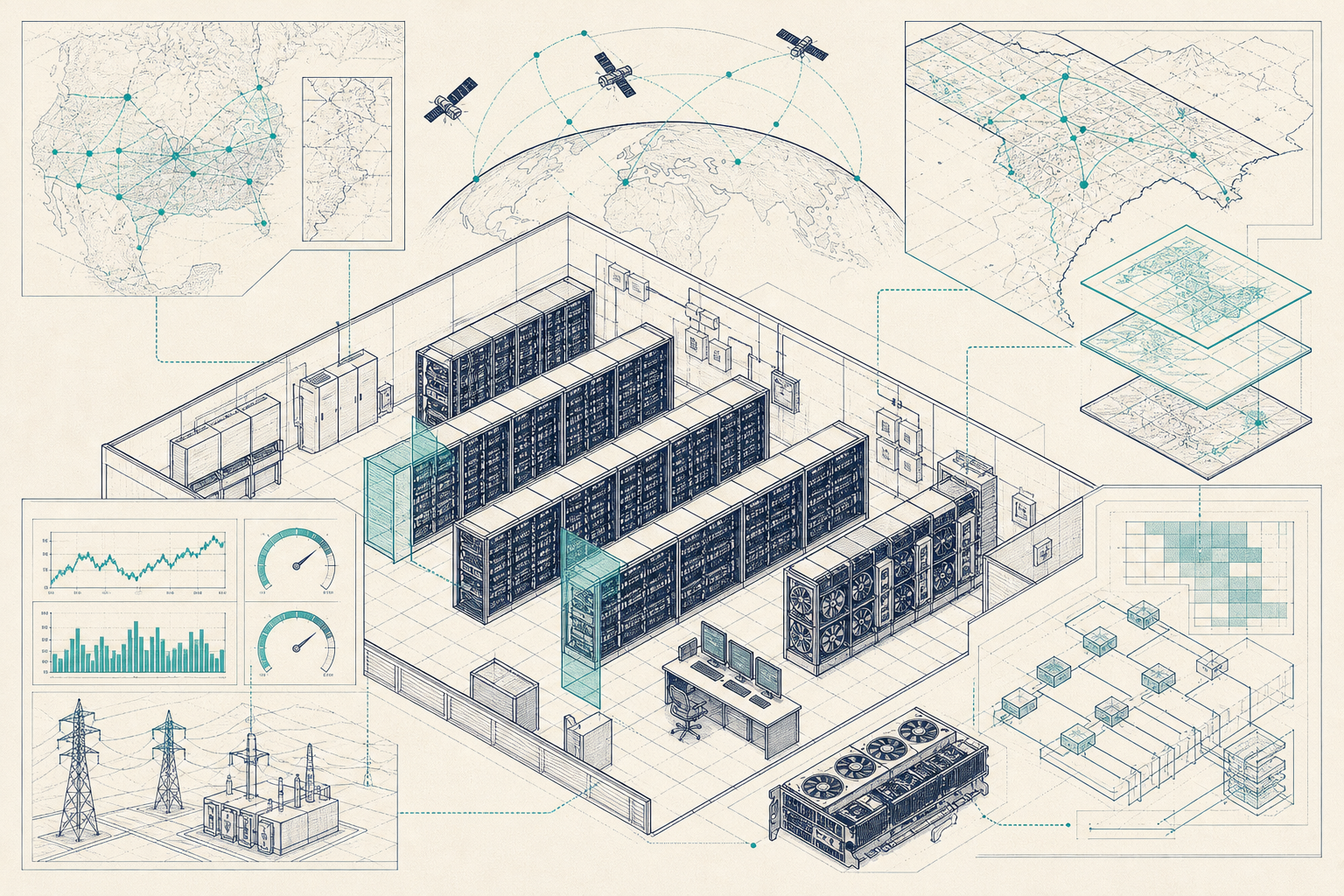
On October 13, 2026, TechCrunch highlighted Satlyt in its Startup Battlefield Top 20, describing a proposal to turn spacecraft into virtual AI data centers. The reference point is not another terrestrial data center buildout. It is a distributed compute model where processing capacity sits on assets that move, connect intermittently, and operate under strict power, thermal, and bandwidth limits.
For most GPU estate operators, orbit is not the deployment target. The useful lesson is more practical: once compute is distributed, intermittently connected, power constrained, and data constrained, scheduling stops being a generic queueing problem. Checkpointing, workload placement, data locality, quota policy, tenant isolation, storage replication, and power envelopes become first-class operating concerns.
That is relevant to small and mid-size GPU estates in the GCC and wider MENA region. A quarter rack to a few racks may look simple compared with a hyperscaler region, but the operational pattern can be surprisingly similar. Operators may have one site in Muscat, another in Dubai, an academic or government location in Riyadh, a colocation cage in Doha, or an edge room supporting a media, energy, or security workload. The sites do not always have identical cooling, fiber diversity, maintenance access, grid stability, or data sovereignty requirements. The economic question is the same: how do you turn real hardware into governed, metered, high utilization capacity without pretending every site is a hyperscaler availability zone?
ClastIQ is built for that class of operator. It combines bare-metal provisioning with MAAS and Juju, Kubernetes and VM tenancy on the same physical fleet, GPU partitioning through MIG where available and time-slicing where appropriate, Ceph storage, per-tenant metering and chargeback, quota and policy engineering, and air-gap or sovereign deployment patterns. The point is not to make a small estate look large. The point is to make it schedulable, accountable, and financially legible.
The bottleneck is not just GPU supply
The common explanation for poor GPU economics is scarcity: not enough accelerators, not enough budget, not enough power. Those are real constraints, but they hide a more controllable bottleneck. Many small estates lose money or internal credibility because the installed GPUs are not presented as a managed utility.
A typical estate starts with several worthy demands:
- Researchers want long-running training jobs with flexible start times.
- Inference teams want low-latency capacity and stable endpoints.
- A government or regulated tenant wants data to remain inside a sovereign boundary.
- A systems team wants maintenance windows, firmware control, and predictable images.
- Finance wants chargeback that matches actual consumption.
- Facilities wants load kept inside a power and cooling envelope.
If those requirements are handled manually, the operator gets informal allocation. One team has SSH access to bare-metal nodes. Another team owns a Kubernetes namespace. A third tenant runs VMs. GPU memory is stranded because full GPUs are allocated to small inference jobs. Storage copies multiply. Nobody can say with confidence whether a given tenant consumed 800 GPU-hours or 1,800 GPU-hours last month.
Distributed and intermittently connected compute makes that model fail faster. Satlyt’s orbital framing is extreme, but it exposes the same design rules that apply on the ground. If a site has limited connectivity, move compute toward the data. If a site has a narrow power window, schedule deferrable work into the right hours. If a tenant cannot move data across borders, prevent the scheduler from placing the workload outside the allowed domain. If a job may be interrupted, checkpoint it in a storage layer that the next eligible node can reach.
For GCC and MENA operators, this is not theoretical. Cooling capacity can be the limiting factor during summer peaks. Some sites may have excellent power but weak cross-border bandwidth. Some workloads may need to remain inside Oman, Saudi Arabia, the UAE, Qatar, or another jurisdiction. Some customers will accept best-effort spot capacity, while others need reserved GPU slices for production inference.
The operator-grade response is to stop treating GPUs as individual servers and start treating the estate as a policy-driven pool.
What an intermittency-aware estate needs
A small estate does not need every mechanism used by hyperscalers, but it does need a few hard capabilities.
| Constraint | Operational risk | Required control |
|---|---|---|
| Uneven connectivity | Jobs fail or data transfers dominate runtime | Site-aware placement and checkpoint location |
| Limited cooling or power | Thermal throttling, breaker risk, emergency shutdowns | Power-aware quotas and maintenance windows |
| Mixed tenants | Noisy neighbor effects and unclear ownership | Kubernetes namespaces, VMs, quotas, and metering |
| Mixed GPU types | Stranded capacity and manual scheduling | Hardware labels, profiles, and partitioning |
| Data sovereignty | Policy breaches or audit gaps | Location constraints and tenant-specific storage policy |
| Small job sizes | Full GPUs wasted on fractional workloads | MIG, time-slicing, and profile catalogs |
These controls are not independent. A quota system without metering becomes political. Metering without tenancy is hard to attribute. Tenancy without storage policy can violate data placement rules. GPU partitioning without scheduling policy can increase fragmentation instead of improving utilization.
This is where orchestration has to cover the whole estate, not just Kubernetes. Bare-metal nodes need reproducible provisioning, firmware baselines, and lifecycle control. VM tenants need access to capacity without bypassing governance. Kubernetes tenants need quotas and device profiles. Storage needs to follow the placement model. Finance needs usage records that can support internal chargeback or external billing. Facilities needs the platform to respect power and cooling limits.
ClastIQ’s role is to bind those layers into one operating model on the operator’s own hardware. MAAS and Juju support repeatable bare-metal and service deployment. Kubernetes handles containerized tenancy. VM tenancy allows teams with OS, license, or isolation requirements to share the same fleet. Ceph provides storage that can be designed for the relevant failure domains and sovereignty boundaries. Metering and chargeback convert allocation into accountable consumption. Quotas and policies convert business rules into scheduler behavior.
A worked example for a two-site GPU estate
Consider an operator with 16 servers, each with 2 GPUs, across two local sites. The estate has 32 GPUs. It is not a hyperscaler region, but it is enough capacity to matter to a university, national lab, AI services provider, systems integrator, or government platform team.
Assume each GPU is available 24 hours per day. The theoretical daily capacity is:
32 GPUs x 24 hours = 768 GPU-hours per day
Before orchestration, the operator sees 38 percent useful utilization after accounting for idle allocations, oversized reservations, queue gaps, maintenance gaps, and jobs waiting for specific nodes. Useful daily consumption is:
768 x 0.38 = 291.84 GPU-hours, rounded to 292 GPU-hours per day
Now assume the facility draw for the IT load, networking, storage, and cooling overhead averages 70.2 kW after PUE. Daily energy use is:
70.2 kW x 24 = 1,684.8 kWh per day
At 0.12 dollars per kWh, energy costs 202.18 dollars per day. Add depreciation, support, colocation, and operations allocation of 3,200 dollars per day. Total daily cost is approximately:
3,200 + 202 = 3,402 dollars per day
At 292 useful GPU-hours per day, the cost per useful GPU-hour is:
3,402 / 292 = 11.65 dollars per GPU-hour
Now add policy-based scheduling, partitioning for smaller inference jobs, clearer maintenance windows, quotas, and chargeback. The same estate reaches 68 percent useful utilization, which is not a perfect number and does not require fantasy scheduling. It means fewer idle full-GPU allocations, fewer stranded nodes, and better fit between job profile and hardware profile.
768 x 0.68 = 522.24 GPU-hours, rounded to 522 GPU-hours per day
The fixed daily cost is still roughly 3,402 dollars. The cost per useful GPU-hour becomes:
3,402 / 522 = 6.52 dollars per GPU-hour
If the operator charges internal or external tenants 8.00 dollars per GPU-hour, the daily recoverable value changes materially:
Before: 292 x 8.00 = 2,336 dollars per day
After: 522 x 8.00 = 4,176 dollars per day
On a revenue per megawatt basis, using the same 70.2 kW facility draw, the annualized recoverable value after orchestration is:
4,176 x 365 = 1,524,240 dollars per year
0.0702 MW of facility draw gives:
1,524,240 / 0.0702 = 21.7 million dollars per MW-year
Before orchestration, the same calculation is:
2,336 x 365 = 852,640 dollars per year
852,640 / 0.0702 = 12.1 million dollars per MW-year
The estate did not buy more GPUs. It made the scheduling, tenancy, storage, and financial model more explicit. For a regional operator with constrained power or cooling, that can matter more than a procurement plan.
Turning placement into policy
The scheduling problem should be expressed in terms that match operator reality. A node is not just a node. It has a site, rack, GPU type, driver branch, power profile, cooling class, storage path, sovereignty domain, and network path. Some of those attributes are stable. Others change during maintenance, grid events, WAN degradation, or peak thermal periods.
A simple Kubernetes example shows the pattern. The exact implementation will vary by estate and hardware vendor, but the useful principle is to make placement visible to the scheduler and enforceable through policy.
kubectl label node gpu-a01 topology.clastiq.io/site=muscat-a
kubectl label node gpu-a01 sovereignty.clastiq.io/domain=oman
kubectl label node gpu-a01 power.clastiq.io/profile=firm
kubectl label node gpu-a01 gpu.clastiq.io/class=partitionable

kubectl taint node gpu-b07 connectivity=intermittent:NoSchedule

kubectl -n tenant-vision create quota gpu-quota \
  --hard=requests.cpu=256,requests.memory=1Ti,requests.nvidia.com/gpu=8
The point is not the specific label names. The point is that scheduling decisions should stop depending on tribal knowledge. If a workload must remain in Oman, the policy should encode that. If an edge site has intermittent connectivity, only workloads that can checkpoint and resume should land there. If a GPU is partitionable, small inference workloads should not consume the whole device by default. If a tenant has a monthly cap, the platform should enforce it rather than discovering the overrun at invoice time.
For mixed estates, the profile catalog matters. Some nodes may carry NVIDIA GPUs with MIG support. Some may carry GPUs better suited to whole-device allocation. Some may use AMD accelerators. Some may be CPU-heavy nodes for preprocessing, postprocessing, CI, or simulation. Hardware-agnostic operation does not mean pretending all devices are identical. It means exposing differences through profiles and policies instead of managing each server as an exception.
Checkpointing and data locality are business controls
Satlyt’s space compute idea makes checkpointing obvious because the compute platform may be intermittently reachable. On the ground, the same issue appears in less dramatic ways. A training job may need to survive a planned cooling shutdown. A WAN link may be congested during business hours. A tenant may need to move from a premium allocation to a best-effort pool. A maintenance team may need to drain a rack without losing days of work.
Checkpointing is not only an application concern. The platform needs to provide storage paths, permissions, and placement rules that make checkpointing useful. If checkpoints are written to a local disk that disappears with the node, they do not help. If checkpoints cross a sovereignty boundary, they may be unusable for regulated workloads. If every restart pulls terabytes across a weak link, utilization will look high while useful work remains low.
Ceph is useful in this class of estate because it can support shared storage patterns while still allowing operators to design around failure domains and location. The key is to decide which data needs replication across racks or sites, which data must stay local, and which scratch data should be treated as disposable. For a small estate, storage policy should be simple enough to audit.
An operator might define three storage classes:
- Sovereign persistent storage, pinned to a country or facility boundary.
- Checkpoint storage, replicated within a site and accessible to eligible GPU nodes.
- Scratch storage, fast and local, deleted at job completion or after a short retention period.
Once storage classes are tied to tenant policy, placement becomes safer. A workload scheduled into the Muscat sovereign domain writes checkpoints into a Muscat-bound storage class. A best-effort rendering job can use scratch storage and restart elsewhere. A production inference service can mount a model catalog that remains inside the approved facility.
Partitioning is a utilization tool, not a substitute for governance
GPU partitioning helps when demand comes in different shapes. A model serving team may need several small, stable slices. A research team may need full devices for a short training run. A batch analytics job may tolerate time-sliced access. Without partitioning, small jobs reserve large devices. Without governance, partitioning creates new contention.
MIG, where available, can divide a supported GPU into hardware-isolated instances with defined memory and compute profiles. Time-slicing can improve access for workloads that tolerate shared execution. VM passthrough may be appropriate for tenants that need OS-level control or software licensing boundaries. None of these is universally right.
The operator needs a catalog that tenants can understand:
| Profile | Typical use | Control required |
|---|---|---|
| Full GPU | Training, large inference, simulation | Reservation, quota, maintenance drain |
| GPU slice | Model serving, notebooks, small inference | Slice catalog, namespace limits, metering |
| Time-sliced GPU | Development, bursty batch, education | Fair sharing, preemption policy, user limits |
| VM with GPU | Licensed stacks, isolation needs, legacy apps | Image control, passthrough policy, billing |
| CPU pool | Data prep, orchestration, CI | Separate CPU and memory chargeback |
This catalog prevents two common errors. The first is giving every tenant a full GPU because smaller profiles are hard to request. The second is overselling fractional access without explaining performance expectations. A governed platform should make both the entitlement and the tradeoff clear.
Metering changes behavior
Small estates often resist chargeback because it seems bureaucratic. In practice, metering is the difference between capacity planning and argument. Even if money does not change hands, a tenant-level usage record changes behavior.
At minimum, metering should capture allocated GPU-hours, actual runtime, profile type, CPU, memory, storage, namespace or project, user or service account, and site. For sovereign or regulated tenants, the record should also show where the job ran and where persistent data was stored. For power-constrained estates, usage should be correlated with power windows or facility events.
Chargeback does not need to be complicated. A simple internal rate card might include:
- Full GPU: 8.00 dollars per GPU-hour.
- Partitioned GPU slice: proportional rate based on profile and reservation class.
- Time-sliced development GPU: lower rate with no production service-level commitment.
- CPU-only preprocessing: CPU-hour and memory-hour rates.
- Persistent storage: per TB-month, with a higher rate for replicated sovereign storage.
The important step is consistency. If a tenant reserves eight GPUs for three days and uses them poorly, the reservation should still appear. If another tenant uses preemptible spare capacity, the discount and risk should be visible. Over time, this gives the operator evidence for procurement, decommissioning, and pricing.
GCC and MENA implications
The GCC and wider MENA region has a specific combination of opportunity and constraint. Demand for AI capacity is growing across government, energy, finance, logistics, media, education, and Arabic language applications. At the same time, data residency, sovereign operations, power availability, cooling design, and cross-border connectivity can shape where workloads are allowed to run.
A small GPU estate in the region may need to answer questions that sound like hyperscaler questions, even at quarter-rack scale:
- Can this tenant prove that data and checkpoints stayed inside the country?
- Can inference remain available if a WAN path degrades?
- Can training jobs move to another rack without violating policy?
- Can cooling limits reduce available capacity automatically before an emergency?
- Can finance see which ministry, department, customer, or research group consumed which GPU-hours?
- Can the operator support both VM tenants and Kubernetes tenants without building separate islands?
This is where an on-premises, hardware-agnostic control plane matters. Operators in Oman, Saudi Arabia, the UAE, Qatar, Bahrain, Kuwait, and neighboring markets may choose different server vendors, accelerator vendors, storage layouts, and colocation models. The orchestration layer should not force a single hardware path. It should make the estate governable across NVIDIA, AMD, and mixed CPU and GPU environments.
Air-gap and sovereign deployments also change support requirements. Some sites cannot depend on a public cloud control plane. Some need local human-led support and installation. Some need update workflows that pass through internal approval before any package reaches production. A platform designed for owned hardware has to treat those requirements as normal, not exceptional.
The operator lesson from orbital compute
Satlyt’s proposal is notable because it pushes compute into an environment where every assumption is constrained. Connectivity is not continuous. Power is limited. Thermal conditions matter. Data movement is expensive. Scheduling must understand location and time.
That is also the direction of serious regional GPU operations, just with different physics. The constraint may be a summer cooling limit rather than orbital thermal management. It may be a national data boundary rather than a downlink window. It may be a saturated intersite link rather than a satellite pass. But the operating model is similar: place the right workload on the right resource, at the right time, with the right data, under the right policy, and meter the result.
For operators with a quarter rack to a few racks, the practical goal is not to imitate hyperscaler scale. It is to adopt hyperscaler discipline where it matters: automated provisioning, profile-based scheduling, tenant isolation, measured consumption, sovereign placement, storage policy, and power-aware operations.
ClastIQ exists for that middle ground. It is a product of Cognition AI and Technology Innovation SPC, registered in Oman, and is designed to run on an operator’s own hardware with local installation and support. For regional operators, the business outcome is straightforward: more useful GPU-hours from the same estate, clearer chargeback, fewer policy exceptions, and better revenue or recovered value per megawatt.
What to do this week
- Inventory every GPU node with site, rack, power feed, cooling class, GPU type, driver branch, storage path, and tenant ownership.
- Define three to five workload profiles, such as full GPU training, partitioned inference, time-sliced development, VM with GPU, and CPU preprocessing.
- Pick one sovereignty rule and encode it in placement policy, for example workloads for a regulated tenant must run and store checkpoints inside one country.
- Start metering GPU-hours by tenant and profile, even if the first month is for showback rather than chargeback.
- Identify one maintenance or cooling event and test checkpoint, drain, and restart behavior before it becomes urgent.
- Build a simple rate card that separates reserved capacity, best-effort capacity, persistent storage, and replicated sovereign storage.
ClastIQ runs this on the operator’s own hardware. request a demo