What changed on August 17
On August 17, 2026, NVIDIA filed a Form 8-K disclosing a multi-year partnership with SB Energy Corp. to advance development of the PORTS Technology Campus at the Portsmouth Site in Pike County, Ohio. The filing describes the project as a large-scale AI data center campus intended to support accelerated computing workloads.
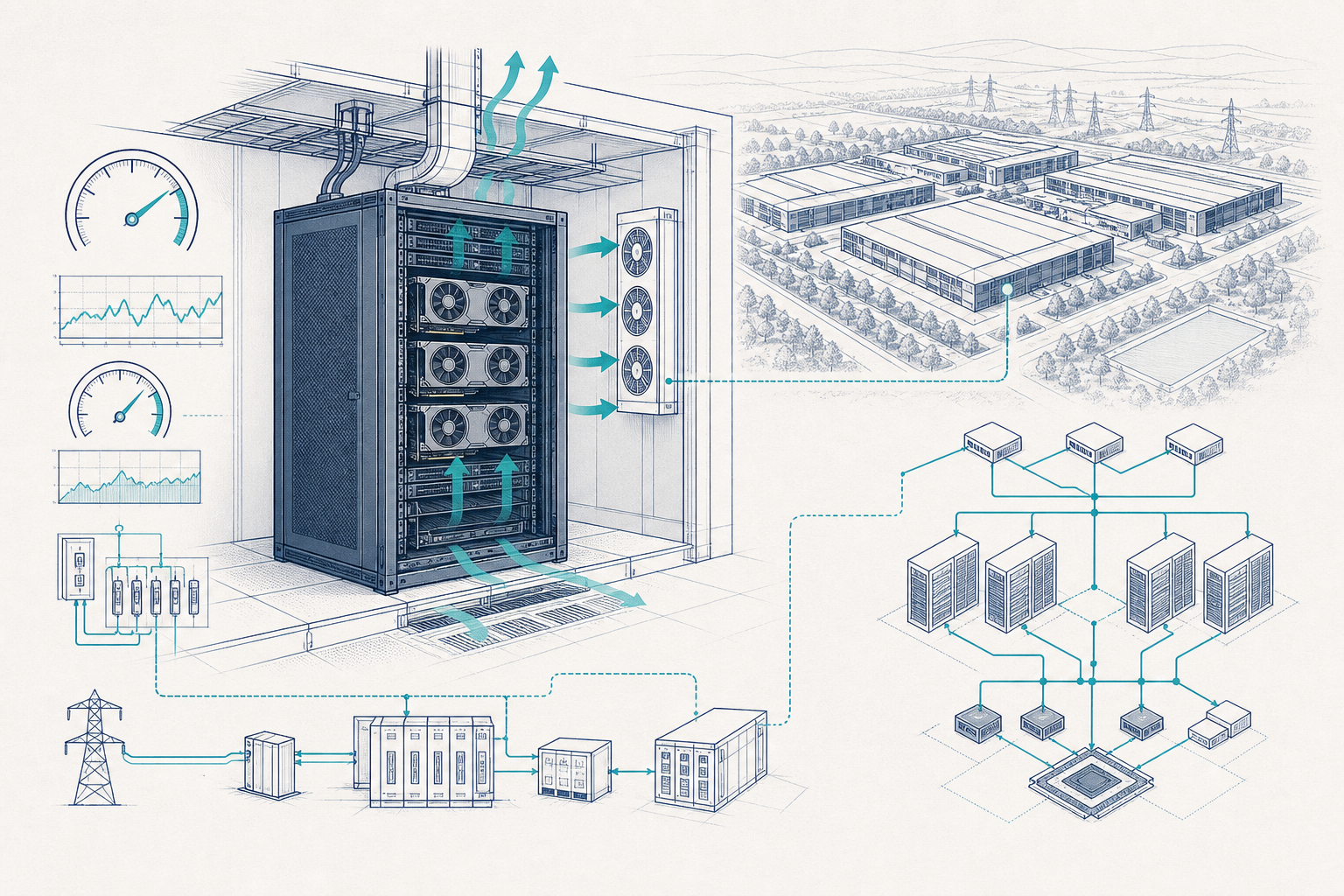
The filing does not publish a rack count, megawatt figure, GPU count, water design, PUE target, or energisation schedule. That absence is important. The infrastructure signal is not a single number. The signal is that accelerated computing capacity is being developed through a campus-level power and site partnership, not just through server procurement.
For GPU operators with a quarter rack, one rack, or a few racks in GCC/MENA or other regional markets, this is the useful lesson: hyperscale AI is no longer constrained mainly by access to accelerators. It is constrained by power, cooling, commissioning time, tenancy discipline, storage locality, and the ability to convert scarce electrical capacity into useful GPU-hours. Smaller estates hit the same bottleneck earlier than many owners expect, just at 8 kW, 30 kW, or 120 kW instead of hundreds of megawatts.
ClastIQ is built for that operator class: organisations that own real hardware, need sovereign or local control, and want hyperscaler-like governance without being a hyperscaler. The practical question is not whether a regional operator can imitate a campus in Ohio. It cannot. The question is whether the operator can run each rack as if power is the scarce asset, and account for every GPU-hour, tenant, quota, and watt.
The bottleneck moves from procurement to provisioning
A few years ago, the operational bottleneck for a small GPU estate was often procurement: finding GPUs, importing servers, and getting enough network ports. Those still matter, but the harder bottleneck now appears after the equipment arrives.
A quarter rack of modern GPU servers can consume more power than an older full rack of CPU equipment. A single dense node can change the thermal behaviour of a room. Tenants ask for exclusive GPUs for training, fractional GPUs for inference, CPU-only VMs for preprocessing, and storage close enough to keep expensive accelerators fed. Finance asks who consumed what. Security asks whether data left the jurisdiction. Facilities asks why one branch circuit is near limit while another rack is half empty.
The PORTS disclosure is a reminder that the largest AI builders are treating energy and site development as first-order architecture. Smaller operators should do the same, but with different tools. They need scheduling, partitioning, metering, quotas, and power-aware operational practice on the hardware they already own.
A rack-scale AI platform should answer five questions continuously:
- Which tenant is consuming each GPU, CPU core, VM, Kubernetes namespace, and terabyte?
- Which workloads can share a physical accelerator through MIG, time-slicing, or CPU fallback?
- Which workloads need bare metal, which need Kubernetes, and which need VMs?
- What is the cost per billable GPU-hour after power, cooling, support, and depreciation?
- What policy prevents a tenant from turning a power or thermal margin into an outage?
ClastIQ addresses these as one operating model: bare-metal provisioning through MAAS and Juju, Kubernetes and VM tenancy on the same fleet, GPU partitioning where the hardware supports it, Ceph storage, per-tenant metering, quota and policy engineering, and deployment patterns suitable for air-gapped or sovereign environments.
Why a hyperscale campus matters to a quarter rack
A campus such as PORTS is not operationally similar to a small estate. It has different financing, utility engagement, construction sequencing, and procurement leverage. But it exposes the same economic equation: revenue or mission value per constrained megawatt.
At hyperscale, that equation is handled through site selection, grid interconnection, renewable or firmed power strategy, thermal design, and multi-year build-out. At quarter-rack scale, the same equation appears in less glamorous forms: breaker capacity, chilled-water availability, hot aisle containment, generator headroom, landlord power limits, and whether a tenant’s notebook session sits idle on a full GPU all weekend.
The smaller operator has one advantage: it can change operating discipline quickly. It can meter tenants this month. It can reclaim idle allocations this week. It can split a GPU for inference today if the accelerator supports it. It can move a CPU-heavy preprocessing job away from a GPU node before it wastes power and PCIe capacity.
The disadvantage is that small estates have little tolerance for waste. A hyperscaler can absorb some stranded capacity across a region. A two-rack operator cannot. If four GPUs are idle because tenancy is manual, or if an entire node is reserved for a tenant that uses it only during office hours, the lost economics are immediate.
Worked example: the cost of idle GPU-hours
Consider a small operator running one quarter rack with two GPU servers. Each server has four accelerators. The simplified assumptions below are deliberately conservative and easy to audit.
- 8 physical GPUs
- 730 hours in a billing month
- 5,840 theoretical GPU-hours per month
- 7.2 kW average IT load for the two servers, networking, and storage share
- 1.35 facility overhead factor for cooling and power distribution
- 9.72 kW facility load
- Electricity at $0.11 per kWh
- Hardware and network allocation of $300,000 depreciated over 36 months
- Local operations allocation of $1,500 per month
Monthly energy cost is:
9.72 kW × 730 h × $0.11 = $781
Monthly depreciation is:
$300,000 ÷ 36 = $8,333
Monthly all-in operating basis for this example is:
$8,333 + $781 + $1,500 = $10,614
If the estate runs at 32% billable utilisation, it produces:
5,840 GPU-h × 0.32 = 1,869 billable GPU-h
Cost per billable GPU-hour is:
$10,614 ÷ 1,869 = $5.68 per GPU-h
If orchestration, partitioning, quota enforcement, and tenant metering raise billable utilisation to 68%, the same physical estate produces:
5,840 GPU-h × 0.68 = 3,971 billable GPU-h
Cost per billable GPU-hour becomes:
$10,614 ÷ 3,971 = $2.67 per GPU-h
Nothing in this example assumes a specific GPU vendor. It is an operating result, not a benchmark. The gain comes from turning reserved-but-idle equipment into allocated, metered work.
If the operator charges internal or external tenants $5.00 per GPU-hour, monthly revenue or chargeback at 32% utilisation is:
1,869 × $5.00 = $9,345
At 68% utilisation it is:
3,971 × $5.00 = $19,855
On the 9.72 kW facility footprint, that is approximately $11.5 million per facility MW-year at 32% utilisation and $24.5 million per facility MW-year at 68% utilisation. The rack did not get more power. The operator got more accountable GPU-hours out of the same power envelope.
That is the small-estate version of the campus lesson.
What changes in the operating model
The first change is that bare-metal provisioning must be repeatable. GPU servers are often treated as special pets because drivers, firmware, networking, and storage paths are sensitive. That does not scale even to a few racks. MAAS and Juju-based provisioning allow the operator to bring nodes into service consistently, rebuild them, attach them to Kubernetes or VM tenancy, and maintain an auditable base state.
The second change is that Kubernetes and VMs need to share the fleet without becoming separate islands. AI teams often want Kubernetes for batch jobs, notebooks, model serving, and internal platforms. Other tenants may need VMs for licensed tools, legacy frameworks, Windows dependencies, or strict isolation. If those platforms are built on separate hardware pools, utilisation falls and power is stranded. A common orchestration layer lets operators place the right tenancy model on the same physical estate.
The third change is partitioning. Some training workloads need whole GPUs and predictable interconnect. Many inference, fine-tuning, development, and classroom workloads do not. On NVIDIA hardware that supports MIG, physical GPUs can be carved into isolated instances. On supported platforms, time-slicing can improve sharing for less latency-sensitive workloads. AMD and mixed estates require their own supported sharing and scheduling approaches. The policy point is hardware-agnostic: the scheduler should match workload demand to accelerator granularity rather than hand out a full device by default.
The fourth change is storage. A GPU rack without nearby, governed storage becomes a data movement problem. Ceph gives small and mid-size estates a way to provide block, file, and object storage from operator-owned infrastructure. It also gives the platform a place to enforce tenant boundaries, capacity quotas, and locality policies. Storage does not need to be exotic to be useful. It needs to be close, measured, resilient, and included in chargeback.
The fifth change is metering. If a tenant gets a namespace, a VM, a bare-metal reservation, and object storage, those should appear in one account. Without chargeback or showback, every tenant optimises for convenience and the operator absorbs the waste. With metering, idle reservations become visible and finance can compare local sovereign capacity against external cloud spend.
Operator control points
| Control point | What usually breaks | ClastIQ operating response |
|---|---|---|
| Power envelope | Rack or branch capacity is exceeded by dense GPU nodes | Place workloads with awareness of node class, quotas, and maintenance windows |
| GPU allocation | Full GPUs are reserved for small or idle jobs | Use MIG or time-slicing where supported; reserve whole GPUs only when needed |
| Tenancy | Kubernetes, VMs, and bare metal become separate silos | Run mixed tenancy on the same fleet with governed provisioning |
| Storage | Data copies multiply and GPUs wait on I/O | Provide Ceph-backed tenant storage with quotas and locality rules |
| Economics | Finance sees capex but not consumption | Meter GPU-hours, CPU, memory, storage, and tenant usage for chargeback |
| Sovereignty | Teams bypass local capacity for convenience | Provide local self-service with policy, auditability, and air-gap options |
This table is not a feature checklist for a hyperscale campus. It is the daily operating surface for anyone trying to make a few racks behave like serious infrastructure.
Policy beats hero scheduling
Many small GPU estates begin with a shared spreadsheet, a chat channel, and a trusted administrator who knows which team is using which server. That can work for a lab. It fails when the estate becomes production infrastructure.
Quotas should be explicit. A research tenant might receive two full GPUs during working hours and one MIG slice pool for development. An inference tenant might receive guaranteed fractional capacity plus burst rights. A data engineering tenant might receive CPU and storage quotas but no accelerator access by default. A national or regulated workload might be pinned to a specific room, rack, or cluster segment.
A simple Kubernetes resource quota illustrates the policy idea. Exact resource names depend on the device plugin and hardware vendor, but the principle is the same: accelerator access is declared, limited, and visible.
apiVersion: v1
kind: ResourceQuota
metadata:
  name: tenant-ai-quota
  namespace: tenant-ai
spec:
  hard:
    requests.cpu: "128"
    requests.memory: 512Gi
    requests.storage: 20Ti
    nvidia.com/gpu: "4"
For a mixed estate, the operator may maintain separate node pools and quotas for different accelerator types, CPU-only workloads, storage-heavy jobs, and sovereign zones. ClastIQ’s role is not to pretend every server is identical. It is to make heterogeneity governable: NVIDIA, AMD, and CPU-heavy estates can be presented through a controlled operating model with clear tenancy and metering.
GCC and MENA relevance
For GCC and MENA operators, the PORTS signal is especially relevant because regional AI capacity is being pulled in two directions.
On one side, governments, universities, telecom operators, financial institutions, healthcare groups, and Arabic-language AI teams need local infrastructure for sovereignty, latency, procurement control, and data governance. Sending every workload to a distant public cloud region can be commercially or legally unattractive. In some cases it is not allowed.
On the other side, the region’s physical conditions punish casual design. High ambient temperatures reduce free-cooling opportunities. Water strategy matters. Power may be available, but not always in the exact room, rack density, or commissioning timeline the AI team wants. Import cycles and support coverage can make replacement planning slower than expected. A rack that looks financially attractive on a spreadsheet can become uneconomic if utilisation is low or cooling headroom is consumed by the wrong workload mix.
This is where small and mid-size estates need the same discipline as hyperscale builders, without the same footprint. Sovereignty is not only a legal attribute. It is an operational capability: the ability to provision, meter, isolate, repair, and audit workloads on hardware under local control. Air-gap deployments add another requirement: the platform must work without assuming constant access to external services.
For a GCC/MENA operator, the immediate win is often not buying more GPUs. It is proving that the current estate can produce more useful GPU-hours per kilowatt, with tenant accountability and local support. That is how an operator improves revenue per megawatt or mission output per megawatt before committing to the next expansion.
Cooling economics are scheduling economics
Cooling is often treated as a facilities topic, separate from orchestration. For AI infrastructure, that separation is expensive. Schedulers decide when nodes ramp power. Tenants decide whether jobs idle. Storage placement decides whether GPUs wait. Quotas decide whether one namespace can saturate a thermal zone.
A small room may have enough average cooling capacity but poor local airflow. One rack may be healthy at 10 kW but unstable at 18 kW because blanking panels, cable congestion, or supply-air delivery are wrong. Another site may have sufficient electrical capacity but generator or UPS constraints that limit simultaneous restart after maintenance.
The operating platform should therefore expose infrastructure facts to policy. Nodes can be labelled by rack, power domain, cooling zone, GPU type, memory size, and tenancy class. Jobs can be spread or pinned. Maintenance windows can drain nodes in a controlled way. Quotas can prevent every tenant from bursting at once.
The goal is not perfect automation on day one. The goal is to stop treating power and cooling as invisible until they fail.
What ClastIQ resolves
ClastIQ’s value for this class of operator is integration across layers that are too often purchased or scripted separately.
Bare-metal provisioning gives the operator a known base. Kubernetes and VM tenancy let different user groups consume the same estate without forcing one abstraction on everyone. MIG and time-slicing, where supported by the hardware, improve accelerator granularity. Ceph provides local storage under operator control. Metering and chargeback convert consumption into an economic signal. Quotas and policies prevent the loudest tenant from becoming the default capacity planner. Air-gap and sovereign deployment patterns keep the estate useful where external dependencies are not acceptable.
Human-led local support matters because small estates do not have hyperscale operations teams. When a firmware update, driver mismatch, storage fault, or thermal incident appears, the operator needs practical help from people who understand the full stack, not only a dashboard.
The important boundary is that ClastIQ does not require the operator to standardise on one accelerator vendor or one server model. Many real estates are mixed: older GPUs for development, newer GPUs for training or inference, AMD and NVIDIA nodes, CPU-only machines for preprocessing, and storage servers added over time. The platform should make that estate more governable, not demand that it be rebuilt from scratch.
The lesson from PORTS
The NVIDIA and SB Energy disclosure is a large-campus event, but its operational message is rack-scale: AI capacity is power-shaped. Every decision about tenancy, partitioning, scheduling, storage, and metering either improves or wastes the return on that power.
A regional operator does not need to copy a hyperscale campus. It needs to copy the seriousness with which hyperscalers treat constraints. A quarter rack with disciplined metering can outperform a larger unmanaged estate economically. A few racks with quota engineering can support more tenants than a manually reserved cluster. A sovereign deployment with local storage and chargeback can keep sensitive workloads onshore while still giving finance a defensible cost model.
The next expansion should be justified by measured demand, not by frustration with the current cluster. If utilisation, cost per GPU-hour, tenant consumption, storage growth, and power headroom are visible, the operator can decide whether to buy more hardware, re-balance workloads, improve cooling, or change pricing.
That is the practical implication of the PORTS campus for small and mid-size GPU operators: power is the product boundary, and orchestration is how you sell or allocate it efficiently.
What to do this week
- Measure theoretical versus billable GPU-hours for the last 30 days. If billable utilisation is below 50%, fix governance before adding hardware.
- Build a rack-level power map: node name, circuit, rack position, average draw, peak draw, and cooling zone.
- Separate workloads into whole-GPU, fractional-GPU, CPU-only, storage-heavy, and sovereign or air-gapped classes.
- Define tenant quotas for GPUs, CPU, memory, storage, and namespace or VM counts; publish them as policy, not informal guidance.
- Produce a monthly chargeback or showback report with cost per GPU-hour and revenue or mission value per facility kW.
- Review whether local storage, backup, and support processes are strong enough before increasing accelerator density.
ClastIQ runs this operating model on the operator’s own hardware — request a demo.