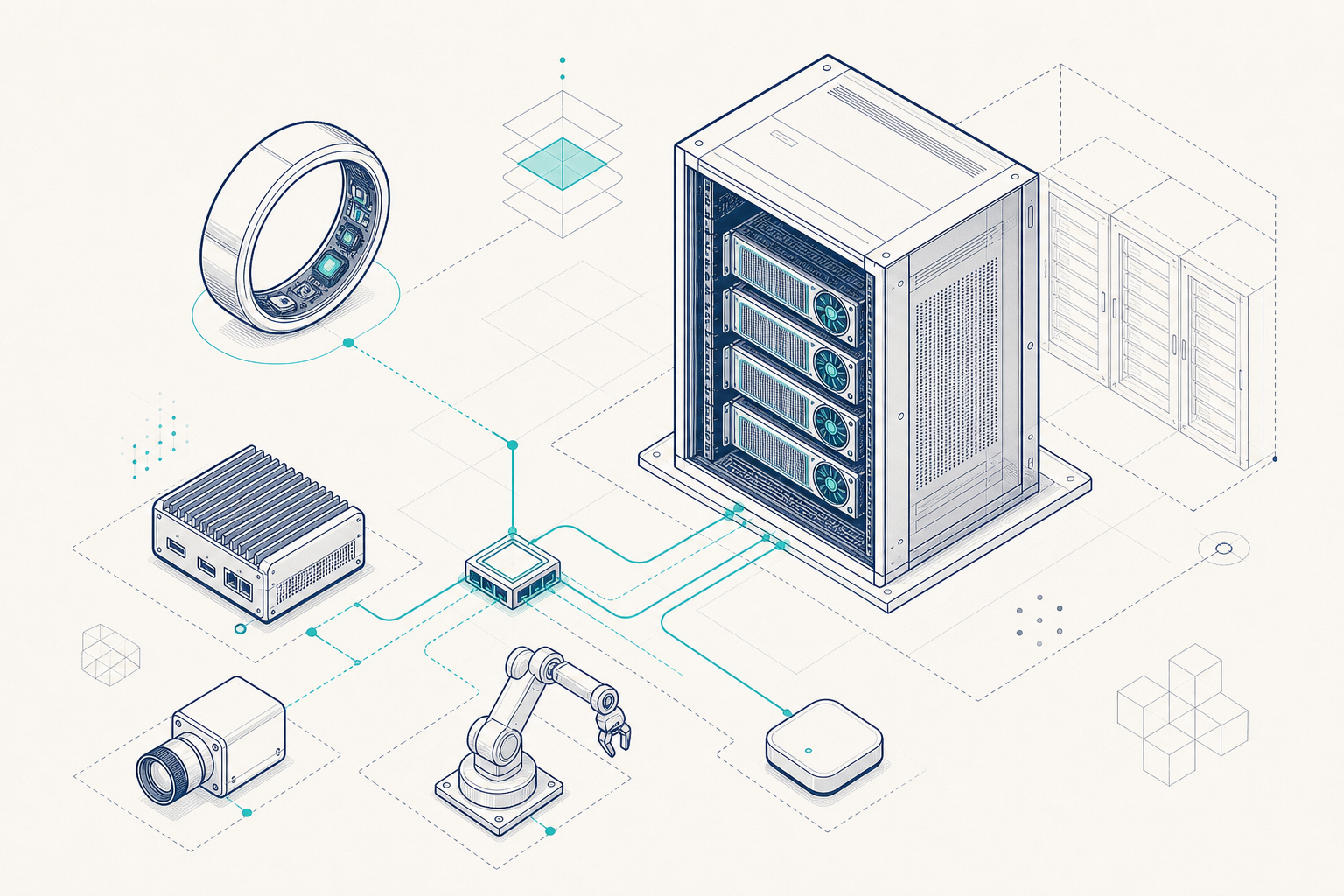
Qualcomm’s Ultrahuman investment is an edge-to-cloud signal
On 3 September 2026, TechCrunch reported that Qualcomm backed Ultrahuman’s $70 million funding round as the company works to move smart rings closer to general-purpose, on-device AI computers. The details matter less than the infrastructure direction: a semiconductor company with a large footprint in device compute is placing capital behind a wearable company whose product depends on continuous sensing, low-power inference and health-adjacent data flows.
For GPU cluster operators, this is not a story about rings. It is a story about where inference happens, where data is allowed to move, and which workloads remain in the rack.
If more interaction moves onto devices, some AI demand shifts away from central cloud inference. But it does not disappear. Device-side models still need training, fine-tuning, evaluation, synthetic data generation, federated learning coordination, fleet analytics, observability, model packaging and periodic retraining. The central estate changes from serving every token or prediction to operating as the control plane and heavy-compute layer for many small edge devices.
That is a better fit for some small and mid-size GPU operators than trying to imitate a hyperscaler’s public inference platform. A quarter rack to a few racks can serve local enterprises, hospitals, insurers, universities, retailers, energy operators or public-sector agencies that need sovereignty, low latency and auditable chargeback. The bottleneck is not only raw GPU count. It is whether the operator can schedule mixed GPU and CPU work, separate tenants, meter usage, enforce quotas, expose Kubernetes and VM tenancy, and keep sensitive data inside a jurisdiction.
Clastiq is built for that operating model: real hardware owned by the operator, hardware-agnostic across NVIDIA, AMD and mixed CPU/GPU estates, with bare-metal provisioning, Kubernetes and VM tenancy, GPU partitioning, Ceph storage, metering, quota engineering and support for air-gapped or sovereign deployments.
The workload moves, but the bottleneck does not vanish
A wearable or phone that performs more inference locally changes the pattern of traffic. Instead of every biometric signal being streamed to a distant region for processing, the device can filter, classify or summarize locally. That reduces bandwidth and can improve responsiveness. It also reduces exposure of raw data if the system is designed properly.
But edge AI creates a different central workload profile:
| Layer | What moves to the device | What remains on-prem or regional |
|---|---|---|
| Inference | Low-latency classification, prompts, personalisation | Larger models, fallback inference, batch scoring |
| Data | Raw high-frequency signals stay local more often | Aggregates, consented datasets, audit logs |
| Model lifecycle | Runtime execution and caching | Training, fine-tuning, validation, packaging |
| Governance | User-level controls | Tenant policy, residency, chargeback, retention |
| Operations | Device telemetry | Fleet monitoring, rollout control, incident response |
For a small GPU estate, the pressure point becomes orchestration. A hospital group may want to fine-tune a model on local data in the morning, run evaluation jobs in the afternoon, and reserve low-latency inference capacity overnight. A university team may need GPU-backed notebooks for two weeks. A public-sector tenant may require an isolated VM environment rather than a shared Kubernetes namespace. A consumer health company may need a sovereign region for Gulf users while keeping global model artifacts synchronised under policy.
These are not purely technical preferences. They determine whether the operator can sell the same physical estate more than once without overcommitting it, and whether users trust the platform enough to bring regulated or sensitive data.
The quarter-rack problem: uneven demand
Consider an operator in Muscat, Riyadh, Doha or Dubai running a small GPU service for local AI teams. The estate is not a hyperscale availability zone. It might be a quarter rack with 8 GPU servers, each with 4 GPUs, plus CPU nodes and Ceph storage. That is 32 GPUs. The hardware could be NVIDIA, AMD, or a mix; the scheduling and accounting problem is the same.
If the operator sells access manually, utilization usually fragments. One tenant reserves whole servers for training. Another needs two GPUs for inference. A third wants a VM with a GPU passed through because its stack is not container-ready. A fourth needs short benchmark windows. Without a shared control plane, the operator either says no to some users or leaves expensive accelerators idle.
The edge-to-cloud shift makes this worse because demand becomes burstier. Model build pipelines, evaluation runs and staged rollouts happen around product cycles rather than steady monthly usage. Local inference endpoints may need guaranteed latency for a few hours per day, while training jobs can be preemptible. Health data workloads may require stricter placement and storage controls than general computer vision work.
The operator bottleneck is therefore a mix of:
- GPU fragmentation: tenants ask for different shapes, from slices to full devices.
- Tenancy mismatch: some teams need Kubernetes, others need VMs or bare metal.
- Storage locality: datasets and artifacts must stay near compute and inside policy boundaries.
- Metering gaps: finance needs tenant-level GPU-hours, storage and network records.
- Quota drift: a single project can consume the estate unless policy is enforced.
- Power awareness: revenue must be understood per rack, per kilowatt and per megawatt.
A platform such as Clastiq resolves this by treating the estate as one governed pool rather than a set of manually assigned boxes. MAAS and Juju handle bare-metal provisioning and repeatable deployment. Kubernetes and VM tenancy sit on the same fleet. GPU partitioning supports multiple consumption patterns, including MIG where supported, time-slicing where appropriate, and full-device allocation when isolation or performance requires it. Ceph provides shared storage. Metering and chargeback give the operator the numbers needed to sell capacity without guessing.
Worked example: from idle GPUs to billable GPU-hours
Take the 32-GPU estate above. Assume each GPU has an internal target price of $2.40 per GPU-hour. That price is not a claim about market pricing; it is a simple operator model that includes depreciation, power, space, support and margin.
There are 32 GPUs available 24 hours per day for 30 days:
32 GPUs x 24 hours x 30 days = 23,040 available GPU-hours/month
In a manually allocated environment, average utilization might sit at 35% because of whole-server reservations, idle overnight capacity, and poor fit between tenant requests and available shapes:
23,040 available GPU-hours x 35% = 8,064 billable GPU-hours
8,064 x $2.40 = $19,353.60 monthly GPU revenue
Now assume the operator introduces shared scheduling, GPU slicing for suitable inference work, VM and Kubernetes tenancy on the same fleet, and quota-based access. Utilization rises to 62%. This is not automatic; it requires workload onboarding and policy. But the arithmetic shows why it matters:
23,040 available GPU-hours x 62% = 14,284.8 billable GPU-hours
14,284.8 x $2.40 = $34,283.52 monthly GPU revenue
The difference is $14,929.92 per month on the same GPU count. Annualised, that is $179,159.04 before considering storage, support plans or data services.
Power makes the point sharper. Suppose the GPU estate plus its share of cooling and platform overhead averages 22 kW. Monthly energy use is:
22 kW x 24 x 30 = 15,840 kWh/month
At the improved revenue level, the monthly revenue per MW of average IT-and-facility draw is:
$34,283.52 / 0.022 MW = $1,558,341 per MW-month
The exact number will vary by tariff, PUE, hardware class and local pricing. The operational lesson is stable: revenue per megawatt is a scheduling and governance metric, not just a hardware procurement metric. Edge AI increases the value of being able to fill gaps with smaller jobs, inference slices, evaluation runs and short-lived tenant environments.
Why device AI increases sovereignty requirements
Health and wellness devices sit close to regulated data. Even where a smart ring is marketed as a consumer product, it can generate signals that insurers, employers, clinicians or governments may treat as sensitive. If on-device AI reduces raw data movement, operators still need to handle derived data, model updates, telemetry and support cases. Those may fall under national data protection rules, sector rules, procurement policy, or contract-level residency commitments.
This is directly relevant in the GCC and wider MENA region. Operators serving customers in Oman, Saudi Arabia, the UAE, Qatar, Bahrain, Kuwait, Egypt or Jordan are often asked where data is stored, who can administer the platform, how logs are retained, whether foreign support access is possible, and whether workloads can run in an air-gapped or sovereign environment. The answer cannot be a slide. It has to be implemented in the platform.
For a small-to-mid estate, sovereignty requirements usually translate into placement and operations controls:
- Pin a tenant’s workloads to a local site or national boundary.
- Keep object, block and file storage in the same jurisdiction.
- Separate regulated tenants from general research users.
- Restrict administrative access and maintain audit trails.
- Support disconnected installation where the site cannot rely on a public cloud control plane.
- Provide usage records for internal chargeback or resale.
Clastiq’s relevance here is practical. It is designed for operators that own the hardware and need to run it locally. Air-gap and sovereign deployment requirements are part of the operating model. Ceph can keep storage under the operator’s control. Kubernetes and VM tenancy allow different application maturity levels without forcing every tenant into the same runtime. Metering, quotas and policy engineering create the evidence needed for governance and billing.
The mixed fleet is normal, not an exception
Edge-to-cloud AI estates rarely stay homogeneous. A ring, phone or gateway may use one accelerator architecture. The regional cluster may include several GPU generations bought across budget cycles. Some tenants may need specific libraries. Others only need generic container execution. CPU-heavy preprocessing jobs may be as important as GPU training runs.
Operators should assume mixed infrastructure from the start. That means hardware-agnostic scheduling and clear resource classes. A tenant should not simply ask for “a GPU” if the workload requires a certain memory size, interconnect, driver stack or partitioning mode. Conversely, a lightweight inference or evaluation job should not be allowed to occupy a full high-memory accelerator if a partition or lower tier will do.
A simple internal catalog helps:
resource_classes:
  gpu-full-training:
    isolation: full-device
    tenancy: kubernetes-or-vm
    quota_unit: gpu_hour
  gpu-sliced-inference:
    isolation: partitioned-or-timesliced
    tenancy: kubernetes
    quota_unit: slice_hour
  cpu-preprocess:
    isolation: namespace-or-vm
    tenancy: kubernetes-or-vm
    quota_unit: vcpu_hour
  sovereign-storage:
    backend: ceph
    quota_unit: tib_month
    residency: local-site
This kind of catalog is not about hiding complexity. It makes complexity billable and governable. Tenants can choose the class that matches their workload. Operators can attach quotas, prices and placement rules. Finance can see consumption by tenant instead of by anecdote.
Partitioning is useful, but not magic
GPU partitioning is one of the first tools operators reach for when inference demand grows. It can improve utilization by allowing multiple smaller workloads to share a device. MIG on supported GPUs can provide stronger partition boundaries. Time-slicing can be useful for development, notebooks, bursty inference or lower-criticality tasks. Full-device allocation remains necessary for many training jobs, latency-sensitive workloads and cases where isolation requirements are strict.
The operator decision is not “partition everything”. It is to expose the right menu:
- Full GPU for training, high memory use and strict isolation.
- MIG or equivalent partitioning where the hardware supports it and the workload fits.
- Time-sliced access for development, experimentation and lower-priority inference.
- CPU-only queues for preprocessing and postprocessing.
- VM tenancy for tenants that need their own OS-level environment.
- Kubernetes tenancy for teams ready to run containers and pipelines.
The important point is metering. If a tenant consumes one GPU slice for 10 hours, that should not be billed or quota-counted the same way as a full GPU for 10 hours unless the operator deliberately prices it that way. If a VM holds a GPU idle, the reservation should still appear in chargeback. If a notebook keeps a slice overnight, the tenant should see the cost.
Edge AI makes this more important because central jobs may be smaller but more numerous. Model validation for a device fleet might run thousands of short tasks. Without accurate metering, those tasks look like background noise until the cluster is congested.
Storage and data gravity still decide outcomes
Wearable and consumer health systems generate time-series data, embeddings, labels, firmware artifacts, model checkpoints and audit logs. Even if raw signals remain on the device, the on-prem or regional cluster needs storage discipline.
Ceph is useful in this pattern because it can provide operator-controlled storage across object, block and file use cases, depending on deployment design. The key is not only capacity. It is quota, locality, retention and tenant separation.
A small GPU operator should define storage classes alongside GPU classes. For example, hot datasets used for training need high throughput and may justify higher chargeback. Model artifacts require versioning and retention. Audit logs need integrity and lifecycle rules. Temporary preprocessing space should expire automatically. If everything lands in the same undifferentiated pool, the operator will eventually face a storage incident that looks like a GPU incident because jobs cannot read or write fast enough.
For GCC and MENA operators, storage location is also a commercial feature. A local AI company building health, Arabic-language, financial or government workloads may choose a regional on-prem provider because the data does not leave the country and support is available locally. That promise depends on storage architecture, not only on a sales commitment.
Chargeback makes the platform investable
Many small GPU estates start as internal infrastructure. A university buys servers for research. A hospital group builds an AI lab. A telecom operator deploys GPUs for internal analytics. A systems integrator hosts a few tenants. The first operational failure is often not technical; it is financial opacity.
If no one can show who used which GPUs, which storage, and which support tier, the platform becomes a cost center that is hard to expand. If the operator can show utilization, revenue per megawatt, tenant growth and quota compliance, expansion becomes a board-level decision with evidence.
A basic monthly tenant statement might include:
- Full GPU-hours.
- Slice-hours or partition-hours.
- vCPU-hours for preprocessing.
- TiB-months of storage by class.
- Public or private network egress where applicable.
- Reserved capacity versus consumed capacity.
- Support or managed-service fees.
This matters for edge AI because the central platform may support many product teams or external customers whose device fleets are at different stages. One team may be preparing a clinical study. Another may be running a consumer pilot. Another may be validating models for Arabic dialect support. Chargeback prevents the loudest tenant from consuming the shared estate without accountability.
Where Clastiq fits in the operator stack
Clastiq’s role is not to decide whether inference belongs on a ring, a phone, a gateway or a GPU cluster. The operator’s job is to provide a governed substrate for the parts that remain central or regional.
In practical terms, that means:
- Provisioning bare metal consistently with MAAS and Juju.
- Running Kubernetes and VM tenancy on the same physical fleet.
- Supporting GPU partitioning models appropriate to the hardware.
- Keeping storage under operator control with Ceph.
- Applying tenant quotas, placement rules and access policy.
- Producing usage records for metering and chargeback.
- Supporting air-gapped and sovereign deployments where required.
- Enabling human-led local support for operators that cannot rely only on remote hyperscaler abstractions.
This is especially relevant for operators that own a quarter rack to a few racks. At that size, every stranded GPU matters. Every manual handoff consumes staff time. Every unclear tenant boundary increases risk. The economic target is not hyperscale volume. It is higher utilization, clearer governance and more revenue per watt from hardware already under the operator’s control.
The operator takeaway
Qualcomm’s backing of Ultrahuman is one more signal that AI interaction will continue to spread across devices. That does not make regional GPU infrastructure less relevant. It changes what regional infrastructure is for.
The rack becomes the place where models are trained, evaluated, packaged, governed and periodically served when the device cannot or should not do the work. It becomes the sovereign control plane for sensitive data flows. It becomes the local capacity pool for companies that need low-latency support without sending everything to a distant cloud region.
For small and mid-size GPU operators, the opportunity is not to chase every inference request. It is to operate the edge-to-cloud middle layer well: mixed tenancy, partitioned GPUs, clear quotas, local storage, auditable metering and power-aware economics.
What to do this week
- Inventory your current GPU estate by usable resource class: full GPU, partition-capable GPU, time-slice candidates, CPU preprocessing nodes and storage tiers.
- Calculate last month’s available GPU-hours, consumed GPU-hours and utilization. If you cannot do this by tenant, treat metering as a priority gap.
- Define three standard tenant offers: full-device training, partitioned inference or development, and VM-based regulated workload tenancy.
- Review data-residency requirements for health, consumer, government and financial workloads in your target GCC or MENA market.
- Add power to your operating model: track revenue and cost per kW, not only per server or per GPU.
- Test one quota policy that prevents a single tenant from consuming idle capacity indefinitely without chargeback visibility.
Clastiq runs this model on the operator’s own hardware; request a demo to discuss a quarter-rack to few-rack deployment.