Satlyt's funding points to a real placement problem
Satlyt raised $8 million on October 1, 2026, according to TechCrunch, to build infrastructure for coordinating AI workloads across satellites. The company describes an abstraction layer for space infrastructure, compared in the article with VMware and Snowflake, so that complex jobs can be shared across many satellites instead of bound to one spacecraft or one vertically integrated operator stack.
The space angle is unusual. The infrastructure problem is not. When compute nodes are constrained, intermittently connected, power limited, and geographically distributed, the central bottleneck is workload placement. Which node should run the job, when should it run, where is the data, what happens if the node disappears, and who pays for the consumed capacity?
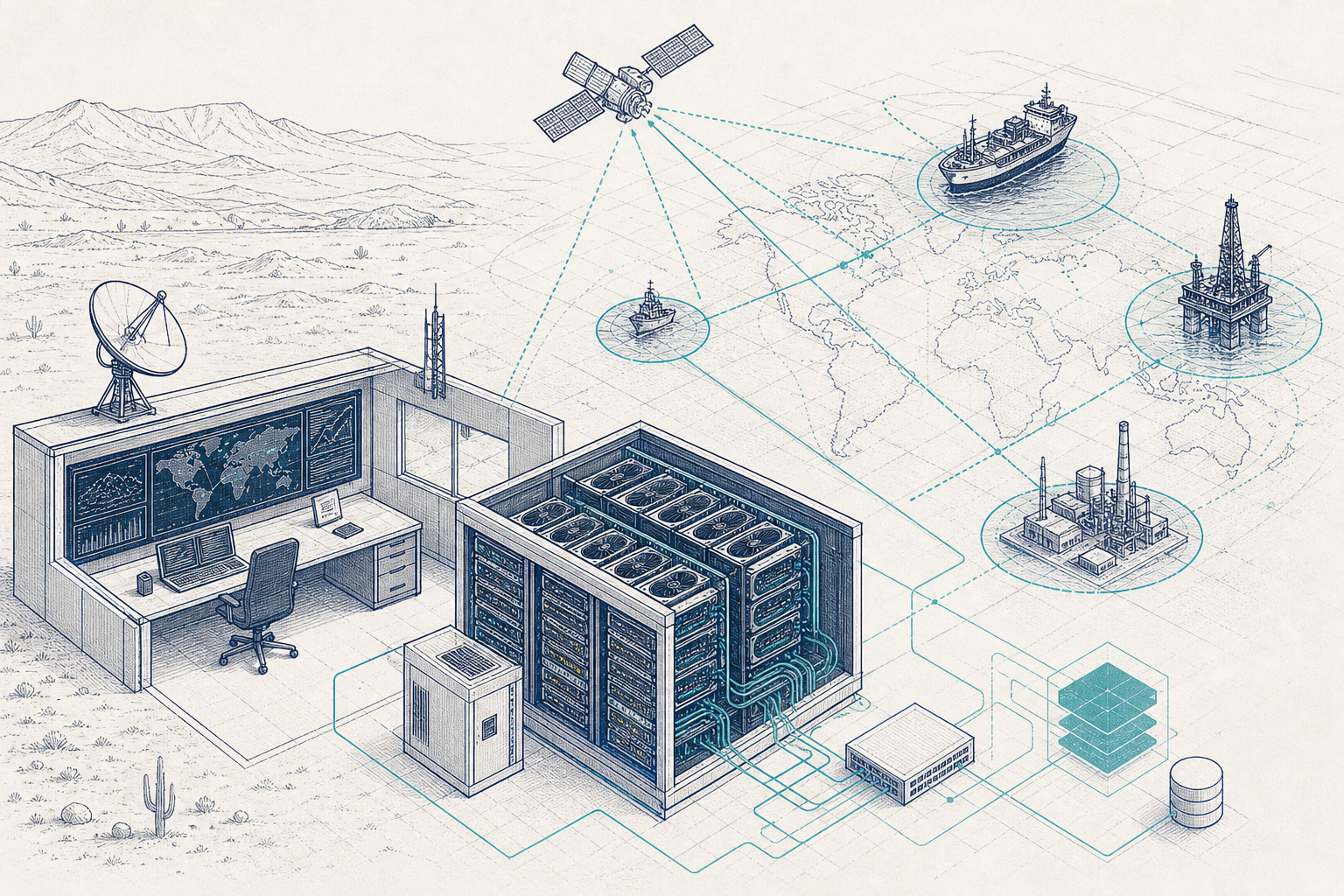
For operators of small and mid-size GPU estates, from a quarter rack to a few racks, this is not an abstract satellite problem. It is the daily operating model for edge AI in remote industrial sites, ports, offshore platforms, logistics yards, security operations, and desert facilities. The node may not be in orbit, but it may still have intermittent backhaul, hard power ceilings, local data gravity, strict sovereignty rules, and multiple tenants competing for a small number of accelerators.
The lesson for terrestrial operators is clear: utilization is not solved by buying GPUs. Utilization is created by scheduling, tenancy, storage locality, quotas, metering, and recovery behavior. If those controls are absent, the estate behaves like a set of expensive islands.
ClastIQ is built for that operating gap. It runs on the operator's own hardware, uses bare-metal provisioning, Kubernetes and VM tenancy, GPU partitioning, Ceph storage, per-tenant metering, quota engineering, and air-gap friendly deployment patterns. The goal is to make a small GPU estate governable, chargeable, and predictable without requiring a hyperscaler operating model.
The satellite abstraction translates to the edge cluster
A satellite constellation has some obvious constraints: limited power, limited thermal headroom, intermittent downlink, nonuniform sensors, and narrow maintenance windows. A remote terrestrial GPU deployment has a similar shape, even if it is bolted into a rack.
A quarter rack at a mine site or port control room may have 4 to 8 GPUs, a few CPU nodes, local NVMe, a small Ceph footprint, and a link back to a regional data center or cloud. The AI workload may include video inference, anomaly detection, document extraction, local model serving, batch analytics, and occasional fine-tuning. The estate may serve internal departments and external tenants. Some jobs must stay local because of latency or sovereignty. Some can be delayed. Some can burst to another site if policy permits.
The hard part is not launching a container. The hard part is deciding whether a job should run at all, where it should run, under which tenant identity, against which data copy, with what checkpoint interval, with what GPU slice, and under what chargeback model.
That is the same class of problem Satlyt is addressing in space: abstract scarce and unreliable compute into a usable substrate. For a terrestrial operator, the abstraction must be practical. It has to work with real servers, mixed accelerators, legacy network constraints, storage failures, tenant politics, and monthly invoices.
The bottleneck is placement, not raw FLOPS
A small GPU estate rarely fails because peak theoretical performance is too low. It fails because the wrong workloads hold the wrong devices at the wrong time.
Common failure modes include:
- A batch training job occupies full GPUs while latency-sensitive inference queues grow.
- Video analytics streams run on full accelerators although fractional GPU allocation would be enough.
- Data is copied repeatedly over an expensive or unreliable link because storage locality is not modeled.
- A tenant reserves GPUs for a project but does not use them, while another tenant waits.
- Jobs restart from the beginning after power or network interruption because checkpointing is optional.
- Chargeback is based on spreadsheet estimates instead of measured GPU-hours, CPU-hours, memory, storage, and egress.
- Sovereignty rules are documented in policy files but not enforced in the scheduler.
This is where the operator's control plane matters. Bare-metal provisioning ensures the fleet can be rebuilt consistently. Kubernetes provides container orchestration and service placement. VM tenancy gives teams a familiar boundary for legacy software and long-running environments. GPU partitioning lets the operator allocate full devices, MIG instances, or time-sliced capacity. Ceph gives a common storage substrate across nodes. Metering and quotas turn scarce capacity into an accountable service.
ClastIQ does not require the operator to standardize on one accelerator vendor. A mixed CPU and GPU estate can include NVIDIA and AMD capacity, with policy determining which tenants and workloads can use each class of device. Hardware agnosticism is important in GCC and MENA markets because procurement often follows availability, sovereign sourcing, project finance, and site-specific power envelopes rather than a single reference architecture.
A worked example: remote inference and batch AI on 8 GPUs
Consider a regional industrial operator with one edge cluster serving a desert facility, a port site, and an internal analytics team. The estate has 8 GPUs, each available for 720 hours in a 30 day month. That is 5,760 theoretical GPU-hours.
Before orchestration, utilization is measured from device telemetry at 31 percent. The estate therefore delivers:
5,760 GPU-hours x 31 percent = 1,785.6 used GPU-hours per month.
Assume the internal cost model, including depreciation, support, power, cooling, space, and operations labor, is $2.40 per available GPU-hour. The monthly cost of the GPU layer is:
5,760 available GPU-hours x $2.40 = $13,824.
At 31 percent utilization, the effective cost per used GPU-hour is:
$13,824 / 1,785.6 = $7.74 per used GPU-hour.
Now apply basic placement controls. Video inference jobs use fractional GPU allocation where supported. Batch analytics jobs are queued into off-peak windows. Training jobs must checkpoint every 30 minutes. Sovereign datasets are labeled so they stay on the local site. Tenants receive hard monthly quotas and burst limits. Idle reservations are reclaimed after a defined grace period.
If utilization rises to 62 percent without adding hardware, the delivered work becomes:
5,760 GPU-hours x 62 percent = 3,571.2 used GPU-hours per month.
The infrastructure cost remains $13,824, so the effective cost per used GPU-hour becomes:
$13,824 / 3,571.2 = $3.87 per used GPU-hour.
Nothing magical happened. The operator did not double the number of GPUs. It doubled useful consumption by reducing fragmentation, idle reservations, and poor placement.
For chargeback, assume three tenants consume the following measured hours in that month:
| Tenant | Workload type | Measured GPU-hours | Rate per GPU-hour | Chargeback |
|---|---|---|---|---|
| Port operations | Video inference | 1,120 | $4.60 | $5,152 |
| Desert facility | Anomaly detection | 1,480 | $4.60 | $6,808 |
| Analytics team | Batch AI | 840 | $3.90 | $3,276 |
Total billed chargeback is $15,236. Against a GPU layer cost of $13,824, the operator has $1,412 available to cover shared platform services, storage growth, or reserves. The exact rate is a business decision. The infrastructure requirement is that usage is measured, attributable, and enforceable.
What ClastIQ has to control in this pattern
The orchestration layer needs to bind four views of the estate: physical hardware, workload intent, tenant policy, and economics.
Physical hardware includes GPUs, CPUs, RAM, local NVMe, network links, power budgets, and rack topology. Bare-metal provisioning through MAAS and Juju matters because small fleets cannot absorb snowflake rebuilds. If a node is replaced, it should return to the same role with the right firmware baseline, network configuration, storage role, and accelerator plugin behavior.
Workload intent describes whether a job is latency-sensitive inference, interruptible batch, stateful model serving, development, or a VM tenant. Kubernetes is useful for elastic and containerized workloads. VMs remain important for vendor software, regulated tenant images, and teams that need operating system control. A realistic platform supports both on the same fleet rather than forcing every workload into one abstraction.
Tenant policy decides who gets priority. A port safety workload may preempt a research job. A sovereign dataset may be pinned to an Omani site. A maritime customer may be allowed to burst into a regional cluster but not to a public cloud. A batch workload may run only when power pricing or generator load permits.
Economics turns the cluster from a shared technical asset into a governed service. GPU-hours, CPU-hours, memory allocation, storage consumed, object operations, image storage, and network egress need to map to departments, projects, or external tenants. Without that mapping, utilization debates become political because nobody can show who consumed the scarce resource.
Queueing, checkpointing, and intermittent connectivity
Remote AI estates need to assume failure. Backhaul will degrade. A site may run on constrained power. Maintenance windows may move. A job may lose access to its object store. Operators should build for resumability rather than hoping the network behaves like a metro data center.
Queueing is the first control. Jobs should declare resource needs and urgency instead of landing wherever a user found capacity. A simple queue can separate real-time inference, scheduled batch, development, and best-effort work. More advanced policy can include data locality, GPU type, memory size, tenant priority, and power state.
Checkpointing is the second control. Training and batch analytics should write periodic state to resilient storage. At small scale, even one lost 10 hour job is expensive. At $4.60 per GPU-hour on 4 GPUs, a failed 10 hour run burns $184 of GPU capacity before labor and schedule impact. More importantly, it blocks other tenants.
Data locality is the third control. If a model consumes sensor data generated at a desert site, it may be cheaper and safer to run inference there and send back only results. If a batch job needs a large historical corpus already stored in a regional Ceph cluster, it may be better to dispatch the job to that cluster instead of pulling terabytes across a weak link.
A practical operator policy might look like this:
clastiq quota set tenant=port-ops gpu_hours_month=1400 burst_gpu=2 priority=high
clastiq quota set tenant=analytics gpu_hours_month=900 burst_gpu=1 priority=normal
clastiq policy set dataset=sovereign-video locality=oman-only egress=deny
clastiq queue submit job=nightly-batch tenant=analytics gpu=1 checkpoint=30m max_runtime=8h
The commands are illustrative, but the operating intent is specific: make placement a declared policy, not a series of manual negotiations.
GPU partitioning is a utilization tool, not a checkbox
For small estates, GPU partitioning can decide whether the platform is economically viable. Many inference workloads do not need an entire accelerator all day. Some need memory isolation. Some need predictable latency. Others are tolerant of time sharing.
Where supported, MIG can divide a physical GPU into isolated instances with defined memory and compute profiles. Time-slicing can improve utilization for lighter workloads, development, or bursty inference. Full GPU allocation remains necessary for large training, high memory models, or workloads that cannot tolerate contention.
The operator decision is not simply enabling every partitioning mode. It is mapping partitioning to service classes. For example:
| Service class | Typical allocation | Best fit | Risk to manage |
|---|---|---|---|
| Critical inference | MIG or dedicated GPU | Safety and operations feeds | Latency under contention |
| Batch analytics | Full GPU or time-slice | Scheduled jobs | Restart cost after failure |
| Development | Time-slice | Notebooks and testing | Idle sessions |
| Tenant VM | Dedicated GPU or mediated profile | Legacy software | Long reservations |
A few racks can behave like a much larger estate if small jobs stop consuming full devices unnecessarily. The reverse is also true: a few bad reservations can make a cluster look full while useful output remains low.
GCC and MENA relevance: sovereignty at the edge
The GCC and broader MENA region have a distinct edge AI profile. Energy, logistics, aviation, public safety, ports, defense-adjacent industry, tourism infrastructure, and desert mobility all create data outside conventional data centers. Many sites are remote. Some links are expensive or intermittent. Some data is sensitive because it involves industrial operations, national infrastructure, location intelligence, or citizen services.
A hyperscaler region can be part of the architecture, but it cannot be the default answer for every workload. Latency, data residency, procurement policy, national cloud strategy, and operating continuity all matter. A port may need local inference even when the international link is degraded. An energy facility may need to keep sensor streams on premises. A public sector operator may require air-gap or sovereign deployment patterns.
This is why the Satlyt story matters beyond space. It shows the direction of infrastructure: compute fabrics are moving toward constrained, distributed, policy-heavy environments. For GCC and MENA operators, the practical question is how to run that fabric on owned hardware without losing utilization discipline.
ClastIQ's role is to provide the control plane for that owned estate. It provisions bare metal, supports Kubernetes and VM tenancy, partitions accelerator capacity where the hardware allows, attaches storage, meters consumption, enforces quotas, and supports air-gap and sovereign deployments. The objective is not to imitate a hyperscaler interface for its own sake. The objective is to give the operator the same governance tools on a smaller physical footprint.
Storage and power are part of placement
Placement decisions fail when storage and power are treated as afterthoughts. A job that looks schedulable from a GPU perspective may be wrong if the data is remote, the Ceph pool is degraded, or the site is approaching its power envelope.
Ceph gives small estates a way to pool storage across nodes and expose block, file, or object-like services depending on design. It also gives operators a consistent place for checkpoints, datasets, tenant volumes, and images. That consistency matters during failure. If a GPU node is drained, the replacement job needs to find its state without a manual recovery exercise.
Power is equally important. Revenue per megawatt is a better executive metric than raw utilization when the operator is constrained by electrical supply. Suppose the 8 GPU edge cluster draws 7 kW at average load including servers, networking, and storage. Annualized, that is:
7 kW x 24 x 365 = 61,320 kWh, or 0.06132 GWh.
If the estate delivers 3,571.2 used GPU-hours per month after orchestration, annual delivered work is 42,854.4 GPU-hours. At an average realized chargeback rate of $4.27 per GPU-hour, annual chargeback is:
42,854.4 x $4.27 = $182,888.29.
The implied annual revenue per MW of continuous load is based on 0.007 MW average load:
$182,888.29 / 0.007 = $26.13 million per MW-year.
This is not a universal benchmark. It is an operator math method. It connects scheduling decisions to power economics. If a site has only 50 kW available for IT load, the platform must convert that power into the highest useful work per watt while honoring policy.
Governance is the difference between shared and sellable
A shared GPU cluster without metering is a technical commons. A metered, quota-controlled, policy-enforced cluster is a service. That distinction matters for municipalities, universities, industrial groups, telecom operators, and private data center owners that want to offer AI capacity from a small estate.
Tenancy should answer five questions:
- Who is allowed to run the workload?
- Which hardware classes can they use?
- Which datasets can they access or export?
- What quota, priority, and preemption rules apply?
- What did they consume, and what is the chargeback basis?
If those answers live in tickets and spreadsheets, the operator will struggle as demand grows. If they live in the platform, the estate can support more tenants without losing control.
This is also where air-gap and sovereign deployments become operational rather than ceremonial. An air-gapped cluster still needs image management, patch processes, identity integration, metering exports, and support workflows. Sovereign placement still needs labels, admission controls, storage policy, and audit trails. The paperwork must map to scheduler behavior.
What to do this week
- Inventory every GPU workload by type: real-time inference, batch, training, development, VM tenant, or idle reservation.
- Measure actual used GPU-hours for the last 30 days and compare them with available GPU-hours. Calculate effective cost per used GPU-hour.
- Identify workloads that can move from full GPU allocation to MIG, time-slice, or scheduled batch windows.
- Label datasets by locality and sovereignty requirement, then convert those labels into placement policy.
- Set tenant quotas for the next month, including burst limits, preemption rules, and checkpoint requirements for long jobs.
- Review power and storage constraints before approving new workloads, not after the queue is already blocked.
ClastIQ runs this on the operator's own hardware, request a demo.