Satlyt's $8 million round puts the constraint in view
TechCrunch reported on October 1, 2026 that Satlyt raised $8 million to run AI on satellites. The reported round is small compared with the capital going into large training clusters, but the infrastructure signal is important. The next AI deployment problem is not only how to buy more accelerators. It is how to place useful inference where the data is created, where connectivity is limited, where power is rationed, and where an operator still needs governance, updates, tenant isolation, and cost recovery.
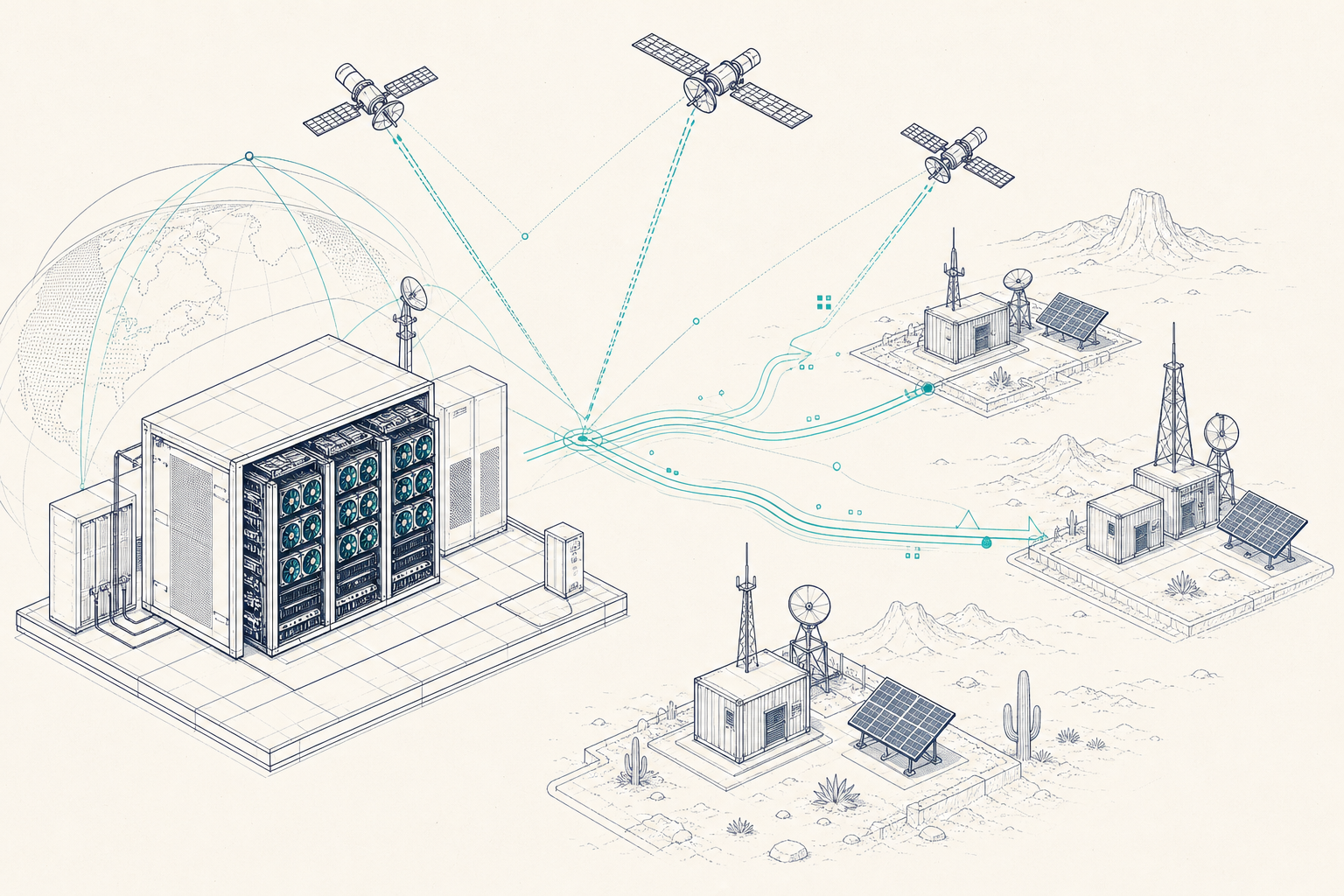
Satellite inference is an extreme case. The accelerator may be in orbit, the link may be intermittent, the model has to fit within tight memory and power envelopes, and an update that fails cannot be fixed by walking to a rack. The same pattern appears in less exotic places: remote energy sites, ports, border facilities, mines, telecom aggregation rooms, sovereign research labs, offshore assets, and temporary event infrastructure. Data is local. Connectivity is uneven. Latency matters. Security policy may prevent raw data from leaving the site. The estate is not one giant cloud region. It is a central room plus a set of small edge pools.
For a GCC or MENA operator that owns a quarter rack to a few racks of GPU and CPU hardware, the practical question is not whether satellite AI is the immediate workload. The question is what the Satlyt story says about the operating model. If inference moves toward distributed locations, the operator needs one control plane that can decide what runs centrally, what runs at the edge, how models are packaged, how quotas are enforced, how telemetry is buffered, how updates are signed, and how GPU-hours are billed back to tenants.
That is where the bottleneck shifts. Hardware remains scarce and expensive, but the limiting factor becomes orchestration discipline.
The edge inference bottleneck is not just accelerator count
A small GPU estate can be deceptively hard to operate because it has cloud-like expectations without cloud-scale staff. A team may have 8 to 64 GPUs, a few CPU-only nodes, a storage cluster, a firewall boundary, and several tenants asking for Kubernetes, VMs, notebooks, model serving, and batch jobs at the same time. The estate may also have remote locations that need local inference during network interruptions.
In that environment, edge inference introduces six operator constraints.
First, packaging becomes a capacity issue. A model that is convenient in a central lab may be too large for a remote node, too slow on a smaller accelerator, or too expensive to replicate over a weak link. Operators need a catalog of approved artifacts: full precision, quantized, distilled, and CPU fallback variants. They also need a way to map those artifacts to node classes.
Second, connectivity becomes a scheduling input. Workloads cannot assume permanent access to object storage, license servers, identity providers, or telemetry backends. The scheduler needs placement rules that understand disconnected operation, cached images, local storage, and delayed log shipping.
Third, updates become a risk surface. A remote model update has to be signed, staged, rolled out, observed, and rolled back. If the site is air-gapped or sovereign, the update chain has to work through an approved transfer process. Operators need reproducibility, not ad hoc copying of containers.
Fourth, telemetry becomes part of the product. If the operator wants chargeback or customer billing, metering must continue when sites are offline and reconcile when they reconnect. GPU allocation, memory partition use, CPU fallback, storage reads, and network transfer all become billable or at least accountable.
Fifth, power is a placement constraint. A remote cabinet with a 3 kW envelope cannot be treated like a data center row. In hot climates, including many GCC and MENA deployments, cooling margin also affects when and where to run nonurgent inference.
Sixth, tenancy has to survive topology. A central Kubernetes cluster with namespaces is not enough if edge nodes host multiple organizations, ministries, business units, or customers. Quotas, admission policy, secrets, image provenance, and network segmentation have to apply consistently.
These are control plane problems. They do not disappear if the hardware vendor changes. A hardware-agnostic estate may include NVIDIA GPUs, AMD GPUs, CPU-only nodes, and older accelerators reserved for lower priority inference. The operating question is how to convert that mixed capacity into governed pools.
What a small GPU operator will actually hit
Consider a regional operator with one central room and three remote inference sites. The central room has 16 GPUs and 24 CPU servers. Each remote site has 2 GPUs and local NVMe storage. The tenants are a university lab, an industrial inspection team, an Arabic document AI team, and a managed service customer. The central site hosts model build, validation, and larger batch jobs. The remote sites run camera analytics, document extraction, or sensor inference near the data source.
The first week may work with manual scripts. By the third month, the failure modes are predictable:
- Tenants reserve full GPUs for models that need only a fraction of memory.
- Edge nodes run stale images because the link was down during the update window.
- Central storage fills with duplicate model weights.
- No one can prove which tenant consumed which GPU-hours.
- A remote site keeps running noncritical jobs during peak cooling load.
- A team wants a VM for a licensed application while another wants Kubernetes on the same fleet.
- Finance asks for a cost per GPU-hour and the infrastructure team has only node uptime.
This is why bare-metal provisioning, Kubernetes, VM tenancy, partitioning, storage, quota engineering, and metering have to be treated as one operating system for the estate. If each layer is installed separately, the operator inherits integration work that is larger than the hardware footprint.
ClastIQ is designed for this class of owner operated estate. It uses bare-metal provisioning with MAAS and Juju patterns, supports Kubernetes and VM tenancy on the same fleet, manages GPU partitioning through mechanisms such as MIG where supported and time-slicing where appropriate, integrates Ceph storage, and provides per-tenant metering and chargeback. The point is not to imitate a hyperscaler interface. The point is to make a small or mid-size estate governable enough to behave like a disciplined region.
A common control plane for central and edge pools
The control plane should answer a simple placement question for every workload: should this run centrally, remotely, or both?
For satellite-like and remote inference, the answer depends on model size, privacy, latency, connectivity, and energy. A raw video inspection workload may need to run at the remote site because backhaul is expensive and latency matters. A nightly retraining job should run centrally because it needs more GPUs, more storage, and more stable power. A document model may run locally for sovereignty but send only aggregate telemetry back to the center.
An operator-grade platform needs to express these differences as policy, not tribal knowledge. The table below shows a practical policy split.
| Workload type | Preferred location | Operator control needed |
|---|---|---|
| Low latency sensor inference | Remote GPU or CPU fallback | Cached images, local queues, power caps |
| Batch model evaluation | Central GPU pool | Quotas, storage throughput, metering |
| Sovereign document inference | Local or in-country site | Data residency, signed artifacts, audit logs |
| Training and fine tuning | Central pool | Multi-GPU scheduling, Ceph capacity, chargeback |
| Emergency analytics | Any available pool | Priority class, preemption rules, budget override |
This policy has to reach below Kubernetes. Bare-metal provisioning matters because edge nodes and central nodes need consistent firmware state, OS images, drivers, container runtimes, and storage mounts. VM tenancy matters because not every tenant can move to containers. Some licensed applications and legacy inference stacks still need a VM. Storage matters because model artifacts and telemetry queues must be local enough to survive link loss. Metering matters because without it, every tenant will ask for peak allocation and pay for average use.
A system like ClastIQ ties these controls together on the operator's own hardware. For example, an operator can maintain a central GPU pool for training and validation, assign smaller partitioned slices for inference tenants, and reserve CPU-only fallback capacity for remote sites. Quotas then become an operating contract: a tenant receives a defined number of GPU-hours, storage capacity, and priority classes, rather than informal access to nodes.
Numeric example: utilization and chargeback
Assume a small estate owns 24 GPUs across a central room and remote sites. Each GPU can provide 730 hours of calendar capacity in a 30.4 day month, so the theoretical monthly capacity is:
24 GPUs x 730 hours = 17,520 GPU-hours per month.
Before orchestration, the operator sees 32 percent effective utilization because tenants over-reserve, jobs wait for manually prepared nodes, and inference workloads occupy whole GPUs. Billable or accountable usage is therefore:
17,520 x 0.32 = 5,606 GPU-hours per month.
If the monthly all-in operating cost allocated to the GPU estate is $52,560, including depreciation reserve, power, cooling, support labor, software operations, and space, the effective cost per used GPU-hour is:
$52,560 / 5,606 = $9.38 per used GPU-hour.
Now assume the operator introduces partitioning for suitable inference jobs, clear quotas, automatic provisioning, and tenant metering. Effective utilization rises to 58 percent. The hardware did not change.
17,520 x 0.58 = 10,162 GPU-hours per month.
The same $52,560 monthly cost now becomes:
$52,560 / 10,162 = $5.17 per used GPU-hour.
If the operator charges internal or external tenants $7.25 per GPU-hour for the metered pool, monthly recognized revenue or chargeback is:
10,162 x $7.25 = $73,675.
The operating margin before other corporate costs is:
$73,675 minus $52,560 = $21,115 per month.
This example is intentionally modest. It does not assume new accelerators, a special benchmark, or perfect utilization. It shows why control plane work matters. The same 24 GPUs move from being a scarce shared lab asset to a measurable production estate. For a power constrained operator, the same logic can be expressed as revenue per megawatt. If the estate consumes an average of 70 kW including cooling overhead, that is 0.07 MW. At $73,675 per month, the monthly revenue per MW is:
$73,675 / 0.07 = $1,052,500 per MW per month.
That figure is only meaningful if utilization and metering are real. Without trustworthy tenant records, revenue per MW becomes a spreadsheet assumption.
Partitioning without pretending all GPUs are the same
Edge inference often needs smaller slices of accelerator capacity. A model that uses 8 GB of memory should not block a full high memory GPU if the hardware supports safe partitioning. Where available, MIG can provide hard partitions. Where MIG is not available, time-slicing may improve throughput for tolerant inference workloads. On other hardware, the right answer may be process isolation, VM assignment, or CPU fallback.
The operator should avoid a single policy called small GPU. Partitioning has to reflect actual isolation, memory behavior, tenant risk, and service level. A research notebook, an internal document classifier, and a paid customer inference endpoint do not have the same tolerance for noisy neighbors.
A practical control plane stores these differences as labels, classes, and quotas. The exact syntax will vary by environment, but the intent should be explicit:
# Example placement labels for an edge inference node
kubectl label node edge-oman-01 site=remote-gpu
kubectl label node edge-oman-01 connectivity=intermittent
kubectl label node edge-oman-01 power_class=limited
kubectl label node edge-oman-01 data_residency=oman
kubectl label node edge-oman-01 gpu_partitioning=time-slice
Those labels are not decoration. They let admission policy decide whether a workload is allowed to land on a node, whether it must use a cached image, whether it can run during a constrained power window, and whether it satisfies data residency rules. The same principle applies to VMs. If a tenant needs a VM near a data source, the VM should still be part of inventory, quota, metering, backup, and update policy.
For GCC and MENA operators, this is especially relevant because deployment geography can be politically and operationally significant. A workload may need to remain in Oman, Saudi Arabia, the UAE, Qatar, Bahrain, Kuwait, or another national boundary. A remote energy site may have limited backhaul and a strict maintenance window. A government or regulated tenant may require an air-gapped update process. Edge inference makes these constraints normal, not exceptional.
Storage and model distribution are first order concerns
A distributed inference estate is also a storage estate. Model weights, tokenizers, calibration data, test sets, telemetry, audit logs, and container images all consume space. If every tenant copies every model to every node, a small Ceph cluster or local NVMe pool will fill quickly. If nothing is cached at the edge, workloads fail when links drop.
The operator needs a model artifact workflow with four properties.
First, artifacts should be versioned and signed. A tenant should not be able to replace a model silently on a remote node.
Second, artifacts should be packaged for the target. A central GPU may run a larger model, while a remote node runs a quantized variant with known accuracy and latency tradeoffs.
Third, storage should be tiered. Frequently used inference artifacts should be local. Larger training data and long retention logs can remain central. Ceph can provide the common storage foundation across the estate, while edge nodes maintain caches or local queues.
Fourth, telemetry should be buffered. If a remote site loses connectivity, metering and audit records must not disappear. They should queue locally, then reconcile with the central accounting system.
This is where operators often underestimate complexity. The model is only one file in a demo. In production, the model is a chain of dependencies, runtime versions, GPU drivers, container images, prompts, policies, test records, and tenant permissions. The control plane has to treat that chain as infrastructure.
Sovereignty, air-gap, and secure updates
The Satlyt example makes one security point obvious: if the target is hard to reach, updates must be boring and repeatable. The same applies to sovereign and air-gapped GCC deployments. Operators need a defined path from development to validation to staging to production, with approvals and rollback.
For an air-gapped site, the update process may involve an offline registry mirror, signed bundles, checksum verification, and a maintenance window. For an intermittently connected edge site, it may involve staged downloads, health checks, and delayed activation. In both cases, the operator should know which tenant, model version, node, and time window were involved.
This is not only a cybersecurity issue. It is also a billing and support issue. When a model update increases GPU memory use by 40 percent, the tenant's quota and cost profile change. When an image pull saturates a weak link, another tenant's workload may miss its service target. When a remote node falls back to CPU, latency and cost allocation change. Metering has to capture the operational reality, not just the desired schedule.
ClastIQ's relevance is in joining the layers that are usually separated: bare-metal state, Kubernetes scheduling, VM allocation, GPU partitioning, Ceph-backed storage, tenant quotas, and chargeback. The system does not need to own the hardware vendor choice. It needs to make a mixed estate accountable.
Power turns placement into economics
Power is often the hard ceiling for small GPU estates. A quarter rack may be limited less by rack units than by kilowatts and cooling. In hot regions, cooling capacity can be the difference between a reliable service and a maintenance problem. Remote sites may have generator limits, solar plus battery windows, or contractual power caps.
Inference placement should therefore include power policy. Nonurgent batch inference can run at night or when cooling margin is better. Emergency analytics can preempt lower value workloads. Tenants can be charged differently for priority execution during constrained windows. If a remote site crosses a thermal threshold, work can shift centrally if data policy allows it, or degrade to a smaller model locally if it does not.
This is also where revenue per megawatt becomes useful. It forces a comparison between workloads that consume the same power budget but produce different value. A full GPU assigned to a lightly used notebook may be less valuable than four partitioned inference endpoints. A remote model that avoids backhaul of high volume sensor data may justify its power draw even if GPU utilization looks lower. Operators need both utilization metrics and business context.
What ClastIQ changes for the operator
The operational target is not maximum abstraction. It is controlled heterogeneity. A small estate will have different node types, different tenants, different network conditions, and different data rules. The platform should make those differences visible and schedulable.
A ClastIQ-style deployment helps in five concrete ways.
It provisions the fleet consistently, so central and edge nodes start from known bare-metal state rather than hand-built servers.
It supports Kubernetes and VMs on the same hardware base, so tenants can use the right runtime without creating separate islands of capacity.
It manages GPU allocation through partitioning and scheduling policy, so inference workloads can use fractions where safe and whole devices where required.
It connects storage, tenancy, and metering, so model artifacts, logs, and GPU-hours become part of the same accounting model.
It supports sovereign and air-gapped operating patterns, so an operator can run within local data boundaries and update controls.
None of this removes the need for engineering judgment. Operators still have to classify workloads, test quantized models, define tenant service levels, and decide which data can move. The benefit is that those decisions become policy in a shared control plane, not a set of exceptions in shell history.
What to do this week
-
Inventory every GPU and CPU node by location, power envelope, memory, partitioning capability, storage, and connectivity profile. Include remote sites, not just the central rack.
-
Pick three inference workloads and produce central, edge, and CPU fallback packaging plans for each. Record model size, image size, expected memory use, and update method.
-
Create a tenant chargeback model using GPU-hours, storage GB-months, and priority class. Run last month's usage through it, even if some values are estimated.
-
Define placement labels for data residency, connectivity, power class, and partitioning mode. Use them to test whether your scheduler can prevent an invalid deployment.
-
Test a disconnected update and telemetry reconciliation workflow. Prove that logs, metering records, and model versions survive a link outage.
-
Set one utilization target and one power efficiency target for the next 90 days, such as moving from 35 percent to 50 percent effective GPU utilization while holding the same power envelope.
ClastIQ runs this control plane on the operator's own hardware. request a demo