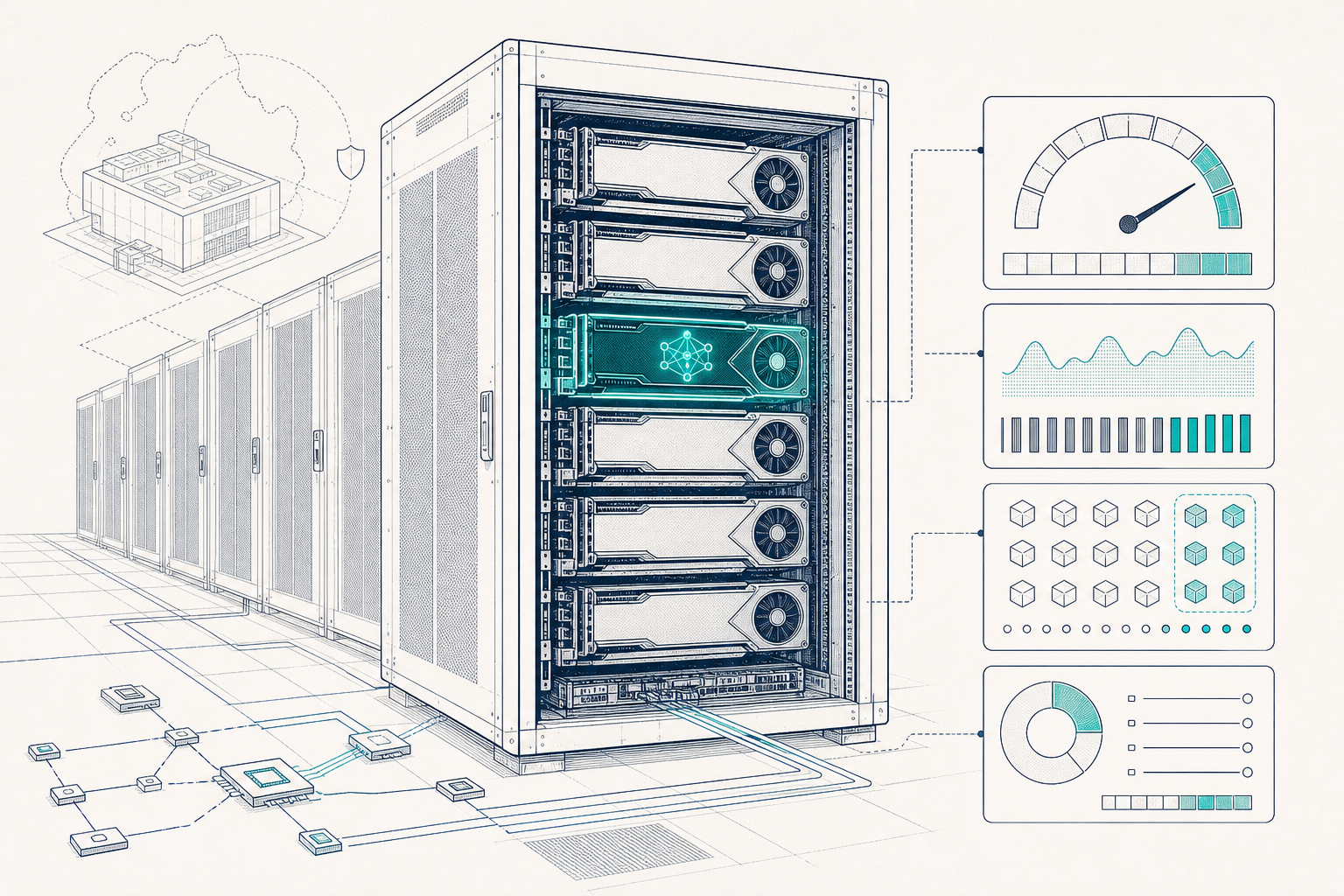
Xing4.0-29B-A4B brings agentic inference into one GPU
On September 24, 2026, Xing4.0-29B-A4B was announced as a China-origin open model designed to run on a single GPU. The model name indicates a 29 billion parameter class system with an A4B architecture claim in the release materials. The announcement positioned it as a versatile agentic large model, meaning the expected use is not only chat completion, but tool calling, planning, retrieval, code execution, and multistep task handling.
There is one timing caveat for operators tracking a strict news window. If the measurement date is October 5, the September 24 release sits just outside a 10-day cutoff. It is still adjacent recent evidence, not an in-window event. That distinction matters for procurement memos and market scans, but it does not reduce the operational question: what changes when an agentic model that previously might have forced a multi-node plan can now be considered for one accelerator?
For a small or mid-size GPU estate, from a quarter rack to a few racks, the change is not that infrastructure becomes simple. It is that the hard boundary moves. The operator no longer starts by asking whether there are enough GPUs for tensor parallel inference across a node pool. The operator starts by asking whether one GPU can hold the selected precision, the runtime, the KV cache, the safety and retrieval sidecars, and the request concurrency without evicting existing tenants.
That is a different bottleneck. It is also a better bottleneck, if the estate is governed correctly.
The first constraint is VRAM, not cluster size
A 29 billion parameter model is in the zone where precision and quantization choices decide whether the deployment is routine or painful. At 16-bit weights, a rough weight-only estimate is about 58 GB before runtime overhead. That may fit on an 80 GB class accelerator, but it leaves limited room for KV cache, batching, framework overhead, adapter weights, tokenizer assets, guardrail models, and transient memory. At 8-bit, the weight footprint is closer to 29 GB. At 4-bit, it can be around 14.5 GB, but quality, latency, and operator acceptance depend on the quantization method, calibration, kernels, and workload.
The practical lesson is that single GPU does not mean any GPU. It means a qualified GPU profile. A 24 GB accelerator may run a heavily quantized build for short context and low concurrency. A 48 GB accelerator may support more useful context or batch size. An 80 GB accelerator gives the operator room for a safer production envelope. Those are not only hardware differences. They become scheduler policy differences.
Agentic workloads amplify this. A simple completion workload consumes tokens, returns text, and exits. An agent workload may call tools, retrieve documents, inspect results, re-plan, run another prompt, and hold intermediate state. Each step can create more tokens and longer contexts. The KV cache can become the hidden capacity consumer. It grows with sequence length, batch size, model shape, and precision. If the serving stack allows long context and uncontrolled concurrency, a single GPU service can hit memory pressure even when the model weights fit comfortably.
This is where an orchestration platform has to be opinionated. It should not merely launch a container on a node with a visible GPU. It should model the GPU as a resource with profiles, memory headroom, policy, and billing tags. ClastIQ is designed for operators who own the hardware and need to turn it into a governed fleet. That includes bare-metal provisioning, Kubernetes and VM tenancy on the same estate, GPU partitioning where supported, per-tenant metering, quota engineering, storage, and local support for air-gap or sovereign deployments.
The MENA operator trade-off
For GCC and MENA operators, the single GPU claim lands in a specific environment. Many organizations have data residency requirements, Arabic and bilingual workloads, public sector procurement boundaries, and budgets that do not assume hyperscaler scale. A ministry lab, university AI center, bank innovation team, energy company, Arabic media group, or local cloud provider may have 8 to 64 GPUs rather than thousands. They may also have mixed generations and mixed vendors across CPU and GPU nodes.
A model that can run on one GPU lets that operator add an agentic service without reserving a full multi-node island. That improves the economics of experimentation and departmental chargeback. A tenant can request one high-memory GPU profile for a pilot, rather than asking the platform team to rewire an inference cluster.
But this only helps if the operator can prevent three failure modes.
First, the agent service must not starve existing inference tenants. A single GPU job can still be noisy if it occupies the best accelerator for long contexts and bursty tool loops.
Second, quantization must be treated as a governed artifact, not an informal engineering shortcut. A 4-bit build that looks acceptable in a demo may fail on Arabic legal text, code generation, or tool selection. The platform should let the operator expose approved model variants with clear profile names and prices.
Third, the estate must meter usage in a way finance can accept. If the AI lab says the model uses one GPU, that is not enough. The operator needs GPU-hours, storage, egress if applicable, CPU and memory sidecar usage, and possibly power allocation.
This is the distinction between installing a model and operating a product catalog.
What actually fills the rack
In a quarter rack to a few racks, the limiting resource is rarely one thing. The operator has to balance GPU memory, GPU compute, host RAM, CPU cores for tokenization and retrieval, local or shared storage, network paths, and power. Agentic inference makes these interactions visible.
A retrieval agent may look like a single GPU workload, but it also needs a vector database, object storage, document index refresh jobs, audit logs, and possibly sandboxed tool execution. A code agent may need isolated execution workers and stronger tenancy controls. A customer service agent may need high availability, observability, and rate limits. A sovereign deployment may need offline image registries, signed artifacts, controlled update windows, and no dependency on external telemetry.
The table below shows the operator issues that usually appear after the first successful boot.
| Bottleneck | Symptom in a small estate | Control the platform needs |
|---|---|---|
| VRAM headroom | Model loads, then fails under longer prompts | GPU profiles, max context policy, admission checks |
| KV-cache growth | Latency spikes as concurrent sessions rise | Batch and sequence caps, queue scheduling, per-tenant limits |
| Quantization quality | Lower memory build gives inconsistent answers | Approved model catalog, versioned artifacts, test gates |
| Tenant interference | One agent service blocks another inference tenant | Hard quotas, partitioning where available, priority classes |
| Chargeback gaps | Finance sees a server cost, not service usage | GPU-hour, storage, CPU, and power allocation metering |
| Sovereignty | Runtime pulls images or models from outside the region | Air-gap repositories, local storage, controlled updates |
ClastIQ addresses this as a fleet problem. MAAS and Juju handle repeatable bare-metal provisioning and service composition. Kubernetes provides container tenancy for inference services and sidecars. VMs can remain available for teams that need traditional isolation or specialized OS images. Ceph provides shared storage for model artifacts, indexes, logs, and tenant data. GPU partitioning, including MIG where supported and time-slicing where appropriate, helps the operator expose smaller profiles without giving every workload a full accelerator. Metering and chargeback attach financial meaning to those profiles.
Hardware agnosticism matters here. Some estates are NVIDIA-heavy. Some are evaluating AMD accelerators. Some have CPU-only nodes for retrieval, preprocessing, and control-plane functions. Many have mixed generations because procurement happened in phases. The platform layer should not assume a perfect homogeneous fleet. It should classify, tag, meter, and schedule what the operator owns.
A worked example for chargeback and revenue per megawatt
Consider a 16 GPU estate in a MENA data center. The operator has 16 high-memory accelerators across several servers, shared Ceph storage, and a Kubernetes inference pool. The cluster is already serving embedding, summarization, and domain chat workloads.
Assume 30 days in the month. The total available GPU capacity is:
16 GPUs x 24 hours x 30 days = 11,520 GPU-hours per month.
Before introducing a single GPU agentic model, average billable utilization is 42 percent:
11,520 x 0.42 = 4,838.4 billable GPU-hours.
The operator allocates monthly platform cost as follows. Hardware amortization and maintenance are 16,000 dollars. Power is based on an average 17.6 kW facility draw for this cluster, including servers, storage share, network share, and cooling allocation. At 0.10 dollars per kWh:
17.6 kW x 720 hours x 0.10 = 1,267.20 dollars.
Operations, rack, network, support, and storage allocation add 5,000 dollars. Total monthly allocated cost is:
16,000 + 1,267.20 + 5,000 = 22,267.20 dollars.
At full theoretical capacity, the cost basis is:
22,267.20 / 11,520 = 1.93 dollars per available GPU-hour.
At 42 percent utilization, the effective cost per billable GPU-hour is:
22,267.20 / 4,838.4 = 4.60 dollars.
Now the operator adds a governed Xing4.0-29B-A4B service profile for agentic pilots. It is not allowed to take over the full estate. The policy allows up to 4 concurrent full-GPU instances, with lower priority than production inference and a monthly cap of 3,000 GPU-hours. The model profile is priced internally at 2.20 dollars per GPU-hour because it is preemptible and used for departmental pilots. Existing production inference remains priced at 4.50 dollars per GPU-hour.
If the agentic profile consumes 2,995.2 GPU-hours in the month, total utilization becomes:
4,838.4 + 2,995.2 = 7,833.6 GPU-hours.
7,833.6 / 11,520 = 68 percent utilization.
The effective cost per billable GPU-hour falls to:
22,267.20 / 7,833.6 = 2.84 dollars.
Monthly internal revenue or chargeback becomes:
Production inference: 4,838.4 x 4.50 = 21,772.80 dollars.
Agentic pilots: 2,995.2 x 2.20 = 6,589.44 dollars.
Total: 28,362.24 dollars.
The same cluster draws an average 17.6 kW, or 0.0176 MW. Annualized chargeback per MW-year is:
28,362.24 x 12 / 0.0176 = 19,337,890.91 dollars per MW-year.
This number is not a benchmark and not a claim about any customer. It is a planning example. The important point is the direction of the math. A single GPU model can turn stranded off-peak capacity into metered service revenue, but only if the operator caps the blast radius. Without quotas and priority, the same workload can reduce service quality for higher-value tenants.
Policy should be expressed before launch
The agentic model should enter the estate as a catalog item with a profile, not as an exception installed by hand. The policy should define who can use it, what GPU profile it can consume, what context lengths are permitted, where model artifacts live, how usage is metered, and whether the workload is preemptible.
A simple policy intent could look like this:
service: xing4-agentic-single-gpu
model_variant: approved-quantized-build
allowed_tenants:
  - ai-lab
  - arabic-agents
resource_profile:
  gpu_profile: single-full
  max_instances: 4
  max_vram_gib_per_instance: 80
  max_context_tokens: 32768
  max_gpu_hours_per_month: 3000
scheduling:
  priority: lower-than-production
  preemptible: true
meter_tags:
  service_class: agentic-inference
  chargeback_rate_usd_per_gpu_hour: 2.20
  data_zone: oman-sovereign
The exact syntax is less important than the discipline. The model cannot be allowed to define infrastructure behavior implicitly. The platform team should define the envelope, then expose it through the scheduler, quota system, metering pipeline, and tenant catalog.
For ClastIQ, this is the natural operating layer. Bare metal is provisioned consistently. GPU nodes are labeled by capability. Kubernetes namespaces or VM projects map to tenants. Ceph stores model artifacts and retrieval indexes under policy. Metering exports usage by tenant, service class, and GPU profile. Quotas prevent one department from turning a promising agent into a rack-wide outage.
Partitioning is useful, but not magic
MIG and time-slicing are often raised when a model fits on one GPU. They are useful tools, but they solve different problems.
MIG, where supported, gives stronger hardware-level partitioning by dividing a compatible GPU into isolated instances. This is valuable for smaller models, embeddings, preprocessing, or tenants with predictable memory needs. A 29 billion parameter agentic model may still require a full GPU profile depending on quantization and context policy. If it does not fit safely into a partition with headroom, forcing it into one only moves the failure to runtime.
Time-slicing increases apparent concurrency by sharing a GPU over time. It can work for bursty, latency-tolerant workloads. It is risky for latency-sensitive agent loops unless queues and service level expectations are clear. If two tenants both believe they own interactive inference on the same accelerator, time-slicing becomes a dispute rather than an efficiency feature.
The operator-grade approach is to use partitioning as part of a product catalog. Small profiles for embeddings and development. Full profiles for large agentic inference. Preemptible profiles for experiments. Reserved profiles for production. Each profile needs a price, quota, and technical definition.
Sovereignty and China-origin models need process, not panic
The China origin of Xing4.0-29B-A4B is relevant for GCC and MENA operators because model provenance, license terms, update channels, and data handling are part of governance. A sovereign operator should ask standard questions. Where are the weights obtained? What license applies? Can the model and tokenizer be mirrored into an offline registry? Are there external calls in the runtime or agent tools? What telemetry is enabled by default? How are safety filters, evaluation sets, and language-specific tests documented?
None of those questions is unique to China-origin models. The same process should apply to models from the United States, Europe, the GCC, or local research groups. The difference is that cross-border policy, public sector sensitivity, and geopolitical procurement rules can make provenance more visible.
For air-gap or sovereign deployments, ClastIQ keeps the deployment anchored on the operator's own hardware. Images, model artifacts, Helm charts or charms, evaluation data, and logs can be kept inside the local environment. Ceph provides local durable storage. The control plane does not need to assume a hyperscaler region. That is central for organizations that need local governance and human-led support rather than a remote-only managed service.
The operating conclusion
A single GPU agentic model changes the shape of the decision. It lowers the entry cost for adding agentic capability, especially for small and mid-size estates that cannot dedicate a multi-node cluster to every new model. It does not remove the need for infrastructure engineering. It increases the need for VRAM planning, quantization governance, KV-cache controls, concurrent-request scheduling, tenant isolation, and chargeback.
For GCC and MENA operators, the opportunity is practical. A local GPU estate can offer agentic pilots to ministries, enterprises, universities, and internal teams without sending data to an external hyperscaler. The economic upside is higher utilization and clearer revenue per megawatt. The operational risk is that an exciting single GPU workload becomes an unmanaged exception.
The right answer is to make it boring. Define the profile. Store the artifacts locally. Meter every GPU-hour. Cap the tenant. Decide which workloads can be preempted. Keep production inference protected. Review the chargeback monthly. That is how a small GPU estate starts to behave like a governed cloud region while remaining on real hardware owned by the operator.
What to do this week
-
Build a VRAM envelope for the model variants you may permit, including weights, runtime overhead, KV cache, context length, and concurrency assumptions.
-
Create at least 2 catalog profiles: a full-GPU agentic profile for serious pilots, and a lower-priority experimental profile with strict monthly GPU-hour caps.
-
Run quantization acceptance tests on your own documents and languages, including Arabic or bilingual workloads if you serve GCC or MENA tenants.
-
Add metering tags before launch, including tenant, cost center, GPU profile, storage bucket, and service class.
-
Check sovereignty controls, including local artifact storage, offline image availability, license review, telemetry settings, and tool-call network policy.
-
Review power and chargeback math so the service improves utilization without displacing higher-value production inference.
ClastIQ runs this on the operator's own hardware: request a demo.