What changed
Town, an employee AI assistant startup, raised $108 million at a unicorn valuation, according to TechCrunch reporting published on October 19, 2026 and updated on October 25. The company launched four months before the financing, which is the relevant infrastructure signal. Buyers are not only funding another chat interface. They are funding assistants that sit inside email, calendars, documents, ticketing systems, customer records, finance tools, and internal workflows.
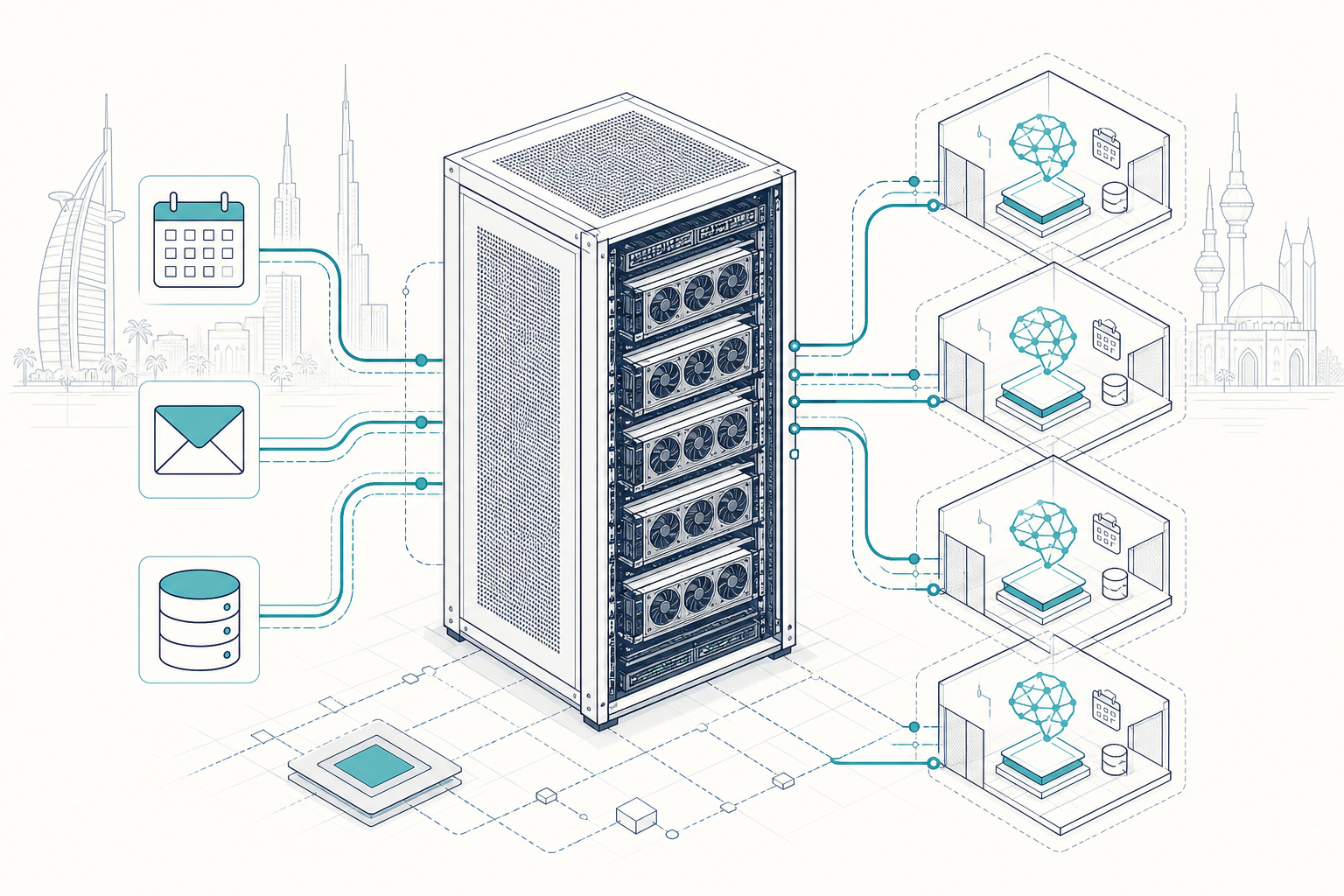
That changes the workload profile. A chat tool is often bursty and discretionary. An employee assistant connected to core systems becomes persistent. It checks calendars before meetings, indexes message history, retrieves policy documents, drafts replies, updates records, summarizes calls, and keeps audit trails. It also carries tool credentials, user permissions, vector indexes, prompt traces, and per-tenant policy rules.
For a hyperscaler, that becomes a regional service design problem. For an operator running a quarter rack to a few racks of owned hardware, it becomes a tenancy problem. The hard questions are not only which model to run. They are where the data can reside, who can see the retrieval index, how GPU slices are shared, how inference is metered, and how a noisy tenant is stopped before it consumes the entire cluster during the morning calendar peak.
This is directly relevant in the GCC and MENA, even though the Town funding story is global. Many organizations in the region want assistants attached to private mailboxes, regulated records, sovereign identity systems, and Arabic and English knowledge bases. Some workloads can use a global API. Others need local or regional inference because prompts, attachments, credentials, and logs cannot leave a jurisdiction or a controlled operating environment. That is where a small or mid-size GPU estate has to behave less like a lab cluster and more like a governed regional utility.
The bottleneck is not only tokens per second
Enterprise assistants create several infrastructure bottlenecks at the same time.
First, concurrency arrives in synchronized waves. The morning workday produces meeting prep, inbox triage, document lookup, and ticket summaries within a narrow window. Lunch periods and end-of-day reporting create smaller waves. Average utilization may look comfortable, while the 9:00 a.m. peak fails.
Second, context windows consume memory. An assistant that reads a thread, retrieves five policy passages, attaches a customer record, and includes tool instructions is not sending a short prompt. Longer context means more prefill work and more key value cache memory per active session. If the platform keeps sessions warm so assistants feel responsive, memory pressure becomes the scheduling constraint before raw compute does.
Third, retrieval is stateful. Vector indexes, document chunks, metadata filters, access control lists, and audit logs must match the tenant boundary. A shared GPU can serve multiple tenants, but a shared index without strict isolation is a security incident waiting to happen.
Fourth, tool credentials are more sensitive than prompts. An assistant that can read mail, create tickets, or query finance data needs scoped credentials and strong auditability. Operators need to know which assistant acted, on behalf of which user, against which system, from which region, and under which policy.
Finally, chargeback matters. If assistants are free at the point of use, demand will grow until the cluster is full. The operator needs per-tenant metering for GPU-hours, storage, index size, request counts, and possibly premium context tiers. Without chargeback, the finance department sees a power bill and a hardware refresh bill, not a service catalog.
Three deployment patterns for enterprise assistants
A small GPU estate does not need to choose one pattern for every workload. The practical design is a policy controlled mix.
| Pattern | Best fit | Main risk | Operator control point |
|---|---|---|---|
| Local inference on owned hardware | Sovereign data, regulated tenants, predictable internal users | Capacity planning and peak concurrency | GPU partitioning, quotas, storage isolation, audit logs |
| Regional hosting | Less sensitive workloads that still need regional residency | Contractual and network dependency | Region tags, encryption, identity federation |
| API fallback | Burst handling, non-sensitive drafts, model diversity | Data egress and variable unit cost | Prompt classification, redaction, spend limits |
The operator-grade approach is not ideological. Run sensitive prompts, retrieval, and audit logs locally. Use regional hosting where policy allows. Use API fallback for overflow or low-risk tasks after classification and redaction. The key is to make the routing decision explicit, logged, and billable.
For GCC operators, the policy matrix should be written before the first assistant pilot. A ministry workload, a bank support desk, a university research assistant, and a private enterprise sales assistant will not share the same data residency rule. They may run on the same physical fleet, but only if the platform enforces tenancy in compute, storage, networking, identity, and logs.
What a quarter rack to few rack estate will hit first
Consider an operator with 24 accelerator cards across several servers, a Ceph storage cluster, redundant switching, and a Kubernetes environment. This is not a hyperscaler region, but it is enough to host meaningful assistant workloads if it is partitioned well.
The first limit is GPU memory fragmentation. Some tenants need full devices for batch indexing or larger model serving. Others need small slices for interactive assistants. If every tenant receives a full GPU for a lightly used assistant, utilization collapses. If every tenant is time-sliced without guardrails, latency becomes unpredictable. The scheduler needs to combine full GPU allocation, MIG-style partitioning where supported, and time-slicing where appropriate.
The second limit is storage and retrieval locality. A 1,200 user tenant may not have huge model weights, but it may have millions of document chunks, embeddings, mailbox references, and audit records. Ceph or another distributed storage layer has to provide tenant-separated pools or buckets, encryption policy, replication, snapshotting, and lifecycle controls. Retrieval indexes must be close enough to the model servers that latency does not erase the benefit of local inference.
The third limit is identity and quota engineering. Assistants should inherit user authorization, not bypass it. The infrastructure layer needs quotas by tenant and by workload class. A document indexing job should not starve interactive inference. A development namespace should not consume production assistant capacity. A test tenant should not be allowed to create a large persistent index without a storage budget.
The fourth limit is power. In small estates, power is a product constraint. If the cluster is already near its rack limit, adding always-on assistant serving can displace training, rendering, analytics, or VM workloads. Operators need to schedule for watts as well as GPU count. This is especially important where revenue per megawatt is a board-level metric.
A worked chargeback example
Assume a 24 GPU estate used for mixed Kubernetes and VM tenancy. The operator has bare-metal provisioning, Ceph storage, and a service catalog for tenants. Monthly capacity is:
24 GPUs x 24 hours x 30 days = 17,280 GPU-hours per month.
Assume the monthly cost base for this estate is:
- Hardware amortization: 720,000 dollars over 36 months = 20,000 dollars per month
- Facility power: 21 kW average IT load, 1.4 PUE, 720 hours, 0.11 dollars per kWh = 2,328 dollars per month
- Operations, spares, and support allocation = 8,000 dollars per month
Total monthly cost = 30,328 dollars.
Raw cost per installed GPU-hour = 30,328 / 17,280 = 1.76 dollars.
But no operator sells every installed hour. If billable utilization is 65 percent, billable GPU-hours are:
17,280 x 0.65 = 11,232 GPU-hours.
Effective cost per billable GPU-hour = 30,328 / 11,232 = 2.70 dollars.
If the internal chargeback rate is 3.20 dollars per GPU-hour, the estate generates:
11,232 x 3.20 = 35,942 dollars per month.
Now add an assistant tenant with 1,200 employees. The tenant reserves 6 GPUs for interactive inference during 10 business hours per weekday:
6 GPUs x 10 hours x 22 days = 1,320 GPU-hours per month.
At 3.20 dollars per GPU-hour, inference chargeback is:
1,320 x 3.20 = 4,224 dollars per month.
If retrieval storage and audit logs consume 18 TB at 0.06 dollars per GB-month, storage chargeback is:
18,000 GB x 0.06 = 1,080 dollars per month.
Total local platform chargeback for the assistant tenant is 5,304 dollars per month, or 4.42 dollars per user per month before application licensing and internal support.
The same math can be expressed as revenue per facility MW. The estate uses 29.4 kW at the facility boundary, based on 21 kW IT load and 1.4 PUE. Annualized chargeback at 65 percent utilization is:
35,942 x 12 = 431,304 dollars per year.
Revenue per MW-year = 431,304 / 0.0294 = 14.67 million dollars per MW-year.
This number is not a benchmark. It is a planning lens. If assistant workloads improve billable utilization without pushing the estate into a power or cooling constraint, they can raise revenue per MW. If they consume peak power while sitting idle off-peak, they can reduce the operator's ability to sell higher value workloads. Metering and scheduling decide which outcome happens.
How ClastIQ fits the operator problem
ClastIQ is built for operators who own real hardware, from a quarter rack to a few racks, and need to run GPU and CPU tenancy without becoming a hyperscaler. For assistant workloads, the relevant capabilities are not cosmetic. They map to the bottlenecks above.
Bare-metal provisioning through MAAS and Juju helps standardize the fleet. Operators need repeatable installation, upgrades, host replacement, firmware tracking, and node role assignment. Assistant platforms are long-running services, so snowflake servers become a reliability risk.
Kubernetes and VM tenancy on the same fleet matters because assistants are rarely only containers. Model servers, retrieval services, observability stacks, databases, identity bridges, and legacy connectors may land in different runtime shapes. Some tenants want Kubernetes namespaces. Others want VMs with controlled access to internal systems. A shared orchestration layer lets the operator allocate capacity without dedicating a separate island for each runtime.
GPU partitioning is central. MIG-style partitioning where the hardware supports it can carve devices into predictable slices for smaller inference workers. Time-slicing can improve utilization for bursty workloads. Full GPU assignment remains necessary for larger models, indexing, or tenants with strict latency requirements. The policy should be per workload, not one global setting.
Ceph storage provides the shared storage substrate for model artifacts, retrieval data, logs, backups, and tenant volumes. The important operating question is not only capacity. It is how pools, access keys, replication, snapshots, and retention policies map to tenant boundaries and regional rules.
Metering and chargeback turn assistants from an uncontrolled cost center into a service. Per-tenant GPU-hours, CPU, memory, storage, network, and accelerator allocation should be visible. Without this, the operator cannot compare local inference with regional hosting or API fallback. With it, each tenant can choose a service tier and see the cost of longer context, higher concurrency, or dedicated capacity.
Quota and policy engineering keep the estate governable. A tenant can receive a daily token budget, a maximum concurrent session count, a storage limit for indexes, and a separate batch indexing window. Production assistants can be protected from development jobs. Sensitive tenants can be pinned to regional or sovereign nodes. Less sensitive overflow can be routed elsewhere under policy.
Air-gap and sovereign deployments are important in GCC and MENA environments where some organizations require local operation, controlled update paths, and human-led support. ClastIQ should not be understood as a claim that every assistant workload must be isolated from the internet. The point is that the operator can support that mode when policy demands it, while still running less restricted workloads on the same governed fleet.
ClastIQ is hardware-agnostic across NVIDIA, AMD, and mixed CPU and GPU estates. That matters because many regional operators buy what is available, expand in phases, and inherit mixed hardware. The orchestration layer has to expose the right accelerator class to the right tenant without forcing every workload onto one vendor or one generation.
A minimal quota pattern
The exact resource names depend on the accelerator vendor and Kubernetes device plugin. The pattern is what matters: create a tenant boundary, label it for region and chargeback, then apply hard limits before users deploy assistants.
kubectl create namespace tenant-finance-assistant
kubectl label namespace tenant-finance-assistant region=gcc-oman chargeback=finance data-class=restricted
cat <<EOF | kubectl apply -f -
apiVersion: v1
kind: ResourceQuota
metadata:
  name: finance-assistant-quota
  namespace: tenant-finance-assistant
spec:
  hard:
    requests.cpu: 128
    requests.memory: 512Gi
    requests.storage: 20Ti
    limits.nvidia.com/gpu: 4
EOF
On an AMD estate, or a mixed estate, the accelerator resource name changes. The operating principle does not. The assistant tenant receives a defined slice of compute and storage, and usage can be metered against a chargeback code. If the tenant needs higher concurrency during a campaign or reporting cycle, the operator can raise the quota, move the workload to a different partition, or authorize fallback under policy.
Local inference, regional hosting, and fallback
For Town-style assistants, the deployment decision should be made at the request class level.
A prompt that includes mailbox content, customer records, internal legal documents, or regulated personal data should default to local or approved regional inference. Its retrieval index should remain in the same policy domain. Audit logs should be immutable enough for investigation, but not so verbose that they become a second copy of sensitive data with weaker controls.
A prompt that asks for a generic draft, translation, or public information summary may be eligible for API fallback. The platform should strip internal identifiers where possible, enforce a spend limit, and log why the request left the local estate.
A batch indexing job should run in a scheduled window, often off-peak. It is a poor neighbor for interactive assistants because it can consume storage bandwidth, CPU, and GPU memory at the same time. In a small estate, off-peak indexing is one of the easiest ways to raise utilization without harming users.
A long-context executive assistant tier should be priced differently from a standard assistant tier. The cost driver is not only output tokens. Longer context increases prefill cost and memory pressure. If tenants want 64k or larger contexts for every interaction, the chargeback catalog should reflect that.
Observability for assistant operations
Operators should collect metrics that map to user experience and economics. Tokens per second is useful, but incomplete. Track queue time, prefill time, decode time, active sessions, failed tool calls, retrieval latency, index size, GPU memory use, GPU utilization, power draw, and cost by tenant. Track policy events such as fallback usage, denied requests, quota hits, and cross-region blocks.
The most useful dashboard for the operator is not a model leaderboard. It is a capacity view that answers five questions:
- Which tenant is consuming peak GPU memory right now?
- Which tenant is driving storage growth this week?
- Which assistant tier has the worst queue time during business hours?
- Which workloads can be moved to off-peak windows?
- What is the current revenue per kW or MW compared with plan?
For GCC and MENA operators, add residency and sovereignty views. Show where a tenant's model serving, retrieval index, audit log, backup, and administrative access path are located. If those do not align, the assistant may pass a demo and fail a governance review.
What to do this week
- Classify assistant data flows. Separate mailbox content, documents, tool credentials, retrieval indexes, audit logs, and generic prompts into clear policy classes.
- Build a concurrency model. Estimate active sessions at 5 percent, 10 percent, and 20 percent of users during the morning peak, then translate that into GPU memory and GPU-hour demand.
- Create a chargeback catalog. Publish rates for shared inference, dedicated GPUs, storage, indexing jobs, long-context tiers, and API fallback.
- Define tenant isolation rules. Map each tenant to namespaces, VM projects, storage pools, network policy, identity groups, and log retention settings.
- Reserve off-peak windows. Move embedding generation, reindexing, evaluation, and batch summarization away from interactive hours.
- Test fallback under policy. Prove that sensitive prompts stay local, eligible prompts can burst, and all routing decisions are logged.
ClastIQ runs this pattern on the operator's own hardware, from compact GPU estates to mixed CPU and GPU fleets. request a demo