The funding news is about access, the operator issue is control
On Nov. 2, 2026, Trajectory announced a $45 million raise to make AI model training accessible to nontechnical users. TechCrunch included the company in its Nov. 3, 2026 startup coverage, which makes the story relevant beyond venture funding. The infrastructure implication is direct: if training interfaces become simpler, more people will submit jobs who do not understand GPU topology, VRAM limits, storage pressure, checkpoint behavior, or the failure modes of distributed training.
That is useful demand. It is also dangerous demand for operators with real constraints. A hyperscaler region can absorb waste with a large fleet, multiple availability zones, and mature quota systems. A university AI center, sovereign cloud, industrial research lab, media group, bank, or government operator with a quarter rack to a few racks cannot. One badly shaped experiment can occupy scarce accelerators, overload checkpoint storage, and block a higher value fine-tune for days.
The issue is not whether nontechnical users should train models. They will. The issue is whether the platform converts that demand into schedulable, measurable, recoverable work. The operator needs admission control before the job starts, VRAM-aware placement while it runs, checkpoint and metadata discipline while it fails and restarts, and chargeback after it consumes power, GPU-hours, storage, and support.
A self-service training product changes the front door. It does not remove the back-end requirement for fleet governance. For small and mid-size GPU estates, the practical question is this: can the site allow easier training without letting interactive experimentation starve long-running fine-tunes, production inference, or paid tenant capacity?
Why a few racks fail differently from a cloud region
A few-rack estate has a narrow error budget. Assume 16 to 64 accelerators, mixed CPU hosts, one or 2 storage tiers, and a modest operations team. The fleet may include multiple GPU generations or vendors. Some nodes may have high-memory accelerators. Others may be better suited to inference or data preprocessing. Network topology may not be uniform. Power draw may be close to the rack or room limit during training peaks.
A simplified training interface hides those differences from users. That is the point. But it must not hide them from the scheduler.
The common failure pattern is predictable. A user launches several experiments from a friendly interface. The jobs request whole GPUs even when they could use partitions. Some ask for more VRAM than the model needs because nobody tuned batch size. Others checkpoint every few minutes into a shared Ceph pool. A notebook session remains idle with a reserved accelerator. A long-running fine-tune waits behind short interactive trials because the default queue favors immediacy. Nobody knows the real cost until the finance team asks for a report.
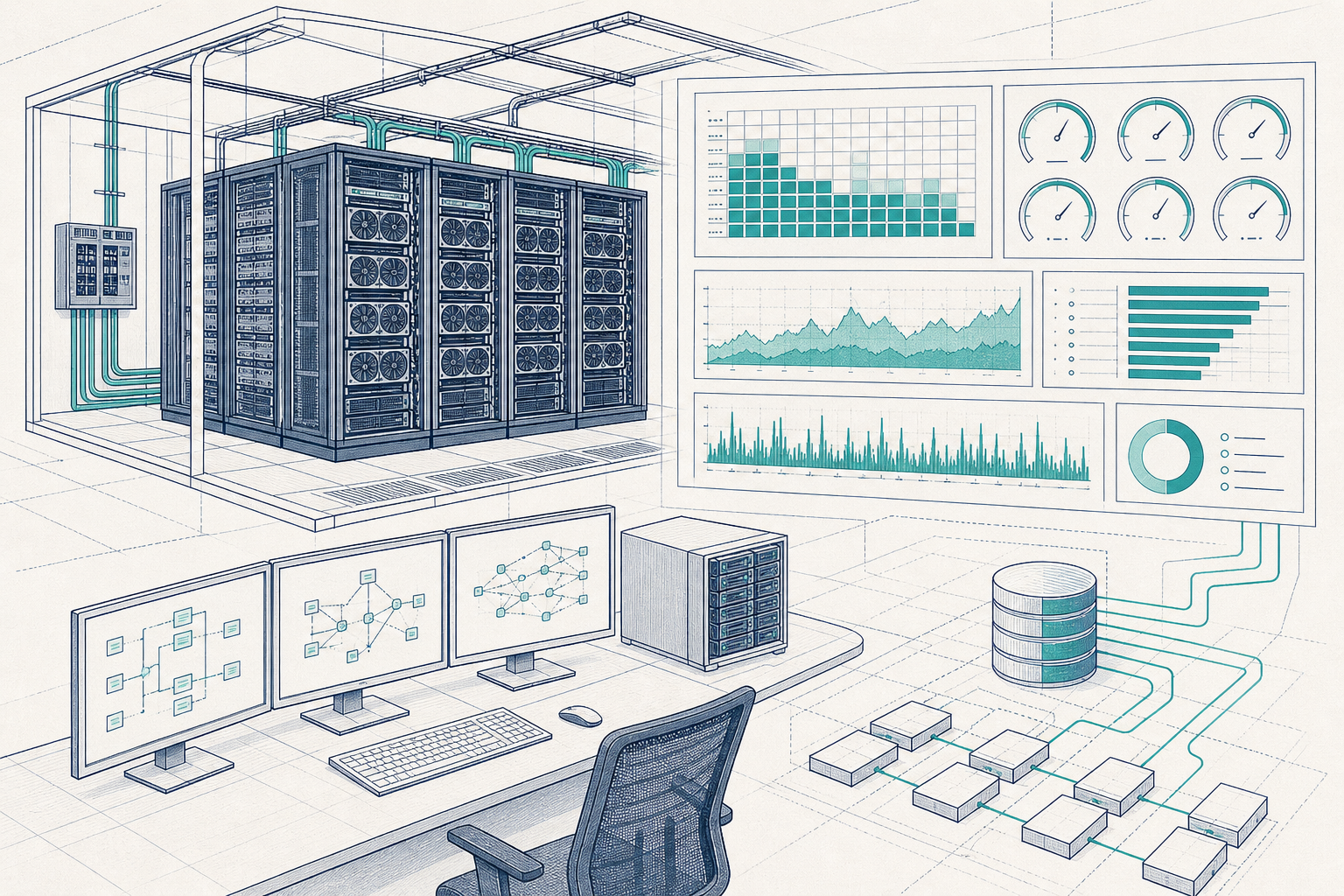
For an operator, the bottleneck is not the user interface. It is the lack of a control plane that joins bare-metal provisioning, Kubernetes, VM tenancy, GPU partitioning, storage classes, quotas, metering, and policy into one operating model.
A system like ClastIQ addresses that layer. It does not require the estate to be a hyperscaler. It treats the fleet as a constrained physical asset and exposes it as governed capacity. Bare-metal nodes can be provisioned into Kubernetes pools or VM tenancy. GPUs can be assigned as full devices, MIG slices where supported, or time-sliced capacity where appropriate. Ceph can provide durable shared storage and checkpoint targets. Per-tenant metering converts GPU-hours, storage consumption, and policy exceptions into chargeback or showback. Quotas and admission rules prevent the front door from admitting work that the back end cannot support.
The operator bottleneck created by easy training
The closer training gets to a form submission, the more the infrastructure platform needs to reject, reshape, or delay jobs before they cause damage. This is an operations problem, not a user education problem.
The minimum control points are:
| Control point | Operator question | What the platform must enforce |
|---|---|---|
| Admission control | Should this job start now? | Tenant quota, queue priority, maintenance windows, power headroom |
| VRAM placement | Which device shape fits? | Full GPU, partitioned GPU, time slice, memory class, topology awareness |
| Checkpoint storage | Where does state land? | Storage class, retention, bandwidth limits, encryption, snapshot policy |
| Experiment metadata | Can the job be explained later? | Owner, project, model, dataset, cost center, reproducibility fields |
| Fair sharing | Who waits when capacity is scarce? | Priority classes, preemption rules, idle session cleanup |
| Metering | Who pays or is charged back? | GPU-hours, CPU-hours, storage GB-months, network and support policies |
These controls must be close to the scheduler. A wiki page telling users to be considerate is not admission control. A monthly spreadsheet is not metering. A shared storage path named checkpoints is not a checkpoint strategy.
Interactive users and long-running fine-tunes need different treatment. Interactive work benefits from small partitions, short leases, and automatic idle shutdown. Fine-tunes need predictable allocation, durable checkpoints, and protection from preemption unless the job has been designed to tolerate it. Batch experiment sweeps need caps so that parameter search does not consume every accelerator because it was easy to click run.
A practical policy fragment might look like this. The exact schema will vary by platform, but the important point is that the policy is machine-enforced before scheduling.
tenant: research-a
monthly_quota:
  gpu_hours: 1800
  storage_tb: 12
queues:
  interactive:
    max_session_hours: 4
    idle_shutdown_minutes: 30
    allowed_gpu_shapes: [partition, time_slice]
    max_parallel_jobs: 6
  finetune:
    max_job_hours: 72
    checkpoint_required: true
    checkpoint_interval_minutes: 30
    allowed_gpu_shapes: [full_gpu, partition]
    priority: normal
admission:
  require_cost_center: true
  require_dataset_label: true
  deny_if_quota_remaining_percent_below: 5
  reserve_capacity_for_queue: inference, 20_percent
This is the difference between self-service and self-harm. Users still get a simpler training path, but the estate does not become a free-for-all.
Worked example: the utilization and chargeback gap
Consider a 32 GPU estate in a regional AI lab or commercial operator. The site has 4 GPU nodes, each with 8 accelerators, plus CPU nodes, storage, and networking. The GPU devices average 700 watts at training load. The rest of the IT footprint, including CPUs, memory, storage, and networking, brings the IT load to about 40 kW when the cluster is busy. With a PUE of 1.25, the facility load is 50 kW.
Monthly theoretical GPU capacity is:
32 GPUs x 24 hours x 30 days = 23,040 GPU-hours.
Before quota and admission control, assume measured useful utilization is 45 percent. That is not unusual when notebooks are left open, jobs fail late, storage stalls cause retries, and users reserve whole devices for experiments that could run on smaller slices.
23,040 x 45 percent = 10,368 useful GPU-hours per month.
Assume the estate has a fully burdened monthly cost of $52,000 for hardware finance, facility allocation, support, spares, and operations, plus power. Power at 50 kW facility load for 720 hours is:
50 kW x 720 hours = 36,000 kWh.
At $0.10 per kWh, monthly power is $3,600. Total monthly cost is $55,600.
At 45 percent useful utilization, the effective cost per useful GPU-hour is:
$55,600 / 10,368 = $5.36 per useful GPU-hour.
Now add enforced queues, partitioning for interactive users, idle shutdown, checkpoint policy, and tenant quotas. Suppose useful utilization rises to 72 percent without adding hardware.
23,040 x 72 percent = 16,589 useful GPU-hours per month.
The same monthly cost becomes:
$55,600 / 16,589 = $3.35 per useful GPU-hour.
If the operator charges internal or external tenants $4.10 per GPU-hour, monthly chargeback at 72 percent utilization is:
16,589 x $4.10 = $68,015.
Annualized, that is $816,180 against a 50 kW facility footprint. Revenue or chargeback per MW-year is:
$816,180 / 0.05 MW = $16.32 million per MW-year.
This example is not a claim about any ClastIQ deployment or benchmark. It illustrates the sensitivity of a small estate to utilization discipline. The operator did not buy more accelerators. The operator changed admission, placement, and metering. In a few-rack environment, that can be the difference between a cluster viewed as an expensive research toy and a governed platform with accountable capacity.
Storage is part of the training scheduler
Training failures often present as GPU problems when the root cause is storage. Easy training interfaces make this worse because users create more runs, more checkpoints, more duplicated datasets, and more experiment artifacts.
Checkpoint storage needs policy. Some jobs need frequent checkpoints because preemption is possible or because training time is expensive. Other jobs checkpoint too frequently and turn shared storage into a bottleneck. If checkpoints land on the wrong pool, they can interfere with tenant home directories, model registries, or inference artifacts.
For a few-rack operator, Ceph is useful because it can provide shared object, block, and file services across commodity hardware. But Ceph still needs storage classes, quotas, placement groups sized correctly, monitoring, and lifecycle rules. The training platform should know the difference between hot checkpoint storage, durable model artifacts, scratch space, and archived datasets.
Experiment metadata matters here. If a checkpoint has no owner, project, model lineage, or retention policy, it becomes operational debt. If a dataset is copied 12 times because each user interface abstracts storage differently, the estate pays for wasted capacity and backup windows. A governed training platform should attach metadata at job submission, not after cleanup.
Partitioning is economic policy, not just a GPU feature
GPU partitioning is often described as a technical capability. For operators, it is also an economic control. If a user needs a 10 GB experiment window, assigning an 80 GB accelerator as a whole device is a policy failure unless isolation or performance requires it.
Hardware-agnostic scheduling means the platform should understand multiple shapes of capacity. On some accelerators, hardware partitioning can expose isolated slices. On others, time slicing may be acceptable for interactive work but not for latency-sensitive inference or high-value training. In mixed CPU and GPU estates, some jobs should run entirely on CPU nodes until they justify accelerator time.
ClastIQ's role in this model is to make those choices enforceable across Kubernetes and VM tenancy on the same fleet. A tenant running notebooks in Kubernetes and another tenant running a VM-based training appliance are still drawing from the same physical pool. The operator needs a single view of who owns which capacity, how it is partitioned, how long it has been held, and what it costs.
That is especially important when a site serves both internal teams and external tenants. Without unified metering, one environment becomes invisible. Invisible usage becomes political conflict.
GCC and MENA relevance: sovereignty, power, and scarce capacity
Although the Trajectory story is global, the pattern is highly relevant in the GCC and MENA. Many organizations in the region are building sovereign AI capability without operating at hyperscaler scale. They may have strong data residency requirements, air-gap needs, local procurement constraints, and a mandate to turn GPU investment into national, academic, or commercial output.
In that context, an easy training interface can be valuable only if it respects sovereign operations. Datasets may not be allowed to leave the country or the facility. Some environments require disconnected installation and patching. Support may need to be human-led and local because remote-only operations do not satisfy the risk model. Chargeback may need to map to ministries, departments, research programs, or commercial tenants.
Power is also part of the regional equation. A few racks of accelerators can become a material electrical load. Utilization is not only a budget metric. It affects revenue per megawatt, cooling planning, and the ability to justify expansion. If 30 percent of GPU time is lost to idle notebooks, failed jobs, and unmanaged queues, the operator is wasting scarce power allocation as well as capital.
A platform like ClastIQ is designed for operators who own the hardware and need to govern it locally. The important point is not branding the cluster as AI-ready. The important point is proving that every GPU-hour can be admitted, placed, measured, and explained within the organization's sovereignty and policy boundaries.
What to do this week
-
Measure idle reservations separately from busy utilization. Do not rely only on GPU utilization graphs. Track allocated GPU-hours, active compute time, idle notebook time, failed job time, and queued demand by tenant.
-
Create 2 queues before adding more users. Define at least an interactive queue and a fine-tune queue. Give interactive work shorter leases, smaller GPU shapes, and idle shutdown. Give fine-tunes checkpoint requirements and predictable priority.
-
Set storage classes for training artifacts. Separate scratch, checkpoint, model artifact, and dataset storage. Apply quotas and retention rules before self-service training increases object count and duplicate data.
-
Require metadata at submission. Enforce owner, cost center, project, dataset label, expected runtime, GPU shape, and checkpoint plan. If a job cannot identify itself, it should not consume scarce accelerators.
-
Introduce tenant chargeback or showback now. Even if money does not change hands, publish monthly GPU-hours, storage GB-months, and effective cost per useful GPU-hour. Behavior changes when teams see their share of the estate.
-
Reserve capacity for protected workloads. Keep a fixed percentage for production inference, executive priority projects, or sovereign workloads that cannot be preempted by experiment sweeps.
The infrastructure lesson
Trajectory's funding reflects a real market direction: training will be packaged for users who do not want to think about infrastructure. That is reasonable. Most users should not need to know rack layout, GPU interconnect, or Ceph pool design.
But the operator must know. More accessible training increases the need for stricter infrastructure governance, not less. The few-rack operator should welcome demand only after the platform can answer basic questions automatically. Who is asking for capacity? What shape do they need? Can a smaller partition satisfy the job? Where will checkpoints land? What happens if the job fails? Which tenant pays? Which workload must not be starved?
For small and mid-size GPU estates, the path to hyperscaler-like economics is not pretending to be a hyperscaler. It is applying hyperscaler-like discipline to scarce local hardware: admission control, quota enforcement, partitioning, metering, sovereign deployment, storage policy, and power accountability.
Self-service training opens the door. The orchestration layer decides whether the cluster remains governable after people walk through it.
Sources
Related product: Canonical MAAS