UMAMI’s LOS turns learning AI into an infrastructure buyer
On August 10, 2026, Wamda reported that Egypt-based UMAMI E-Learning Solutions launched LOS™, a Learning Operating System for governments, ministries and large institutions in MENA. The company described LOS as AI-powered learning infrastructure that connects learning, skills, workforce readiness, performance and institutional decision-making into one system. Wamda also reported an investment plan exceeding EGP 50 million, about $1 million, to roll the platform out across Egypt and the wider MENA region.
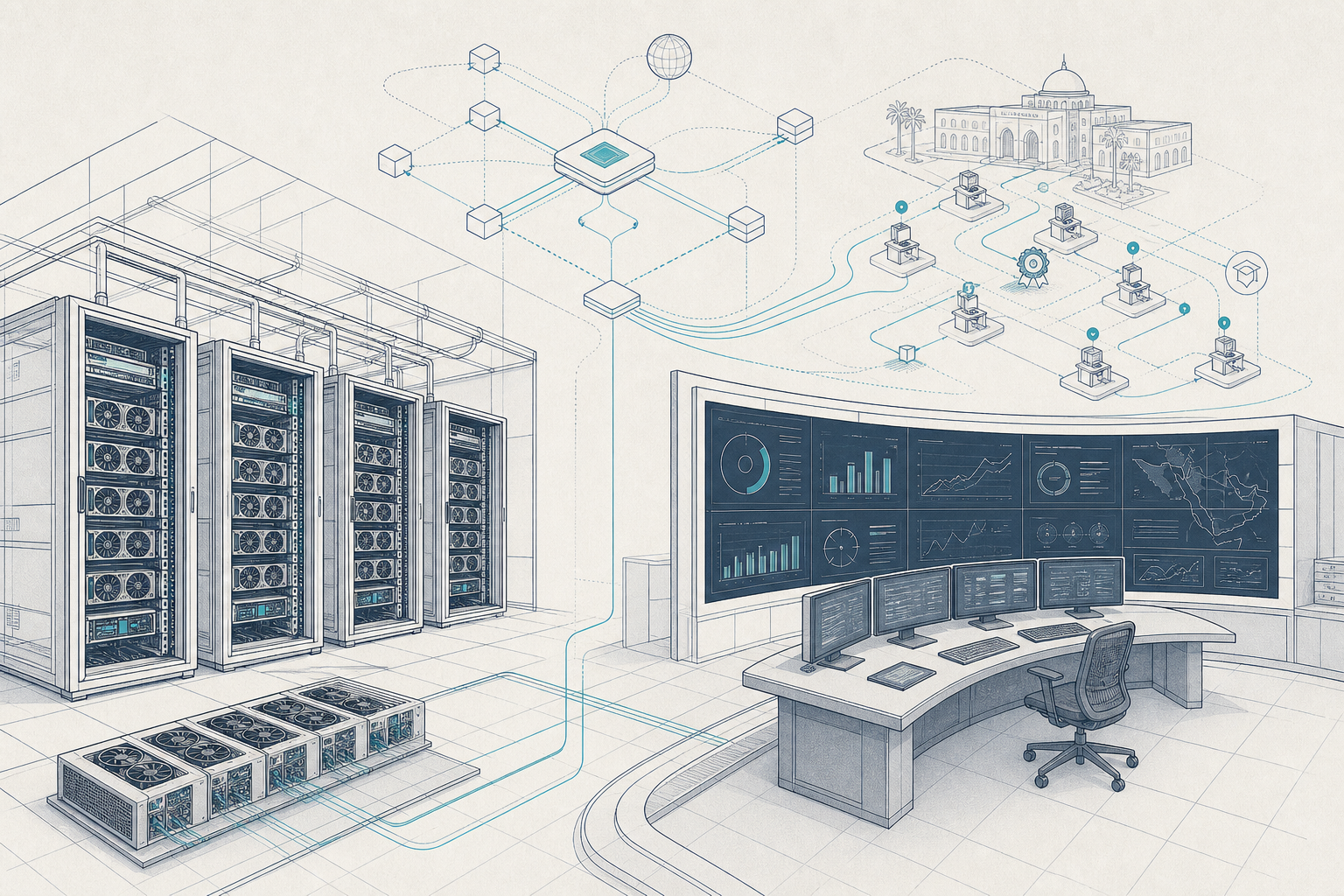
The important change is not that another education application has added AI. The important change is that the buyer is being framed as an institution running a learning estate: a ministry, university system, enterprise academy or national workforce programme. That pushes the workload out of the simple SaaS category and into the same operating questions faced by any sovereign AI platform: where data sits, who can access accelerators, how usage is measured, how budgets are controlled, and whether the estate can serve many tenants without turning into a manually scheduled GPU room.
For GPU cluster operators in the GCC and MENA, this is the useful reading of the news. AI learning infrastructure will not only mean periodic model training. It will also mean retrieval jobs over curriculum content, student and employee analytics, Arabic and bilingual content generation, speech and video processing, recommendation and assessment services, batch reporting for decision-makers, and low-latency inference during peak study periods. These jobs do not arrive in neat blocks. They arrive by ministry calendar, exam timetable, content release cycle and enterprise training deadline.
That is exactly where a quarter rack to a few racks of GPUs can either become an efficient regional AI platform or an expensive queue.
The bottleneck is not only GPU count
A small-to-mid estate may have enough raw accelerator capacity on paper. The bottleneck is usually that the fleet is not governed as a shared utility. One team reserves whole nodes for experiments. Another team needs predictable inference during working hours. A third needs a VM with a legacy data pipeline. A fourth wants Kubernetes because its serving stack is containerised. Storage is treated as an afterthought until datasets are copied three times. Finance sees only hardware invoices, not GPU-hours by tenant. Security asks whether student records and workforce data ever leave the country, and the operator cannot answer from telemetry alone.
A learning operating system at institutional scale makes this worse because its workload mix crosses several patterns:
- interactive inference for learners, instructors and administrators;
- batch inference over content libraries and assessments;
- fine-tuning or adaptation jobs for local curriculum, language and policy;
- analytics over sensitive learner, workforce and performance data;
- periodic reporting workloads for ministries and executive teams;
- sandboxes for researchers, partners or vendors.
The operator-grade question is therefore not simply how many GPUs are required. It is how to divide a real hardware fleet between these patterns without overbuying, without violating data boundaries, and without losing the ability to charge back usage to the institution or programme that consumed it.
This is the layer ClastIQ is built to provide on operator-owned hardware: bare-metal provisioning, Kubernetes and VM tenancy on the same fleet, GPU partitioning through mechanisms such as MIG or time-slicing where the hardware supports it, Ceph-backed storage, per-tenant metering, quota and policy engineering, and air-gap or sovereign deployment patterns. The point is not to replace the LOS application. The point is to give the operator an estate that can run such applications with measurable utilisation and enforceable boundaries.
A practical estate shape for MENA learning AI
Consider a regional operator supporting a learning platform for several public agencies and large institutions. The estate is not hyperscale. It is 32 GPUs across a few racks, mixed CPU and GPU nodes, local NVMe for hot working sets, Ceph for shared storage, redundant networking and enough power headroom to keep inference service-level objectives during the working day.
The tenancy model might look like this:
| Tenant or workload | Typical pattern | Infrastructure control needed |
|---|---|---|
| National learning portal | Daytime inference peaks, evening study traffic | Guaranteed GPU slices, autoscaling, latency limits |
| Curriculum content team | Batch generation and review | Scheduled GPU-hours, storage quotas, audit trails |
| Workforce analytics unit | Sensitive datasets, periodic reporting | Isolated namespace or VM, Ceph pool policy, access control |
| University research group | Variable experiments | Hard quotas, pre-emptible queues, time limits |
| Platform operations | Monitoring, CI, registries, backup | Reserved CPU, storage and network capacity |
Without orchestration, each line in that table becomes a negotiation. With orchestration, each line becomes a policy object: a tenant, a quota, a storage pool, a scheduling class, a metering label and an approval path.
For a ministry or large institution in MENA, that distinction matters. Education and workforce data can include minors, civil servants, employment records, assessment results and performance profiles. A platform operator must be able to state where the data is stored, which workloads touched it, which tenant paid for the accelerator time, and whether a contractor’s sandbox was separated from production records. Those answers cannot come from spreadsheets after the fact.
Worked example: from reserved GPUs to chargeback
Assume a 32-GPU estate dedicated to learning AI and related institutional workloads. Each GPU can be consumed as a full device for training and batch jobs, or partitioned for inference where supported. The month has 30 days.
Total available GPU-hours:
32 GPUs × 24 hours × 30 days = 23,040 GPU-hours per month.
Before quota and tenancy work, the estate averages 38% useful utilisation. Some nodes are reserved but idle, some GPUs sit behind long-running notebooks, and inference is over-provisioned for peaks. Useful GPU-hours are:
23,040 × 0.38 = 8,755 GPU-hours per month.
If the operator uses an internal chargeback rate of $6.50 per GPU-hour, the metered value recovered from tenants is:
8,755 × $6.50 = $56,907.50 per month.
After introducing tenant quotas, scheduled batch windows, GPU partitioning for inference, and reclaim rules for idle sessions, utilisation rises to 70% without adding hardware:
23,040 × 0.70 = 16,128 GPU-hours per month.
At the same chargeback rate:
16,128 × $6.50 = $104,832 per month.
That is an additional $47,924.50 per month of accountable capacity from the same 32 GPUs. This is not a claim about public cloud pricing or margin. It is a way for an operator or institution to put a value on scarce accelerator time and decide who should pay for it.
Now add a power lens. Suppose the IT load for the estate is 40 kW including GPUs, CPUs, memory, storage and networking. With facility overhead at a PUE of 1.35, facility draw is:
40 kW × 1.35 = 54 kW, or 0.054 MW.
Annualised chargeback at 38% utilisation is:
$56,907.50 × 12 = $682,890 per year.
Chargeback value per facility MW-year:
$682,890 ÷ 0.054 = $12.65 million per MW-year.
At 70% utilisation:
$104,832 × 12 = $1,257,984 per year.
$1,257,984 ÷ 0.054 = $23.30 million per MW-year.
The power bill did not halve. The GPUs did not change. The difference is that the estate moved from informal reservation to metered allocation. For operators in markets where power availability, data-centre space and import timelines are constraints, revenue or chargeback per megawatt is a useful management metric.
How ClastIQ maps the problem to controls
The operational pattern is straightforward: provision the metal, divide the fleet into safe tenancy units, expose accelerators to the right runtime, meter everything, and enforce policy before the queue becomes political.
Bare-metal provisioning is the first step. MAAS and Juju can be used to bring servers under repeatable control rather than treating each GPU node as a one-off installation. That matters in mixed estates. A regional operator may have NVIDIA systems in one rack, AMD accelerators in another, and CPU-heavy nodes for data engineering, vector indexing or storage services. Hardware-agnostic orchestration lets the operator place workloads according to capability rather than vendor assumption.
The second step is supporting both Kubernetes and VMs on the same fleet. Many AI services are Kubernetes-native: model servers, API gateways, vector databases, batch workers and monitoring agents. But institutional learning platforms often retain VM-based components: legacy ETL, licensed software, Windows-based tools, secure jump hosts or vendor appliances. Forcing everything into one runtime creates friction. ClastIQ’s role is to let the operator allocate both models from the same governed estate, with quotas and metering applied at the tenant boundary.
The third step is GPU partitioning. For inference, a full high-end GPU may be wasteful if a service needs only a small, predictable slice. On hardware that supports MIG, operators can carve a GPU into isolated instances for separate workloads. On other hardware or less sensitive workloads, time-slicing can improve utilisation for bursty inference or development. The right answer depends on the accelerator, the isolation requirement and the workload profile. The operator should treat partitioning as a policy choice, not as a developer convenience.
The fourth step is storage. Learning AI is data-heavy even when models are not huge. Courseware, transcripts, assessment records, video, embeddings, model artefacts and audit logs all need lifecycle policy. Ceph gives an operator a way to present block, object and file storage from the same estate, with pools and quotas aligned to tenants. It also avoids the pattern where every team builds its own unmanaged storage island beside the GPUs.
The fifth step is metering and chargeback. A tenant should see not only that it has four GPUs allocated, but how many GPU-hours it consumed, how much storage it holds, whether it used guaranteed or pre-emptible capacity, and what its month-to-date chargeback position is. Finance should be able to split the learning portal from the content team from the research sandbox. Operations should be able to show utilisation by rack, node, tenant, accelerator class and time of day.
A simple quota check should not require a meeting. For example:
kubectl -n tenant-los-prod describe resourcequota los-prod-gpu

Name:          los-prod-gpu
Resource       Used   Hard
requests.cpu   420    600
requests.memory 2Ti   3Ti
accelerator.shared/gpu-slice 48 64
ceph.rook.io/block-storage 38Ti 50Ti
The resource names will vary by device plugin, storage class and operator policy. The principle should not vary: every tenant has a visible ceiling, usage is measured, and exceptions are explicit.
Sovereignty is an operating mode, not a slogan
UMAMI’s target market makes the sovereignty question unavoidable. Egypt and the wider MENA region have ministries and institutions that may prefer, or require, local control over learner data and AI services. GCC operators face similar expectations for government, education, healthcare and national workforce programmes. Sovereignty in this context is practical: local hosting, controlled network paths, auditable access, known administrators, documented backup locations, and the ability to run during limited connectivity or in an air-gapped environment.
For a learning infrastructure platform, air-gap and sovereign deployment patterns affect more than installation. Operators need private registries for container images, controlled model and dataset import, offline patch procedures, mirrored package repositories, internal certificate authorities, and logging that remains inside the approved environment. If the AI stack depends on live external services for model pulls, telemetry or licensing, the operator must discover that before launch, not during a ministry security review.
This is where turnkey installation and human-led local support have operational value. Small and mid-size GPU operators do not always have separate teams for Linux provisioning, Kubernetes, Ceph, accelerator drivers, identity, metering and policy. A few racks can still have hyperscaler-grade complexity. The installation must leave behind runbooks, dashboards, quota models and escalation paths that the local operations team can use.
Policy design before demand arrives
The worst time to design GPU policy is the week a national programme goes live. Operators should define classes of capacity before application teams arrive.
A useful starting model is:
- guaranteed inference capacity for production services;
- scheduled batch capacity for content generation and analytics;
- pre-emptible capacity for experiments and research;
- maintenance reserve for upgrades and node failures;
- emergency reserve for public deadlines, exams or executive reporting.
Each class should have different pricing or chargeback treatment. Guaranteed capacity should cost more internally because it blocks the scheduler from using that slice elsewhere. Pre-emptible capacity should be cheaper because it can be reclaimed. Batch windows should be priced to encourage off-peak usage if the power and cooling envelope allows it.
Quota policy also needs a human process. A university team should know how to request a temporary increase for a research deadline. A ministry analytics unit should know who approves access to sensitive datasets. A vendor integration team should get a bounded sandbox, not broad access to the production namespace. ClastIQ can enforce the technical boundaries, but the operator must define the institutional rules.
What this means for LOS-style platforms
LOS-style learning infrastructure will likely be judged by institutional outcomes: learner engagement, skills visibility, workforce readiness, reporting quality and cost control. But behind those outcomes is a GPU and CPU operating model. If the platform is successful, demand will grow across more agencies, more content, more languages and more analytics use cases. Growth without metering produces arguments. Growth without partitioning produces idle capacity beside queues. Growth without storage policy produces data sprawl. Growth without sovereignty controls produces procurement and compliance delays.
For MENA operators, the opportunity is to turn owned hardware into a governed regional AI utility. That does not require hyperscaler scale. It does require treating a few racks as a platform rather than as a collection of servers. The measures that matter are not only tokens per second or training throughput. They are GPU-hours delivered, utilisation by tenant, cost per GPU-hour, chargeback recovery, storage growth, power draw, and revenue or institutional value per megawatt.
UMAMI’s launch is therefore a useful signal for infrastructure teams. As learning systems become institutional infrastructure, they will need local accelerator capacity that can be shared, audited and priced. Operators who prepare that layer will be able to support ministries, universities and enterprises without rebuilding the platform for each contract.
What to do this week
- Inventory the fleet by accelerator type, CPU, memory, local disk, network and power draw. Include both GPU and CPU-only nodes.
- Define three initial capacity classes: production inference, scheduled batch and pre-emptible development. Attach quotas to each.
- Build a monthly GPU-hour and storage chargeback model, even if the first version is only for internal reporting.
- Review sovereignty requirements for learning data: residency, administrator access, backup location, registry mirroring and offline patching.
- Test one mixed-tenancy path: a Kubernetes inference service, a VM-based data pipeline and a Ceph-backed dataset under one tenant policy.
- Set a utilisation target and a power metric, such as billable GPU-hours per month and chargeback value per facility MW-year.
ClastIQ runs this orchestration, tenancy and metering layer on the operator’s own hardware — request a demo.