What changed at YC Demo Day
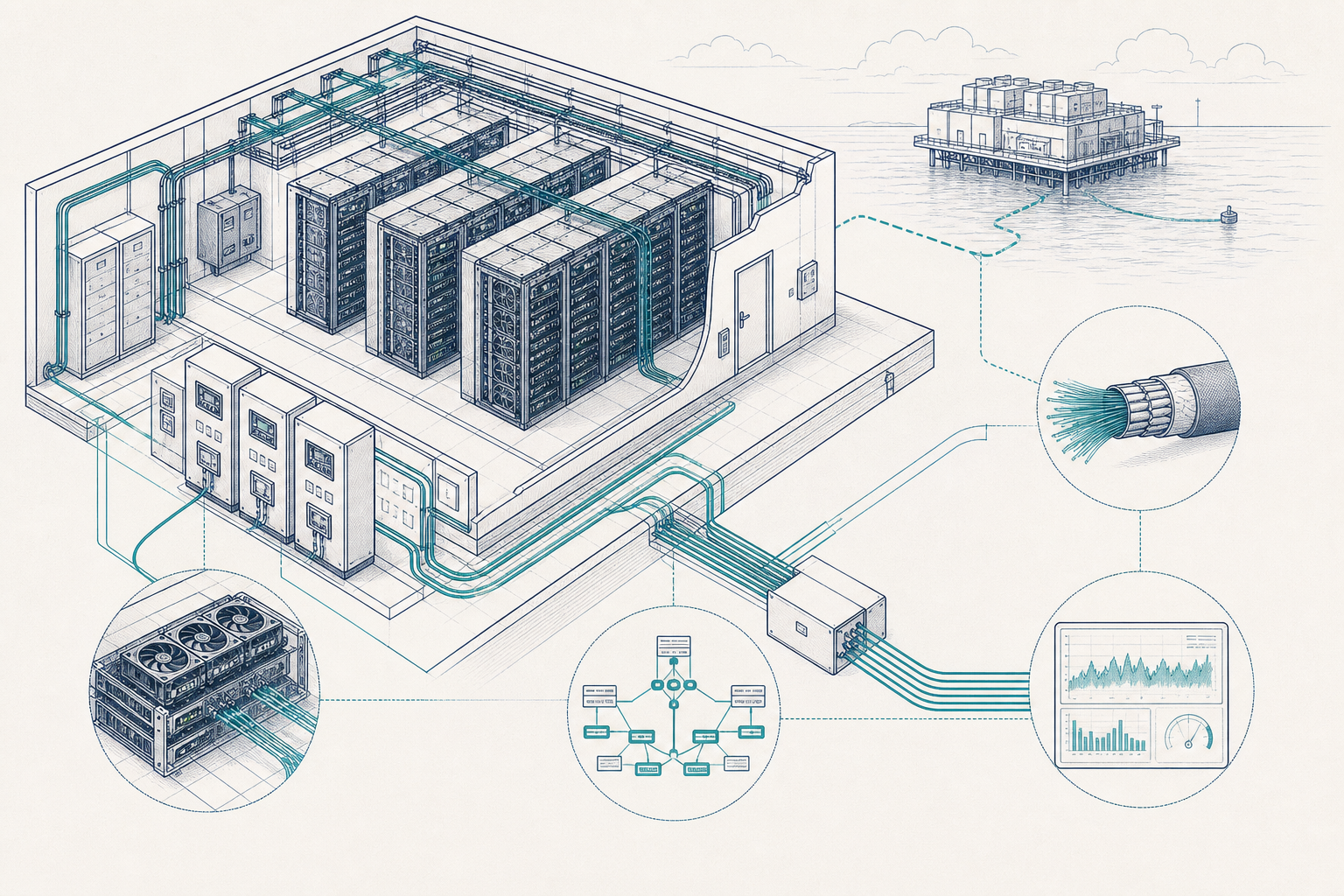
On 13 September 2026, TechCrunch published its list of the nine buzziest startups from Y Combinator’s latest Demo Day, based on venture investor attention. Two names matter to GPU infrastructure operators even if neither is selling a product that a quarter-rack operator will buy this quarter: Automarine, which is working on nuclear-powered floating data centers at sea, and Dipole Labs, which is building energy-efficient high-speed optical networking hardware for AI data centers.
The immediate lesson is not that every operator in Dubai, Riyadh, Doha, Abu Dhabi, Manama or Muscat should wait for a nuclear barge or replace a top-of-rack switch with a new optical system. The lesson is that early-stage capital is moving toward the same two physical constraints that small and mid-size GPU estates already feel: power and fabric.
A second TechCrunch item from 1 September 2026 is relevant. Sequoia-incubated Empirik launched with 21 million dollars to predict outages before they happen. That is a different layer of the stack, but it points in the same direction. AI infrastructure is no longer only a procurement problem. It is an operating problem: how to keep scarce accelerators, storage, network and power inside predictable envelopes while serving multiple tenants.
For a GCC operator with a quarter rack to a few racks, this is the practical translation:
- Energy and siting decide whether the estate can expand, not only GPU supply.
- Network topology decides whether expensive GPUs wait on data movement.
- Multi-tenant governance decides whether utilization becomes revenue or noise.
- Metering decides whether the operator can defend internal chargeback or external billing.
- Sovereignty and air-gap requirements decide which workloads can run at all.
A system like ClastIQ is not a floating power plant or an optical switch. It sits at the layer where those constraints become scheduling, quota, tenancy, storage and chargeback decisions on hardware the operator already owns.
The power bottleneck arrives before the science fiction
Automarine’s nuclear-at-sea concept is dramatic, but the underlying problem is ordinary: dense AI compute wants power, cooling and siting faster than urban grids and buildings can always provide. In the GCC, the issue is not a simple lack of energy. The region has large power systems, industrial zones and large-scale data center ambitions. The constraint for smaller operators is more specific: the right power, in the right building, on the right commercial terms, with acceptable cooling and sovereignty posture.
A few racks of GPU servers can move an operator from normal enterprise hosting assumptions into data-center engineering. A 4U or 8U GPU server can draw several kilowatts under load. Fill a rack with accelerated nodes and the rack may be limited by what the room, busway, breaker, cooling loop or landlord will allow before it is limited by available rack units.
That changes operating behavior. If the operator treats GPUs as a flat pool and lets every tenant reserve whole devices for long periods, the power bill and opportunity cost are carried by the operator while the tenant sees only a queue or a monthly invoice. If the operator treats power as a schedulable resource, it can decide which tenants may burst, which jobs must run off-peak, which nodes should be reserved for latency-sensitive inference, and which jobs should be placed where cooling headroom exists.
In GCC and MENA markets, this also intersects with sovereignty. Government, finance, healthcare, Arabic-language model work, oil and gas, and national AI programs often have constraints on data location and operational control. A smaller operator may have a commercial reason to keep workloads inside the country or inside a controlled campus, even if a public cloud region would be easier for burst capacity. That makes utilization on owned hardware more important, not less.
A worked example for a few-rack estate
Assume an operator runs 32 GPUs across four 8-GPU servers in one or two racks. The estate averages 32 kW of IT load including GPUs, CPUs, memory, local disks, NICs and switching. Use a 30-day month.
Available GPU-hours:
32 GPUs × 24 hours × 30 days = 23,040 GPU-hours per month
Assume total monthly fixed and semi-fixed cost is 50,765 dollars:
- Facility, depreciation, support, network and operations: 48,000 dollars
- Energy: 32 kW × 24 × 30 × 0.12 dollars per kWh = 2,765 dollars
If the estate has 35 percent productive utilization, it delivers:
23,040 × 0.35 = 8,064 productive GPU-hours
Cost per productive GPU-hour:
50,765 ÷ 8,064 = 6.30 dollars
If better orchestration, partitioning and quota control raise productive utilization to 68 percent, the same hardware delivers:
23,040 × 0.68 = 15,667 productive GPU-hours
Cost per productive GPU-hour:
50,765 ÷ 15,667 = 3.24 dollars
If the operator charges or internally allocates at 5.00 dollars per productive GPU-hour, monthly recognized value at 68 percent utilization is:
15,667 × 5.00 = 78,335 dollars
Normalized to IT power, that is:
78,335 ÷ 32 kW × 1,000 = 2.45 million dollars per MW-month
This is not a recommended price. It is a control model. The important point is that the same physical estate can look uncompetitive at 35 percent utilization and viable at 68 percent. The difference is not a new GPU generation. It is operating discipline.
| Operating lever | Without control | With fleet control |
|---|---|---|
| Productive utilization | 35% | 68% |
| Productive GPU-hours/month | 8,064 | 15,667 |
| Monthly cost base | $50,765 | $50,765 |
| Cost per productive GPU-hour | $6.30 | $3.24 |
| Value at $5/GPU-hour | $40,320 | $78,335 |
For small operators, this is where the business case usually sits. The next rack, power upgrade or lease expansion is easier to justify when the current rack has measurable utilization, tenant demand, chargeback and policy compliance.
The optical networking signal is really about contention
Dipole Labs’ focus on energy-efficient high-speed optical networking hardware for AI data centers points to another constraint: east-west traffic. Large training jobs and distributed inference systems do not only need GPU FLOPS. They need predictable movement of gradients, embeddings, checkpoints, model weights and datasets.
A quarter-rack operator may not deploy a hyperscale optical fabric, but it will still hit fabric limits. The symptoms are familiar:
- GPUs show low utilization while jobs wait on storage or network.
- One tenant’s distributed job affects another tenant’s inference service.
- Backups, checkpointing or dataset copies saturate links during working hours.
- Operators add GPUs but not enough top-of-rack, spine or storage bandwidth.
- Troubleshooting focuses on individual pods or VMs while the problem is placement.
In small estates, the fix is rarely exotic. It is often a combination of topology awareness, workload placement, storage class design and tenant quotas. Put chatty distributed jobs on nodes with the right local adjacency. Keep latency-sensitive inference away from noisy training jobs. Separate management, storage and tenant traffic where the physical network allows it. Meter network and storage use alongside GPU use, because a tenant consuming 10 percent of GPU-hours can still consume 60 percent of storage bandwidth.
ClastIQ’s role in this layer is to make the fleet legible. Bare metal is provisioned consistently. Kubernetes and VM tenancy can run on the same estate rather than creating stranded islands. GPU resources are exposed in schedulable units. Ceph provides shared storage with policy, replication and tenant accounting. Quotas and placement rules become part of the operating model instead of being maintained in spreadsheets.
Mixed tenancy is not an edge case
Many GCC operators do not have the luxury of a single workload type. A small sovereign AI estate may need to support:
- Kubernetes notebooks and batch jobs for data science teams
- VM-based environments for vendors or regulated workloads
- Inference endpoints with latency SLOs
- Fine-tuning jobs that need larger contiguous GPU allocations
- CPU-only preprocessing and ETL
- Shared Ceph-backed storage for datasets and outputs
If each requirement becomes a separate cluster, utilization falls. One tenant has idle GPUs while another waits. One rack is built for VMs, another for Kubernetes, and neither can absorb the other’s demand. Operations teams then solve allocation by ticket, which does not scale beyond a few active tenants.
ClastIQ is designed around the opposite assumption: the operator owns real hardware and needs multiple consumption models on the same fleet. MAAS and Juju handle repeatable bare-metal provisioning and lifecycle work. Kubernetes and VM tenancy can coexist. GPU partitioning through MIG where available, time-slicing where appropriate, and vendor-specific device exposure let the operator match a workload to a slice of accelerator capacity rather than handing every tenant a full card by default. The platform remains hardware-agnostic across NVIDIA, AMD and mixed CPU/GPU estates.
Partitioning is not magic capacity. It is a way to reduce waste. A notebook that needs a small accelerator allocation should not pin a full high-memory GPU for a week. A classroom, hackathon or internal analytics team may need bursty access. A production inference tenant may need reserved capacity and isolation. A training team may need full devices during scheduled windows. These are different products, and the infrastructure should represent them as different policies.
The minimum viable control plane
The basic operator question is simple: who is using what, under which policy, and who pays for it? If that cannot be answered daily, the estate is not governable.
A practical control plane for a quarter-rack to few-rack GPU operator should include:
- Inventory of nodes, GPUs, GPU partitions, CPUs, memory, local disks, NICs and power zones
- Bare-metal rebuild and recovery workflows
- Kubernetes namespaces and VM projects mapped to tenants
- Quotas for GPU, CPU, memory, storage and object capacity
- Metering by tenant, project, namespace and time window
- Storage accounting for Ceph pools, volumes and object buckets
- Placement rules for sensitive, noisy or latency-critical workloads
- Air-gap-friendly installation and update paths where required
- Reports that finance and tenant owners can read
Generic Kubernetes commands already show why this must be operationalized rather than handled manually:
kubectl get nodes -L accelerator,vendor,power-zone
kubectl get resourcequota -A
kubectl -n tenant-a describe resourcequota
kubectl top pod -A --containers
kubectl get persistentvolumeclaims -A
These commands are useful during troubleshooting, but they are not a chargeback system. They do not by themselves answer whether tenant A consumed reserved GPUs, burst GPUs, Ceph capacity, premium storage IOPS, or a protected inference pool. They also do not reconcile Kubernetes usage with VM usage. ClastIQ’s value is in turning those operational signals into tenant-level metering, quota enforcement and policy decisions across the estate.
Power should be part of scheduling
Small operators often track power at the room or rack level, not the tenant level. That is understandable, but it hides the constraint that most affects expansion. If power is scarce, it should appear in planning and scheduling.
This does not require every workload to be billed by watt-hour from day one. It does require power-aware categories. For example:
- Standard GPU pool: normal training and development
- Reserved inference pool: lower contention, stricter change windows
- Off-peak batch pool: cheaper internal rate, scheduled outside peak hours
- High-density pool: limited access because it consumes rack and cooling headroom
- Sovereign or air-gapped pool: restricted images, networks and update path
In a hot climate, cooling risk is also operational risk. GCC operators may run in high-quality facilities, but the ambient environment makes cooling design and maintenance discipline non-negotiable. The operator should know which racks can accept another high-density node, which circuits are near limit, and which tenants are driving sustained power draw. That information should feed capacity planning before a purchase order is issued.
Storage is part of GPU utilization
Ceph storage is not a side issue. GPU utilization often collapses because data is not where the compute expects it to be, or because shared storage is treated as free. For an operator running multiple tenants, the storage plan should cover at least three patterns:
- Shared datasets with controlled access, so every tenant does not make a private copy.
- Project volumes for notebooks, pipelines and VM environments.
- Checkpoint and artifact storage with lifecycle rules.
If a tenant keeps 80 TB of checkpoints indefinitely, that is a cost. If a fine-tuning job reads from a slow tier and leaves GPUs underfed, that is also a cost. Metering must include capacity and, where possible, performance-sensitive classes. Chargeback does not have to be punitive. Its first job is to make behavior visible.
ClastIQ’s inclusion of Ceph in the operating stack matters because storage, tenancy and metering can be designed together. The alternative is a GPU scheduler on one side and a storage island on the other, with human operators reconciling the two after a tenant complains.
Sovereignty changes the buy-versus-build calculation
In the GCC, many AI infrastructure decisions are shaped by data governance, national cloud policy, sector regulation and customer perception. A small operator may not be trying to compete with a hyperscaler on global capacity. It may be offering a local, controlled, Arabic-capable, contract-specific environment for organizations that cannot place all workloads in a generic external service.
That makes owned hardware rational, but only if it is operated with cloud-like discipline. Tenants will still expect self-service access, clear quotas, repeatable environments, storage durability, audit trails and predictable invoices or internal showback. The operator cannot rely on heroic manual administration simply because the estate is small.
Air-gap and sovereign deployments also change lifecycle management. Image repositories, package mirrors, GPU drivers, firmware, Kubernetes components and monitoring tools need controlled update paths. Bare-metal provisioning must be repeatable without assuming continuous access to public internet services. Human-led local support matters because the failure domain includes facilities, cabling, firmware, storage and tenant policy, not just YAML files.
What to take from the YC signal
Automarine and Dipole Labs may or may not define the next generation of AI infrastructure. For a GCC GPU operator, their importance is simpler: they identify the bottlenecks that will determine margins.
Power and siting will decide whether small estates can expand beyond opportunistic GPU hosting. Network and storage design will decide whether GPUs are productive or waiting. Tenancy, quotas and metering will decide whether utilization can be turned into internal accountability or external revenue. Reliability tooling, such as the outage-prediction category represented by Empirik, reinforces the same point: the operator needs a system of control, not only a pile of accelerators.
The practical strategy is to run a small estate as if it already has the governance problem of a larger one. Label hardware by capability. Expose GPUs in appropriately sized units. Keep Kubernetes and VM tenants under one operating model. Meter every tenant. Treat storage and power as first-class constraints. Keep sovereignty requirements in the design from the beginning rather than adding them after the first regulated workload arrives.
That is the layer where ClastIQ fits: it helps operators of real hardware make a quarter rack to a few racks behave like a governed GPU region, without forcing a single hardware vendor or a single tenancy model.
What to do this week
- Build a one-page capacity ledger: GPUs, CPU cores, memory, Ceph usable capacity, rack power limit, current draw, switch ports and uplink capacity.
- Calculate last month’s productive GPU-hours and cost per productive GPU-hour. Use conservative utilization numbers if telemetry is incomplete.
- Define three tenant classes: reserved production, shared development and scheduled batch. Attach quota and metering rules to each.
- Audit storage behavior. Identify duplicate datasets, stale checkpoints and tenants with high capacity but low GPU usage.
- Label nodes by accelerator type, network zone, storage proximity and power zone so placement policy can be enforced.
- Test one rebuild path from bare metal to tenant-ready capacity, including drivers, Kubernetes or VM handoff, storage attachment and metering.
ClastIQ runs this control plane on the operator’s own hardware; request a demo.